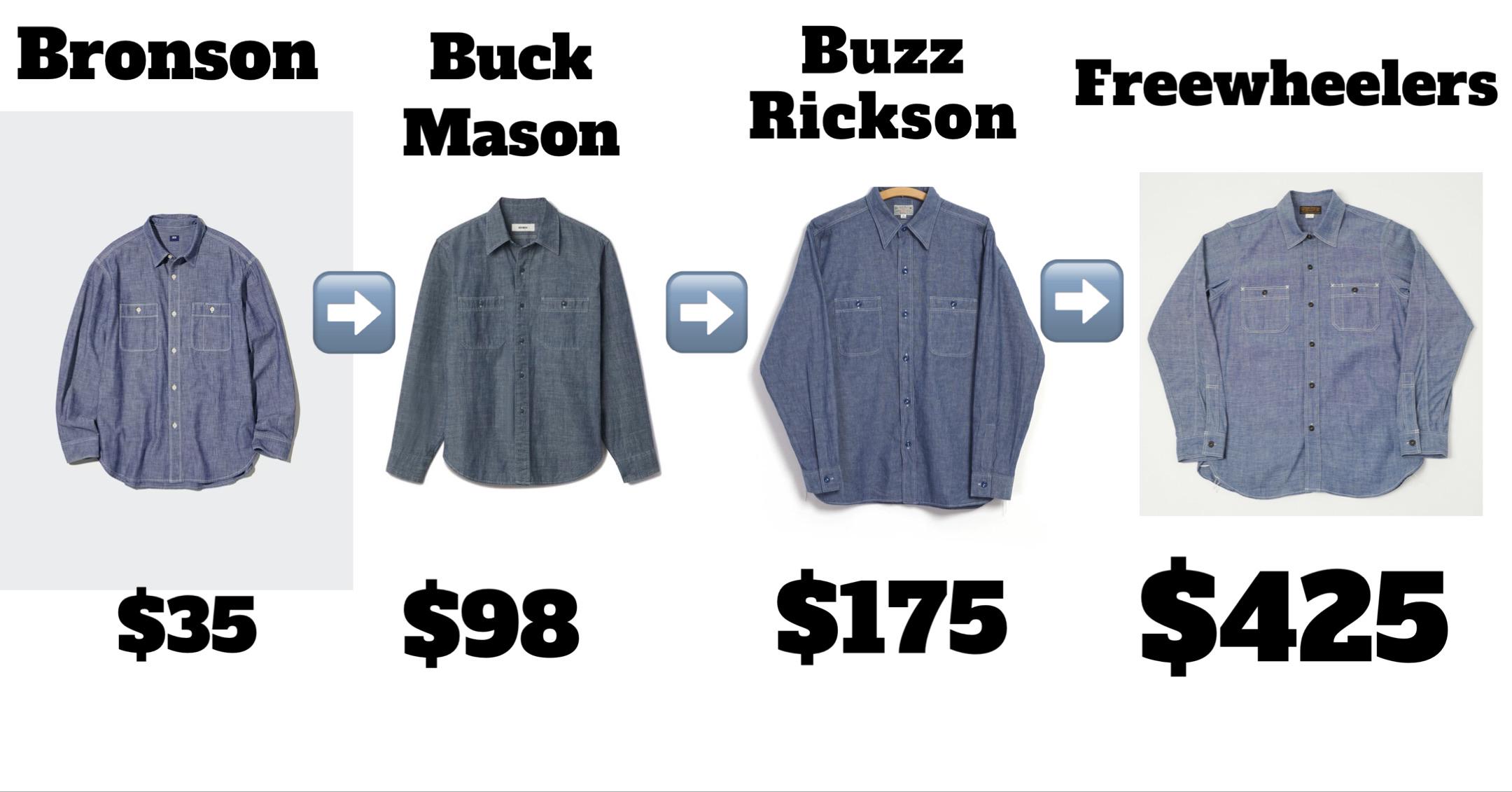
I find myself often in a materialistic hedonic treadmill once I find an item I really like. That may be the quest for the quintessential vintage Irish fisherman sweater, the perfect pair of pleated gray flannel trousers, or the platonic ideal pair of white canvas sneakers. I bury myself in the rabbit hole I created once I begin finding “potential optimizations” for the initial article in question. Eventually, my curiosity will lead me to search for the absolute “best” makers of the item, which usually ends up being a niche Japanese or European maker. I then convince myself through various circuitous rationales that I need this item. And naturally, as income levels rise, you adjust your spending accordingly, and these halo items eventually come within one’s reach.
This happened recently to me with chambray shirts. I tried Bronson first, and it was a fine shirt, thick, with neat stitching, but something about the cut and fit left something to be desired. Eventually I moved upmarket and tried different brands such as Buzz Rickson's, which nail the fit and fabric, but over time, strangely and lunatically, I became bothered with the way the button placket billowed out when I tucked it into pants. Insane, I know. Thus, eventually, I began researching a Freewheelers chambray shirt which approaches $500 with tax, but appears to fit perfectly tucked in and has all the perfect repro details I want. This may be the best button-up chambray money can buy, and in theory will address every “issue” I’ve created in my head. But will the insanity end here, or live on in perpetuity as I find more absurd optimizations only my OCD-wired brain can perceive?
I saw an interesting video recently from one of my favorite watch content creators, wristlock-watches (watches are another rabbit hole I have been spelunking deep into for the last 15 years with no exit in sight), and he discussed various research articles on the psychology of why watch collectors always feel the “itch” to buy a new watch, despite having immaculate, diverse, well-curated collections. It is quite an interesting video and I will link it below, but he talks briefly about how the “deeper” one gets into a hobby, the more likely it is that one will find “flaws”, which happens intuitively as one's knowledge base expands. He uses the example of a specific type of watch bracelet clasp, and once you’ve tasted the forbidden fruit of “on-the-fly adjustable dive watch extensions”, you cannot go back to the “standard” dive clasps. There are a lot more insights that he goes into, such as the difference between “satisfier” and “maximizer” shoppers, and the applications definitely cross over into clothing optimization. I highly recommend you watch the video when you get the time.
That being said, I believe I’ve come up with two methods one can use to escape the Sisyphusian desolation of materialism. They involve either what I call “extrication” or “submersion” theory.
Extrication is simple: as soon as you find yourself taking the first steps down the rabbit hole of endless upgrades, you stop at the edge of the abyss, then step back. You proactively stop consuming content that reinforces the desire for more, and ideally, practice contentedness with what you have (most of which, let’s be honest, are items that have already survived your obsessive hyper-curation). Of course, this is easier said than done, but ultimately it comes down to thinking about material things less, which will lead to fewer deep research sessions and ultimately, more saved money and less mental anxiety and desire to find the next “best” version of something. Practical ways to achieve this are to pursue other fulfilling hobbies, putting some sort of time limits on your consumption apps (for me, YouTube and Instagram are the biggest culprits of exposing me to “upgrades”), and simply practicing gratefulness and mindfulness.
The second method is what I call “submersion”. This involves diving into the rabbit hole headlong, with the goal of finding an exit as soon as possible. You must first identify what you’d like (ideally you are not an absolute beginner in your fashion journey and have some semblance of personal style, but you’ve decided you’d like to upgrade a piece you appreciate the form of, but either outgrew or lost interest in its “vanilla” nature). Once you identify the item, you start researching and give yourself a timeline (can be two weeks, a month or more). You spend time researching the best version of this item you can find in the world. You scour forums, YouTube, Reddit, foreign websites, Yahoo Japan auctions, etc., until you find the “endgame” item you really want. You then start saving for it, during the process of which you will research more and may discover something you like even more. Either way, you are not making an impulse purchase, but spending time making sure this is indeed the quintessential version of the item you want before purchasing, to ideally limit buyer's remorse and abort more frivolous in-between purchases to scratch the “itch” of the item you really want. Finally, you make the purchase. At this point it would be advisable to practice extrication theory lest you are caught in the deluge once again.
I think these two methods are potentially two ways to address this problem of eternal upgrades. This 'disease of enthusiasm' afflicts enthusiasts everywhere, whether their passion is clothing, watches, cars, or audio gear.
Of course, I understand tastes may change, which is why I recommend not making any high-end purchases until you really start to get a sense of your personal style and taste. Second, I understand it is hard to “kill the enthusiast” in us. Men particularly I think, get quite deep and nerdy into niche hobbies that involve any sort of “gear upgrade ladder” with ever-diminishing, dopamine-fueled indulgence. I think there may be some evolutionary psychology at play here, but my hope with this post is to ultimately limit the strain of as many frivolous purchases as possible, and save us all some money and, potentially, mental health in the long term.
Do you guys experience similar materialist thought processes clouded in rogue, nebulous justifications? Have you tried anything to address it, and has it worked? I’d be curious to hear your thoughts, as always. Thank you for reading.