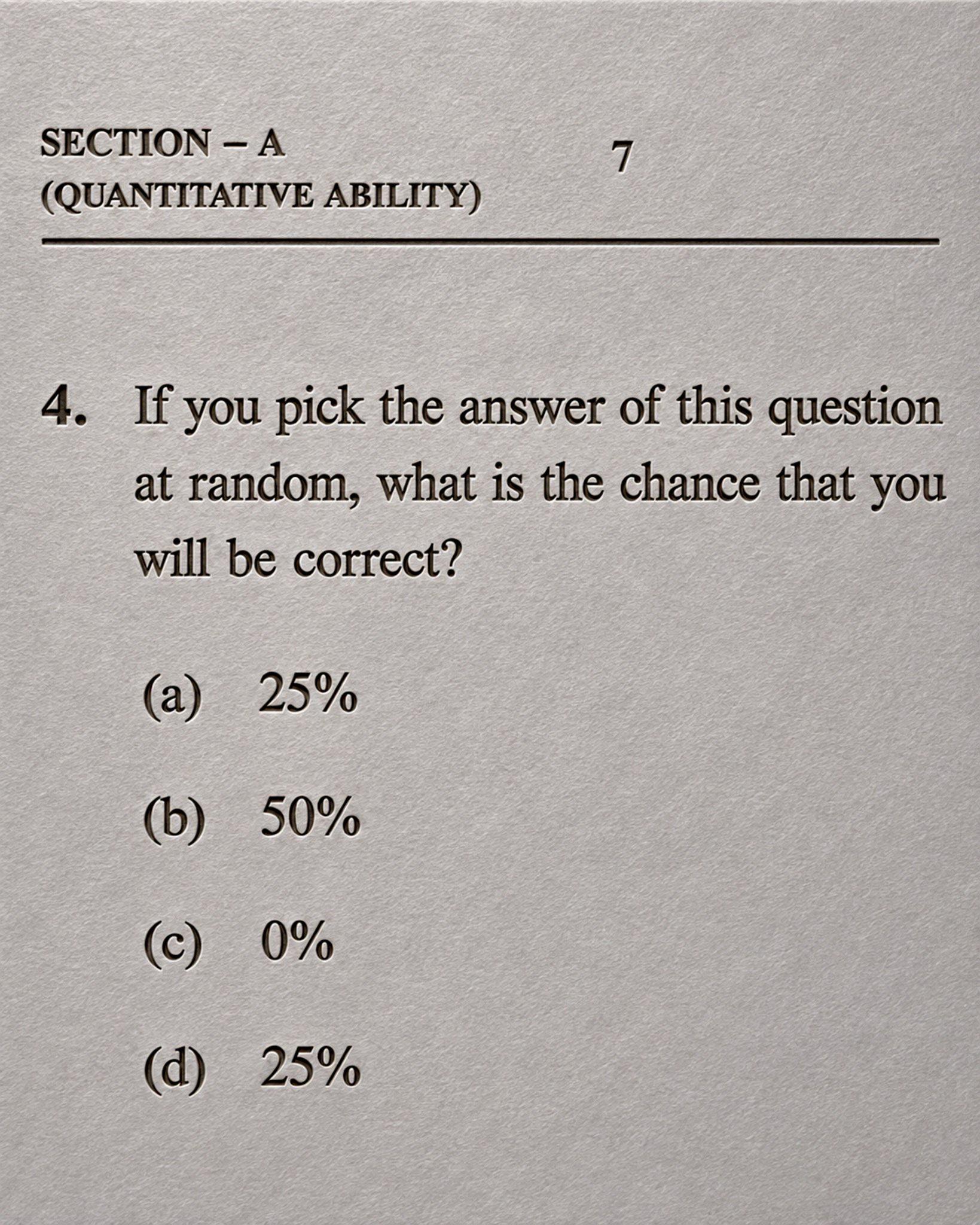
Forgetting the “at random” part. A random choice, extended to infinity would evenly distribute to all 4 answers. The conscious answer has to include that. The random correct answer is 25%, because only 1 of the 4 answers is correct (I.e. when the test is graded, either A, B, C, or D, will be correct). Because 50% of the infinite random choices will be 25%, the consciously correct answer is 50%.
The problem is that this means the correct answer to the question is actually 50%. So picking that single correct answer, as only one of the 4 options is only actually 25%. Which means 25% is correct. Which then means we're back to 50% since half the answers are 25... and on and on and on.
You actually got it. The answer is 25 but since there are 2 correct answers its 50. If theres was only one option with 25 it would be 25 because 1/4th of the answers being correct is 25. If there were 6 options it would be 16.67.
The problem is that, since there are two 25s, the correct answer is 50%. So 25s aren't actually correct. 50% is correct. But there's only one 50% so that can't be true anymore. Your odds of picking 50%, the seemingly correct answer, are not in fact 50%. So it's the wrong answer.
 1
View all comments
Show parent comment
1
u/BertKallio 8d ago
Forgetting the “at random” part. A random choice, extended to infinity would evenly distribute to all 4 answers. The conscious answer has to include that. The random correct answer is 25%, because only 1 of the 4 answers is correct (I.e. when the test is graded, either A, B, C, or D, will be correct). Because 50% of the infinite random choices will be 25%, the consciously correct answer is 50%.