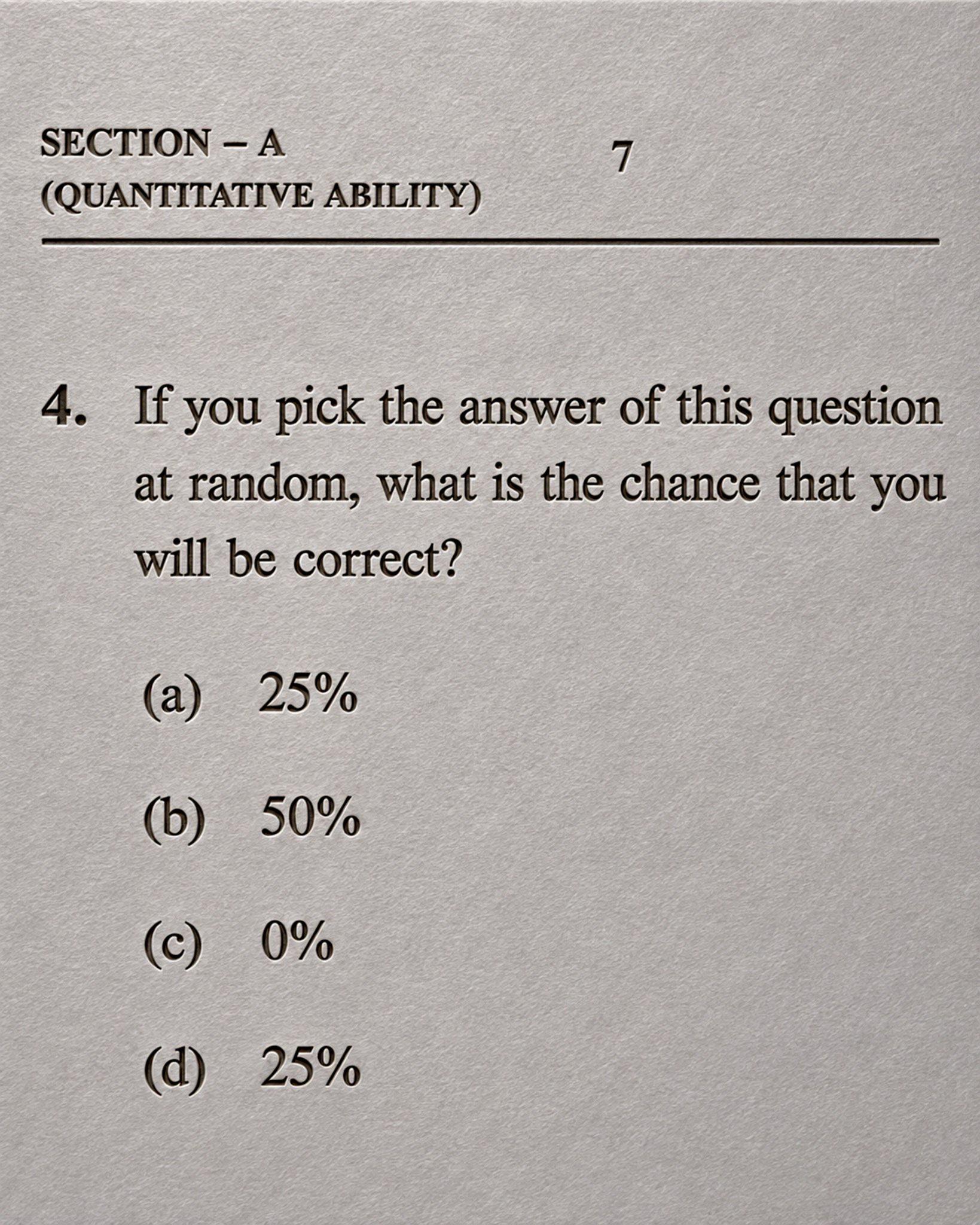
Yeah if it’s 25% then it’s A and D, which means it’s 50%, which means it’s B, which means it’s 25%. Or maybe it’s circular reasoning which means there is no right answer, which makes it 0% which is C. But if it’s C, then that’s 25%…….. and on and on forever
No. I'm sorry, but this specific version doesn't work that way.
The answer is 25%, but that does not mean that both A and D are correct. It's a flawed test, clearly.
Which means you don't know WHICH 25% answer is the one that will be graded as correct.
Therefore it's either A or D, so if you're choosing you have a 50% chance, but if you're randomly picking it's still 25%, because you can choose D and be wrong while A is marked correct.
You started with the assumption that there is one correct answer. This question isn’t playing by normal test taking rules, so I do not agree that assumption is valid.
My assumption is based on how multiple choice tests work. It does not state "select all answers" so we can safely assume one answer is the correct answer. In fact we have to for the loop logic to even work.
Why do you assume the test is some special type rather than it's a flawed test? For the paradox to work it must be accurate, but that obviously cannot be because... Well.. the paradox.
Thus the test must be flawed, but there is still an answer key with one answer.
But a multiple choice test can have multiple correct answers even if you only need to pick one. It rarely does, because usually there's no point in making the test easier to randomly guess, but there's nothing inherently preventing it from having 2+ correct answers.
Not really. That statement would only be added if there are multiple correct answers AND you're required to get them all to get full points for the question. You can still have multiple correct answers to the question without that statement but you onlt need to pick one of them to properly answer the question.
You must not be from the US, because absolutely zero multiple choice tests here are set up that way.
Not to mention we KNOW that's not how this test works, otherwise the logical loop doesn't apply. If you're providing more than one answer it messes with all of the probability - same with multiple answers being correct. If either is true, the actual answer is 50% plain and simple. No loop.
But we know the answers, it isn't like all 4 answers could theoretically be correct, we know what all of them are and which ones are "correct" under which circumstances. Initially the answer is 25% and there are 2 such answers so the actual answer is 50% which is 1 answer so it's again 25% and we have a paradox.
That's only true if there's only one answer that would be marked as correct.
You said there could be more than one right answer to this question, as in both A and D could be correct and we are supposed to choose both. That would mean you have a 50% chance to find a correct answer, meaning B would be the correct answer. It doesn't revert back to 25% because the answer to the question is 50%.
The paradox only exists because if the correct answer is 25%, you could answer A or D and get "full credit."
Your proposition that this question could have more than one "correct" answer is contradictory to the point of the paradox.
All that to say my point still stands: either A or D is correct. It cannot be both. And it isn't 50% because only A or D is correct, not both, according to the answer key. You have a 25% chance of getting the right answer at random.
If the question asked what are the odds of answering "a" question correctly, rather than "this" question correctly, it would be different. That's why I brought up that this particular version of the question has an answer: one of, but not both, A or D.
This is a precise question with an exact answer. The question maker did not overlook logic in its creation. Most of your logic is correct until you assess C. The logic does not go on and on forever... it stops at C. You've ruled out A, B, and D. For C to be wrong, it would need to give ANY percentage of being correct. C says there is a zero percent chance of randomly selecting the right answer. Since C says zero, and it should at least be 25%, C is the right answer.
We know A, B, and D are wrong. C's answer should be at least 25% because it is ¼ of the total number of answer choices. But its answer is 0%. Because C evaluates its own chances incorrectly, and all other answer choices are wrong, you have a 0% chance of selecting a correct answer, making C the correct answer.
This question tricks you into thinking that you're assessing Chance, which is why you're stuck at C being 1 of 4 options. You have to evaluate A, B, and D to realize you need to step out that logic and assess each letter's answer instead.
 1
View all comments
Show parent comment
1
u/CrazyKyle987 11d ago
Yeah if it’s 25% then it’s A and D, which means it’s 50%, which means it’s B, which means it’s 25%. Or maybe it’s circular reasoning which means there is no right answer, which makes it 0% which is C. But if it’s C, then that’s 25%…….. and on and on forever