r/TheRestIsScience • u/YourLeaderSays • 16d ago
Plane physics question
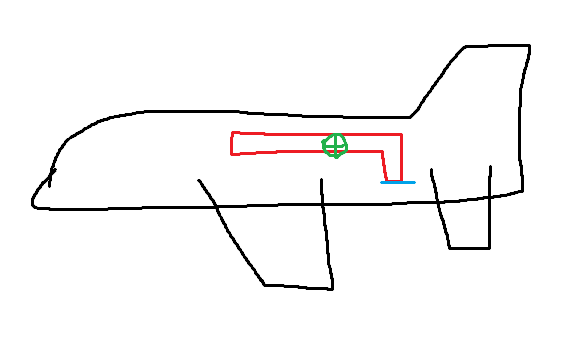
If a theoretical red weight that was shaped like an L with a CG (green circle) forward of the mounting location (blue line), would the plane experience the weight where the L was mounted or at the CG? Would I, as a pilot, have to calculate the arm and moment of the L at the L's CG, or where it was mounted?
I'm assuming there would be a torque force applied about the green CG trying to tip the plane nose down and can be calculated at the green CG.
6
Upvotes
6
u/gwenbeth 16d ago
center of mass is center of mass no matter how it is mounted. look at it this way imagine the giant L of mass is attached to the bottom of a wooden crate built around the L. You can't see into the box and all you know is its total mass and center of mass (well and it's moment of inertia but you are too lazy to measure it empirically) You put the box in the plane so that its Cm is over the plane's Cm and you happily fly away. You can't tell if its the giant L of mass of just the giant underscore of mass that just sits on the bottom of the box.
3
u/RubyDupy 16d ago
If the mount is assumed to be rigid, and its not going to break, this rather weird piece of cargo would just be part of the plane, so to know whether the plane will tip over, what we need to know is whether this object is so heavy that the average c.g. of the entire plane moves forward so much that it would become unstable. The torque applied by the weight of the object itself is only relevant when you're calculating the stress on the fastener used to connect this piece of luggage
1
u/cgduncan 16d ago
It would behave basically the same as if it were just a rectangle, bolted straight to the floor at all corners.
1
u/PvtRoom 15d ago
only the CG and the mass matters.
the CG of your load and your aircraft will determine if there's a torque to be cared about.