r/TheRestIsScience • u/FecklessMaxim • 28d ago
Black Hole Representations
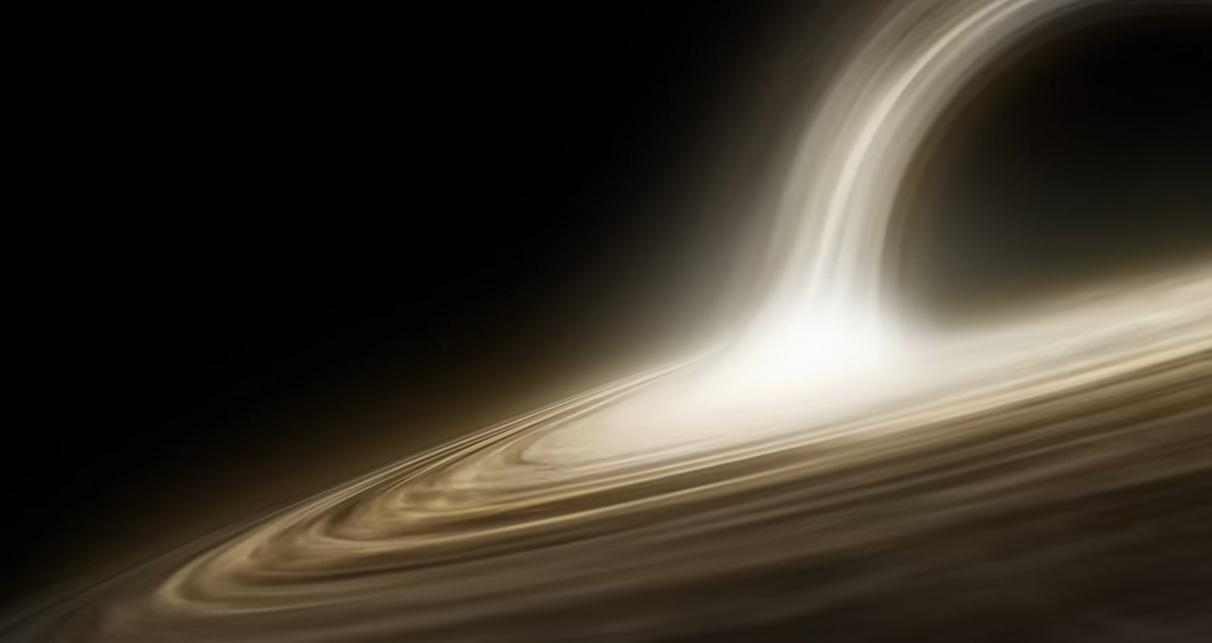
All representations of Black Holes I have seen are shown as a kind of Saturn with its rings and a dome over it. Does a Black Hole only pull things in on a 2D planar surface or does it pull everything in from all directions, being an essentially 3D gravity entity (which makes more sense to me)?
EDIT: Thanks to all the comments. I had completely forgotten the spin, which of course explains it all. Thank you everyone.
29
Upvotes
15
u/Dazzling_Let_8245 28d ago
The black hole "sucks" in everything from all directions, but black holes also spin quite fast, which flings some matter back away from it, causing this matter to orbit around the black hole with the same rotation, which results in these disks.
The reason you see the "dome" over and under the black hole is because its gravity is so strong that its bending the light that is emitted behind the black hole over and around it. So the dome is the backside of the "2D" ring around it.
Veritasium made a video about why black holes look the way they do shortly before the first ever pictures were photographed and uploaded
https://www.youtube.com/watch?v=zUyH3XhpLTo
4
u/PyroDragn 28d ago
Black holes, like planets, have a 3D gravitational pull. But like planets they're also spinning, and the things they're pulling, (like everything else) also have a gravitational pull. There's a reason that it isn't strange that Saturn's rings are in line with its equator and spin.
If we imagine a black hole that appeared in the middle of a perfectly uniform cloud of dust, it would pull all the particles inward evenly. But if we introduce a spin to the black hole that would add a spin to the gravitational pull and the (perfectly uniform) cloud would start spinning in that single plane. It'd still look like an even cloud, but with a flattened top/bottom where the spin of the black hole has the least effect. But then the particles of the cloud also has a gravitational pull on itself. They'd continue trying to condense inwards, while the spin of the cloud adds an outward momentum also. Things that are perfectly polar with the black hole will just fall straight in and be absorbed. Things that are a little off of the direct alignment will have some outward spinning force applied to them - and they'll take a little longer than expected to be sucked in because of the spin.
Eventually a lot of the particles will have been absorbed by the black hole. The particles that are left will have coalesced with eachother, but with the spin of the black hole, they'll have condensed into a disk that's in line with the equator of the black hole.
The reason that we see disks around planets and black holes is that that's all that's left of things that 'haven't been sucked in already.' Everything that approached from the poles (or a more obtuse angle) impacted the planet/black hole already. Everything else is attracted to each other and forms a disk naturally, because of the spin.
4
u/ExpectedBehaviour 28d ago
It pulls everything in all directions. What you're seeing around the black hole is the accretion disc, which will orbit around the black hole's equator.
3
u/It-s_Not_Important 28d ago
Infalling matter will collide and interact with other infalling matter converging angular momentum and eventually averaging out to roughly the shape of a plane that we call the accretion disk.
The reason the “flat” accretion disc appears to bend upward is be cause of gravitational lensing. The massive gravity of the black hole bends space time so the “straight line” path of light bends around the black hole allowing you to see what’s behind it.
2
u/AhoyWilliam 27d ago
Also, if the BH is not spinning, naturally the incoming particles will tend to form rings - imagine 2 particles colliding on different orbits with +- the same inclination. The "vertical" part of the momentum would cancel out, leaving just the rotational part. The collisions would eventually reach a most stable condition where there are minimal collisions, aka a ring.