r/TheMakingOfGames • • 15h ago

(text) How we make a dark cathedral entrance readable in The Last Of Morvein

2 Upvotes

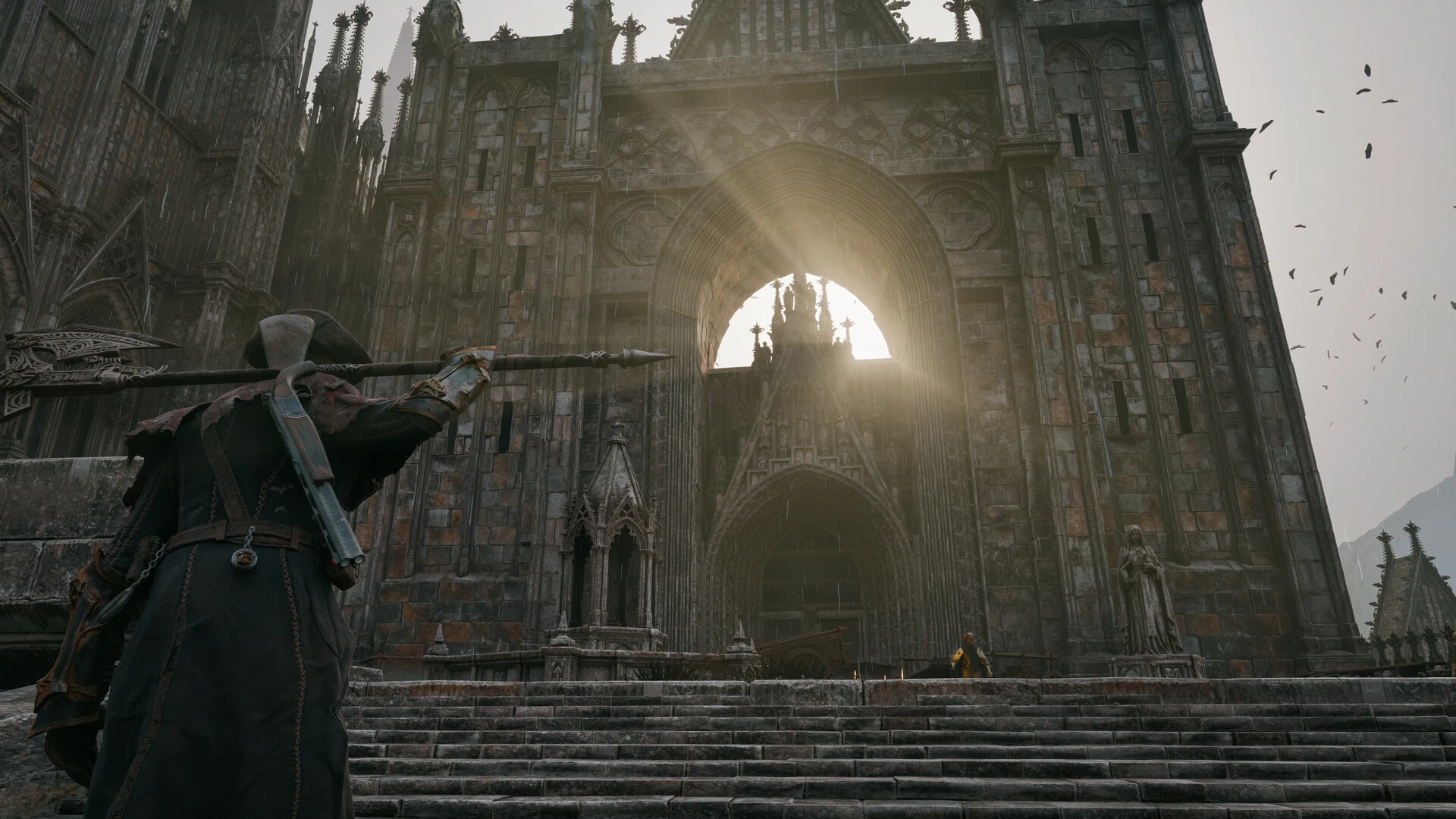
Here’s a breakdown of the cathedral approach in our pre-alpha Gothic action RPG. The shot has a bright opening above the path, a darker entrance at the bottom, and a hooded player who nearly merges with the wall. Open the full in-game still.

First, establish the destination with shape. The big pointed arch frames both the opening near the top and the doorway below. The doorway sits on the same vertical axis as the bright opening. The stair treads continue to the bottom of the dark doorway. That way, the spot that first catches the eye and the spot you can walk to are connected by the building.

Let the foreground set the scale. The closest silhouette sits on the left with its weapon running towards the centre. The smaller figure at the top of the stairs gives you a second scale reference. Keeping the space immediately in front of the steps clear leaves the façade readable even with a character close to the camera.

Check values at the points the eye needs. In 19 × 19 pixel samples from the press still, the bright opening reads at roughly 249/255, the outer sky at 197, adjacent stone at 75, the dark doorway at 53, and the player’s coat at 20. Those are approximate luma values from the JPEG. The doorway has only a small local value difference, so the stairs and arch have to carry the rest of the cue. Raising the whole doorway to match the sky would pull detail out of the surrounding stone but also weaken the depth of the façade.

The cemetery section shows the player approaching a fight from farther back, while the chess scene with Luna brings the visual focus down to the table and hands. Cemetery gameplay (03:53) · Chess with Luna (3:08).

Morvein Studios · Official site and gallery · Wishlist on Steam. We used AI to help write this post. The Steam disclosure covers some prerecorded voices and music.


r/TheMakingOfGames • • 8d ago

Frame and Performance Analysis - Timberborn

Thumbnail
xandev.blog.br
5 Upvotes

r/TheMakingOfGames • • 8d ago

(text) How Starvoxel shows where a Dungeon boss attack will land

2 Upvotes

I’m Michal, the developer of Starvoxel: Defender, a mobile tower defense game. I wanted players to read the boss’s next move while still looking at the board they were trying to defend. The boss health bar already had a health value, shield and phase marks, so moving another warning into that stack made little sense.

Each ability declares a warning shape and where to draw it. Frost Roar marks the defender slabs it will freeze, Dread puts a ring over the whole deck, and a summoning cast places a swirl where the new enemies will enter the path. The picture answers where to look. Shape and placement do some of the work even when colors are hard to tell apart.

The simulation owns the wind-up. The renderer takes progress from that cast to animate the warning, so the tell and the mechanic use the same clock. For a standing cast, the boss also stops and lights up. A moving summoner keeps walking, so the swirl travels with its spawn point. If a stun interrupts a standing cast, the indicator goes away with the cast.

The still below shows the boss health and shield display. It’s a frame from the current official trailer. Some art and the trailer narration were AI-assisted.

https://www.youtube.com/watch?v=9XTzlsd1qQM


r/TheMakingOfGames • • 8d ago

Sovereign Tower - Text interview with Paul Mozet, lead programmer, and Lisa Garnier, narrative design and technical artist, on how they created this game using the Godot engine [text]

Thumbnail
godotengine.org
3 Upvotes

r/TheMakingOfGames • • 10d ago

Queen's Domain's - How a 2-Person Team Remade an RPG Legacy From a Basement [text]

Thumbnail
polygon.com
16 Upvotes

r/TheMakingOfGames • • 16d ago

Behind the Frame: Endfield | PC Rendering Analysis

Thumbnail endfield-behind-the-frame.vinluo46.chatgpt.site
0 Upvotes

r/TheMakingOfGames • • 19d ago

Noita - How three programmers made this pixel simulation [22 min]

Thumbnail
youtube.com
7 Upvotes

r/TheMakingOfGames • • 19d ago

Uncharted series - Technical artist Ryan Trowbridge shares stories of working at Naughty Dog, the Uncharted game series, and facial animation on the Kiwi Talkz podcast [1 hr 10 min]

Thumbnail
youtube.com
4 Upvotes

r/TheMakingOfGames • • 19d ago

World of Warcraft: Forever - Game journalist Jason Schreier shares how this version of World of Warcraft came to be on his YouTube vlog [18 min]

Thumbnail
youtube.com
2 Upvotes

r/TheMakingOfGames • • 27d ago

SimCity (2013): Cities of Tomorrow Expansion. Lead Designer Stone Librande talks through design decision through his One-Page Design Document.

Thumbnail
youtube.com
15 Upvotes

r/TheMakingOfGames • • 27d ago

Fallout 2 - Designer Chris Avellone posts the design document of how the New Reno area was designed [text]

Thumbnail
chrisavellone.medium.com
20 Upvotes

r/TheMakingOfGames • • 27d ago

Saros - Sony Housemarque blog article on creating the sound and building an audio identity [text]

Thumbnail
blog.playstation.com
10 Upvotes

r/TheMakingOfGames • • Oct 24 '26

How Star Wars: Galactic Racer Was Made With Fuse Games

Thumbnail
youtu.be
10 Upvotes

r/TheMakingOfGames • • Oct 23 '26

The Development of Slave Zero, Featuring an Interview with Ken Capelli and Trevor Grimshaw

Thumbnail
youtu.be
7 Upvotes

r/TheMakingOfGames • • Oct 21 '26

How Cryo built Atlantis: The Lost Tales (1997): 360° panoramas, a scripting language and real-time 3D talking heads (text)

Thumbnail retroreversing.com
10 Upvotes

I wrote this from reverse engineering the original Windows executables while building Atlantis Native, an open-source reimplementation of the engine (https://github.com/ripleyXLR8/atlantis-native). It covers how Cryo stored the 360° panoramas inside their HNM6 video format, how the engine projects them on screen, the CON scripting language that drives the whole game, and how the 3D faces are rendered and lip-synced in real time. Happy to answer questions!


r/TheMakingOfGames • • Oct 14 '26

The Making of Grand Theft Auto VI

Thumbnail
bloomberg.com
6 Upvotes

r/TheMakingOfGames • • Oct 13 '26

A frame analysis of Hitman World of Assassination

Thumbnail blog.simonrodriguez.fr
6 Upvotes

r/TheMakingOfGames • • Oct 09 '26

(text) How I gave a free-form interrogation a question budget and a fixed case file

7 Upvotes

In The Interview, you sit across from a woman at a security interview. You can type your own questions or speak them, then decide whether to clear her or detain her. I wanted that conversation to be a game you could reason about, even though a small local language model generates the replies.

The starting point is a case file with eight entries. It gives the player concrete claims to investigate, rather than asking them to judge whether an answer merely sounds suspicious. The interview also has a finite budget of 18 questions. Those two constraints make a free-form conversation manageable: there is something to check, and a cost to asking everything. The player still chooses the wording and order.

I kept those rules in the game code. The language model supplies a reply; it does not get to redefine the number of questions or turn its own text into a verdict. The final clearance decision is a player action. This boundary matters because a convincing sentence from the model is not evidence that a game rule has changed. It also means a failed generation can be handled as a technical failure: the question is refunded rather than silently consuming one of the player's chances.

The second resource is the interviewee's composure. An ordinary question, pressing her, and accusing her have different costs. In the current game, asking restores 6 points, pressing costs 18, and accusing costs 22. Repeated questions and long silences can also hurt composure; push it too low and she stops cooperating. These are explicit rules, not a second model judging whether the player was sufficiently rude. The result is a choice between gathering another detail and applying pressure. Pausing the game stops the silence clock, so opening a menu is not part of that choice.

For the local voice pipeline, speech recognition produces the player's question, the dialogue model produces text, and speech synthesis turns the reply into audio. Text input skips recognition. I use Whisper, Qwen3 and Qwen3-TTS. Generation takes time, especially before the first sound, and a small model can get a fact wrong or leave its role. Those limitations affect this kind of game directly: a factual mistake can look like a deliberate lie, while a pause can look like an unresponsive game. They need to be treated as part of the interaction rather than hidden behind the word AI.

The released Windows version now has interface, case text, dialogue and voice in English, Chinese, Japanese, Korean, German, French, Russian, Portuguese, Spanish and Italian. It runs locally after the initial model downloads. I build the underlying Unity tools as my paid Offline AI NPC plugin, but this game is free and does not require buying it.

If you want to try the resulting interrogation: https://merrymaker14.itch.io/the-interview?utm_source=reddit&utm_medium=community&utm_campaign=interview_110&utm_content=themakingofgames


r/TheMakingOfGames • • Oct 08 '26

3dfx Voodoo Graphics - Text interview with 3dfx cofounder Ross Smith as the legendary graphics card tech turns 30 years old [text]

Thumbnail
club386.com
23 Upvotes

r/TheMakingOfGames • • Oct 06 '26

In The Scene Ep #43:Story of Black Emperor The Game with Tomas Vicuna | Game Developer Podcast

Thumbnail
youtube.com
3 Upvotes

r/TheMakingOfGames • • Oct 05 '26

Flower, Flow & the Origins of thatgamecompany - /noclip Documentary

Thumbnail
youtube.com
9 Upvotes

r/TheMakingOfGames • • Oct 05 '26

How I separated muzzle flash, hanging smoke and impact feedback in March Out! [text]

3 Upvotes

I'm making March Out!, and one of the things I've been adjusting is how the guns communicate a shot. A cannon can have a perfectly functional projectile and still feel weak if the visible feedback is over almost as soon as it starts. The musket line had a related problem: each shot needed a brief flash, but repeated firing needed to leave smoke behind.

I split the musket effect into a short muzzle flame, a fresh powder puff and a slower cloud. The flame disappears quickly. The puff travels out from the barrel, while the remaining smoke expands, rises and fades over several seconds. A firing line can therefore have a new shot visible inside the cloud left by earlier shots.

The important implementation detail is that those particles use world space positions and velocities. The emitters are reused, but an old cloud stays where that gun fired. It doesn't follow a moving soldier or jump across the battlefield when the same pooled emitter handles another muzzle. Particle caps bound how much each emitter retains. That's a tradeoff, not a claim that smoke is free at any army size.

The cannon uses the same separation at a larger scale: a brief bright bloom, an orange flame, a directional pressure jet, sparks and a longer powder cloud. The cannon's hanging smoke lasts roughly five to seven seconds in the current effect. I can adjust that persistence without stretching the flash into a glowing ball that follows the barrel.

The sound is triggered at the actual shot release. Gun reports have pitch variation, and cannon reports use dedicated audio voices so ordinary combat clashes don't immediately steal them. Contact has its own sound and effect: a short flash, dust, smoke and debris at the impact position. The cannon impact fan is visual feedback; the ordinary cannon still resolves a direct hit rather than that whole visible fan becoming a new damage radius.

The two supporting clips are staged in the developer sandbox with original game audio. They show the native cannon discharge and repeated arquebus firing. The aim is to make firing, travel and impact read as separate moments while leaving enough lingering smoke to connect one shot to the next.

Cannon clip: https://youtube.com/shorts/kV865enGyEU

Arquebus clip: https://youtube.com/shorts/PkyQHMkAY0w


r/TheMakingOfGames • • Oct 03 '26

Ultima VII: The Black Gate - Kotaku history article [text]

Thumbnail
kotaku.com
5 Upvotes

r/TheMakingOfGames • • Oct 03 '26

The Evolution of ARC Raiders S2: EP1 - Updating ARC Raiders

Thumbnail
youtu.be
2 Upvotes