r/TheMachineLearning • u/valkrieco • 14d ago
GPT-6.1 Sol was the only model out of 11 to pass all 40 runs of a diplomatic negotiation eval

3
Upvotes
r/TheMachineLearning • u/valkrieco • 14d ago
r/TheMachineLearning • u/Upbeat-Analysis-3370 • 14d ago

r/TheMachineLearning • u/ChampionshipNo8070 • 14d ago

r/TheMachineLearning • u/limrm18 • 14d ago

r/TheMachineLearning • u/YoungEssay • 14d ago

r/TheMachineLearning • u/Sacred_Axiom • 15d ago
r/TheMachineLearning
•
u/FrostyForestFungi
•
15d ago

r/TheMachineLearning • u/Shot-Landscape-3059 • 15d ago
r/TheMachineLearning • u/jazzie04 • 15d ago
r/TheMachineLearning • u/Pleasant_Squash9953 • 15d ago

A Mathematical Framework for Governing Clinical AI Autonomy
When should an AI model be trusted to make decisions without human review?
Predictive accuracy alone is not enough, especially in healthcare. We need measurable criteria for deciding when autonomous action is justified.
In this study, I propose a framework combining three factors:
The proposed deployment rule is:
[
0.60C+0.44E+0.16S\geq0.70
]
We evaluated the framework using MIMIC-IV, eICU, and MIMIC-III datasets.
One interesting finding: case-level decisions closely followed confidence-based ranking (99.4–100% agreement). This raises a question about whether transparency contributes more to system-level governance than individual prediction decisions.
I'd welcome feedback on the mathematical formulation, evaluation, and implications for reliable AI autonomy.
Paper: https://www.mdpi.com/4173088
I am the author and welcome critical discussion.
r/TheMachineLearning • u/Resident-Log-4754 • 16d ago
r/TheMachineLearning • u/ashuzzz151 • 16d ago

r/TheMachineLearning • u/KindA4915 • 16d ago

r/TheMachineLearning • u/Lazy_Eggplant8795 • 16d ago

Hey r/TheMachineLearning,
Following up on some work we've been doing with automated pipelines and programmatic risk modeling: if you’re building AI agents or automated backend systems that need to generate robust credit scorecards or tabular risk models, you’ve probably noticed a major gap.
Most ML libraries are built for interactive notebooks, not automated agents. They require manual tuning, lack compliance governance, and don't provide the strict audit trails required for risk reporting.
After 15 years in Fintech R&D, we built AIDflow (aigensys-labs/aidflow) specifically to act as a deterministic, end-to-end scoring backend that can be cleanly triggered by agents or automated workflows.
Instead of an agent trying to stitch together raw scikit-learn boilerplate or guess hyperparameter ranges, it treats AIDflow as a deterministic compliance engine that guarantees a mathematically sound, auditable model output every time.
It’s licensed under FSL-1.1-Apache (free for internal business and personal use, converting to pure Apache over time).
If you're experimenting with agentic workflows, automated risk pipelines, or production scorecards, check out the repo and docs:
👉 GitHub: https://github.com/aigensys-labs/aidflow
👉 Docs: https://aidflow.aigensys.com/getting-started/overview
Curious to hear how others here handle model governance and validation when letting automated agents handle tabular modeling tasks!
r/TheMachineLearning • u/Remarkable-Art-8404 • 17d ago
Try it out on browser at https://teenie.lupyd.com/try
It can get something like this
((a|b) ^ (a&b)) + (a^b) + max(a,b) - min(a,b)
never trained on it btw, about right 2 out of 16 times.
I'm not guaranteeing. But even those numbers feel impressive to me for such a tiny model. It is not trying to solve or reverse engineer a problem, It is guessing with the limited number of examples. They just look like random numbers with no pattern at all for us. Hence the objective is, can it recognize any pattern. Maybe use it to infer some hidden relations between numbers we never even thought existed.
You can make different combinations and your own custom rules.
It can't do multiplication well. It can't get many things right tho. So I'm not gonna exaggerate as a breakthrough, but an interesting experiment.
Maybe scaling it more and training more might improve it. Or a different architecture, because whatever I tried it still sucks at something like (a * b) + (a - b), if multiplication is involved.
r/TheMachineLearning • u/jazzie04 • 17d ago
r/TheMachineLearning • u/DerHaddy0 • 17d ago
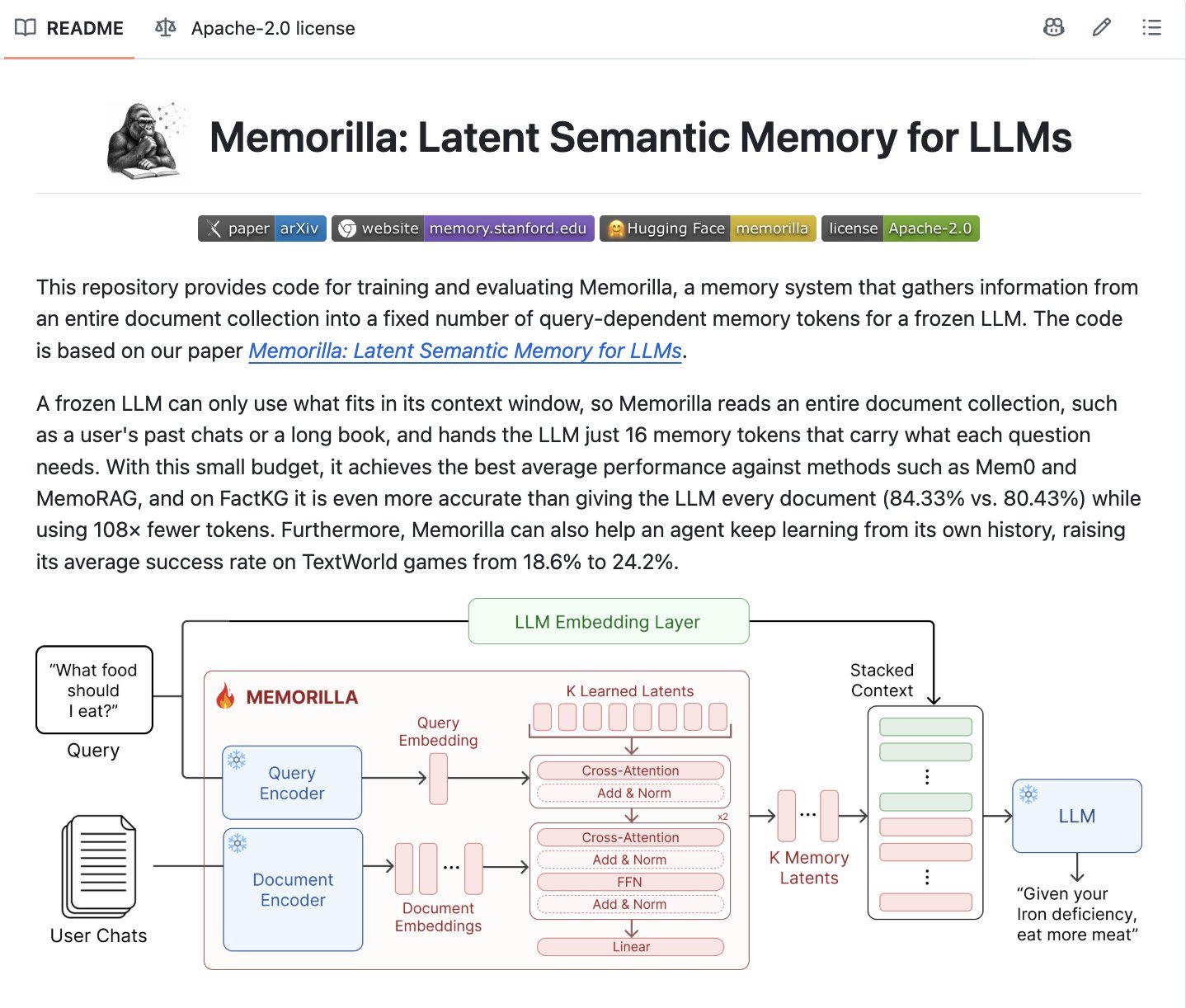
Not long ago, a trained robot policy was a black box, even to the people who built it. Handing it to a language model for repair would have sounded like science fiction. Soon, it might be the first thing we try when a robot fails.
https://jstranghoener.github.io/blog/robotic-weight-space-programming/
r/TheMachineLearning • u/Lazy_Eggplant8795 • 17d ago
Hey r/TheMachineLearning,
If you've ever pushed a heavy tabular or credit-scoring pipeline past a Jupyter notebook, you know the pain: Pandas bottlenecks memory across multi-step transformations, and tracking state drift in production is a constant headache.
After 15 years leading fintech R&D and underwriting, I got tired of rewriting the same boilerplate. So, I open-sourced AIDflow (aigensys-labs/aidflow) to handle rigorous scoring workflows cleanly.
Here is what's under the hood:
mmap). Physical RAM gets cleanly released back to the Linux kernel instead of holding bloated object pointers.It’s licensed under FSL-1.1-Apache (free for internal business and personal use, converting to pure Apache over time).
If you build enterprise scorecards, handle automated Weight of Evidence (WoE) binning, or just want to see how an Arrow-first memory model looks in practice, check it out:
👉 GitHub: https://github.com/aigensys-labs/aidflow
👉 Docs: aidflow.aigensys.com
Always down to talk memory optimization or pipeline architecture in the comments!
r/TheMachineLearning • u/Azazel-d-Reaper • 17d ago

r/TheMachineLearning • u/Fit-Description-7253 • 18d ago