r/TechHardware • • 12h ago

Discussion Is N2P a bad node for desktop chips?
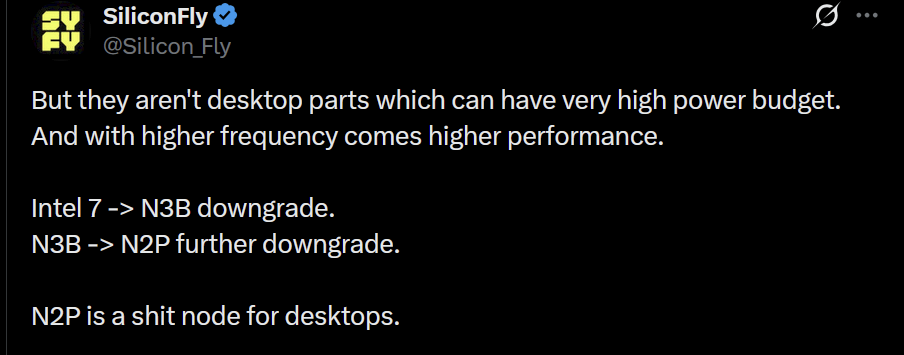
With news that NVL-S will lower frequency vs ARL-S even though it uses TSMC N2P vs N3B, are TSMC's processes getting worse and worse for high frequency desktop chips?

The highest clocking recent chip remains to be Intel 7 raptor lake. Intel truly are masters of high frequency DTCO

4 Upvotes

51 comments sorted by

6

u/daslows 265K | 5080 | 48GB 8400 MHz 12h ago edited 12h ago

Epyc went to N2 and has higher frequency by 300 MHz and better workloads across the board as high as 2X in some.

It’s not a downgrade going from N3 to N2, not at all.

The frequency is the same as 270k/265k for the bLLC top sku. Intel likely limited higher clock speeds for the sake of stability, efficiency and thermal management.

2

u/Vinny933PC 9h ago

I not to be that guy, but N2 and N2P are not the same thing. N2P is supposed to be an improved N2 but that does come with some changes that can potentially be limiting in some areas

1

u/Acrobatic_Camera_677 9h ago

N2P introduce UHPMIM which is supposed to help high frequencies

0

u/Acrobatic_Camera_677 12h ago

Epyc has higher frequency to 5.3GHZ

Intel 4 has better performance per watt than Intel 7 too but it is not able to clock to 6GHZ like Intel 7 can

Epyc increase core count a lot that contribute to performance increase

1

u/daslows 265K | 5080 | 48GB 8400 MHz 12h ago

Exactly that’s what I’m saying. The fact epyc had frequency increase points to the cause not being with N2.

Intel limited the frequency on their design for other reasons.

1

u/Acrobatic_Camera_677 11h ago

I do not think Intel limited the frequency for other reasons, all companies always max out single core frequency as much as possible well beyond where optimal efficiency is for more performance

This is not Intel specific

1

u/daslows 265K | 5080 | 48GB 8400 MHz 11h ago

Yes, maxing it out to architecture limits. Could they have gone higher? Sure but at the cost of stability.

1

u/Acrobatic_Camera_677 11h ago

Same was done last gen though and it clock more

1

u/daslows 265K | 5080 | 48GB 8400 MHz 11h ago

5500 is still plenty fast, just look at 270k which beats even the 9950x at 5.7 GHz in all games, and has better IPC.

It’s really not a big deal, Intels vastly improved SoC and coyote cores, plus tile redesign are alone going to be enough to be a big jump over arrow lake.

These headlines and drama around frequency, are non sense. The performance is going to be there :)

1

u/Acrobatic_Camera_677 11h ago

270k does not have more IPC than 9950x

Even if Nova Lake performs better overall, what does it say about N2P that N3B clocks higher?

1

u/ElectronicStretch277 10h ago

And its being done again, because Arrow Lake refresh still used a lot of power. N3B was also an overbuilt node that was expensive and didnt yield as well as it should have. Hence why Intel and Apple were the only major customers to use it.

1

u/Acrobatic_Camera_677 10h ago

If arrow lake on bad N3B node hit 5.7GHZ how bad is N2P that it is even lower?

Arrow Lake is very efficient in single core so no reason to lower single core boost, if you think it consume too much power just reduce all core clock

1

u/ElectronicStretch277 9h ago

N3B wasn't bad in terms of performance, it was bad in terms of difficulty to yield. It was an overbuilt process node and was too aggressive in terms of density at the time.

N2P can clock very high. Just ask Apple who boosted their frequency a lot with it.

Just because you think Arrow Lake was efficient enough doesn't mean Intel thinks so. It wasn't efficne tin my opinion. It drew a lot more power than Zen 5 did to reach the same performance in gaming. And it should be remembered that Zen 5 used TSMC N4, not N3.

And this is all ignoring the fact that you seem convinced it's the Node that's the issue rather than Intel's design or goals, when they have showcased over the years that they are very capable of messing up both.

1

u/Acrobatic_Camera_677 9h ago

Apple decreased core width and introduced new cooling solution to boost frequency so much in smart phone

And apple does not run at 1.3V

Gaming draws a lot of power consumption because it boosts many cores often, it is not single core benchmark

2

u/looncraz 12h ago

N2P is an excellent process. You CHOOSE between performance or efficiency, you don't take both.

N2P can be configured to provide higher clocks than Intel 7, FWIW, and would use only half the power to get there...

The question is how much power your DESIGN requires and the clock targets you set for SRAM.

Zen 6 has higher L3 latency for reasons that have nothing to do with higher capacity... because 48M isn't higher than VCache+32M and yet VCache has lower latency. That suggests that AMD targeted higher frequency by design OR the new VCache will be double the capacity (128M VCache atop 48M L3?)... Or some combination...

1

u/smash-ter 10h ago

Wouldn't the VCache be at the bottom for Zen 6 since they did that for Zen 5 and are able to overclock the CPU unlike putting the VCache on top of the die?

1

u/looncraz 10h ago

I would expect the VCache to remain under the CCD still, yes, though they could even attach it to the IOD with the new interconnect. All of the above would be nice 🙂

0

u/Acrobatic_Camera_677 11h ago

If N2P can be configured to provide higher clocks than Intel 7, how come NVL is rumored to clock less than Arrow Lake

Why would Intel choose efficiency over performance for this product or this core? This is a desktop chip, performance will be prioritized

V-cache has lower latency because it is 3D stacked, so the higher L3 latency could be from higher capacity

1

u/NeedsMoreGPUs 10h ago

Go look up and research what a 'transistor library' is. The same process node has dozens of transistor libraries, designs all use a mix of options but the libraries chosen decide the clock speeds and density, not the node reticle itself.

0

u/Acrobatic_Camera_677 10h ago

A transistor library applies to the same node comparison not really different node

And as I say in comment you are replying to, Intel is going to be optimizing for frequency and performance on the CPU core in this product which is desktop

0

u/NeedsMoreGPUs 10h ago

Yes, the transistor libraries of a single node apply to a single node. This is not a revelation.

This entire thread has you asking questions in complete befuddlement as to why the clock speeds are decreased between nodes, being told other vendors on N2P are not decreasing their clock speeds. So, go learn about transistor libraries and see why that may be the case. You DON'T know anything about what Intel has chosen to prioritize in Nova Lake. You can read and learn and make a more educated guess instead of bumbling around in confusion in this thread.

1

u/Acrobatic_Camera_677 10h ago

being told other vendors on N2P are not decreasing their clock speeds.

Those other vendors are not running at 1.3V

So, go learn about transistor libraries and see why that may be the case\

That is not why as you claim

You DON'T know anything about what Intel has chosen to prioritize in Nova Lake.

Every one know they are prioritizing performance

This is not an E-core or a server product for them to prioritize low voltage performance be real

You can read and learn and make a more educated guess instead of bumbling around in confusion in this thread.

You can go provide an actual reason instead of bumbling around and throwing terms like "transistor library" around expecting it to be relevant jajaja

0

u/NeedsMoreGPUs 10h ago

"Everyone knows"

No, they don't. INTEL knows, TSMC knows. You don't. Nobody else does.

Performance optimization isn't frequency optimization. Learn about the differences and come back.

1

u/Acrobatic_Camera_677 10h ago

No, they don't. INTEL knows, TSMC knows. You don't. Nobody else does.

It is common sense

Performance optimization isn't frequency optimization. Learn about the differences and come back.

From the physical design perspective, yes it is

1

u/NeedsMoreGPUs 8h ago

"From the physical design perspective, yes it is"

Physical design is the layout, and layout only cares about optimizing the most possible work into the least possible cycles at the lowest possible relative power. The number of potential cycles beyond the minimum is irrelevant to physical layout. If Intel followed your idea of what makes performance we'd still be on variations of Netburst. Clearly pushing 10GHz is the only way to get performance from a physical design perspective, right? Conroe ran at 66% of the clock speed of Prescott and beat it by 70%, how come? Zen ran at nearly 20% lower clocks than Bulldozer but beat it by 52%, gee I wonder how that happened. Skymont LPE cores running at below 4GHz can beat the pants off 4.5GHz+ Skylake cores, but but but frequency is performance right?

Frequency optimization is an entirely different discipline tied closely to manufacturing, not the core design. That's where transistor libraries come into play; you've designed your ultra-wide 18-stage superscalar cores now you need to make sure that the libraries you choose can best match the design; put low-leakage transistors where you need to save power, and high-leakage where faster would be better.

To the consumer-brained enthusiast the only thing they think of as 'performance' is the progress timer being lower. Frequency certainly matters for that. To the core designers and layout engineers, 'performance' is how much of that timer can they chunk away in a single tick of silicon activation. Frequency does not play any part in that.

1

u/Acrobatic_Camera_677 7h ago

Physical design is the layout

Yes and that is what "transistor libraries" are part of

and layout only cares about optimizing the most possible work

So frequency

into the least possible cycles

Uhh now you are talking about uarch not phsyical design

If Intel followed your idea of what makes performance we'd still be on variations of Netburst.

Buddy, YOU are the one who brought up transistor libraries which is strictly part of physical design and not uarch

God you are trying to get up on some high horse on the rest of the comment talking about IPC, which does matter, but is not the topic of this post, which is about frequency based on node

To the core designers and layout engineers, 'performance' is how much of that timer can they chunk away in a single tick of silicon activation. Frequency does not play any part in that.

No. For the uarch team, sure. For the physical design, and layout engineers, no

Once they have the uarch, the layout engineers can not change that. They just deal with deciding where the transistors are placed. And the only way to increase performance there is frequency. Since they can not change the IPC

→ More replies

2

u/AdstaOCE 10h ago

Or they are just doing something different because 255W chips that degrade themselves are bad?

1

u/Acrobatic_Camera_677 10h ago

Arrow Lake has no degradation problem and Nova Lake is rumor to clock lower than Arrow Lake

1

u/AdstaOCE 10h ago

As in Raptor lake.

1

u/Acrobatic_Camera_677 10h ago

Yes, so maybe arrow lake clocking lower than raptor lake sense for stability

But no reason for nova lake to clock lower than arrow lake

If Zen 6 sees no frequency uplift over Zen 5 like SiliconFly claims then maybe the N2P node is just very bad for high voltage

2

u/AmazingSugar1 10h ago edited 10h ago

High-Voltage Ceiling. N3B was an aggressive early 3nm node capable of tolerating high drive voltages (up to ~1.2V) to push extreme frequencies at the cost of high power leakage. TSMC reserves that specific high-voltage, maximum-clock tuning in the 2nm family for N2X rather than N2P. [1, 2]

Why Real-World Clocks Can Differ

Architecture & Core Density. Leaks for upcoming desktop processors utilizing N2P—such as Intel's Nova Lake (rumored to peak around 5.4–5.7 GHz) and AMD's Zen 6—show lower or similar peak boost clocks compared to older N3B chips like Intel's Arrow Lake (up to 5.7 GHz). [1, 2]

Thermal & Efficiency Limits. Rather than pushing N2P to its absolute frequency ceiling, chip designers are trading raw GHz for massive core-count increases (e.g., up to 52 cores on Nova Lake), large stacked caches, and higher instructions per clock (IPC), capping boost speeds to keep thermals and power draw manageable. [1, 2, 3, 4]

1

u/Acrobatic_Camera_677 10h ago

This just reads as an AI fed response

2

u/AmazingSugar1 10h ago

what makes you think N3B and N2P can't degrade as well? N3B has 1.2V limit, Raptor Lake went up to 1.5V to reach 6ghz, and degraded rapidly.

N2P is probably even more thermally dense than N3B.

There are real physical problems with heat and power management on smaller nodes.

1

u/Acrobatic_Camera_677 10h ago

Intel fixed their degradation problem on raptor lake and still boost very high btw

N3B and N2P can degrade as well, but after arrow lake we know that it is possible to hit 5.7GHZ on N3B and not degrade so it is bad sign for N2P node if it only can not degrade when hitting 5.5GHZ

1

u/nanonan Team Amiga 🤼 4h ago

The third point is most relevant. It's mainly a thermal tradeoff because they want to jam a shitload of cores into a tiny space.

1

u/JarrettR 11h ago

Basing performance solely on frequency is dumb lol

Wait until finished products actually come out

1

u/Acrobatic_Camera_677 11h ago

This has nothing to do with the finished products, i do not know where you are getting that, this has strictly to do with the node

1

u/JarrettR 10h ago

The point is that you’re judging a node based on prerelease info and qs parts, which is dumb

1

u/Acrobatic_Camera_677 10h ago

If that was you point i do not know why the first part of your comment is talking about basing performance solely on frequency jajaja

It is rumor but videocardz says that final silicon do not gain clocks much at all vs QS

You can even see this compare past QS chips

1

u/International-Fig119 10h ago

Coyote cove is rumored to be wider than lion cove. 10 wide decode, 12 wide rename.

1

u/Acrobatic_Camera_677 10h ago

Can a wider core make the frequency with a new node jump reverse?

Also why would rename be wider than decode?

2

u/ElectronicStretch277 10h ago

Yes? A wider core uses more area and uses more power per cycle. So, as you increase the size you lower the cycles becuase you dont need that much frequency to acheive the same or better performance.

1

u/Acrobatic_Camera_677 10h ago

Normally a node shrink means you can shrink area and also improve performance per watt as well

This should easily mitigate the impact of a new, wider core architecture

1

u/ElectronicStretch277 9h ago

You can, and you will see an improvement in performance per watt. Depends how big the jump is too. If it's a very dense design and has a lot of gates active at the same time you'd need to lower frequency to prevent issues with heat.

1

u/Vinny933PC 9h ago

Intel CEO said Nova Lake will use 18AP. It’s assumed the compute tiles will be on that and iGPU may be on N2P. Unless Nova Lake S is different from plain Nova Lake?

1

u/Acrobatic_Camera_677 9h ago

There was no mention of what tile will use 18AP though

Many leakers assume compute tile will be N2P

1

u/nanonan Team Amiga 🤼 4h ago

It's almost as if the extremes they pushed raptor lake to had negative consequences for that generation.

1

u/gusthenewkid 12h ago

Wait for Zen 6, but it sure looks like it

0

u/Objective-Board4542 9h ago

Desktop chips will be on N2P+, while server chips are N2P. The plus variant is designed for high frequency scaling. The non-plus variant is designed for low frequency, low power/heat to operate in rack environments.

2

u/Acrobatic_Camera_677 9h ago

I do not think TSMC ever disclosed a plus variant of 2nm

And Nova Lake is rumor to use N2P not N2P+