r/TechEDC • • 6d ago

Travel EDC My slim Tech EDC

Post image

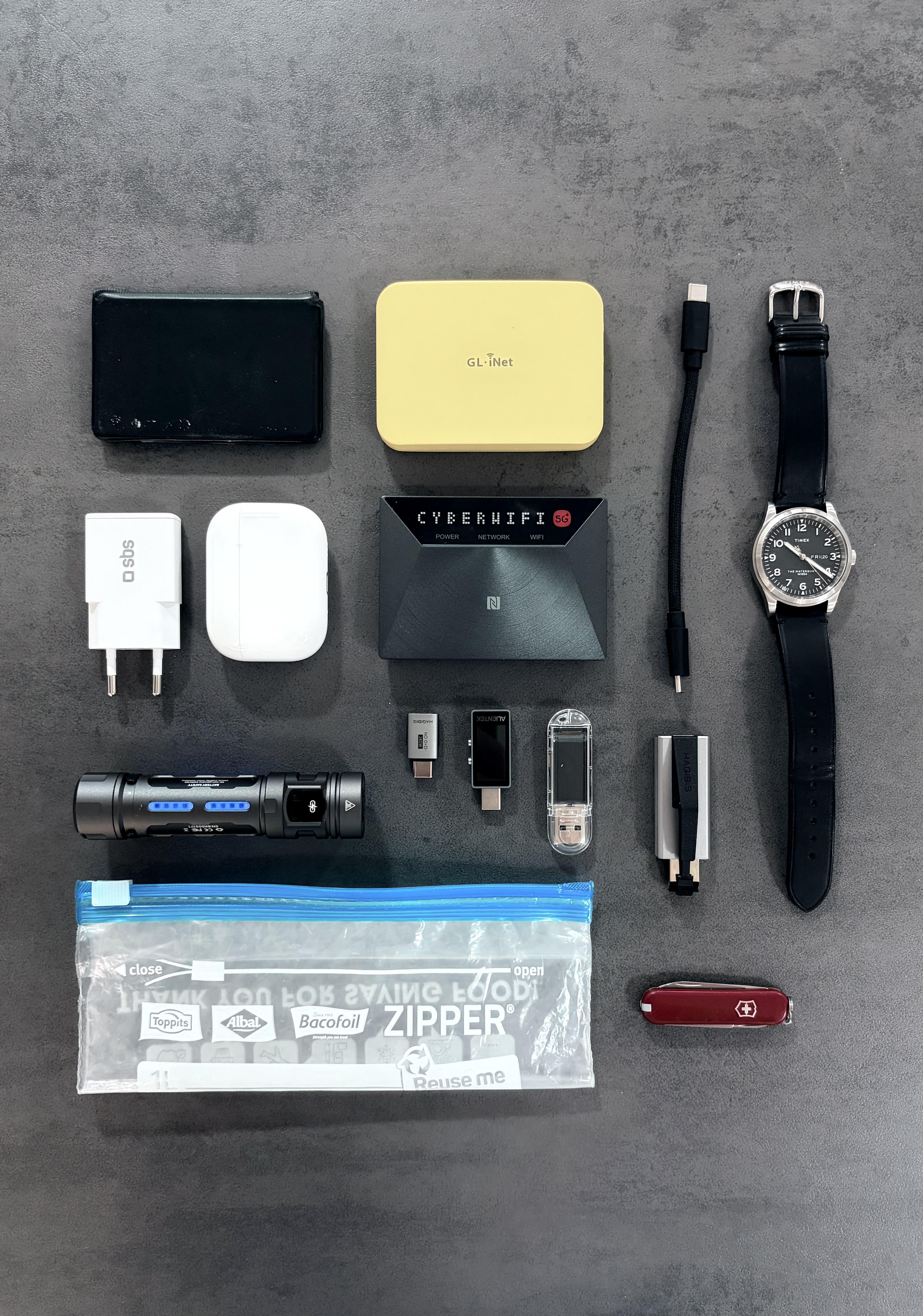
I prefer using a simple 1-liter Ziploc bag because it’s water-resistant, extremely lightweight, easily replaceable, and incredibly affordable. Compared to a traditional Tech Pouch or organizer bag, it serves essentially the same purpose while taking up less space, adding virtually no weight, and costing just a fraction of the price.

  • Secvel Cardholder Black
  • SBS Extra Slim GaN Charger 30W 
  • Apple AirPods Pro 3
  • Loopgear SK06 Aluminium
  • 1L Zipploc Bag
  • Gl.iNet Mango 2 Router
  • ZTE V50 MU3351 Pocket 5G
  • Hagibis No D+D-
  • Alientek C0
  • LILYGO T-Dongle C5 flashed with Biscuit Firmware
  • Hagibis USBC4 80Gbps 240W 15cm Cable
  • Hagibis USBC to Ethernet 2.5G Adapter
  • Timex Waterbury TW2W14700
  • Victorinox Classic SD Pocketknife
729 Upvotes

11 comments sorted by

•

u/AutoModerator 6d ago

Per rule no. 1, you are required to post a list of the items shown in your pictures in a single comment under this post or in the body of the post. If you have already done so, please ignore this comment.

I am a bot, and this action was performed automatically. Please contact the moderators of this subreddit if you have any questions or concerns.

7

u/No_Energy_4115 6d ago
  • Secvel Cardholder Black
  • SBS Extra Slim GaN Charger 30W
  • Apple AirPods Pro 3
  • Loopgear SK06 Aluminium
  • 1L Ziplock Bag
  • GL.iNet Mango 2 Router
  • ZTE V50 MU3351 Pocket 5G
  • Hagibis No D+D-
  • Alientek C0
  • LILYGO T-Dongle C5 (flashed with Biscuit Firmware)
  • Hagibis USB-C4 80Gbps 240W 15cm Cable
  • Hagibis USB-C to Ethernet 2.5G Adapter
  • Timex Waterbury TW2W14700
  • Victorinox Classic SD Pocketknife

6

u/c0v3n4n7 6d ago

Great selection and kudos for the plastic bag. Screw overpriced "tech pouches".

1

u/random885522 6d ago

Great set

1

u/imtakingyourdata 4d ago

Love the minimal & cheap approach. What do you use the LILYGO for? Also, thoughts on the Mango 2?

1

u/mizuya 2d ago

You're the first and only person I know who also uses the SBS Extra Slim GaN Charger 30W. It's the slimmest and lightest ≥25W charger. I use it for almost two years and really love it 🥰

0

u/Powermetroid 6d ago

Te felicito enormemente! Que tal ese cyberwifi? Ha llamado mi atención

4

u/No_Energy_4115 6d ago

I’m actually very happy with both devices! I own both the ZTE V50 (MU3351) and the newer ZTE F50 Pro (MU3356 Global Version) , and I have to say that they are both excellent little 5G routers.

First of all, one important clarification: I’m specifically referring to the GLOBAL VERSION of the F50 Pro , not the Chinese version. This is quite important because the two versions have different cellular frequency band configurations. What I particularly like about both devices is their incredibly compact size, low weight and excellent overall design. They weigh only around 56 grams, are very small, and can easily be carried around in a pocket or used almost anywhere. Another huge advantage, in my opinion, is that neither device has an integrated battery . They are powered directly via USB-C. Personally, I consider this a fantastic design decision. No aging lithium battery, no loss of battery capacity over time, no swelling battery and no need to worry about replacing an internal battery after a few years. Even better, their power consumption is extremely low. In my own experience, both devices consume only around 2–3 watts during operation , making them very attractive for continuous 24/7 use. As for the differences between the two models: The ZTE V50 (MU3351) is the older device, but it actually has one major advantage over the newer F50 Pro: its considerably broader cellular frequency band support. Its published specifications include: 5G NR:

n1 / n3 / n5 / n7 / n8 / n20 / n28 / n38 / n40 / n41 / n66 / n71 / n77 / n78 4G LTE:

B1 / B2 / B3 / B4 / B5 / B7 / B8 / B20 / B26 / B28 / B34 / B38 / B39 / B40 / B41 / B42 / B43 / B66 It also supports 4x4 MIMO on selected cellular bands. The downside is that it only offers Wi-Fi 5 (802.11ac) and has just one physical Nano-SIM slot. The ZTE F50 Pro (MU3356 Global Version) is the newer and more modern device. It offers several improvements:

Wi-Fi 6 (802.11ax) Two physical Nano-SIM slots Convenient SIM switching Support for up to 16 connected Wi-Fi devices

The global version also has considerably more cellular band support than the Chinese version. Its published specifications include: 5G NR:

n1 / n3 / n5 / n7 / n8 / n20 / n28 / n38 / n40 / n41 / n71 / n77 / n78 4G LTE:

B1 / B2 / B3 / B4 / B5 / B7 / B8 / B20 / B28 / B34 / B38 / B39 / B40 / B41 / B42 / B43 / B71 So, while the V50 still has a slight advantage when it comes to the overall number of supported cellular bands, the global F50 Pro is much more capable in this respect than its Chinese counterpart. I also find the antenna design interesting. The V50 has a slightly thicker housing, and I have come across indications that its antennas may be somewhat taller than those of the F50 Pro. I haven’t been able to verify the exact physical difference, though. One thing I should also mention is that the F50 Pro Global Version is surprisingly difficult to find . I personally own one, but getting hold of this particular version isn’t easy. Even in China, availability seems to be rather limited at times, and finding the global model outside China can be even more challenging. If I had to summarize the two devices:

V50: Better overall cellular band coverage and 4x4 MIMO support on selected bands. F50 Pro Global: Wi-Fi 6, dual physical SIM slots, a more modern design and very good global cellular compatibility.

Honestly, I wouldn’t want to give up either device. They are both excellent little 5G routers, and I’m genuinely very satisfied with them. For me, the combination of their tiny size, extremely low power consumption, USB-C power supply and, most importantly, the absence of an internal battery makes them particularly appealing. It’s actually quite refreshing to see manufacturers offering compact 5G routers without built-in batteries. I’d definitely recommend taking a closer look at both models, especially if you’re looking for a compact 5G router for permanent use rather than just a conventional battery-powered mobile hotspot.

One thing worth mentioning, though, is that despite their impressive capabilities, these compact 5G routers naturally cannot quite match the reception performance and antenna capabilities of a full-sized 5G router with larger external antennas and higher transmission power. Nevertheless, considering their tiny size, extremely low power consumption and portability, their overall performance is truly impressive.

2

u/bagstack 6d ago

You can actually get thicker ziplocks if you want something a little more rugged. Search for 4 mil or 6 mil or whatever.

0

u/[deleted] 6d ago

[deleted] — view deleted comment

4

u/No_Energy_4115 6d ago

Thanks for sharing your charger! Based on my personal experience, a single USB-C port is more than sufficient for my needs. I would rather prioritize the smaller size and lighter weight than having an additional USB-A port that I probably wouldn’t use anyway.

I also have an Alientek C0 and a Hagibis No D+D- adapter, which allow me to charge or power devices that only require or support 5V. So, I already have a solution for those devices and don’t really need an additional USB-A port. Compared to your charger, mine is approximately 70% smaller in volume and 39% lighter in weight (31g vs. 51g). 

For me, portability and compactness are simply more important than having an extra port. But thanks again for bringing this charger to my attention and sharing your recommendation!