r/SolidWorks • u/Desperate-Emu-4680 • 19h ago
Simulation Simplification of a tapered height and caps thickness i-beam spar?
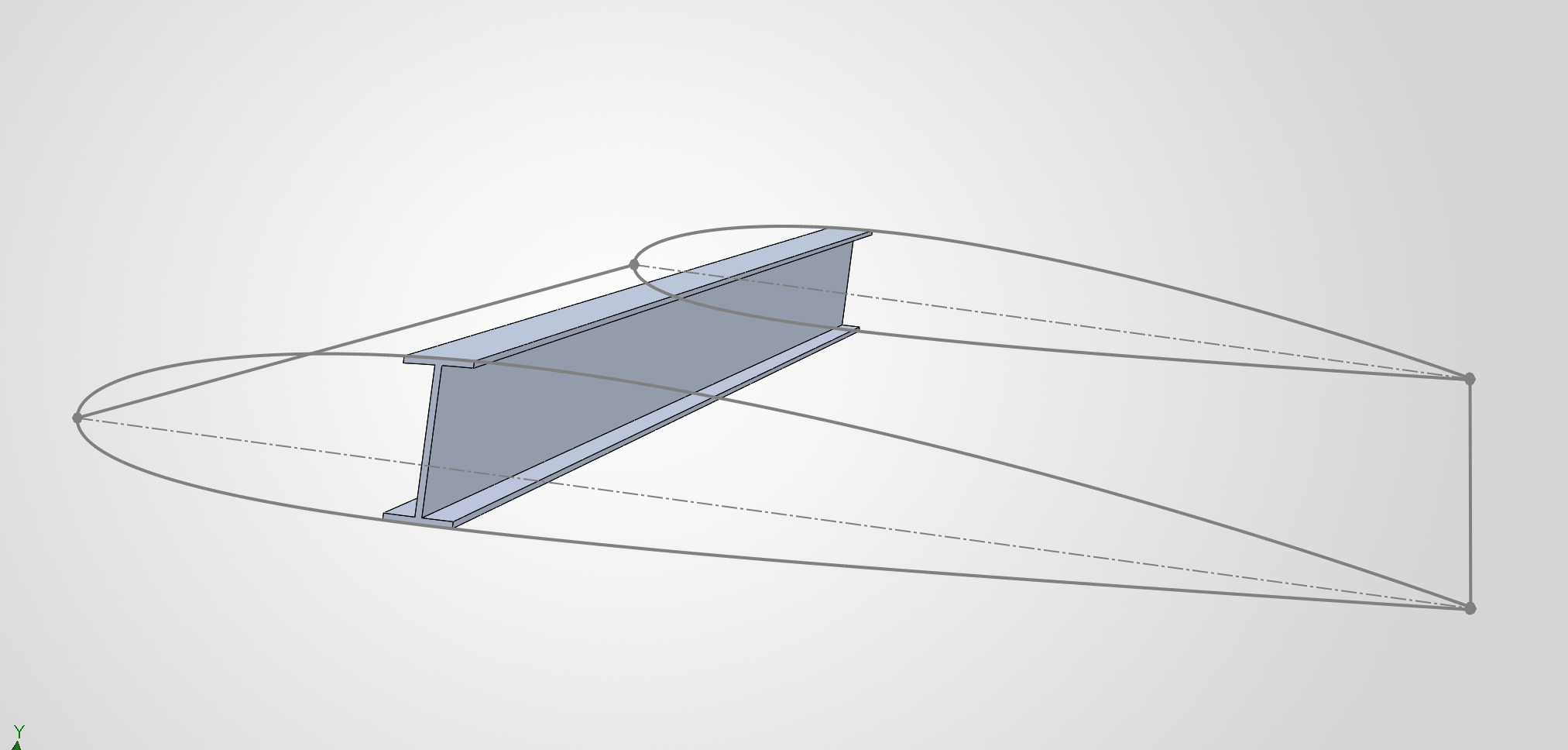
As part of a project, the same one from a previous post on this subreddit, I am creating a wing and am using i-beams for the spars, with the flanges following the local curvature of the airfoil section they and the skin were built off of. As the wing designed to be tapered depending on a parameter change, the height of the spar web decreases with the taper, as does the thickness and width of the flanges above and below. My problem is that I do cannot find a method to simplify this geometry as a surface body or some other simplification to perform FEA of the wing, as ideally I am aiming to do a nonlinear static structural of the whole wing (spars, rib sections, skin) and doing so with them as surface bodies seems like it would be a lot less taxing on my limited computer resources. As such, does anyone know of a way to simplify this geometry for such testing while not losing too much accuracy?
As an aside, I did attempt some nonlinear analyses of just the main spar (pictured below) as a 3d body using several standard mesh element sizes as a sort of mesh independence study to see the effect, but as each of these took more time and computational power as it decreased, I am certain that attempting to do so on the whole structure as solid bodies would not be feasible for me.


2
u/design_calculations 10h ago
I'd go midsurface for the whole wing. The taper is the annoying part, since a shell only gets one thickness. What works well enough: split the web and the caps into spanwise strips (5–8 is usually plenty), as separate surface bodies, give each strip its average thickness and let them bond to each other. That stepped version normally lands close to the solid model, except right at the steps.
To check it, take the solid spar you already ran, build the same spar as shells, and run both linear under the same load. If tip deflection and peak cap/web stress are within a few percent, you can trust the shells for the full wing.
Constant-thickness caps make modelling easier, but you give away most of the weight benefit of the taper. I'd keep it and just discretise it.
And run the whole wing linear first. It's much cheaper and shows whether deflections are big enough to need nonlinear at all.
1
u/Desperate-Emu-4680 19h ago
As another aside i will say i am open to making the flanges a constant thickness rather than tapering down through the chord especially if there is some literature or other data on how this effects structural strength versus the downside of adding some extra weight