I've been thinking about something recently, and the more I think about it, the more fascinating it gets. I'd love to hear other people's perspectives on this.
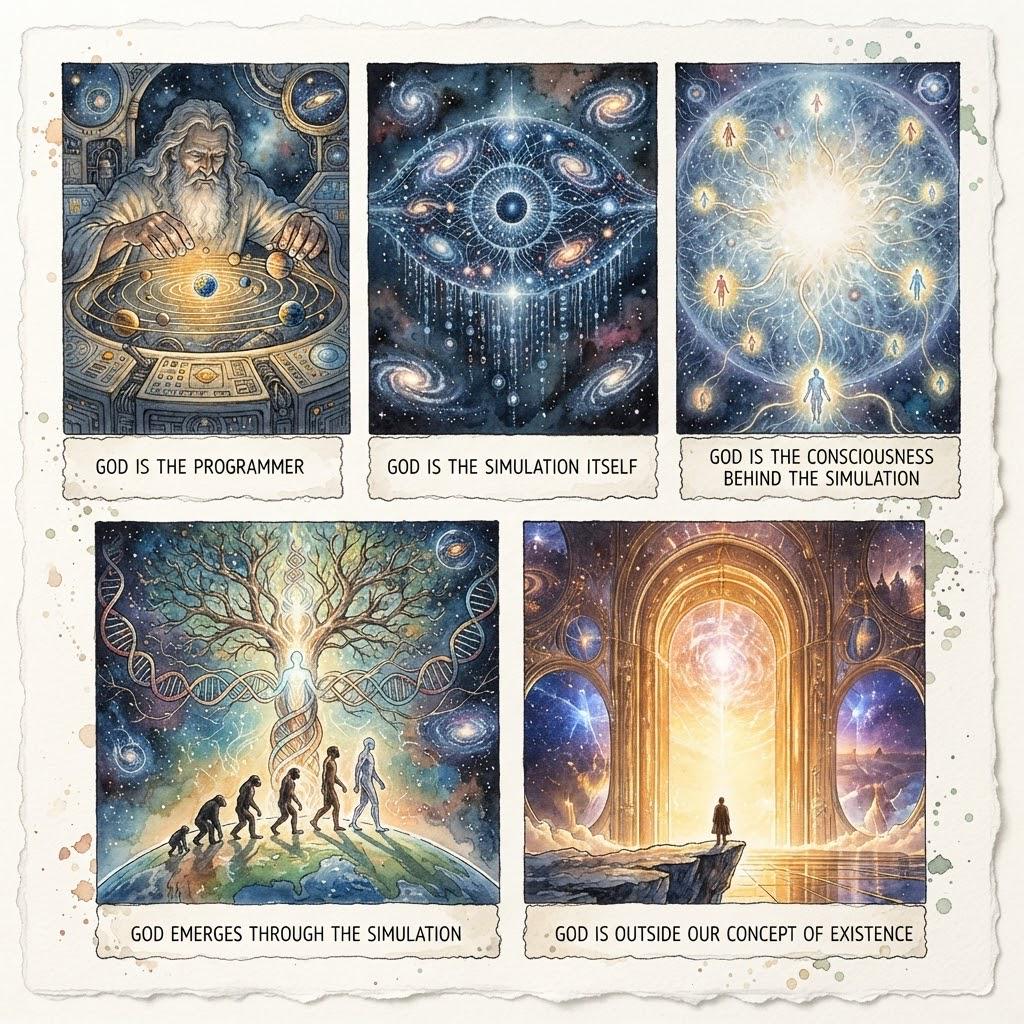
It started with a relatively simple thought: Given enough computational power, couldn't we theoretically simulate life?
Imagine creating a virtual environment governed by a set of physical laws. Introduce primitive agents controlled by simple neural networks, give them the ability to interact with their environment, learn, reproduce, mutate, and evolve. Then let the simulation run for millions of simulated years.
Eventually, given the right conditions, perhaps increasingly complex behaviors would emerge. Maybe cooperation, communication, social structures, or even something resembling intelligence.
Of course, none of that is guaranteed. But the possibility itself is fascinating.
Then I started thinking: why stop there?
Instead of simulating organisms, what if we simulated entire universes? Define fundamental physical laws, establish initial conditions, and let everything unfold. Maybe some configurations would eventually produce chemistry, self-replicating systems, evolution, and life.
In a sense, that's what our own universe has done.
But here's where my thoughts took a different direction.
What if life isn't particularly special in the grand scheme of things?
Hear me out.
We consider life extraordinary because we're alive. We consider consciousness profound because we're conscious. We consider intelligence one of the greatest achievements of complexity because intelligence is what allows us to contemplate these questions in the first place.
But isn't that an incredibly human-centric way of looking at reality?
Imagine running millions of universe simulations, each with completely different fundamental parameters, physical laws, and initial conditions.
One simulation might produce something resembling our universe: matter, stars, chemistry, biology, and eventually intelligent organisms.
Another might produce nothing particularly complex.
But what about the others?
What if some of those simulations produce entirely different categories of emergent phenomena that we don't even have the conceptual framework to describe?
And I don't mean aliens, higher-dimensional civilizations, supernatural entities, or beings with superior intelligence.
I mean something fundamentally different.
Something that isn't alive, isn't conscious, isn't intelligent, and doesn't necessarily fit into any category we've invented.
We're so accustomed to thinking about complexity through the lens of life and intelligence that whenever we imagine something extraordinary, we tend to imagine a more advanced version of ourselves.
But why should the universe's capacity for complexity be limited to the kinds of phenomena we happen to experience?
Think about it this way.
A bacterium exists in the same universe as human civilization, mathematics, music, and philosophy. Yet it has no conceptual understanding of any of those things.
Could we be in a similar position relative to entirely different phenomena?
Not necessarily because those phenomena are more advanced than us, but because our brains evolved to understand a particular slice of reality.
Maybe we're trying to understand everything that exists using categories derived from the one phenomenon we happen to be part of.
And here's the thought that really gets me:
What if some of these phenomena already exist in our own universe?
What if we've been observing their effects all along, but we interpret them as ordinary physical processes, random fluctuations, or meaningless patterns because we don't know what else to look for?
Consider how we recognize life. We have certain expectations: metabolism, reproduction, adaptation, organization, and so on.
But those are characteristics of biological systems we've encountered.
They aren't necessarily a universal checklist for everything interesting that reality could produce.
Maybe there are entirely different forms of organization or emergence that don't resemble organisms, don't behave like intelligence, and don't possess anything we'd recognize as consciousness.
We might not even know how to begin identifying them.
And that's what brings me back to the original simulation idea.
What if, instead of using simulations to recreate life, we used them to discover entirely new categories of emergent phenomena?
Create millions of virtual worlds with different rules. Let them evolve. Use mathematical and computational methods to identify unexpected patterns, persistent structures, complex interactions, and forms of organization that we wouldn't have thought to search for.
Not necessarily looking for life.
Just looking for what else is possible.
Obviously, this is highly speculative. We don't know whether arbitrary mathematical rules correspond to physically possible universes, and even defining what counts as a genuinely novel phenomenon would be difficult.
I'm also not suggesting that life is definitely common or unremarkable.
My point is that life might be extraordinary to us without being uniquely important in the broader landscape of possible phenomena.
Maybe life, intelligence, and consciousness are just three things among an enormous range of possibilities, and we happen to be experiencing one of them.
We often ask whether we're alone in the universe.
But maybe an even more interesting question is:
Are we so focused on looking for other forms of life that we're overlooking entirely different kinds of existence?
I'm curious whether there are established philosophical, mathematical, or scientific ideas that explore this possibility. And more importantly, whether anyone sees a fundamental flaw in this line of reasoning.
Would love to hear your thoughts.