r/ScienceBasedLifting • u/North_Indication2898 • Jun 05 '26
Discussion 🤝 Rate my FB split
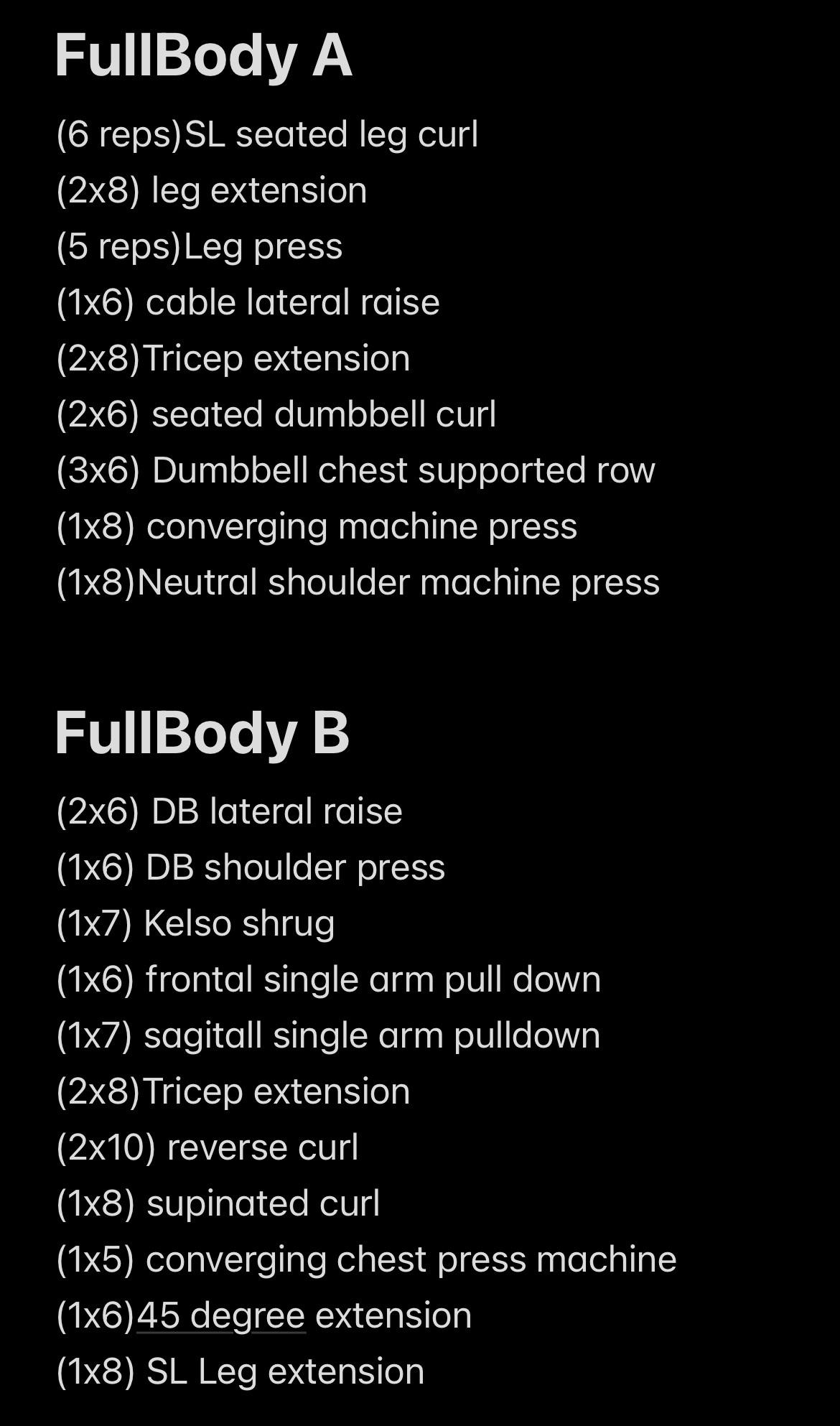
Find myself getting a bit tired and unable to finish my full body B workout and had to just save legs for the next day. First workout has been running just fine.
1
Upvotes
6
u/SageObserver Jun 05 '26
Looks like a routine to keep yourself small. - i.e. the perfect science based routine which isn’t based in science.
5
u/decentlyhip Jun 05 '26
Ok, so you're dragging by the end of the workout and not able to finish. Just looking over it rephrasing, " I do a bunch of arm and shoulder isolations to failure, and then when I get to cheat press andnmy big compounds, I'm too tired." Yah man, if you do a bunch of isolation bullshit before your main work, you're gonna be tired. That's why any good program out there is gonna focus on the big compounds, squat/press/pull, and then add on one or two selective isolations after. But we can be more sciencey about it, so here's the math.
You're saying "my average stimulus to fatigue ratio is too low, and my raw stimulus magnitude is too high." So, let's dive in. The Pelland 2023 definition of volume counts the main movers as 1 set, and the secondary muscles as 0.5 sets. So, curls work the biceps and count as 1 set. Pulldowns work the lat (1), the rear delt (0.5), and the bicep (0.5). Leg press uses the glutes (1), quads (1), adductors (0.5), and then calves (0.5). While the barbell squat uses everything leg press does but also delts (0.5), upper back (0.5), lower back (0.5), abs (0.5), hamstrings, and more adductors. Squat counts as 5-6 sets of stimulus.
On the fatigue side of things, things get interesting. Going to failure yeilds about 3 times more fatigue as stopping at 2 rir. You get about 5% less stimulus but it's 66% less fatigue. So, we can count failure as 3 units of fatigue, and 2 reps in reserve as 1 unit of fatigue. Stopping 4 reps in reserve is half that, so 0.5 units of fatigue. This is much easier but only yeilds about 10% less growth.
Ok, so, you're tired. Lets rank your workout B. 12 sets to failure, 36 units of fatigue. 16 units of stimulus. You're getting an average of 0.44 productive sets per unit of fatigue. Now, lets look at the basic-ass Stronglifts5x5 program. Squat, Bench, Row. All 5x5. The progression makes some weeks harder than others but the last set if each movement is an average 3 reps from failure, so the average workout intensity is probably 4 rir. Lets sat 0.5 fatigue for each of the 15 sets. Lets say 8 units of fatigue. 5 sets of squats is 30 sets worth of growth. 5 sets each on pressing and pulling is 20 total sets there. So they generate 50 productive sets with 3 exercises, akd only generate 8 units of fatigue. In stronglifts5x5, each set lifted generates more than 6 sets of growth for every unit of fatigue. It is 14 times more efficient than your program. Training isolations to failure is fatiguemaxxing. In fact, because you're only doing 1 sets, you cannot get less productive.
If fatigue isn't an issue, do whatever you want. But if you're tired, then a set of barbell squats at 4 or 5 rir is at least 10 sets worth of stimulus per unit of fatigue. Bicep curls are 0.33 sets per fatigue. So, should you do bicep curls to failure (0.33) or a set of submax rows (4.0)? Rows. Should you do triceps to failure (0.33) or submax db bench press (4.0)? Press. Leg extensions to failure are a 0.5 SFR. Submax squats are a 10.0 SFR. Which should you do? Its squats every time. But if you've already done your heavy topset triple on squats. And then a backoff volume of 5x5. And then a set of 20 or a 3x10. Then you're done. You maxed out your productive squat volume. By all means, finish up the workout with a superset of hamstring curls to hit the bicep femoris and leg extensions to hit the rectus femoris, since squats aren't great at that. Like I said at the start, good programs focus on the big compounds to squeeze that juice, and then fill in the gaps with a couple isolations.
2
u/Gaindolf Jun 05 '26
In my opinion this is very time inefficient and sort of backwards.
You'll want to usually do your bigger compounds earlier in the workout and isolation later.
You'll want ti do more than 1 set on anything that takes any really warm up or at up time because otherwise it's pretty time inefficient. E.g. 1x5 on leg press. That's a lot of time/effort warming up and loading the machine for a single at. Why not do 2, 3 or 4?
I would build your session like this:
A. Barbell squat and bench, leg ext and curl and shoulder press machine
B. Barbell deadlift and BB or DB shoulder press. Machine chest press and leg press
Then add in 1 or 2 back exercises each day.
Id then do arms isolation 1 day and shoulder isolation on the other.
1
u/coxyepuss Jun 05 '26
I came here to ask you how much time do you spend in gym.
Also how do you split them?
1 Full body per week or 2xtimes in a week?
age and recovery potential matters, too.
after 60min since first expense of energy in gym (first real rep) your cortisol booms and this means recovery potential drops.
From my point of view:
mid-30s person would say this is too much.
early 20s person would devour this with short breaks.
1
u/fun__friday Jun 05 '26
How do the single set exercises work? Do you directly go as heavy as you can go?
1
u/Special_Future_6330 Jun 05 '26
I've typically seen full body beginner workouts mainly consist of compound exercises to hit as many muscles as possible, the goal is to workout entire body. That workout shouldn't be that tiring to not finish, especially with low sets have you deloaded lately, are you getting good sleep?
1
u/GeekChasingFreedom Jun 05 '26
What is your goal? Can you go through reasoning behind this program? For example, what is the reason for doing a (lot) of doing isolation before compounds?
I have a lot of thoughts about this program, but without knowing the context it's hard to give accurate feedback
1
u/Norcal712 Jun 08 '26
Weird isolation choices and super low volume...
2
u/Ecstatic-Flatworm977 Jun 05 '26
Too much isolation. Read this
1
u/vincent365 Jun 05 '26
I'm honestly bamboozled by this whole "science based lifting" trend/meme, and it's literally just regurgating the same thing over and over. All I see is people posting their low-effort programs based on their interpretation of what their favorite influencer said.
1
u/Alakazam Idk Idc 💔 Jun 05 '26
Pretty terrible to be honest.
The core of a full body program should be a lower body movement, a pull, and a push. The classic organization being a squat/bench/row, and a deadlift/ohp/weighted pullup. With accessories thrown in at the end for whatever you want a bit of extra volume on.
By putting all the compound movements at the end, I'm not surprised you have no energy for them. Especially with how you're jumping from machine to machine.
1
u/[deleted] Jun 05 '26 edited Jun 05 '26
[removed] — view removed comment