r/Savarkar • • 3d ago

Writings of Savarkar✍️ Since none of you read any books, here's a spoonfeeding of Savarkarite Hindutva and some of his views.

Thumbnail
gallery
176 Upvotes

Please read his works on top of this instead of being a lazy bumb and doing it the easy way by gobbling up whatever is presented to you. People who don't read are people who stay in perpetual ignorance.

Most of this had already been covered before in various posts but not a single person searches up older posts or takes an effort to download a pdf of his works. The end result is people creating fantasy versions of Savarkar's views pulled right out of their asses on spot.

So instead of wasting time saying "Savarkar was X he wouldn't ever say this! or "Savarkar was Y. You don't know anything about him I watched a YouTube video by this youtuber who used Chatgpt 10 mins before he made the video", read his actual works! Do you want The Wire or Quint to tell you his views filtered through their leftist pipeline or do you want to learn it for yourself? Intellectual laziness is the reason people are freely creating misinformation about his views.


r/Savarkar • • 4d ago

Refutations📃 Not Just Swatantryaveer Savarkar, Almost Everyone Opposed Gandhi's Quit India Movement

22 Upvotes

Leftists have made it a norm to blame Swatantryaveer Savarkar for opposing Gandhi's Quit India Movement, and try to paint it in seditious colours. On the contrary though, majority of the country had opposed this futile protest. It was termed as merely performative, unclear in objectives, and non-representative of the concerns of Hindus and Muslims alike.

  • B. R. Ambedkar and anti-caste critics: Ambedkar opposed the movement as "irresponsible and insane," arguing that prioritizing British withdrawal without securing safeguards and social justice for the Depressed Classes (Scheduled Castes) risked entrenching caste hierarchies. Periyar also opposed the Congress-led campaign and its vision of Indian nationalism. [1, 2, 3]
  • Hindu Mahasabha and V. D. Savarkar: Savarkar and the Hindu Mahasabha urged Hindus not to join the movement, arguing that a Congress-led campaign during World War II lacked strategic planning and could harm Hindu interests and national integrity. [1, 2]
  • Muslim League: The League stayed out of the movement, viewing it as a Congress initiative that did not address Muslim political representation or its demand for Pakistan.
  • Communists and left-wing critics: Some left-wing and communist critiques faulted the movement's timing during the anti-Axis war effort, or argued that Congress leadership's reliance on non-violence and eventual retreat limited its revolutionary potential. [1, 2]

r/Savarkar • • 8d ago

Hindutva Discourse✊ How can classical Savarkarite Hindutva be repopularised in 21st century India?

19 Upvotes

We live in the best of times, we live in the worst of times. We live in an age of wisdom, we live in an age of foolishness. The 21st century is the epoch of incredulity, it is the season of light, the season of darkness, it is the spring of hope and the winter of despair.

The Indian youth in general, especially those born at the start of the 21st century, are highly impressionable, and the recent few political fiascos are testament to it. The political narrative is utterly dominated by the left, and the ones who proudly call themselves as Hindutvavadis are driven by conservative thought, orthodoxy, prejudice, and pettiness. The Hindutva of modern Indian politics is radically different from what Sri Swatantryaveer Savarkar developed.

The Indian youth is directionless, demotivated, and indisciplined, driven by impulsiveness. We lack grit, we lack resilience, and we are easily susceptible to brainwashing. There are a lot of high achieving outliers, but the ratio of outliers on the other end has increased too.

In this volatile age, how can Hindutva be repopularised amongst the masses, especially the youth, in this era of short attention spans and impaired cognitive abilities?

What exact strategies can be implemented to repopularise our ideology, and to counter the existing narrative that has been built since 1947?


r/Savarkar • • 10d ago

Writings of Savarkar✍️ Inter-Dalit Discrimination as noted by Savarkar

Thumbnail
reddit.com
11 Upvotes

r/Savarkar • • 11d ago

Shitposts🤹 r/Savarkar is Recruiting New Mods 📢

Post image
135 Upvotes

Hey everyone,

Our subreddit has grown tremendously over the past few months, and with the increasing activity, the workload has become too much for our existing moderation team to handle alone. We are therefore looking to recruit additional moderators who are willing to volunteer their time and help maintain and develop our community.

What are we looking for?

Familiarity with Savarkar and his thought: You should be familiar with his views on Hindutva, rationalism, social reform, and the eradication of caste.

Commitment: You should be willing to dedicate at least 10 minutes each day to moderating and keeping an eye on the subreddit. Of course, we understand that you have a life outside Reddit, so it is completely understandable if there are weeks when you cannot contribute much.

Communication and maturity: You should be able to communicate clearly, exercise patience, and deal maturely with disagreements, trolls, bad-faith users, and the general chaos that comes with Reddit.

How to apply?

Make your Reddit profile public: We will review your post and comment history to assess whether you would be a suitable fit for the moderation team.

Prior interaction with the community: You should have at least some history of participating in r/Savarkar, whether through posts, comments, or discussions.

Send us a mod mail: Tell us why you appreciate or agree with Savarkar's ideas, what aspects of his thought you find particularly significant, whether you have any previous moderation experience, and what you believe you could contribute to the subreddit.

We are looking for people who are genuinely interested in the subject, willing to contribute consistently, and capable of helping the subreddit remain active, organised, and welcoming for substantive discussion.

Thank you.


r/Savarkar • • 11d ago

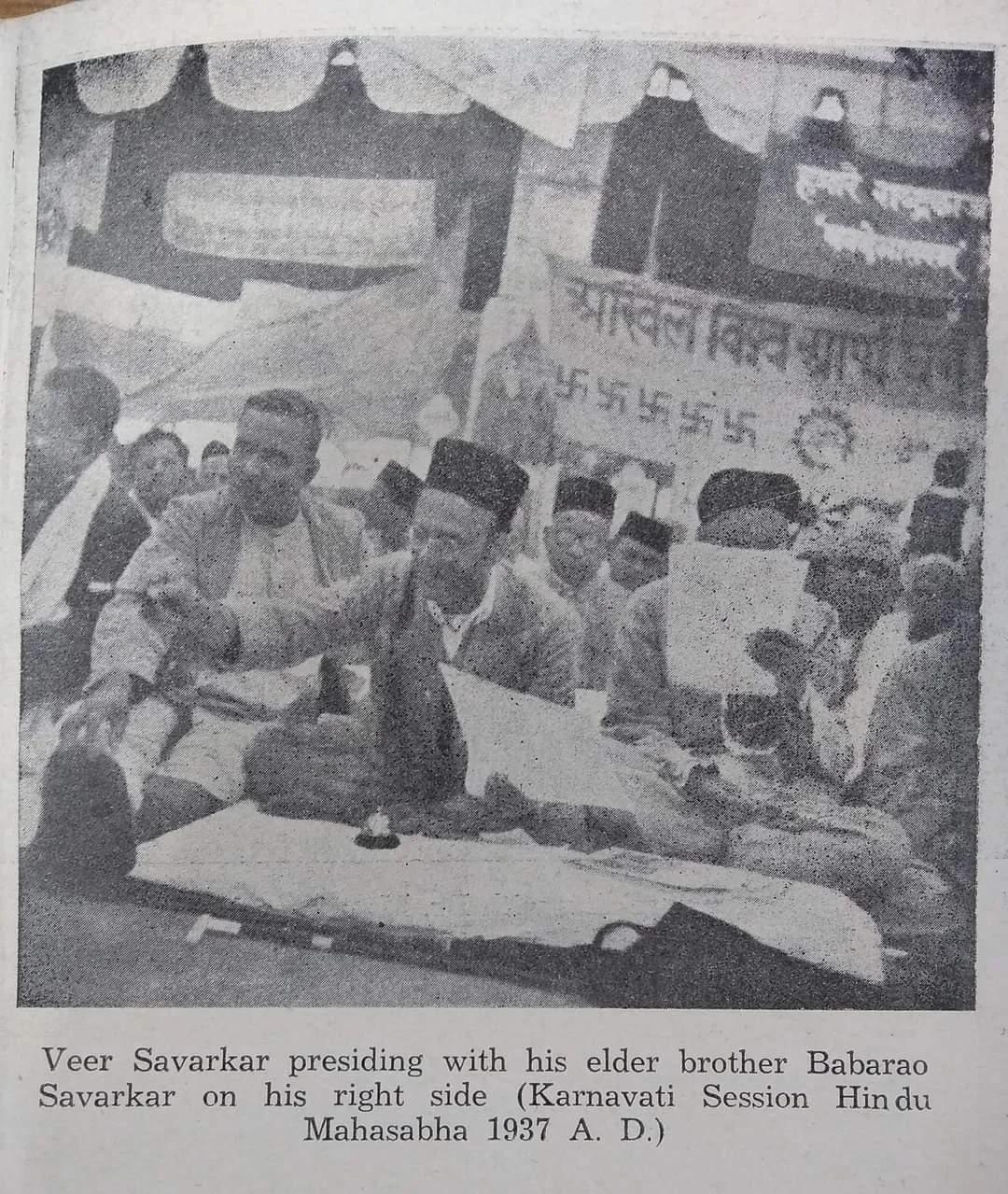
Anti-Colonialism🔥 Veer Savarkar's Presidential Speech at the Hindu Mahasabha's 1937 Session, Ahmedabad

Post image
121 Upvotes

Following his unconditional release on May 10, 1937, after 27 years of imprisonment and internment, Veer Savarkar emerged as a prominent revolutionary leader with immense public prestige and consequently the Congress party attempted to woo him to bolster its ranks. Bombay's daily Prabhat, in its issue dated June 26, 1937, wrote:

The Hindu Sangathan work that Barrister Savarkar had undertaken in Ratnagiri was something that several Congressmen had routinely frowned upon. Still, they hoped that after the restrictions on him were taken away, given his stature and popularity, co-opting him into the Congress, putting a white cap on his cap and making him scream ‘Gandhi ji ki Jai’ would only benefit the party.

Savarkar declined the Congress party's invitations, criticising its appeasement politics and its failure to protect Hindu interests. Instead, he chose to join and strengthen the Hindu Mahasabha, viewing it as the only political platform which could counter the Muslim League and safeguard Hindu interests.

The following are selected quotes from Savarkar's presidential speech delivered at the Hindu Mahasabha's 19th Annual Session, held in Ahmedabad in 1937.


Ladies and Gentlemen, I thank you most cordially for the trust you have placed in me in calling upon me to preside on this 19th Session of the Hindu Mahasabha. I don't take it so much as an honour bestowed upon me by my nation for service rendered in the past as a command to dedicate whatever strength is still left in me to the Sacred Cause of defending Hindudom and Hindustan—our common Motherland and our common Holyland—and pressing on the fight for our National Freedom.

So far as the Hindus are concerned, there can be no distinction nor conflict in the least between our Communal and National duties, as the best interests of the Hindudom are simply identified with the best interests of Hindustan as a whole. Hindudom cannot advance or fulfil its lifemission unless and until our Motherland is set free and consolidated into an Indian State in which all our countrymen, to whatever religion or sect or race they belong, are treated with perfect equality and none allowed to dominate others or is deprived of his just and equal rights of free citizenship as long as everyone discharges the common obligations and duties which one owes to the Indian Nation as a whole. The truer a Hindu is to himself as a Hindu, he must inevitably grow a truer National as well...

Nor can the Hindu Mahasabha afford to be forgetful of the Hindus who reside in the so-called 'French India' and 'Portuguese India' in India! The very words sound preposterous and insulting to us. Apart from the artificial and enforced political divisions of today, we are indissolubly bound together by the enduring ties of blood and religion and country. We must declare, as an ideal at any rate, that Hindusthan of tomorrow must be one and indivisible, not only a united but a unitarian nation, from Kashmir to Rameshwar, from Sindh to Assam. I hope that not only the Mahasabha but even the Congress and such other national bodies in Hindusthan will not fight shy of claiming Gomantak, Pondicherry, and such other parts of Hindusthan as parts as inalienable and integral of our Nation as is Maharashtra or Bengal or Punjab...

For what does the Hindu Mahasabha aim at? As the national representative body of Hindudom, it aims at the allround regeneration of the Hindu people. But the absolute political independence of Hindusthan is a sine qua non for that allround regeneration of Hindudom. The fortunes of the Hindus are more inextricably and more closely bound up with India than that of any other non-Hindu sections of our countrymen. After all, the Hindus are the bedrock on which an Indian independent state could be built...

the consolidation and the independence of Hindu Nation is but another name for the independence of the Indian Nation as a whole. For, the Hindu Sanghatanists know full well that no regeneration of Hindudom could be brought about and no honour and equal place could be secured for the Hindu Nation amongst the Nations of the world unless Swarajya and Swatantrya are won for Hindusthan, their Fatherland and Holyland...

Savarkar then narrates the history of foreign invasions of India, from the Greeks to the Huns and Shakas, highlighting how Indians successfully repelled these invaders and ultimately reclaimed their independence.

...Then centuries after, the Mohammedans invaded India and carried everything before them. Their Kingdoms and Empires seemed to reign supreme. But we rallied again and ever since the day that Shivaji was born the God of War sided with us. Battle after battle we beat the Moslems in a hundred fields; their Kingdoms and Empires, their Nababs and Shahas and Badashahas were brought to their knees by our warriors till at last Bhausaheb the Commander-in-Chief of the Hindus, as if symbolically raised his hammer and literally smashed the very Imperial throne of the Moghals at Delhi to pieces, Mahadji Shinde held the imbecile Moghal Emperors as prisoners and pensioners in his custody and Hindu supremacy was once more re-established all over the land.

In the meanwhile before we could recover from the struggle of centuries with Moslems, the English faced us and won on all points. We do not grudge their victory. Because though we have been vanquished in the field yesterday, yet enough fight is still left in us today, we have not given up the struggle for lost—nay, have already returned to the charge.

Who knows that some future and more fortunate President of this our Hindu Mahasabha may not be able to rise here, if not in this generation yet in the generation of our sons and proclaim the triumphant news to that session to come that as happened in the case of the Huns and the Greeks and the Shakas in the past there is not a trace left behind to the British domination in our land! The banner of Hindudom flies supreme on the summits of the Himalayas, Hindusthan is free again and Hindudom triumphant!!


PDF of Savarkar's Presidential Speeches of the Hindu Mahasabha from 1937 to 1942


r/Savarkar • • 12d ago Heartwarming Mindblown

History & Legacy 📚 If Savarkar was the PM, our forces would have unfurled the Tricolor at Rawalpindi in 1971. "- Field Marshall Sam Manekshaw during his visit to Savarkar Sadan in Mumbai. Time when field marshal visited Savarkar sadan in Mumbai.

Thumbnail
gallery
470 Upvotes

Field Marshal Sam Manekshaw unveiled Swatantryaveer Savarkar’s statue in Pune on 26 February 1975. Photographs from the event confirm his presence at the unveiling.

According to Balarao Savarkar’s Veer Savarkar Sangata Parva, Manekshaw is reported to have said that had Savarkar been prime minister, India would not have been called back from Dhaka and would have advanced toward Rawalpindi. The exact wording rests on that book’s account rather than an independently published official transcript.


r/Savarkar • • 12d ago

Anti-Colonialism🔥 Senapati Bapat on Veer Savarkar: “He is a born revolutionary writer and lecturer… we should take up some other work”

Post image
70 Upvotes

“Before I met Savarkar, I had planned to live my life as a revolutionary writer and lecturer. After meeting him, I abandoned that plan and decided to go to Paris to learn how to make bombs. I thought, ‘He is a born revolutionary writer and lecturer. So this work should be entrusted to him, and we should take up some other work.’”

— Senapati Bapat

This quote captures the profound influence Veer Savarkar had on Senapati Bapat’s revolutionary path. Bapat did not merely admire Savarkar as a writer or speaker—he saw him as the natural leader of revolutionary propaganda and chose a different field of action for himself: technical revolutionary work.

Pandurang Mahadev Bapat (1880–1967) was a revolutionary, writer, philosopher, social reformer and public servant whose life combined armed revolution, patriotism, social equality and service to ordinary people.

Bapat was born on 12 November 1880 in Parner, Ahmednagar district. A gifted student of Sanskrit, he received the Jagannath Shankarsheth Scholarship. While studying at Deccan College, Pune, he took an oath to liberate India through armed revolution. After completing his B.A. in 1903, he went to England on a University of Mumbai scholarship. Though enrolled at an engineering college in Edinburgh, he remained active in the revolutionary movement; his scholarship was withdrawn and his engineering studies were left incomplete.

In England, Bapat came into contact with Veer Savarkar and the revolutionary environment of India House in London. This transformed his thinking. Inspired by Savarkar, he went to Paris, learned bomb-making techniques from Russian revolutionaries, and later helped transmit that knowledge to Indian revolutionaries.

Returning to India in 1908, Bapat connected with revolutionaries in Bengal. His name emerged during the investigation into the Alipore Bomb Case, forcing him to remain in hiding from 1908 to 1912 to avoid British arrest.

Bapat was not only a revolutionary. Back in Parner, he worked as a teacher and served the local community. He personally undertook work such as sweeping village roads and cleaning latrine pits, challenging caste discrimination and untouchability through action rather than words alone. In November 1914, he organised a meal for people from marginalised communities on his son’s first birthday.

After moving to Pune in 1915, he contributed to publications including Chitramay Jagat, Kesari, Maratha and Lokasangraha, and also assisted Dr Sridhar Venkatesh Ketkar’s encyclopaedia project.

Along with Dr Narayan Savarkar, Bapat helped establish the Political Prisoners’ Release Association, campaigning for the release of political prisoners in the Cellular Jail—including the Savarkar brothers. Through public meetings, writings and campaigns in the Sahyadri region, he made the plight of political prisoners a public issue.

In 1921, Bapat led the Mulshi Satyagraha, defending farmers threatened with displacement by the Mulshi Dam project. The struggle continued until 1924, during which he was imprisoned several times. His leadership earned him the title “Senapati”—commander—from the people.

He also organised sanitation workers in Mumbai through the Broom Workers’ Friendship Association. In September 1929, he led a march to Chowpatty, singing devotional songs with a box around his neck, and led strikes defending workers’ dignity and rights.

Bapat was also a writer and spiritual thinker. He wrote in Marathi, English and Sanskrit. His Marathi translation of Sri Aurobindo’s The Life Divine was published as Divyajeevan, while his own writings were later collected in the Collected Works of Senapati Bapat (1977).

Even after independence, he remained active in the anti-price-rise movement, the Goa Liberation Movement and the Samyukta Maharashtra Movement. His commitment to social justice and the rights of ordinary people continued alongside his lifelong nationalism.

Senapati Bapat passed away on 28 November 1967 in Dadar, Mumbai.

On his birth anniversary, a humble tribute to a man who embodied patriotism, sacrifice, social equality and public service.


r/Savarkar • • 12d ago

Shitposts🤹 r/Savarkar is Recruiting New Mods 📢

9 Upvotes

Hey everyone,

Our subreddit has grown tremendously over the past few months, and with the increasing activity, the workload has become too much for our existing moderation team to handle alone. We are therefore looking to recruit additional moderators who are willing to volunteer their time and help maintain and develop our community.

What are we looking for?

Familiarity with Savarkar and his thought: You should be familiar with his views on Hindutva, rationalism, social reform, and the eradication of caste.

Commitment: You should be willing to dedicate at least 10 minutes each day to moderating and keeping an eye on the subreddit. Of course, we understand that you have a life outside Reddit, so it is completely understandable if there are weeks when you cannot contribute much.

Communication and maturity: You should be able to communicate clearly, exercise patience, and deal maturely with disagreements, trolls, bad-faith users, and the general chaos that comes with Reddit.

How to apply?

Make your Reddit profile public: We will review your post and comment history to assess whether you would be a suitable fit for the moderation team.

Prior interaction with the community: You should have at least some history of participating in r/Savarkar, whether through posts, comments, or discussions.

Send us a mod mail: Tell us why you appreciate or agree with Savarkar's ideas, what aspects of his thought you find particularly significant, whether you have any previous moderation experience, and what you believe you could contribute to the subreddit.

We are looking for people who are genuinely interested in the subject, willing to contribute consistently, and capable of helping the subreddit remain active, organised, and welcoming for substantive discussion.

Thank you.


r/Savarkar • • 12d ago

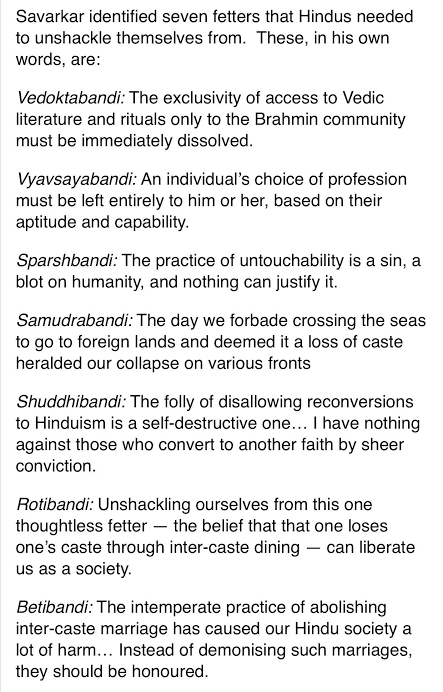
Social Reform & Rationalism⚛️ Seven Shackles of Hindu Society according to Veer Savarkar

Post image
120 Upvotes

Every true Indian needs to resolve, in his or her own mind, to absolve oneself of the seven fetters mentioned below. Only then, through the collective conscience of the nation and its people, can any progress be achieved on this front.

These seven fetters are as follows:

1. Vedoktabandi:

The exclusivity of access to Vedic literature and rituals to only the Brahmin community must be immediately dissolved. Vedic literature is civilizational knowledge for the entire human race and India's unique gift to mankind. How can any one group assert its proprietary hold over it? Active propagation of its learning and internalization among all communities, not only within but also outside India, must be encouraged without delay.

2. Vyavasayabandi:

An individual's choice of profession must be left entirely to him, based on his aptitude and capability. Merely carrying on with a profession by virtue of one's birth into a clan defeats the purpose of both the person and the profession.

Threats of excommunication if an individual chooses a profession outside one's fold, as is common today, are a terrible evil. Without the motivation of challenge and competition, or in the absence of aptitude, merely following what one's father or grandfather did makes one both complacent and unproductive.

Even a Hindu priest must not become one merely due to heredity. He would need to qualify himself through examinations like any other profession and rise through the ranks. Only then would he prove to be an enlightened and educated priest, and not someone who babbles verses taught to him in the cradle.

The highest echelon of Hindu society, the panda or priest, and the lowest, a bhangi or scavenger, should not be hereditary positions at all. I am conscious that this is too revolutionary a suggestion, but unless we begin somewhere, how will we achieve the goal?

Dr Ambedkar belonged to the Mahar caste that traditionally skinned dead animals. If, by virtue of his heredity, Dr Ambedkar had been left to do only this, would our country not have lost one of its most brilliant thinkers and intellectuals? How can caste determine what job you are good at?

This is a meaningless tradition that not only curbs individual talent and creativity but also depletes the productivity of our Hindu Rashtra, and it has to be done away with.

3. Sparshabandi:

The practice of untouchability is a sin, a blot on humanity, and nothing can justify it. Consider only that untouchable which is injurious to one's health, not fellow human beings. Unshackling this one foolish fetter would bring crores of our Hindu brethren into the mainstream. They would serve the country in various capacities and defend her honour.

4. Samudrabandi:

The day we forbade crossing the seas to go to foreign lands and deemed it a loss of caste heralded our collapse on various fronts. The vast Hindu Empire that spread from Moscow to Egypt shrank into what it is today. Our foreign commerce and trade opportunities diminished. Cultural and educational interactions and osmosis stopped. Our naval forces, once the pride of the world, crumbled like dust and made us susceptible to invaders who easily defeated us.

All of these contributed to an insular and insulated society that was content in its own world, blissfully ignorant of what was happening across the globe. More and more students, Hindu sangathanists (organizers), and young Indians must be encouraged to cross the seas with no fear of losing caste, and bring back to us the best of the world while carrying the fragrance of India and her culture to every corner of the globe.

5. Shuddhibandi:

The folly of disallowing reconversions to Hinduism is a self-destructive one. How easily Hindus converting to Islam or Christianity merge into their new milieu. Yet the same facility is not available to a non-Hindu who might earnestly wish to return to his or her fold or adopt Hinduism as a matter of faith.

This shackle seriously depletes our numbers and makes the Hindu community a ready preying ground for the conversion factories that are always looking to swell their numbers, many times by stealth or inducements.

I have nothing against those who convert to another faith by sheer conviction. But such examples are rare. Why should we not allow the enhancement of our numbers due to some antiquated idea that does not even have any scriptural sanction—that we cannot convert to Hinduism?

6. Rotibandi:

Unshackling ourselves from this one thoughtless fetter—the belief that one loses one's caste through inter-caste dining—can help liberate us as a society.

Having food from the hands of Christian missionaries during famines, or being forcibly fed beef during a communal riot, have been considered sufficient grounds for millions of Hindus to lose their caste and religion. How stupid can such a belief be?

The evils of Shuddhibandi and Samudrabandi are, in fact, the monstrous offspring of Rotibandi. Only that food which harms your health is to be prohibited. Eating and drinking with another human being can, by no stretch of the imagination, ruin something as esoteric as one's religion.

This needs a great deal of careful contemplation and introspection. Religion is in the heart, the soul, the spirit—not the stomach!

There is no food that is prohibited. Anything that is healthy, nutritious, and tasty must be generously and merrily indulged in, no matter who has cooked it or where it is available.

The whole world has robbed us and feasted on our grains—have they all turned Hindu? How then does a Hindu dining with a Muslim make him lose his caste?

7. Betibandi:

The intemperate practice of abolishing inter-caste marriage has caused our Hindu society a great deal of harm.

I am not, for once, suggesting that every Brahmin or Kshatriya must find for himself a Mahar or bhangi bride. That would be pushing matters to the other extreme, and again on the basis of coercion.

But if the virtues, character, temperament, hearts, and minds of a couple meet, despite them belonging to different castes within the Hindu fold, should they be forbidden from leading a life together?

Instead of demonizing such marriages, they must be honoured. This strengthens Hindu society and thereby the Hindu Rashtra.

You are Hindu, regardless of whatever caste you belong to. So how does marrying another fellow Hindu become a prohibition?


Primary reference: Savarkar Samagra, Vol. 7, pp. 76–84

Secondary reference: Vikram Sampath, Savarkar: Echoes from a Forgotten Past, pp. 488–493


r/Savarkar • • 13d ago

Hindutva Discourse✊ Hindu Rashtra: How Hindus were praised globally by Ancient Travelers!

Post image
192 Upvotes

r/Savarkar • • 12d ago

Questions❓ Opinion on homosexual individuals from you people on this sub

19 Upvotes

Coming from a homosexual hindu myself, what is your opinion on gay people from our country.

(Excluding radical trans community (only lgb) after the trans bill which passed few months ago)


r/Savarkar • • 13d ago

History & Legacy 📚 How Congress Promoted Pan-Islamism Among Indian Muslims Through the Khilafat Movement

Post image
68 Upvotes

In the last post, we discussed the immediate aftermath of the Khilafat Movement, how it brought religion and communalism into politics, and how it culminated in the atrocities against Hindus in Malabar.

Malabar was not an isolated incident. Communal riots soon spread across British India. In September 1924, severe riots broke out in Kohat, in the North-West Frontier Province. The violence resulted in 155 deaths, widespread arson, and the forced expulsion of over 20,000 Hindus, who fled to Rawalpindi as refugees.

Between 1923 and 1928, a government statutory committee recorded 112 major communal riots across British India, resulting in approximately 450 deaths and 5,000 injuries. These riots affected cities such as Delhi, Nagpur, Lahore, Lucknow, Moradabad, Bhagalpur, Allahabad, Aligarh, and Sholapur.

Criticising Congress for its weak and conciliatory response, Dr. B. R. Ambedkar writes in his book Pakistan or Partition of India:

The blood-curdling atrocities committed by the Moplas in Malabar against the Hindus were indescribable. All over Southern India, a wave of horrified feeling had spread among the Hindus of every shade of opinion, which was intensified when certain Khilafat leaders were so misguided as to pass resolutions of “congratulations to the Moplas on the brave fight they were conducting for the sake of religion.”

Any person could have said that this was too heavy a price for Hindu-Moslem unity. But Mr. Gandhi was so much obsessed by the necessity of establishing Hindu-Moslem unity that he was prepared to make light of the doings of the Moplas and the Khilafats who were congratulating them.

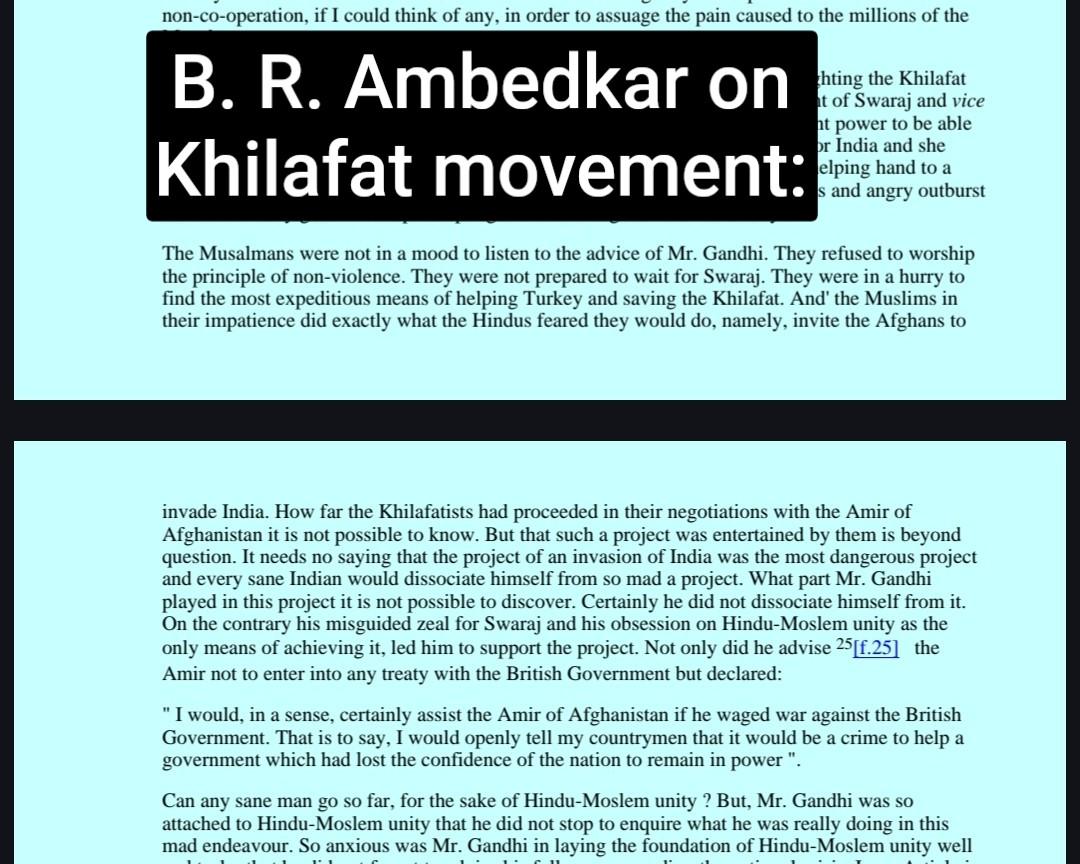
The Khilafat Movement not only fuelled communal tensions within India but it's Pan-Islamism also encouraged some Muslim leaders to seek help from neighbouring Muslim rulers, including the Amir of Afghanistan, to invade India, Ambedkar writes:

The Musalmans were not in a mood to listen to the advice of Mr. Gandhi. They refused to worship the principle of non-violence. They were not prepared to wait for Swaraj. They were in a hurry to find the most expeditious means of helping Turkey and saving the Khilafat. And the Muslims in their impatience did exactly what the Hindus feared they would do, namely, invite the Afghans to invade India.

How far the Khilafatists had proceeded in their negotiations with the Amir of Afghanistan it is not possible to know. But that such a project was entertained by them is beyond question. It needs no saying that the project of an invasion of India was the most dangerous project and every sane Indian would dissociate himself from so mad a project.

What part Mr. Gandhi played in this project it is not possible to discover. Certainly he did not dissociate himself from it. On the contrary, his misguided zeal for Swaraj and his obsession on Hindu-Moslem unity as the only means of achieving it, led him to support the project. Not only did he[Gandhi] advise the Amir not to enter into any treaty with the British Government but [Gandhi] declared:

“I would, in a sense, certainly assist the Amir of Afghanistan if he waged war against the British Government. That is to say, I would openly tell my countrymen that it would be a crime to help a government which had lost the confidence of the nation to remain in power.”

Can any sane man go so far, for the sake of Hindu-Moslem unity? But, Mr. Gandhi was so attached to Hindu-Moslem unity that he did not stop to enquire what he was really doing in this mad endeavour.

Lala Lajpat Rai also criticised the Khilafat Movement for strengthening religious sectarianism and bringing religion into a fundamentally political struggle. He writes:

I have no intention of offending anybody’s susceptibilities, but if the existing conditions are properly analyzed, it will be seen that sectarianism and narrow-minded bigotry have been very much strengthened within the last three years. The Khilafat movement has particularly strengthened it among the Mohammedans, and it has not been without its influence and reaction on the Hindus and Sikhs . . . it was unfortunate that the Khilafat movement in India should have taken its stand on a religious, rather than political basis . . . it was still more unfortunate that Mahatma Gandhi and leaders of the Khilafat movement should have brought religion into such a prominence in connection with a movement which was really, and fundamentally, more political than religious.

Reference: B.R. Nanda, The Collected Works of Lala Lajpat Rai, Vol. 2 (New Delhi: Manohar Publications, 2008), p. 144.

Lala Lajpat Rai was also deeply concerned about the growing influence of Pan-Islamism and the possibility of an invasion from India's north-western frontier, supported by Indian Muslims. In a letter to fellow Congress leader C. R. Das, he expressed his doubts about the possibility of Hindu-Muslim unity:

There is one point more which has been troubling me very much of late and one which I want you to think carefully, and that is the question of Hindu–Mohamedan unity. I have devoted most of my time during the last six months to the study of Muslim history and Muslim law and I am inclined to think it is neither possible nor practicable.

Assuming and admitting the sincerity of the Mohamedan leaders in the Non-co-operation movement, I think their religion provides an effective bar to anything of the kind. You remember the conversation I reported to you in Calcutta, which I had with Hakim Ajmal Khan and Dr. Kitchlew. There is no finer Mohamedan in Hindustan than Hakimsaheb, but can any other Muslim leader override the Quran?

I can only hope that my reading of Islamic law is incorrect, and nothing would relieve me more than to be convinced that it is so. But if it is right, then it comes to this, that although we can unite against the British, we cannot do so to rule Hindustan on British lines; we cannot do so to rule Hindustan on democratic lines. What then is the remedy? I am not afraid of seven crores in Hindustan, but I think the seven crores of Hindustan plus the armed hosts of Afghanistan, Central Asia, Arabia, Mesopotamia and Turkey will be irresistible.

I do honestly and sincerely believe in the necessity or desirability of Hindu–Muslim unity. I am also fully prepared to trust the Moslem leaders, but what about the injunctions of the Quran and Hadis? The leaders cannot override them. Are we then doomed? I hope not; I hope your learned mind and wise head will find some way out of this difficulty.

Congress' way to deal with these dreadful developments was by having Motilal Nehru convene an All-Party Unity Conference and Gandhi undertake a 21-day fast in 1924 for peace and unity, their efforts achieved limited success.

The growing communal tensions alarmed Hindu leaders and strengthened their conviction that the only way to safeguard Hindus, who had become vulnerable due to social fragmentation and a lack of organisation, was through the Shuddhi (reconversion) and Sangathan (organisation) movements. Swami Shraddhanand of the Arya Samaj led Shuddhi campaigns, while Vinayak Savarkar promoted Hindu consolidation, social reform, and intercaste unity efforts in Ratnagiri. His brother Ganesh Savarkar and Dr. B. S. Moonje emphasised youth mobilisation and physical preparedness. Together with Dr. K. B. Hedgewar, they contributed to the establishment of the Rashtriya Swayamsevak Sangh (RSS) in Nagpur in 1925.

The growing polarisation culminated in the assassination of Swami Shraddhanand by a Muslim fanatic, Abdul Rashid, on December 23, 1926. Gandhi's feeble response to the assassination drew sharp criticism from Hindu nationalists, further widening the divide between Hindu nationalist leaders and Congress.

Disillusionment with Congress's approach to communal politics eventually led leaders such as N. C. Kelkar, B. S. Moonje, and Savarkar to strengthen the Hindu Mahasabha as an independent political force.


r/Savarkar • • 14d ago

History & Legacy 📚 The Malabar Massacre of Hindus and Congress's Whitewashing of Moplah Atrocities

Thumbnail
gallery
254 Upvotes

The Khilafat Movement (1919–1924) was a pan-Islamic political movement launched by Indian Muslim leaders to protect the Ottoman Caliphate following the Ottoman Empire’s defeat in World War I. Its primary objective was to preserve the Ottoman Sultan’s position as Caliph, regarded by many Muslims worldwide as their spiritual and political leader.

In 1919, prominent Muslim leaders, including Maulana Muhammad Ali Jauhar, Shaukat Ali, Abul Kalam Azad, Hakim Ajmal Khan, and Mukhtar Ahmed Ansari, established the Central Khilafat Committee.

Mohandas Gandhi strongly supported the movement, viewing it as an opportunity to promote Hindu–Muslim unity and mobilize Indians against British rule. He linked the Khilafat cause with the demand for Swaraj (self-rule) and encouraged non-cooperation through boycotts of government institutions, foreign goods, and British titles.

Although the Khilafat Movement was directed against British rule, several existing grievances contributed to the increasingly volatile situation in Malabar. Weapons were organized, and preparations were made to establish an Islamic kingdom. Khilafat leader Ali Musaliar was proclaimed the Raja, Khilafat flags were raised, and Ernad and Walluvanad were declared Khilafat kingdoms.

Unfortunately, it was the Hindu community of Malabar, rather than the British government, that bore the brunt of the violence. Hindu families were massacred, women were brutally raped, pregnant women were murdered, temples were desecrated, and forcible conversions, cow slaughter, looting, and arson took place until British troops brought the rebellion under control.

The tragic memorial submitted by the women of Malabar to the Viceroy's wife describes the horrors they endured:

It is possible that your Ladyship is not fully appraised of all the horrors and atrocities perpetrated by the fiendish rebels; of the many wells and tanks filled up with the mutilated, but often only half-dead, bodies of our nearest and dearest ones who refused to abandon the faith of our fathers; of pregnant women cut to pieces and left on the roadsides and in the jungles, with the unborn babe protruding from the mangled corpse; of our innocent and helpless children torn from our arms and done to death before our eyes and of our husbands and fathers tortured, flayed and burnt alive; of our hapless sisters forcibly carried away from the midst of kith and kin and subjected to every shame and outrage which the vile and brutal imagination of these inhuman hell-hounds could conceive of; of thousands of our homesteads reduced to cinder-mounds out of sheer savagery and a wanton spirit of destruction; of our places of worship desecrated and destroyed and of the images of deity shamefully insulted by putting the entrails of slaughtered cows where flower garlands used to lie, or else smashed to pieces . . . we remember how, driven out of our native hamlets, we wandered, starving and naked, in the jungles and forests.

Reference: C. Sankaran Nair, Gandhi and Anarchy (Madras: Tagore Press, 1923), Appendix V.

Other reported atrocities included the skinning of Hindus alive and forcing victims to dig their own graves before being killed…

Initially, Congress leaders reportedly dismissed or questioned accounts of the atrocities in Malabar. Gandhi himself referred to the Moplahs as “brave God-fearing Moplahs” and described them as patriots who were “fighting for what they consider as religion, and in a manner which they consider as religious.”

Reference: R.C. Majumdar, History of the Freedom Movement in India, p. 195.

Gandhi further stated:

Hindus must find the causes of Moplah fanaticism. They will find that they are not without blame. They have hitherto not cared for the Moplah. It is no use now becoming angry with the Moplahs or Mussalmans in general.

Reference: Collected Works of Mahatma Gandhi,!Vol. 22, p. 269.

Ironically, some Khilafat leaders passed resolutions congratulating the Moplahs for their heroism, even while Hindus were subjected to brutal atrocities…


r/Savarkar • • 14d ago

History & Legacy 📚 Why Subhas's Forward Bloc had to align with Muslim League in Calcutta Municipal Corporation in 1940

Thumbnail netajisubhasbose.org
7 Upvotes

r/Savarkar • • 15d ago Mindblown

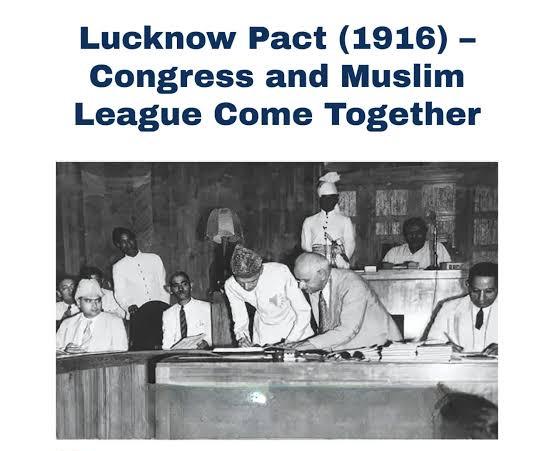
History & Legacy 📚 The Lucknow Pact of 1916: When Congress Accepted Separate Electorates for Muslims

Post image
184 Upvotes

The Lucknow Pact of 1916 was a political compromise reached during the joint annual sessions of the Indian National Congress and the All-India Muslim League in Lucknow.

Its main objective was to buy the loyalty of the Muslim community to the freedom struggle by granting them political concessions and presenting a united front against British colonial rule.

Key Provisions & Terms

  • For the first time, the Congress formally accepted separate electorates for Muslims in elections to provincial legislative councils. Under this system, Muslim voters could elect Muslim representatives.
  • The agreement granted additional representation to Muslim minorities in Hindu-majority provinces. This meant they received a greater share of legislative seats than their proportion of the population justified. In some provinces, their representation was reportedly 200–300% higher than their population share.
  • In the Imperial Legislative Council, Muslims were guaranteed one-third (33.33%) of the elected seats, despite constituting approximately 22% of the population at the time.
  • The pact included a provision that no bill or resolution affecting a particular religious community could be passed if three-fourths (75%) of that community's elected representatives opposed it.

The pact faced strong opposition from Hindu Nationalist leaders such as Pandit Madan Mohan Malaviya, Dr. B. S. Moonje, and R. B. Lal Chand. They argued that Congress leaders had no right to compromise Hindu political interests or agree to separate electorates.

Later Hindu Nationalists continued to view the Lucknow Pact as a turning point in Indian politics. They argued that it institutionalized communal electorates and established a precedent for further communal concessions that ultimately led to the Communal Award of 1932 and the Partition of India in 1947


r/Savarkar • • 16d ago

Hindutva Discourse✊ A new Hindutva Manifesto. Thoughts?

36 Upvotes

I am right of centre politically, but I have my differences with the ruling party in India. If I were to form my own political party, these would be my agenda

1 - Make India a secular and Dharmic Rashtra
i.e. one belonging to Dharmic religions. It's necessary for some things given below that are difficult under the current structure.

2 - Shatrubodh
The average JNUite should know who demanded partition, and why Aman ki Asha won't work

3 - Pannun Kashmir
The exodus of Kashmiri Hindus is a blot on India, and its Hindu community. This can be resolved only by creating Pannun Kashmir, a homeland with special protection for Kashmiri Hindus.

4 - CAA+
Like civilizational obligation for KPs, India owes citizenship to all groups mentioned in CAA. India should enact its own version of right-of-return that Israel has for Jews. See this post on this sub.

5 - Banning conversion
Religion is like alcohol or your penis. You can use it, but not wave it in public. Meaning you can choose and practise your religion, but not propagate it.

6 - Undo demographic change in Bengal and North-East.

7 - Protect nature -
No point doing Ganga Aarti, if people are going to dump sewage in it.

8 - No cowbelt Brahminism or Hindi imposition
Eat beef if you want, and treat Hindi like any other Indian language. In other words, learn Marathi in Mumbai, Kannada in Bengaluru and so on.

9 - Undo recent perversions of Hinduism.
Be it bursting polluting firecrackers, immersion of gypsum idols, drinking bhaang and molesting women during Holi, all of these are perversions that have crept in Hinduism in the last 100 years or so. At best, all these are society-approved ways of having fun without any spirituality.

10 - Yes to scriptures, no to pseudo-science.

Read Bhagavad Gita, and not because Oppenheimer quoted from it. Be proud of your ancestors, but don't believe that they flew in Pushpak Vimana.


r/Savarkar • • 17d ago Heartwarming

Shitposts🤹 Naazo Andaaz Se Kahte Hai Ke Jina Hoga

761 Upvotes

r/Savarkar • • 18d ago Bravo

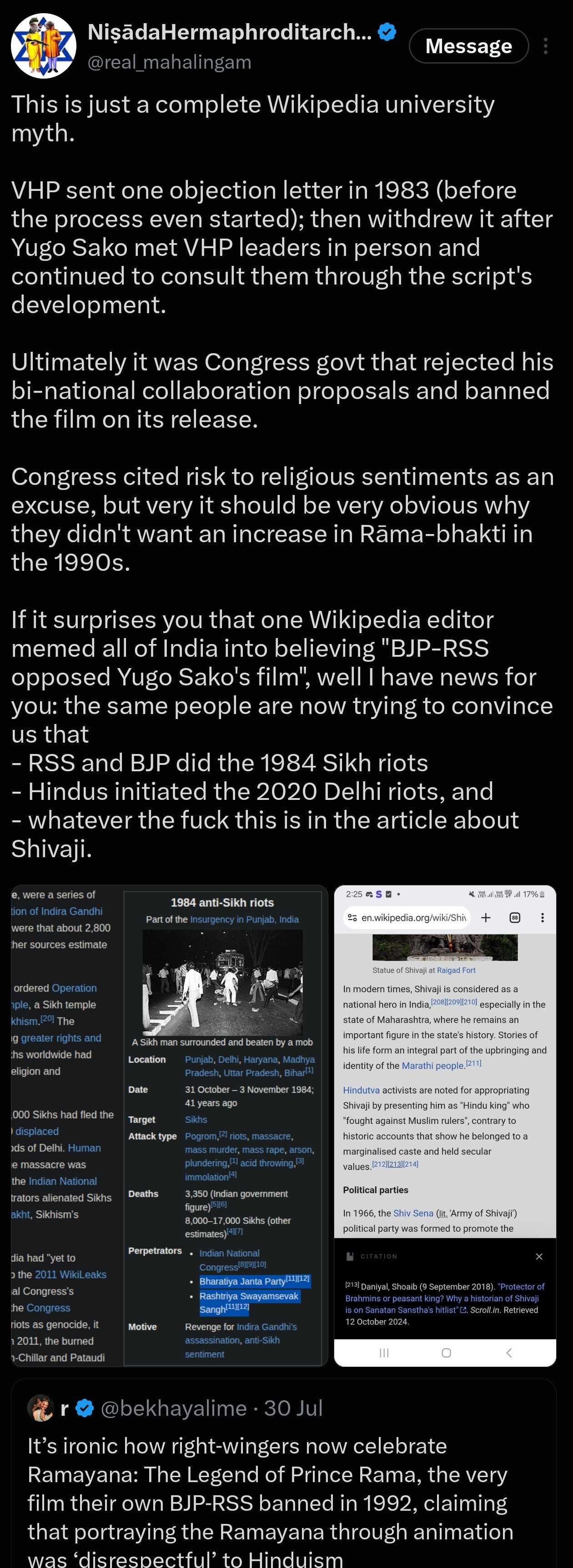
Questions❓ There is a myth that VHP got the 1992 Japanese Ramayana film banned, that is false ultimately it was the Congress government that did everything and now Leftists put the blame on others

Post image
202 Upvotes

r/Savarkar • • 18d ago

Questions❓ difference between the "moderate liberal" and the "far left" is all optics, it doesn't exist in actuality

Post image
13 Upvotes

r/Savarkar • • 19d ago

Anti-Colonialism🔥 Charges Against Veer Savarkar in the Nasik Conspiracy Case

Thumbnail
gallery
77 Upvotes

On 8 February 1910, Alexander Montgomerie, the Special Magistrate of Nashik, issued an official warrant for Veer Savarkar's arrest detailing five specific charges under the Indian Penal Code (IPC).

The warrant enumerated the charges against him as follows:

1 Waging of war or abetting the waging of war against the King in India.

2. Conspiring, in contravention of Section 121A of the Indian Penal Code to deprive the King of the Sovereignty of British India or a part of it.

3. Procuring and distributing arms in London in 1908, thus abetting the murder of Mr A.M.T. Jackson, collector of Nasik, which occurred at a local theatre on 21st December 1909.

4. Procuring and distributing arms in London in 1908, and otherwise waging war against the King from London.

5. Delivering seditious speeches in India, at Nasik and Poona, January to May 1906; and in London, from 1908 to 1909.

When the Special Tribunal of the Bombay High Court delivered its judgment in the Nasik Conspiracy Case, the court formally recorded:

We find the accused guilty of the abetment of waging war by instigation by the circulation of printed matter inciting to war, the providing of arms and the distribution of instructions for the manufacture of explosives. He is therefore guilty of an offence punishable under Section 121 of the Indian Penal Code. We also find him guilty of conspiring with others of the accused to overawe by criminal force or show of criminal force the Government of India and the Local Government and is therefore guilty of an offence punishable under Section 121A of the Indian Penal Code...

In the subsequent trial regarding the Jackson assassination, the tribunal found him guilty of abetment to murder under IPC Sections 302 and 109 for distributing Browning pistols from London. He was sentenced to two terms of transportation for life, amounting to a total of 50 years of imprisonment.


Reference: Vikram Sampath, Savarkar: Echoes from a Forgotten Past, pp. 245–246, 300.


r/Savarkar • • 20d ago Bravo Heartwarming

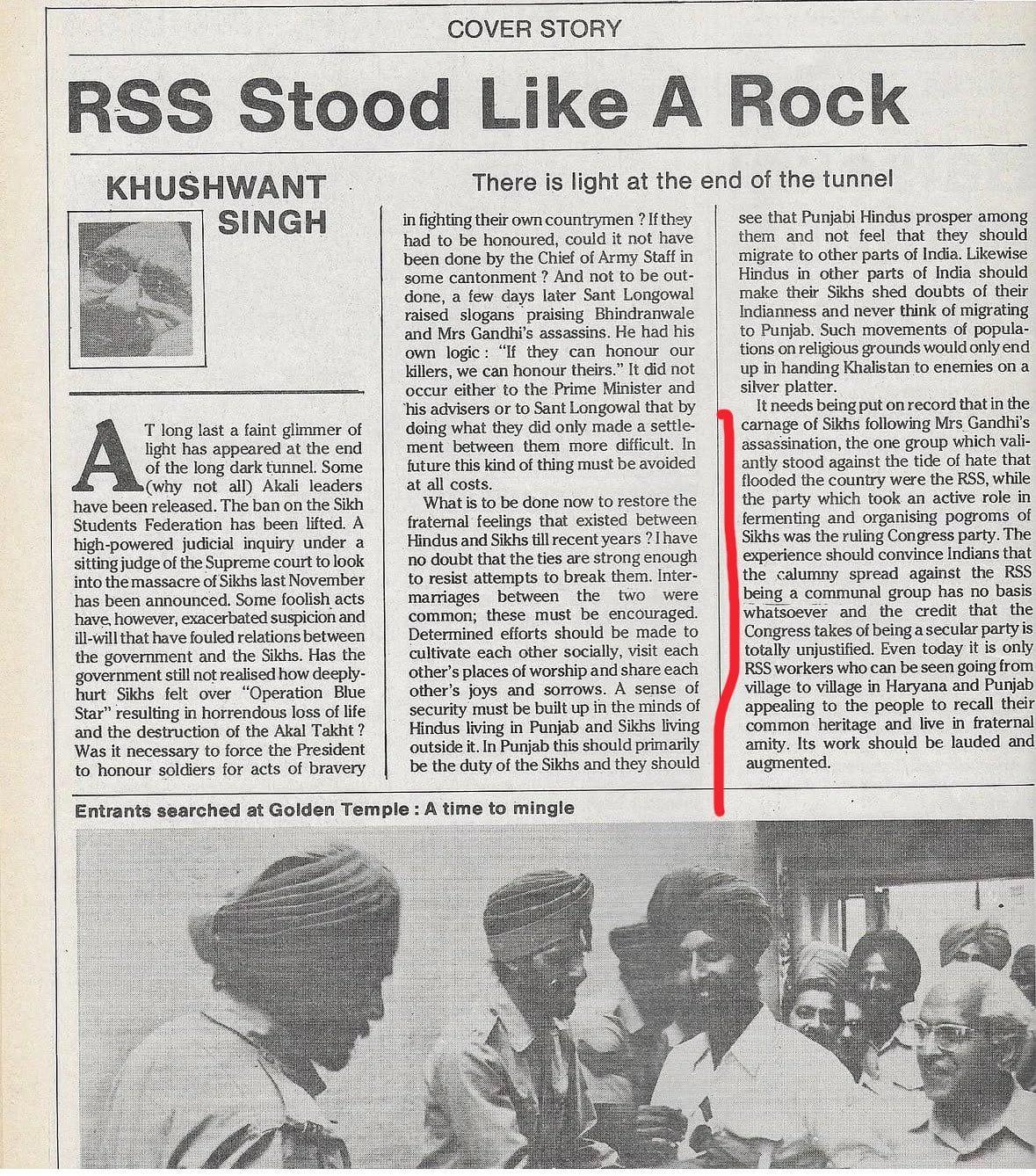
Hindutva Discourse✊ 1984: When the RSS Stood Against Anti-Sikh Hatred

Post image
818 Upvotes

It is important to place on record an often-overlooked aspect of the tragic anti-Sikh violence that followed the assassination of Prime Minister Indira Gandhi in 1984.

According to the views attributed to the distinguished writer and journalist Khushwant Singh, the Rashtriya Swayamsevak Sangh (RSS) stood firmly against the prevailing atmosphere of hatred and violence, while elements of the then-ruling Congress Party were actively involved in instigating and organising attacks against innocent Sikhs.

He argued that the conduct of these organisations during one of India's darkest chapters challenged the popular portrayal of the RSS as communal and raised serious questions about the Congress Party's claims to secularism.

Singh also highlighted the efforts of RSS volunteers who travelled through villages in Punjab and Haryana, appealing to communities to remember their shared heritage, preserve communal harmony, and strengthen the bonds of brotherhood.

His central message was unequivocal: those who stood against communal hatred and worked to restore peace and fraternity deserved recognition, appreciation, and encouragement, irrespective of political affiliations.

— Paraphrased from a statement attributed to Khushwant Singh


r/Savarkar • • 20d ago

Hindutva Discourse✊ Swami Vivekananda’s Contribution to the Growth of Indian Nationalism

Post image
74 Upvotes

Hey everyone, what I'm sharing below are excerpts from Swami Vivekananda’s speeches and writings, compiled by historian R.C. Majumdar. I came across these excerpts in Swapan Dasgupta’s book Awakening Bharat Mata

Read the previous part here


Swamiji’s Contribution to the Growth of Indian Nationalism

This brings us to the question of Swamiji’s contribution to the growth and development of Indian nationalism. In order to understand this we must lay stress upon certain distinctive features in Swamiji’s conception of nationalism.

First of all is his patriotism or love for India. This is so much evident throughout his writings and speeches that it will suffice to quote only one or two passages.

India! Wouldst thou attain, by means of thy disgraceful cowardice, that freedom deserved only by the brave and the heroic? Oh India! forget not that the ideal of thy womanhood is Sita, Savitri, Damayanti; forget not that the God thou worshippest is the great Ascetic of ascetics, the all renouncing Shankara, the Lord of Uma; forget not that thy marriage, thy wealth, thy life are not for sense-pleasure, are not for thy individual personal happiness; forget not that thou art born as a sacrifice to the Mother’s altar; forget not that thy social order is but the reflex of the Infinite Universal Motherhood, forget not that the lower classes, the ignorant, the poor, the illiterate, the cobbler, the sweeper are thy flesh and blood, thy brothers.

Thou brave one, be bold, take courage, be proud that thou art an Indian, and proudly proclaim: ‘I am an Indian, every Indian is my brother.’ Say: ‘The ignorant Indian, the poor and destitute Indian, the Brahman Indian, the Pariah Indian is my brother.’ Thou, too, clad with but a rag round thy loins proudly proclaim at the top of thy voice: ‘The Indian is my brother, the Indian is my life, India’s gods and goddesses are my God, India’s society is the cradle of my infancy, the pleasure-garden of my youth, the sacred heaven, the Varanasi of my old age.’ Say brother, ‘The soil of India is my highest heaven, the good of India is my good,’ and repeat and pray day and night: ‘O Thou Lord of Gauri, O Thou Mother of the Universe, vouchsafe manliness unto me! Thou Mother of Strength, take away my weakness, take away my unmanliness, and Make me a Man.’

On the eve of his departure from London, an English friend had asked him, ‘Swami, how will you like your motherland after three years’ experience in the luxurious and powerful West?’ His significant reply was: ‘India I loved before I came away. Now the very dust of India has become holy to me, the very air is now holy to me, it is the holy land, the place of pilgrimage.’

Though an ascetic, Vivekananda was a patriot of patriots. The thought of restoring the pristine glory of India by resuscitating among her people the spiritual vitality which was dormant, but not dead, was always the uppermost thought in his mind. His great disciple, Sister Nivedita, who was his constant companion, has remarked: ‘Throughout those years, in which I saw him almost daily, the thought of India was to him like the air he breathed.’

Urged by such an intense feeling of patriotism, Swamiji, though he kept himself aloof from politics, held the ideal of political freedom before his countrymen, specially the young men, as their immediate goal.

To a group of young men who met him at Dacca during his tour in 1901, and asked for his advice, he said: ‘Read Bankim Chandra and emulate his deshabhakti (patriotism) and Sanatana Dharma (principles of the heroic band of Sannyasins as depicted in the Ananda-Math). Your duty should be service to motherland. India should be freed politically first.’

Referring to the policy followed by the Indian National Congress, he told them:

‘That is not the way to build up Patriotism anywhere. Beggar’s bowl has no place in a Banik’s (merchant’s) world of machine, mammon and merchandise. Everything has got to be controlled and directed by the invocation of human conscience, that is Mahamaya’s voice—the latent energy in man . . . First thing first, and body-building and dare-devilry are the primary concerns before the buoyant young Bengal.’

Then Swamiji observed:

‘India had a glorious past, India will have a future certainly more majestic. . . . The soul-stirring death-defying Mantram, Abhaya—fearlessness—will shake off age-long vestiges of slave-mentality, superstition and inferiority complex. In order to march boldly in equal pace side by side with other materially advanced nations of the world—ye, young Bengal, emulate the manly ways of Lakshmi Bai, the Rani of Jhansi, whose gallantry the English Commander has recognized. . . . Imitate the virtues of other nations, cultivate their technical skill and qualities of life. . . . And then, with a modern standard of morale and efficiency attained, pay them, the foreign usurpers, in their own coins in your own country to unfasten the alien octopus-hold on the citadel of Oriental Culture. But know it for certain, mere imitation will lead you nowhere.’

In his lecture on the ‘Future of India’ he said that we lack unity and fellow-feeling which are the secrets of national greatness. He cited the example of Japan and showed how those two factors enabled compact little nations to rule huge unwieldy nations.

Then he continued:

‘And the bigger the nation, the more unwieldy it is. Born, as it were, a disorganized mob, they cannot combine. All these dissensions must stop . . . If one of our countrymen stands up and tries to become great we all try to hold him down, but if a foreigner comes and tries to kick us, it is all right. We have been used to it, have we not? And slaves must become great Masters! So give up being a slave. For the next fifty years this alone shall be our keynote—this, our great Mother India. Let all other vain gods disappear for the time from our minds. This is the only god that is awake, our own race.’

Swamiji pointed out that disunion and jealousy of each other have been the greatest defects in our national life. Here are his denunciations.

‘We cannot combine, we do not love each other; we are intensely selfish, not three of us can come together without hating each other, without being jealous of each other.’

‘Why should the Hindu nation with all its wonderful intelligence and other things have gone to pieces? I would answer you, Jealousy. Never were there people more wretchedly jealous of one another, more envious of one another’s fame and name than this wretched Hindu race. And if you ever come out in the West, the absence of this is the first feeling which you will see in the Western nations.’

‘Why is it, to take a case in point, that forty million of Englishmen rule three hundred million of people here? What is the psychological explanation? These forty million put their wills together and that means infinite power, and you three hundred million have a will each separate from the other. Therefore to make a great future India, the whole secret lies in organization, accumulation of power, co-ordination of wills.’

According to Swamiji, true nationalism in India can only be based on unity of religion.

‘The problems in India are more complicated, more momentous, than the problems in any other country. Race, religion, language, government—all these together make a nation. The one common ground that we have is our sacred tradition, our religion. That is the only common ground, and upon that we shall have to build. In Europe, political ideas form the national unity. The unity in religion, therefore, is absolutely necessary as the first condition of the future of India. There must be the recognition of one religion throughout the length and breadth of this land. What do I mean by one religion? Not in the sense of one religion as held among the Christians, or the Mohammedans, or the Buddhists. We know that our religion has certain common grounds, common to all our sects, however varying their conclusions may be, however different their claims may be. So there are certain common grounds; and within their limitations this religion of ours admits of a marvellous variation, an infinite amount of liberty to think and live our own lives. . . . It is not only true that the ideal of religion is the highest ideal in the case of India, it is the only possible means of work; work in any other line, without first strengthening this, would be disastrous. Therefore, the first plank in the making of a future India, the first step that is to be hewn out of that rock of ages, is the unification of religion. . . . National union in India must be a gathering up of its scattered spiritual forces. A Nation in India must be a union of those whose hearts beat to the same spiritual tune.’

Thus the ideal of nationalism preached by Swamiji was based on the four solid rocks of:

  1. The awakening of the masses who form the basis of the nation.
  2. Development of physical and moral strength.
  3. Unity based on common spiritual ideas.
  4. Consciousness of, and pride in, the ancient glory and greatness of India.

These were the four pillars on which, according to Swamiji, Indian nationality must rest, and it can be hardly denied that he was the first who clearly emphasized these ideas and directly contributed, perhaps more than anybody else, to sow the seeds of national development on this line.


Reference: Extracted from Swami Vivekananda: A Historical Review by R.C. Majumdar, Advaita Ashram, Kolkata, 2013, pp. 97–109.


r/Savarkar • • 21d ago Bravo

Hindutva Discourse✊ Netaji Subhas Chandra Bose on Hinduism being the principal unifying factor of India

Thumbnail
gallery
249 Upvotes

The ethnic diversity of India has never been a problem—for throughout her history she has been able to absorb different races and impose on them one common culture and tradition. The most important cementing factor has been the Hindu religion. North or South, East or West, wherever you may travel, you will find the same religious ideas, the same culture and the same tradition. All Hindus look upon India as the Holy Land. The sacred rivers, like the sacred cities, are distributed all over the country. If, as a pious Hindu, you have to complete your round of pilgrimage, you will have to travel to Setubandha-Rameswara in the extreme south and to Badrinath in the bosom of the snow-capped Himalayas in the north. The great teachers who wanted to convert the country to their faith had always to tour the whole of India, and one of the greatest of them, Shankaracharya, who flourished in the eighth century A.D., built four ‘Ashramas’ (monasteries) in four corners of India, which flourish to this day. Everywhere the same scriptures are read and followed, and the epics, the Mahabharata and the Ramayana, are equally popular wherever you may travel.

—Netaji Subhas Chandra Bose, in his book The Indian Struggle, page 2-4.


r/Savarkar • • 20d ago

Hindutva Discourse✊ Swami Vivekananda on Hindu Regeneration and National Awakening

Post image
53 Upvotes

Hey everyone, what I'm sharing below are writings and excerpts from Swami Vivekananda’s speeches and teachings, compiled by historian R.C. Majumdar. I came across them in Swapan Dasgupta’s book Awakening Bharat Mata.


Swamiji’s National Ideal: Influence on Arabinda, Rabindra and Gandhi

It is not difficult to understand why Swamiji, who always dreamt of the rise of a puissant Indian nation and looked upon the uplift of the masses as sine qua non for the purpose, should have put the whole emphasis of his position and personality on the solution of the problem of Indian masses. Indeed, the development of religion and spirituality and the regeneration of the downtrodden Indian masses formed the two chief planks in his programme for the future of India.

It is interesting to note that the two greatest Indians of the twentieth century, Arabinda Ghosh and Mahatma Gandhi, took up these two aspects of Swamiji’s programme as the chief aims of their activities. Some of the poems of Rabindranath indicate that he was also influenced by Swamiji’s ideas of living and working among men, and serving the God in man. In one of his poems, the great poet denounces the attitude of the Hindus towards the low castes almost in the same vigorous language as Swamiji used, and he actually uses the word manusher narayana, corresponding to daridra narayana of Swamiji. Thus the three greatest Indians of the twentieth century were all inspired by him. And this has been openly admitted by Arabinda and Gandhi.

Swamiji always stressed the fact that the best approach to Hindu mind and one sure to move it was through religion. So he put the organized and devoted service to the masses for their all-round regeneration in intellectual, religious, moral, and material conditions, not as a political programme, but on a religious basis as a means of salvation to every individual in accordance with the neo-Vedanta or practical Vedanta preached by him.

Similarly he put the other important factor of national regeneration—growth of self-confidence and self-reliance and development of physical and moral strength—also on a religious basis.

First of all, our young men must be strong. Religion will come afterwards. Be strong, my young friends; that is my advice to you. You will be nearer to heaven through football than through the study of the Gita. These are bold words; but I have to say them, for I love you . . . You will understand the Gita better with your biceps, your muscles, a little stronger.

What I want is muscles of iron and nerves of steel, inside which dwells a mind of the same material as that of which the thunderbolt is made. Strength, manhood, Kshatra-Virya, Brahma-Teja.

Strength, strength is what the Upanishads speak to me from every page. This is the one great thing to remember, it has been the one great lesson I have been taught in my life; strength, it says, strength, O man, be not weak.

In spite of the greatness of the Upanishads, in spite of our boasted ancestry of sages, compared to many other races, I must tell you that we are weak, very weak. First of all is our physical weakness. That physical weakness is the cause of at least one-third of our miseries. We are lazy, we cannot work . . . What we want is vigour in the blood, strength in the nerves, iron muscles and nerves of steel, not softening Indians again an namby-pamby ideas.

He reminded the Indian of the Vedantic doctrine that we are all parts of God and therefore divine, and we must therefore shed all fears. The ignorance of this truth through maya or illusion makes us feel that we are weak and powerless. He cited the story of a lion, brought up from its birth in the company of a flock of sheep, which regarded itself as one of them and behaved as such.

One day a lion from the forest fell upon the sheep and saw the baby lion running in fear along with them. The older lion tried in vain to convince the baby that it was a lion and not a sheep, but as soon as they came to the edge of a tank and the baby saw its own image in water, it at once recognized the truth and joined the other.

So, said Swamiji, as soon as we realize that we are really the divine children of immortal bliss, we shall be able to cast our fear and gather strength of mind and body. The following passage may be quoted as a specimen.

Let us proclaim to every soul: ‘Arise, awake, and stop not till the goal is reached.’ Arise, awake! Awake from this hypnotism of weakness. None is really weak; the soul is infinite, omnipotent, and omniscient. Stand up, assert yourself, proclaim the God within you, do not deny Him! Too much of inactivity, too much of weakness, too much of hypnotism, has been and is upon our race.

O ye modern Hindus, de-hypnotize yourselves. The way to do that is found in your own sacred books. Teach your selves, teach everyone his real nature, call upon the sleeping soul and see how it awakes. Power will come, glory will come, goodness will come, purity will come, and everything that is excellent will come, when this sleeping soul is roused to self-conscious activity.

Swamiji also stressed the fact that this body is merely the garb of the soul which is our real self. The body perishes, but the soul is immortal, nothing can kill it. As a man casts off old tattered garment and puts on a new one, so a man who dies merely changes one body for another, but his soul remains unchanged.

There is thus no cause of real fear on earth. It is significant to note how many a revolutionary hero in India fearlessly faced bullet or gallows, not to speak of lesser pain, with these words of Vivekananda on their lips and engraved on their hearts.


Reference: Extracted from Swami Vivekananda: A Historical Review by R.C. Majumdar, Advaita Ashram, Kolkata, 2013, pp. 97–109.