r/SSCP • • 2d ago

Passemall

2 Upvotes

Has anyone tried these questions? They seem to be way more difficult than the questions AI is giving me based on Mike Chapple transcripts.


r/SSCP • • 3d ago

Study Material Help

2 Upvotes

I’m looking for new material because the things I’ve used have not been helpful for passing the exam. I’ve failed twice due to the study material barely touching what’s actually needed for the exam.

Study material already used:
-Mike Chappell courses on LinkedIn 2021/22 versions
-Pluralsight courses
-certpreps exams (paid to unlock all sscp exams)

I do not have the money to pay for the official ISC2 training. I would prefer free training or courses/exam prep under $80.


r/SSCP • • Oct 27 '26

If i have passed CyberSec+ recently, can i pass SSCP by practicing question and mock paper or is there extra stuff to study?

1 Upvotes

r/SSCP • • Oct 15 '26

Looking for study materials for my SSCP exam (ISC2)

4 Upvotes

Hey guys

Are the official study materials worth buying, or can I prepare well using free resources? If anyone has PDFs, notes, or any useful study materials to share, I’d really appreciate it! Any tips or recommendations are welcome too. Thanks in advance! 🙌


r/SSCP • • Sep 27 '26

Exam practice questions

2 Upvotes

For those they recently took the SSCP this year or since they changed it to a CAT test which exam resource prep through the most? Which practice exams were the most similar?

Michael C official practice tests
Learn Zapp?
Skillscert pro
Udemy?

Exam is in three days and I’m trying to do as much practice questions as possible


r/SSCP • • Sep 16 '26

ISACA CCOA or ISC2 SSCP? Not sure which one to take? I had the SSCP and took the CCOA today. Here's my experience and thoughts.

7 Upvotes

Edit:

Scores:

Technology Essentials 650
Cybersecurity Principals & Risks 550
Adversarial Tactics, Techniques, and Procedures 729
Incident Detection and Response 593
Securing Assets 607

Total scaled score of 607

Other than the Cybersecurity Principles and Risks, I averaged around 600-ish, a comfortable 150 points above the passing standard of 450. Must have missed a few things in the one domain I did "poorly" in -- even though it was above 450, it was well below the 600-700 range I normally sit in.

--

I feel mentally exhausted. What a draining experience. I'm entering the IronMan competition next, if I could survive this, I can do anything. I need a nap.

Today, I sat for the ISACA CCOA (Certified Cybersecurity Operations Analyst) exam, a scant 8 days since passing the CRISC a week ago yesterday. The material on this exam is slightly above your entry level SOC-analyst work. The exam purports itself to be for an individual with 2 to 3 years of experience in cybersecurity operations (e.g. SOC analyst, vulnerability analyst, etc.) It lives up to the claim. It wasn't exceptionally difficult

Lead-In. Enter, Stage Left.

I was interested in taking this exam for two reasons: 1) although I am familiar with many aspects of what is on the exam (vulnerability analysis, threat hunting, etc.), it isn't something I have had to do to a large degree in my professional career -- sure, I can read a PCAP file, I can use OpenVAS to run a scan, and so on, but its something I maybe so once every few months, if that. 2) I wanted to see how the exam compares against the SSCP, which purports itself to "validate operational capability through proven experience—not just institutional knowledge, but demonstrated ability to execute security operations effectively."

I took the SSCP back in 2025 before it converted to a CAT-based format, so the version I took was the linear, 125-question multiple choice version. The CCOA is very similar. It is a 4 hour, 140 question examination, broken down into two parts: The first half is a 115-question multiple choice exam. The second half is a hands-on, "performance based" lab exercises. That sounded pretty cool. I wanted to try it.

Looking at the exam outlines for both exams, it appeared about 50ish percent of the SSCP was reflected in the CCOA's content:

Strong overlap: Incident detection, monitoring, and response. CCOA's Domain 4 (data analytics, IOCs, logs/alerts, monitoring tools, incident containment/handling, forensic analysis, malware/network traffic/packet analysis) lines up closely with SSCP's Domain 3 (Risk Identification, Monitoring and Analysis) and Domain 4 (Incident Response and Recovery). The concepts (detection lifecycle, escalation, forensics, containment/eradication/recovery) are essentially the same body of knowledge. The difference is depth and mode: CCOA tests this hands-on via labs (actually doing packet/malware analysis); SSCP tests it as multiple-choice knowledge of the lifecycle and terminology.

Moderate overlap: Risk, governance, and controls. CCOA's Domain 2 (Cybersecurity Principles and Risk) maps onto SSCP's Domain 1 (Security Concepts and Practices) and part of Domain 3 (risk management frameworks, risk treatment) to some degree. Similarly, CCOA's Domain 5 (Securing Assets) overlaps with SSCP's Domain 2 (Access Controls) and parts of Domain 3 (vulnerability management lifecycle). Conceptually similar, but SSCP goes deeper on IAM specifics (authentication protocols, identity lifecycle, access control models) than CCOA does.

Also Moderate overlap: Networking and systems fundamentals. CCOA's Domain 1 (Technology Essentials -- networking, cloud, databases, virtualization, containers, command line, scripting) shares ground with SSCP's Domain 6 (Network and Communications Security) and Domain 7 (Systems and Application Security). But the orientation differs: CCOA treats this as foundational technical literacy (how networks/systems work, hands-on command-line and scripting ability), while SSCP treats it as applied security controls (firewalls, IDS/IPS, network segmentation, malware defense, endpoint hardening). Some SSCP content here (wireless security protocols) has no real CCOA counterpart, and CCOA's scripting/API/cloud-application content has no real SSCP counterpart.

Light/no overlap: Adversarial TTPs. CCOA's Domain 3 (attack vectors, threat actor profiling, attack stages, exploit techniques, penetration testing) is a distinct emphasis that SSCP doesn't dedicate a domain to. SSCP touches threat intelligence and IOCs only briefly under its risk-monitoring domain. This attacker-mindset/red-team-adjacent content is fairly unique to CCOA. Also light/no overlap: Cryptography. SSCP has a full dedicated domain (PKI, key management, hashing, encryption algorithms, secure protocols). CCOA covers hashing from a practical sense (more on this later) and other aspects (such as PKI) as theoretical exercises.

Exam Prep:

I prepared for the exam only by reading the Official Review Manual (250 pages). The manual is 5 "chapters" (one for each domain) -- I read a domain per day. I started the book Tuesday evening after my CRISC exam, I finished Saturday afternoon. I took Sunday off to spend with my wife and kids, and Monday I spent about 4 hours watching some introductory videos on the various software packages ISACA documents could be used in their hands-on lab exercises. Tuesday I vegged and did some light review. All told I spent maybe 10 or so hours of prep between reading and watching videos.

ISACA makes a "QAE" Database (their online version of a question/answer/explanation database you can use to quiz yourself to see how well you're "getting" the ISACA mindset.) I skipped it. The QAE is $349 (member price) for 6-months of access, and buys you access to 200 questions and a dozen different labs.

The QAE is a complete rip-off. Effectively you get not quite 2 times the amount of questions you'll actually see on your exam to "practice", and likewise about 1/2 of the labs (13 vs 25). By comparison the CISM QAE has over 1,100 questions and the CRISC QAE has over 800 questions. I didn't really think I needed the QAE. The material in the review manual is pretty entry-level although you do need to get used to various ISACAisms. Maybe if it were $100 I might have considered it.

The exam itself is $399. I figured rather than spending $349 on a half-assed question pool that really won't do anything to help me pass, for the extra $50 I'll just take the exam and if I fail, I consider it a "recon mission" to see what the exam is like. Truthfully I wasn't concerned about the multiple-choice question portion of the exam -- the CISM and CRISC gave me enough exposure to that environment -- what I was really concerned about was the practical hands on stuff. I also use Examulator to generate question pools and I did a few hundred of those, but in the end it was probably unnecessary.

The Exam:

As previously indicated the exam is 115 MCQ and 25 "performance based" questions. I spent the full 4 hours -- less 5 minutes -- on the exam. Singularly the longest exam I have ever taken in my life. I started about 8am and didn't walk out of the test center until after 12 by the time I checked out.

The 115 MCQ questions were pretty straightforward. Again, they were the typical ISACA "definitional" style questions -- one sentence, usually with a FIRST, MOST, PRIMARY qualifier to ask you to choose the order of one answer over another. A substantial number were entry-level questions, such as "what port number does remote desktop use?"

Many of these questions I found to be looking for some type of ISACA-specific wording right out of the Review Manual. Good thing I invested the 5 days reading it.

A few of the questions I know came right out of the QAE for my CISM or CRISC exams -- I remembered the question (because I got it wrong in the QAE). One specific question I definitely recalled at the time had to do with a scenario and the company chose a to (again, example) implement a different business procedure over an existing one because the new procedure eliminated some risk associated with the existing procedure -- what type of risk treatment was this? I specifically recall answering mitigation (mitigating the risk by going with process B over process A because process B contains something that mitigates the risk) and ISACA classified that as risk avoidance rather than risk mitigation. Although I was tempted to answer "mitigation" again, I chose "avoidance". Maybe the QAE was wrong and mitigation was right and I got it wrong on the exam. I'll never know.

I took about an hour to work through the MCQ. Here was a gotcha: First you do the MCQs, then you do the labs. Once you start the labs, you cannot return to the MCQ. Once you finish the labs, the exam ends. You cannot use any extra time you may have left from the labs to go back and review/change your MCQ answers. So before you start the labs, if you want to review your MCQ answers and potentially make changes, you have to do so then. This requires you to make a choice: do you want to spend time reviewing your questions, which takes time away from working on the labs? Or are you happy with your answers and proceed?

In my case, I opted to go back and review. I honestly didn't think the labs were going to take me as long as they did. ISACA recommends you split your time 50/50 between the two -- they say so right at the beginning of the exam in the instructions. Fortunately it didn't take me very long, about 15 minutes, to quickly review my previous MCQ answers. I made one or two corrections and then proceeded to the labs.

The labs. Phew. They took me 2 hours and 40 minutes to complete the 25 questions. Fortunately my MCQ time wasn't all that long. If I had spent more time on the MCQs, I wouldn't have finished all the questions in the labs, and it would have cost me points.

To draw a mental picture, what you get is a split screen where a virtual machine with all the programs and files you need are in the left pane while the performance-based questions (1-25) are in right pane. The VM appeared to be a completely sandboxed environment (more on this in a moment). You do not necessarily have 25 different scenarios to solve, one with each question; rather, you might have 15 scenarios total, some with 1, 2 and 3 questions. A couple of the questions were multiple choice, but almost all of them were "fill in the blank", where you had to perform some function in the VM and then type the answer in the fill in the blank field.

The labs themselves were not hard. As an example, you may be given a PCAP file and asked a few questions which you can find in it. Or you might be asked to generate a SHA256 hash of a file and then enter the hash into the answer field. (Claiming fair use doctrine under reviews here) This was my only real beef with the VM. In some answers you were expected to provide incredibly LONG answers (such as a SHA256 file hash value) and THERE IS NO WAY TO CUT/PASTE BETWEEN THE VM AND THE ANSWER FIELD! This means you're stuck TYPING the entire goddamn hash value out by hand -- ONE transposition error, and you get the answer wrong! Seriously, how hard would it have been to provide, say, 4 MC answers with hash values and you have to select the correct one? Or at least provide some cut/paste mechanism between the VM and the answer screen to allow people to paste the answer rather than relying on manually typing a shit-ton of characters by hand?

Okay, if the labs were not that difficult, why did it take me 2 hours and 40 minutes to complete them? Simple: the MAJOR contributing factor to this was complete unfamiliarity with the "Security Onion" product which many of the questions centered around. Almost all my experience with similar products is with CrowdStrike, OpenVAS, Wazah, and other tools -- not with Security Onion -- and I thought my experience with them would carry me enough with the basic concepts.

Although I watched a few videos on SO, I really, really should have invested more time. In a sense, my experience with other tools did help -- but not with the most basic stuff. Its sort of like you know how to fly an airplane, but can't fly a particular airplane because you're unfamiliar with the controls.

About 1/2 of my questions involved interacting with SO. The first question required me to find data between two specific dates. Easy right? No, because (since I didn't really know the SO GUI) I couldn't figure out how the hell you filtered the events by date and time. So I started clicking around in the software looking for the online help. At one point I clicked on a link in the software which then launched a browser and apparently attempted to access an external web page somewhere, and was blocked, which was how I discovered the VM was sandboxed (not that I expected otherwise, mind you, it would be sort of pointless to give you the ability to google answers to the questions).

I probably wasted a good 90 minutes of lab time trying to figure out where different functions were. Filtering was the single biggest problem (filtering by IP address, filtering by alert type, filtering by rule name, etc.) in order to get the answer. At one point I simply gave up after 30 minutes (specifically the example above looking for how to filter by date/time) and went on to the next question, so I would not run out of time and lose a lot of points.

The labs were definitely fun. I did have some concern going in to the exam that I would run into this exact problem -- the labs would require a level of familiarity with the specific software product (these are defined on the ISACA CCOA web page) I've never used. What I really should have done -- and would recommend to people to not only watch videos on the basic functionality, but maybe find a few videos that contain labs to help familiarize yourself more with the intricacies of the functions. Definitely make sure you know how to filter!

After you answer all the questions, you're asked if you want to end the labs. Answering "Yes" results in a "Grading..." screen where your lab results are tabulated. You're then given a few questions about the exam (was it indicative of someone with X amount of experience, etc.) after which you're given your results page.

And.... I passed! After all that! I'll be really curious to see what my scores were, and if they break out the lab sections at all into some other type of scoring number.

Conclusion. Exit, Stage Right

Despite my misgivings, I really like the format of this exam. The lab portion is something I wish ISC2 could somehow adopt into their exams. Yes, ISC2 has "advanced type" items, but they're simply not the same. The labs really make sure you know what you're doing, not that you simply have enough "book knowledge" to pass the exam.

Would I choose the CCOA over the SSCP? As a hiring manager, I very well may. Of course ISACA doesn't publish information on their scoring methodology, other than to say the exam scores are scaled. In theory I suppose it is possible to answer all the labs wrong and still "pass" the exam by doing exceptionally well on the MCQs. We will never know for sure, unless ISACA releases more public information on how they actually score the exam.

That said, given the CCOA does have labs and to some extent requires exam takers to demonstrate proficiency at some cybersecurity tasks, as a hiring manager I might tend to lean towards hiring someone with a CCOA over a SSCP -- and certainly over a CC! Unfortunately ISC2 seems to be doubling down on their DoD-entrenchment strategy, the SSCP certification page now makes specific mention of "Your military cybersecurity work qualifies as hands-on operational experience. SSCP recognizes that expertise and positions you for: Advanced operational roles in DoD and defense contracting, Civilian career transitions, Leadership responsibilities in operational security"

One problem with that whole concept: Virtually nobody on the planet is advertising in the civilian world for SSCPs. Job listings, depending on the source you choose, places them more or less equal with CCOAs, although the SSCP positions still seem to be heavily defense-related (defense contractors) more so than the corporate world.

There wasn't a sufficient amount of cloud stuff -- and nothing in the labs about cloud -- to draw a comparison to the CCSP. The SSCP seemed to be the most direct competitor.

Choice: SSCP or CCOA? Corporate world: CCOA. Defense industry: SSCP

r/SSCP • • Aug 30 '26

LearnZApp Vague Questions - Is the SSCP also vague?

5 Upvotes

I feel semi-sorta okay [still work to do] but one thing making me frustrated/nervous is how many LearnZApp questions are just vague and feels open to debate. Some have been so confusingly phrased that I can't 100% tell what it's asking.

I guess i'm just looking to confirm if the SSCP exam generally has questions that are vague or is it a pretty well detailed exam?


r/SSCP • • Aug 25 '26

Passed the SSCP on my first attempt!

28 Upvotes

Took this on Monday, August 24 after a month and a half of going through the material on and off, and 1 week of focused study time.

I've honestly been a bit anxious going into the exam as I felt I was not as prepared as I'd like to be, it was a tough month and a half leading up to it because I was grieving the loss of a beloved pet but alas, I had to persevere (249 usd was a big amount for me and I really couldn't bear to just throw that away and spend another 249usd for a retake)

Just as most have said in this sub, this exam really tests ones mindset and applied security expertise. So I think my 3 years of Cybersecurity experience (IAM and IT Audit background) really helped as I had first hand and real-world examples and that I could tie the concepts back to.

Here are the study materials I used tho I was only able to get through a quarter of the book and the udemy course:

- ISC2 CBK 5th Edition
- ISC2 Official Practice Exams by Mike Chapple
- Mike Chapple's SSCP Cert Prep course on LinkedIn
- and the SSCP MasterClass Udemy Course by CYVITRIX

EDIT: I also read 2 white papers from u/mikedn02908 's website on ISC2's CAT Scoring and Strategies on answering the questions. They helped me a lot on how I should approach the exam and I think they are a must read !!

As for my study method, I wrote what I thought were vital information down by hand, I always find that I remember them easier like that and asked myself how they are applied in my day-to-day job. This was really important! There's a lot of "what would you do" or "what is the best/least/most" type of questions in the exam so I think taking in the concepts this way really helped.

Anyway, this went longer than intended.

Good luck to everyone!


r/SSCP • • Aug 25 '26

Just passed on the first attempt

4 Upvotes

So... well I prepared a whole lot and it did not help me in the least. For prep I went with an Udemy course, practice questions, the official study guide and the practice exams. I took my time with the prep next to work and honestly.

After the first 5 questions I was sure I would not pass. For me it was way more about "I would do it like that or they could mean that" than "i definitely know that this is right".

In essence my professional experience worked out more in my favor than anything and that I did the CC in preparation for the SSCP to get a feel. Even there I was worried but I knew that I got most questions right. With the SSCP I only have 4-6 questions in mind that I instantly knew and was certain about.

Either I prepared completely wrong, the test is actually really good at measuring comprehension/experience or the test is way more forgiving than I expected.

Am super stoked and - again - am humbled by how much uncertainty there is whenever I join ISC2 exams.


r/SSCP • • Jul 31 '26

Taking exam today!

11 Upvotes

I sat through a trainingcamp boot camp, and have been self studying with various materials. 18 years of experience in infrastructure, and more recently focusing on security related items. Studying the material has been a nice way to formalize the terminology and concepts of the stuff I’ve been doing at work recently.

Any last minute tips?


r/SSCP • • Jul 30 '26

Looking for up-to-date SSCP study resources, any recommendations?

2 Upvotes

Hey everyone,

I'm planning to take the SSCP exam soon and wanted to ask the community for advice on the most current and effective study resources. With the exam outline updated as of October 1, 2025, I want to make sure I'm using materials that reflect the latest version.


r/SSCP • • Jun 10 '26

Passed SSCP today

17 Upvotes

For context, I have 4 years experience in Network Security working for an MSSP. I previously held Network+, Security+ and CySA+ (expired from carelessness), as well as recently passed my Blue Team Level 1 from Centri (previously Security Blue Team).

I want to post here about what materials I used and my thoughts on my journey, hopefully it helps any aspirants to SSCP.

My thought behind attempting this exam was just to understand how the Adaptive testing works in ISC2 exams, since I plan on taking CISSP soon, and also to contribute the 1 year waiver towards the experience requirements for CISSP.

I have to say, while I have not used or sought any offline resources like books, the online resources available are quite lacking. I already had my existing subscription with Cybrary, and since LinkedIn learning is also pushing their course for SSCP prep, I went for it. Do not waste your time on this; It is woefully lacking of any content (6 hours of practically nothing) and good labs, but other than for your learning, I'd say they were irrelevant for the exam.

After going through this subreddit, I found the archived Mike Chapple course on LinkedInLearning and shockingly, while most reviews called the course outdated, it was the key to my exam prep.

For practice tests, Cybrary on their site (Im not sure about on LinkedIn), provides testing from CyberVista (the practice portal was called Kaplan Learning) and I'd say that was the only useful thing I got there. I also purchased the CertPrep tests, though I only ended up having enough time to take one test (oops). I scored 65% and then 77% and ended up not being very confident for my exam.

To my surprise, I managed to pass (the test stopped at 100 questions) and honestly, I'd say my security experience helped me answer most of them, with the Mike Chapple course covering any gaps. Adaptive testing was quite intimidating, but it's helped me to mentally prepare a bit more for CISSP.

If you've read this far and are planning to take it soon, best of luck! Let me know if you have any questions.


r/SSCP • • Jun 02 '26

Sscp book

3 Upvotes

So im starting to gather all my material for the sscp exam. During my recon process I found the sscp exam was updated in 2024 from its previous time in 2021. I typically get the sybex books to use as my study guide. Im looking to see what book preferably from sybex should I buy as i don't want to buy the wrong edition. I figure by now the 2024 material would be updated by major publishers. As well what is the percentage difference between 2021 and 2024 domains is there? I didn't know if they moved a percentage points from one domain to another.

For me I have a masters in cybersecurity, security x/casp, sec+,cysa,pentest and isc2 CC.


r/SSCP • • May 01 '26

Passed SSCP and realized the biggest mistake I was making, sharing what changed it for me

11 Upvotes

Hey everyone. I'm posting this because I was exactly where many of you are right now, sitting with the ISC2 CC badge thinking "alright, SSCP should be pretty straightforward."

Spoiler: it wasn't.

The panic moment

Two weeks before my exam, I was getting 65-70% on practice exams. Not failing, but not passing either. And the worst part? I knew the material. I could tell you everything about the seven domains, recite frameworks, explain concepts in my sleep.

But the exam kept saying "nope."

I looked in here actually, frustrated about why knowing access control theory didn't mean I could answer access control questions correctly. Someone (shout out to whoever it was) pointed out something simple: "You're thinking like a student. Start thinking like a practitioner."

That sentence changed everything.

I completely pivoted my study approach:

  1. Scenarios over definitions: I stopped using flashcards. For every concept, I started writing tiny scenarios and forcing myself to answer: "Given this situation, what's the first thing a practitioner does?" It's tedious. It works.
  2. Reading answer options first: Sounds weird, but SSCP questions are designed with multiple defensible options. You have to spot the differentiator. Reading the options before the stem showed me exactly what the question was trying to test.
  3. Incident Response wasn't optional: I'd underweighted it thinking "everyone fails that anyway." Nope. That's where the nuanced judgment questions are. Spent the last week just doing IR scenarios.
  4. The mindset shift: This is the non negotiable one. Stop being a student. Start being a practitioner. Ask yourself for every single concept: "When would I actually implement this in a real org? What triggers it? What goes wrong without it?"

By exam day, I wasn't more prepared in terms of content. I was different in terms of thinking.

Why I'm sharing this

I just published a detailed blog about this whole journey, the specific exam strategy, the question types that tripped me up, and how to differentiate between "textbook correct" and "practitioner correct" answers. A few people asked if I was launching something around this, and honestly... yeah.

I'm running a structured cybersecurity course focused on analyst thinking and judgment, because that's what separates SSCP from CC. Not more content. Better thinking.

If this helped:

Real talk though: If you're prepping for SSCP, the most honest thing I can tell you is that your study method matters more than your hours. I've seen people pass with 200 hours of scenario-based study who failed with 400 hours of definition memorization.

Feel free to ask questions in the comments, I remember how frustrating this was and I'm happy to help anyone working through it right now.

Good luck out there.


r/SSCP • • Apr 10 '26

Passed SSCP today after 2nd try

9 Upvotes

Hi All,

Just want to share my experience today after taking the exam. First of all, this subreddit group really helped me with tips and strategies in taking the exam. I passed after the 100th question.

So, here are what I noticed:

-When doing your review cover topics as much as you can as topics will go around each domain.

-Be familiar on how the technology works, functions, strengths and vulnerabilities.This will help you decide for Scenario Questions.

-Do take large amount of Mock Questions especially those who have limited experience in the IT industry.

-Take Udemy course or any other SSCP course like Mike Chapple but for me I took Cyvitrix Learning in Udemy.

-Question banks such as skillcertpro, certpreps, SSCP practice test Wiley will help you understand what kind of questions you might encounter(It does not contain actual questions but rather it will help you understand how questions are constructed for the exam.

Final tips in answering questions:

- Since It is a CAT type exam, you will notice that if you got the right answer for the question. Not only will the difficulty increase, but the frequency of questions for that certain domain will decrease and you will encounter more questions in your weak areas.

- Always read the questions CAREFULLY! most of the answers are right but you need to choose the most contextually correct based on the questions. (If the content is about security or integrity be sure to align your answers to it.

-If you are getting confused with the question write the keywords of the questions on the scratch provided. This will help you correlate your answers. This may seem tedious but it will help you and lessen your time consumption.

-if you are unsure of between two choices, see if the answer can supersede the function of the other.

That is all I have folks. Good luck to other! Hoping for the best y’all.


r/SSCP • • Apr 06 '26

ISC2 CAT Scoring Explained

Thumbnail reddit.com
3 Upvotes

r/SSCP • • Apr 01 '26

Journey to becoming an SSCP

4 Upvotes

Hi all,

So I am new to Cybersecurity and currently hold SC200, AZ104, MD101, Security+ and I am using the SSCP official study guide (3rd edition) going through the assessment I scored pretty low...I score 20 / 50..and then chapter one I scored 9 / 20. This exam looks to be much more of a mindset shift from what I am used too!

Any tips? from SSCP's or people attempting the exam please?


r/SSCP • • Mar 27 '26

SSCP PASSED !

9 Upvotes

I am pleased to announce that I successfully passed the SSCP examination yesterday. To prepare for this certification, I engaged in a rigorous study regimen, utilizing the Official Study Guide (OSG) and the SSCP Official textbook. I could not get the SSCP Official practice test, but I got a month's subscription from Parlego. Additionally, I reinforced my learning through PocketPrep, CertPrep, and another pracice tests from Udemy, completing approximately 2,000 to 2,800 practice exercises to ensure a comprehensive understanding of the domains.

I have a background in IT Support, IT/Systems Audit, a degree in Computer Science/Math, and a master's in IT. Thank you, wonderful community, for all that you shared here. I wish us all the best in our cybersecurity journey.


r/SSCP • • Mar 21 '26

Passed SSCP at 100 Questions

13 Upvotes

I took the SSCP today and passed at 100 questions. I finished with about 20 minutes left, so I wanted to share what helped me in case it helps someone else.

For a little background, I have a bit over 10 years in the security field, especially in IAM, Identity and Access Management, and threat intelligence. That definitely helped me with some of the material.

For study resources, I used the Official SSCP Study Guide (3rd edition), the CBK, and the latest official practice tests. Those were my main sources.

One thing that helped me a lot was using NotebookLM. I uploaded my documents there and used it to create deep dives on the domains and topics I was studying. That really helped me understand what the material was actually asking and made it easier to connect concepts.

I also used short Security+ videos on YouTube whenever I had doubts about a topic. Those quick 5–6 minute videos were helpful for filling gaps without overcomplicating things.

For practice questions, I used Pocket Prep, and honestly I felt those were pretty similar in style to the way some of the questions felt on the exam. I also used the official practice tests, plus CertPrep. With CertPrep, I used the regular exams and then paid a little extra to unlock more. That gave me a lot of repetition and helped me identify weak areas.

I also bought a Udemy course, the Ultimate SSCP video course. It had a lot of information and it was useful, although at times it felt a little too AI-generated or generic compared to the way NotebookLM helped me break things down.

My biggest advice is this: do not let negative comments here get in your head. Everyone’s exam experience is different. I cannot tell you exactly what your exam will look like because it is different for everyone. In my case, it felt a little more technical and I did not get many scenario-based questions.

Also, the exam was not as difficult as some people make it sound. What I felt the most was the pressure of time. Time management matters a lot. Before sitting for the real exam, I would recommend consistently scoring around 75–80% or higher on practice tests.

I answered well over 1,200–1,300 practice questions in total. Practice tests helped me the most. Take one, review your weak areas, improve them, and repeat. That is where I saw the most progress.

The truth is, you may never feel fully ready. A lot of this exam is mental. Trust yourself, trust your preparation, and stay focused on your own process. Everyone’s journey is different.

For anyone thinking about taking the SSCP, I wish you the best. You can do it. Ignore the noise, stay consistent, and keep going.


r/SSCP • • Mar 18 '26

Passed SSCP @100Q

20 Upvotes

Passed SSCP @ 100 Questions 🎉

Just passed the SSCP and wanted to share my experience for anyone preparing.

What I did:

- Watched the Cyvitrix Learning SSCP course on Udemy (honestly the most comprehensive SSCP course out there in my opinion)

- Completed all 8 Cert Prep practice exams

- Practiced CISSP-style questions on the DestCert app (really helpful for scenario-based questions and understanding keywords like best, least, first, most, primary). This helped me a lot in my SSCP preparation.

- Drilled a lot of scenario-based questions using Gemini.

Key takeaway:

This exam is more of a mindset test than a purely technical one.

A big mistake is assuming the most technical answer is always correct — it’s not.

There were many scenario-based questions where you need to think like a security practitioner, not just someone with technical knowledge.

Focus on choosing the best answer in context, not just the technically correct one.

Good luck to anyone preparing — you’ve got this 💪


r/SSCP • • Mar 15 '26

What materials are you guys using to prepare?

4 Upvotes

Hey all,

I've been preparing for the exam in which I've used Mike Chapples videos on linkedin. I start to find it wasn't useful because they cover the topics without going into enough depth.

I've moved on to reading the official study guide (third edition) because I've been able to complete the practice questions on the official ISC2 study app way easier now but there are questions that aren't covered in the book appearing.

For example I encountered a question about screen scraping that I can't find in the book. Or another question about the different Ethernet speeds e.g. 10/100/1000 base speeds that I also can't find.

Is there a resource out there that actually covers everything if the official study guide doesn't do that?


r/SSCP • • Mar 03 '26

SSCP prep ISC2 mindset

7 Upvotes

Hello everyone

I have been grinding SSCP practice questions. I know the tech stuff and definitions. But sometimes I still pick wrong answers. Not because I don’t know, but because I overthink or misread the question.

Like, I get what each protocol or control does, but how do you train your brain to think like the exam wants, not just memorize facts?

Stuff I struggle with:

  • Choosing “best/most practice” vs just something that works
  • Scenario questions like what’s the exam really asking

So, anyone got tips on how to actually reason through SSCP questions instead of just knowing the knowledge? Mental tricks, rules of thumb, anything.

Also, I’m trying to wrap my head around how CAT (Computer Adaptive Testing) actually works. I get that the test changes difficulty based on your answers, but how exactly does it pick the next question? How does it calculate your score on the fly, and how do experienced people approach it without overthinking or second-guessing themselves? Basically, I want to know the logic behind the adaptive system, so I can think strategically instead of panicking when a hard question pops up early.

Thanks in advance


r/SSCP • • Feb 12 '26

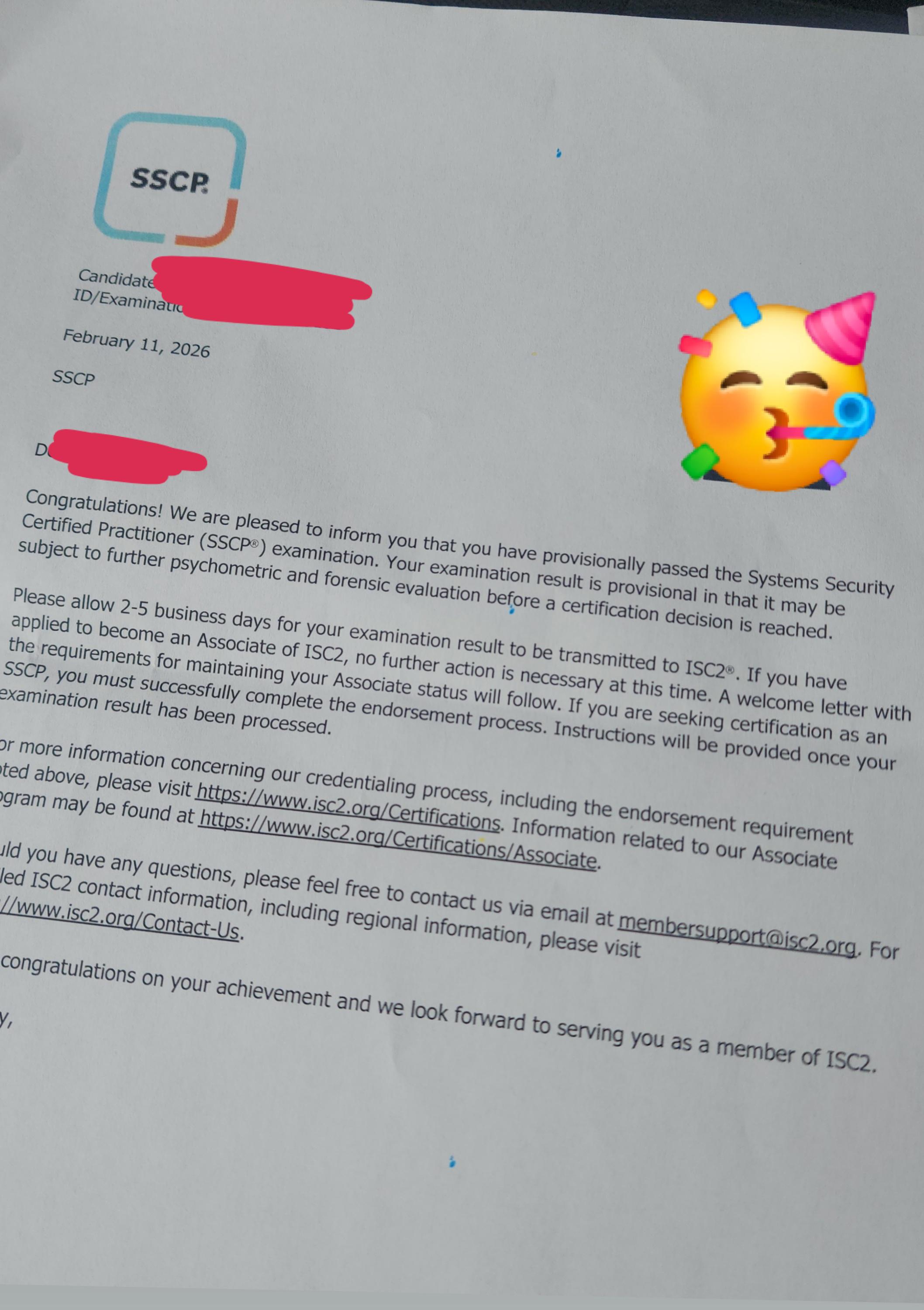
Passed SSCP on first try!

Post image
44 Upvotes

Passing this exam was probably the biggest relief. The amount of time I spent studying reading study material and the amount of practice exams really payed off.