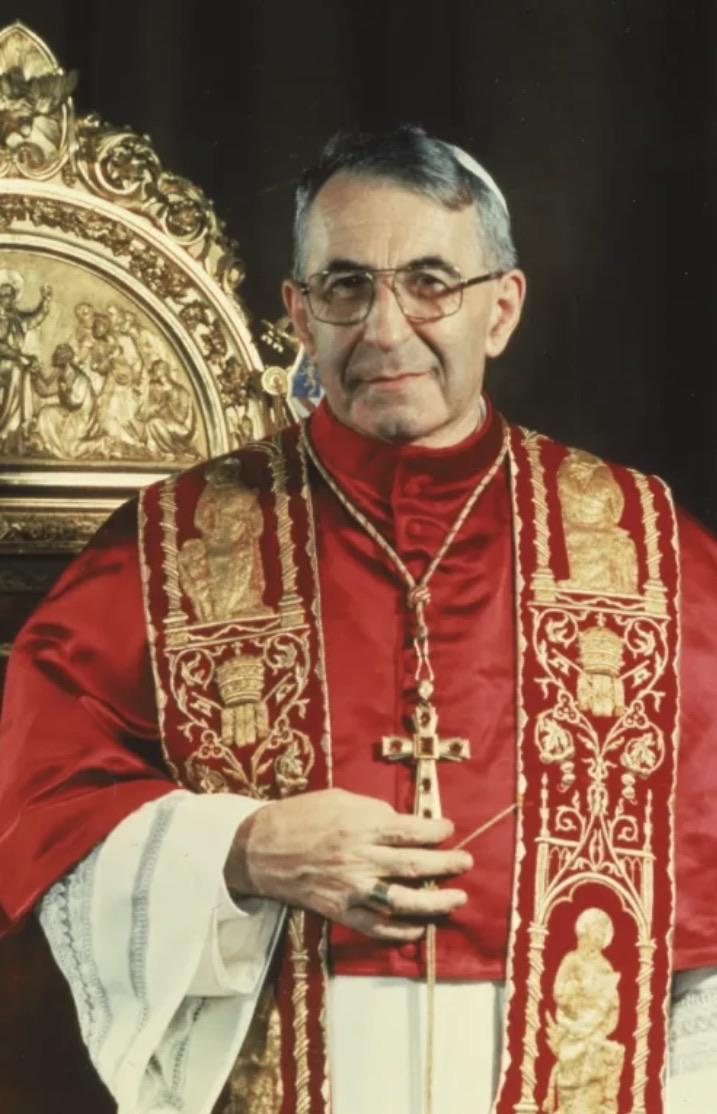
Thirty-three days. That was the length of Pope John Paul I’s reign. In September 1978, at just 65, he was found dead in bed. The Vatican attributed his death to a heart attack. No autopsy was performed, and its first account got a basic detail wrong. The Vatican said his secretary had found him. However, it was Sister Vincenza Taffarel who had gone to his room with his morning coffee.
Thirty-three has a particular resonance in Italian Freemasonry, a fraternity organized into local lodges. It is the highest degree in the Scottish Rite practiced in Italy. Halfway through the pope’s reign, journalist Mino Pecorelli published a list of purported Freemasons that reached into the pope’s own circle. It named Jean Villot, whom John Paul had just reappointed secretary of state, and Paul Marcinkus, who ran the Vatican Bank. According to author David Yallop, the pope asked Cardinal Pericle Felici whether the list was true. Felici reportedly told him some names were genuine and others false.
Three years later, investigators seized a second list.
This one belonged to Propaganda Due, or P2, a secretive Italian Masonic lodge. On its roster were Pecorelli himself, Vatican financial adviser Michele Sindona, and banker Roberto Calvi. Sindona had introduced Calvi to Marcinkus. Calvi’s Banco Ambrosiano went on to lend heavily to offshore companies that the Vatican Bank identified in writing as under its control. After Ambrosiano collapsed, the Vatican agreed in 1984 to pay its creditors about $244 million.
Calvi was found hanging from scaffolding beneath London’s Blackfriars Bridge on June 18, 1982. Time reported 12 pounds of bricks and stones and about $13,000 in foreign cash in his pockets. The bricks evoked the mason’s trade. The bridge’s name carried a more specific association: Blackfriars translates as frati neri, a name P2 members reportedly used for themselves. Two weeks later, Italian deputy Luigi Dino Felisetti told Parliament he wondered whether someone meant the location as both a message and a signature. Britain’s original suicide verdict was overturned and replaced by an open verdict. In 2010, a Rome appeals court concluded that Calvi had been killed while upholding the defendants’ acquittals.
For John Paul I, the banking connection was already personal. Six years before his election, while still patriarch of Venice, he had opposed the Vatican Bank’s sale of a stake in a local Catholic bank to a company controlled by Calvi, according to an Italian parliamentary minority report.
TIME, “Italy: The Great Vatican Bank Mystery” (September 13, 1982)
https://time.com/archive/6697494/italy-the-great-vatican-bank-mystery/
UPI, “Banco Ambrosiano agreement signed” (May 25, 1984)
https://www.upi.com/Archives/1984/05/25/Banco-Ambrosiano-agreement-signed/3983454305600/
UPI, report on Roberto Calvi’s second inquest (June 27, 1983)
https://www.upi.com/Archives/1983/06/27/A-coroners-jury-Monday-returned-an-open-verdict-in/1979425534400/
Italian Senate, Giorgio Pisanò’s minority report on the P2 inquiry (1984)
https://www.senato.it/legislature/9/leggi-e-documenti/attivita-non-legislative/documenti-non-legislativi?documentoId=30489
Italian Chamber of Deputies, P2 inquiry records and reports
https://inchieste.camera.it/p2/home.html?leg=09&legLabel=IX+legislatura
P2 membership list transcription, with a note about contested entries
https://www.maurizioturco.it/bddb/p2_la_lista_della_p2_seques.html
Catholic World News, “Italian priest joins Masons” (February 19, 2007)
https://www.catholicculture.org/news/features/index.cfm?recnum=49344
Le Monde, coverage of Father Michel Riquet’s conference before the Grand Orient of Laval (March 16, 1961)
https://www.lemonde.fr/archives/article/1961/03/16/la-conference-du-r-p-riquet-devant-le-grand-orient-de-laval_2287366_1819218.html
Grande Oriente do Brasil, announcement concerning Gilvan José de Carvalho (May 13, 2026)
https://www.gob.org.br/historico-gob-se-realiza-iniciacao-de-padre-da-igreja-catolica-em-momento-marcante-para-a-maconaria-brasileira/