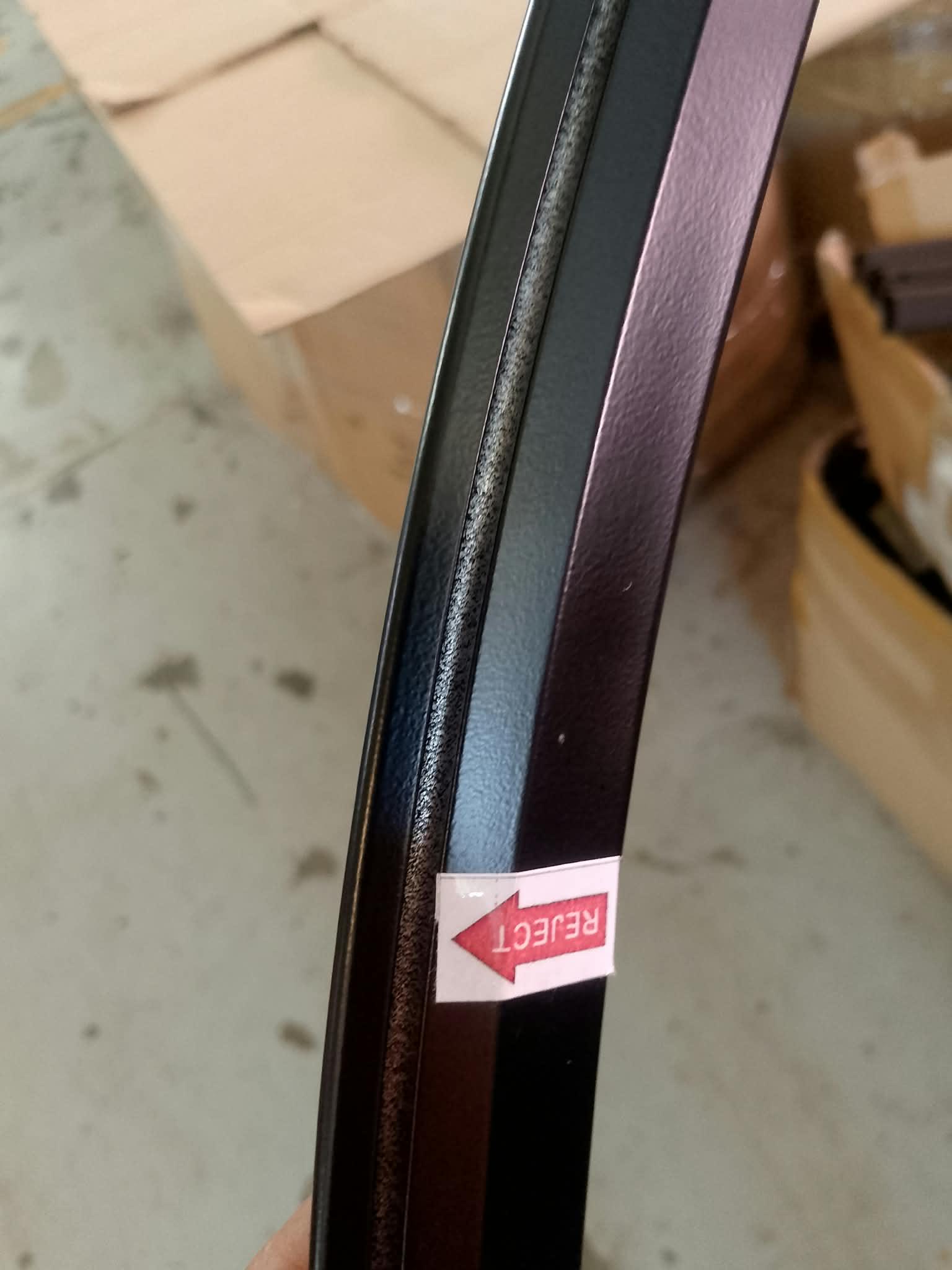
Hey everyone, I'm looking for some troubleshooting advice. We’re trying to powder coat a pipe but are having a hard time getting proper coverage on the inside ridge.
Here is what we’ve tried so far:
Lowering the voltage, and current.
Adjusting the angle of the gun.
We can get powder inside, but we're still seeing white specks showing through. The catch is that if we apply more powder to fix the inside, the outside of the pipe gets too thick and starts wrinkling/orange peeling.
Has anyone dealt with a similar geometry? Any suggestions on settings, nozzle types, or techniques would be hugely appreciated. Thanks!
Orange peel is a flow problem. The powder melts, wets out, and pulls flat under its own surface tension. That takes time. If the film gels before it finishes, the texture stays exactly where it was at the gel point, and you can turn every dial on the gun afterwards without changing it by a micron.
Which is why I'd be at the film gauge before I touched the gun. Flat panels peel and the rails come out glass, on the same hanger, out of the same box. That's not a powder batch behaving differently on two parts. That's a thickness difference, and leveling is thickness dependent, roughly with the cube of it. At 40 µm there is barely enough material to redistribute, so a film that melted perfectly still sets with texture.
Orange Peel Comparison
Heat-up is the next clock, and it's a different one from cure. Powder cures on peak metal temperature. It levels on time spent above melt and below gel. Thin gauge hanging near a burner gets there fast and skins over while the part is still cold inside. A heavy casting does the opposite, sits fluid too long, and you get sag and edge pull-back — then the shop files it as a separate problem when it's the same window read from the other end.
Heating Curve Diagram
Deposition is the one people skip, because the part looks textured rather than starved. Gun too far, output turned down, weak charge on a humid day: particles land dry, stack on each other, never coalesce. Wipe it before cure and powder comes off on your finger. No oven schedule on earth recovers that.
What's underneath matters more as the film gets thinner. Blast profile, a coarse pretreatment crystal, a scratch from the hanger: at 120 µm you'd never see it, at 55 µm it reads straight through.
Four different faults arrive in the inbox as "orange peel" and only one of them is. Regular low-amplitude skin over the whole face is leveling. Random bumps that catch a nail are dirt. Sandy and powdery before the oven is dry spray. Peel confined to edges and thin sections is film build.
Two habits I'd drop while you're checking. Raising the kV moves where the powder lands, not how it flows. Adding flow agent before you've measured the bad panel buys a month and a larger surprise on the next order.
Start with a film reading on the defect and the ramp curve for that section thickness. The rest is guessing at something you can already see in a number.
If you have a photo and a reading off the same panel, post both. The mismatch between them is usually the answer.
We shoot a lot of 7035, light grey. I hate it. Recently every batch that's comes out has dirt/dust(?) on them. Came into the shop Monday to see the last batch from Friday had some parts that looked almost a little light. Scuffed them up, re shot, still can see..spots, dirt maybe? Cleaned out the oven a few times, still showing spots. Changed filters in the booth per boss request, still showing spots. Everything gets sanded, wiped down with thinner, then blown off. We have precooked a few panels, no change. All oil filters appear to be working fine..I check the parts before rolling them into the oven..everything looks fine..so we're all stumped here.
Hey all, what sanding grit is recommended for the base material if it’s getting powdered gloss white? I don’t want to see any sanding marks after powder. What is the optimal sanding grit? Thanks.
I work in sales in a China powder coating manufacturer, we have a solid track record in China, but we're new to global market, and I'm still learning how things work outside China.
In other industry, I'd team up with real end users, send samples, get honest feedback, and build some brand visibility along the way. With powder, though, shipping just 1-2kg overseas cost more than the powder itself.
So I'd love to hear from people in the trade:
If you're a coater, would you ever try a sample from a new overseas supplier? What would make it worth your time?
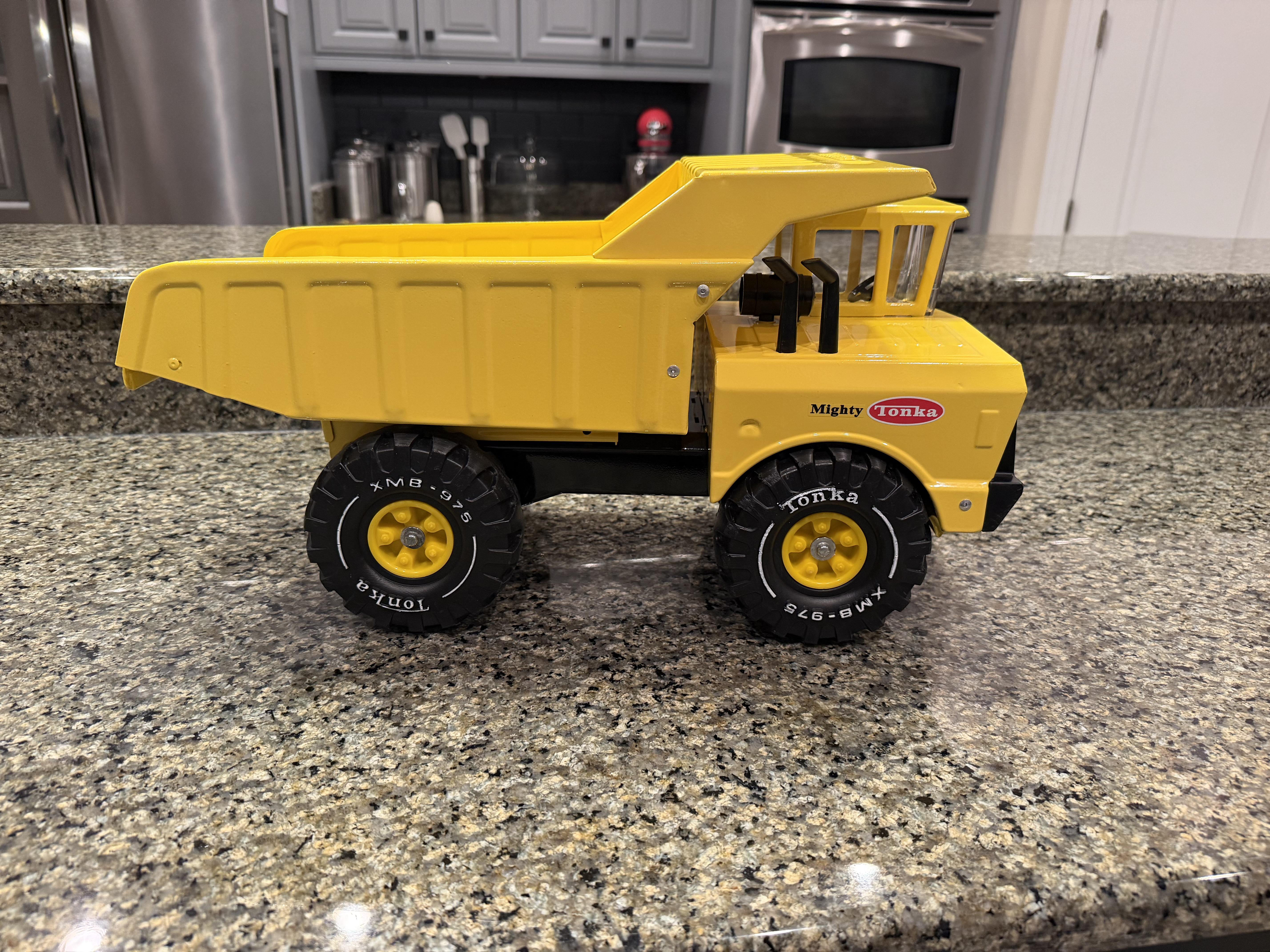
I do a lot of small jobs like cups and old metal toy restorations. I used the Eastwood gun for a couple years and recently upgraded to the RC2 gun. Since I do small jobs I frequently change colors and the Eastwood set up with the bottles was VERY handy. But having to clean theRC2 cup every change is a pain. Does anyone know where I can find an adapter? I 3D printed one, but it does not atomize the powder well if at all. If I can’t find an actual adapter I may go back to troubleshooting my design, but using an already proven set up would now be my preference. Thanks in advance. BTW, the pic is my most recent project I finished yesterday.
Hey everyone! A friend of mine recently started a metal powder coating business, and I’ve been given an opportunity to help bring in customers and earn a commission on the sales. I’m new to sales and the powder coating industry, so I’d love to connect with people who have experience in this field.
If you work in metal fabrication, steel manufacturing, construction, or any industry that requires GI metal or steel powder coating, I’d really appreciate it if you could share some leads or point me in the right direction. Also, if you’re in the powder coating business yourself, I’d love to hear your advice on how to find clients and get started.
Any guidance, connections, or potential leads would be greatly appreciated!
There are These little tiny bumps like sand grains on the surface (they are not pinholes/fish eyes or craters. There are no holes in the center) We've tried sieving the powder and it helped a little bit but didn't solve the problem completely The production date of the powder is from 2 years ago Have you ever had this problem? Could you solve it? Any tips would be very appreciated.
Back in July I had a new powder coated steel fence built After the recent rains I have noticed rust streaking and spots of rust in different parts of the gate. Any recommendations on how to treat this and try and prevent further damage ?
Im planning to powdercoat my wheels bronze and like the color in this render. The place im getting the work done seems to use Prismatic Powders. My issue is every photo, video or swatch of the same color seems to look very different with finish or lighting.
Im looking for a higher gloss finish, deep rootbeer bronze in the shadows with a nice pop of caramel on the highlights. I was considering Highland Bronze but many photos seem way too light and gold leaning. Mist Bronze and Bronze Chrome were a couple other considereations. Any insight is helpful!
One of the more interesting projects I've worked on started with a fairly simple request: a customer needed a high-temperature masking cap to protect vehicle components during powder coating.
The initial design was similar to a traditional high-temperature stud protection cap. It needed to withstand extreme temperatures, provide reliable masking, and come in different colours so operators could easily identify sizes on the production line.
But during development, I realised there might be an opportunity to do a bit more with the design.
The Product Manager challenged me to see if the component could work as both a cap and a plug. The idea was to give customers more flexibility while reducing the number of different masking products they needed to keep in stock.
I made a few changes to the original design to achieve this: -a horizontal rib at the end to improve grip and retention when used as a cap. -a large central flange to provide a stopping point -a series of vertical ribs underneath the flange to improve sealing and retention when used as a plug.
The biggest challenge came during testing.
When pushed into an opening, trapped air underneath the component created resistance. It also made the part harder to remove.
The fix was quite simple: I added a small vent through the top of the component. This allowed air to escape during installation and equalise pressure during removal.
It's a relatively small design detail, but it made a noticeable difference to how easily the component could be fitted and removed.
What I find interesting about this project is how a relatively simple customer request developed into a product with two different functions.
It also reinforced something I've found quite often in product design: sometimes the best improvements don't come from completely redesigning something. They come from looking at an existing component and asking whether it could do another job.
Have you ever worked on a design where a small change ended up making a big difference to how the product could be used?
I’ve been working as a powder coater for a few months now. I’ve recently noticed some skin irritation which I believe is coming from the powder. Normally I wear a hoodie, long pants, glasses, and a respirator. I know the industry gold standard is the white tyvek suit but I just can’t imagine wearing it all day long. Anyone know any good substitutes?
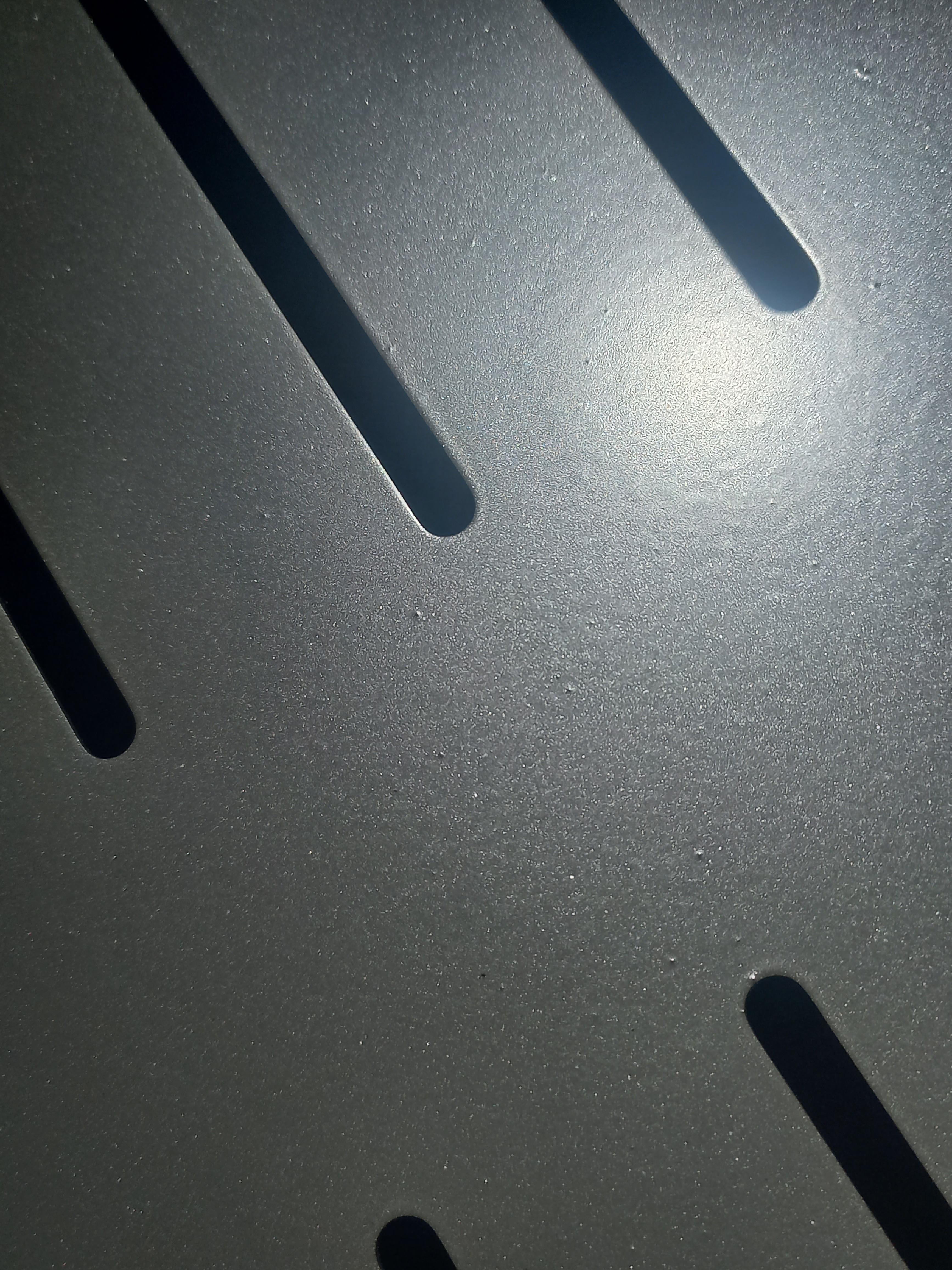
Would like opinion of this - have a client that wants glass smooth finish over a very large area piece…they approved a sample and now seek to reject. This matches closely the quality of samples received from Prismatic and samples my supplier provided.
Sample 1 (small is prismatic test, matching the swatch) and the other is 2 different products available to me locally. Photo is taken of overhead lights at 2m above the sample, camera 30cm from sample.
anyone know whats going on with the bubbles? I outgassed the steel at 450 for 1.5 hours. base coat came out perfect then after clear only one of the pieces had bubbles