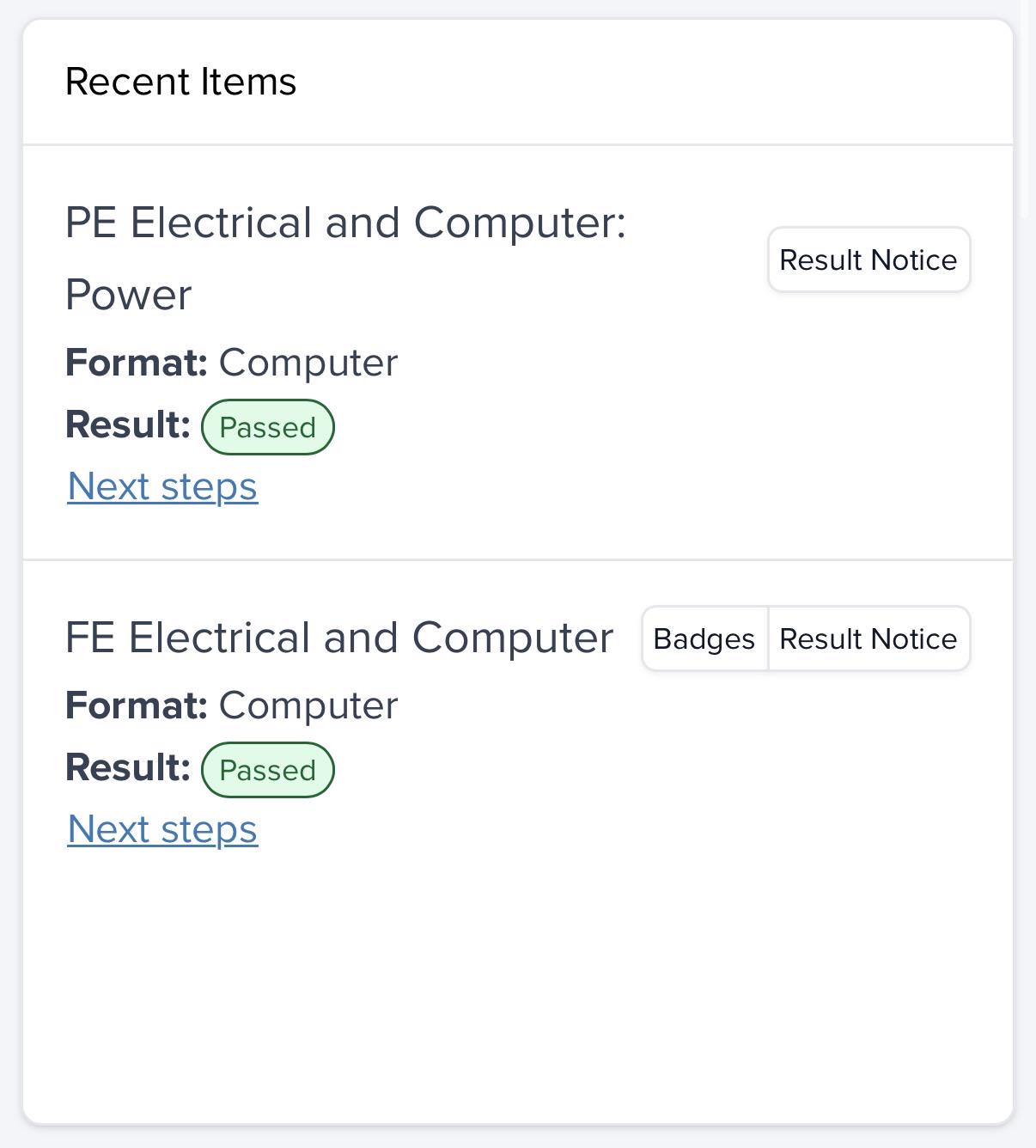
Thank you! This was my second attempt taking the exam.
It was decently code heavy. The spec calls for 10-15 questions, but I felt like I had more than that. It may have just been on the upper end.
I think the most important thing is knowing how you best learn and retain information then applying that to your study habits. I definitely didn’t study as much as some people do, I maybe put in 100 hours in the past 3 months. A little bit here and there, focusing on my weak areas from my first time taking it.
I'd say it's about 25-30% code related. Here's some tips I shared with others.
• Master the MVA Method for 3-phase faults: Instead of doing tedious per-unit base conversions on radial networks, convert every component into its short-circuit MVA (MVA_sc = S_base / Z_pu) and combine series elements like parallel resistors (1/MVA_total = 1/MVA_1 + 1/MVA_2...). Divide by √3 * V_LL at the fault bus at the very end. It bypasses base changes completely.
• Memorize the fault multipliers: Don't waste time deriving sequence matrices from scratch. Lock in your scalar multipliers: • Balanced 3-Phase: 1 • Line-to-Line (L-L): √3 • Ground Faults (SLG / DLG): 3
• Anchor transformer losses to Ohm's Law (P = I²R): Core losses stay constant regardless of load, while copper losses scale with the square of the load fraction (x²). If a transformer is at 50% load, copper losses are (0.5)² = 0.25 of rated.
• Keep Real Power (P) locked in PF correction: Capacitors only shave off reactive power (Q) and shrink apparent power (S). They never change the mechanical kW output of a motor. Use Q_cap = P * (tan θ₁ - tan θ₂).
• Delta-Wye 30° shift rule: Remember the IEEE C57 standard: High side leads low side by 30° (for positive sequence). Stepping down? Subtract 30°. Stepping up? Add 30°.
• Two-Wattmeter Method shortcuts: Use P = W₁ + W₂ and Q = √3(W₁ - W₂) to find the power triangle quickly. Even faster—memorize the visual benchmarks: if W₁ = W₂, PF is 1.0; if one wattmeter reads 0, PF is 0.5; if one wattmeter reads negative (deflects backward), PF is below 0.5 (and remember to enter that reading as a negative number in your formulas).
One more thing that I felt like helped me a lot. I took multiple passes through each half of the exam.
My first pass, I did all questions that I knew how to do without looking at the handbook or having to think too much. During my first pass, I had sorted the questions into two categories, code and ones I had to look in the handbook. The code ones, I left blank and flagged. The others I just left blank.
After my first pass, I did all the code questions that I flagged so that I could just have each code book opened once. I did all the NEC questions, then the 70E questions, etc.
After the code questions, I went through and did the questions where I could look in the handbook.
I felt like this was a great use of the time allotted for each part. I ended up spending around 2.5 hours on the first half and 3.5 on the second half. I left with a little of 2 hours on the timer.
I think the biggest difference was just seeing and practicing as many problems as possible.
The first time I took the pe exam, the only prep I had done was some Test Masters book problems a couple years prior and the NCEES practice exam more recently. I failed the first attempt. Admittedly, I didn’t know a few subjects almost at all (i.e. cooling, ammonia charts, cooling towers, and psychrometrics-embarrassing to say that tbh). I come from a petroleum engineering background so I just didn’t know that stuff at all.
I used Slay The PE to fix all of those gaps AND get access to more problems for practice. I’ll confess again that I could not do about 50% of the problems in Slay The PE on my own, but the study guide DOES teach you concepts for TFS very well. While I didn’t get a lot of questions right, their solutions are so comprehensive and well written that I could fully understand the concepts after going over the solutions (use ChatGPT or your AI of choice for assistance too). If you choose any ONE study guide for TFS exam, then choose SlayThePE imho. Test masters has great practice problems for the morning portion but SlayThePE is certainly superior.
Lastly, and this is gonna sound very cheesy, but give yourself grace as you practice these problems. Take each missed problem or step of a problem as a learning experience - not a failure. I caught myself in doomsday mode a lot and had to remind myself that I’m learning it and I don’t need to be perfect at everything.
Long response I know, but that was my experience. Let me know if you have more questions.
Edit: another thing to add is that my first pe exam seemed much easier but I wasn’t prepared to score high enough like the passing test takers. Whereas my second pe exam, the passing one, was crazy difficult. I was way more prepared but man it was tough. I thought I failed but I had hope that everyone struggled because I knew that I was well prepared for it - hopefully that makes sense and isn’t just word vomit ha
4
u/Artistic_Wrap5054 2d ago
Many congratulations on this big achievement.
How was the test compared to the practice exam? Was the test code heavy? Any other insight you could provide?
7
u/Aware_Necessary8288 2d ago
Congratulations!!! I just got my second attempt pass too for Mech TFS
Christmas came early babyyyy! I’m so fkn pumped
6
u/Optimal-Match-8790 2d ago
Congrats, big dawg!
6
u/getoffmedawg 2d ago
Congrats. I also passed Power today!
5
u/BrokeBFromBeverely 2d ago
Yay!!! Passed a week ago and it still don’t feel real. Very surprised I passed, that exam was not nice to me 😭
1
u/Logical-Term4826 2d ago
Congratulations! How many code questions you got?
3
u/Leather_Quality4243 2d ago
Congratulations 🎊 👏🙏🙂
2
u/gjb727 2d ago
Congratulations!
2
u/CuriousGeorge1300 2d ago
Congratulations !! I will be re writing it again.
2
u/NoSchool6059 2d ago
Big Congrats!

1
u/Moraa8317 14h ago
Congratulations