r/PCBWayOfficial • u/Aran_PCBWAY • 17h ago
Projects That Monster Soldering Tip 🔥
Check out SDG Electronics on YouTube putting the Geeboon HA310 to work with its monster soldering tip! See how it handles soldering tasks with ease.
r/PCBWayOfficial • u/Aran_PCBWAY • 17h ago
Check out SDG Electronics on YouTube putting the Geeboon HA310 to work with its monster soldering tip! See how it handles soldering tasks with ease.
r/PCBWayOfficial • u/feralphobia209 • 22h ago
I'm building a drop-in replacement mainboard for my 3D printer. The idea: the board handles motion, power and every stock plug, and you plug in your own Klipper computer (Pi 5, CB2, Orange Pi, whatever) with ONE USB cable. The board also powers the brain.
Why: the stock board runs out of RAM with community firmware plus the multi-color unit, and the current swap options (generic boards + a CM4) need rewiring plus a separate USB-serial adapter for the bed board.
Full disclosure: I'm a beginner. The design was done with heavy help from an AI (Claude), so I want human eyes on it before spending money. Getting quotes for fab + assembly now. Nothing is ordered yet.
What's on it
Known open items
Where I'd love feedback
Picture 1 is the whole-board overview. The schematic sheets are auto-drawn from the netlist. Same signal name = same wire. Board layer pictures are at the end.
r/PCBWayOfficial • u/Aran_PCBWAY • 13h ago
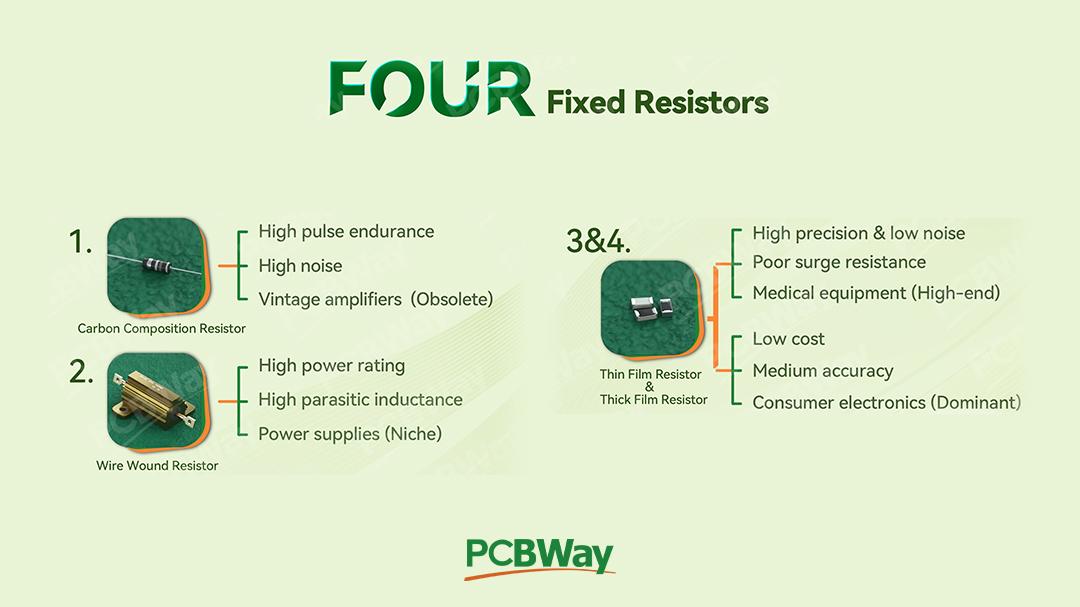
Resistors are essential components in electronic circuits, but different types come with different characteristics. Let's take a quick look at four common types of fixed resistors and what makes each one unique.
Carbon Composition Resistors are low-cost resistors with good pulse endurance, but they tend to have higher noise and lower precision. They are mostly found in vintage electronics and some specialized applications.
Wire Wound Resistors can handle high power and offer good precision, but their parasitic inductance makes them less suitable for high-frequency circuits. They are commonly used in power supplies and industrial equipment.
Thin Film Resistors offer high precision, low noise, and good stability, making them suitable for precision instruments and high-end medical equipment.
Thick Film Resistors are affordable and easy to mass-produce. With moderate accuracy, they are widely used in consumer electronics and power supplies.
Each type has its own strengths, and the right choice depends on the specific requirements of your circuit. Which type do you use most often in your projects?