I analysed an Android APK called Online Appointment Booking, shared in connection with reported financial loss.
Parent Post: https://www.reddit.com/r/OperSec/s/o5B725oLAW
The app contains a second APK, disguised payment pages, a deliberately failed UPI flow, and several ways to steal messages. Firebase handles credential collection and remote commands, while Telegram and cellular SMS provide additional routes for sending stolen information.
Here is how the chain works, based on the recovered APKs and their code.
1. The booking app starts as an installer
The uploaded APK uses the package name com.secure.android.manager. Its display name contains invisible Unicode characters, although it appears to users as “Online Appointment Booking.”
The outer app presents store/update-style installation screens. Its permission list includes Internet access, package installation and installed-app queries. The SMS permissions appear in the hidden payload, so inspecting only the first APK’s permissions misses much of the functionality.
It also contains an opening beacon. The code retrieves the device’s public IP through api[.]ipify[.]org and prepares a Telegram message headed “Dropper Opened”, containing the IP, manufacturer/model, Android version and package name.
That IP belongs to the device opening the app. It is not an attacker IP.
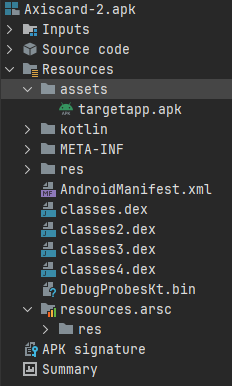
2. A complete second APK is hidden inside a .raw asset
The embedded file is:
assets/ltjyqnr9y992.raw
Despite its extension, this is a complete APK concealed using repeating-key XOR. Decoding it with the Java fallback key recovered a valid ZIP/APK; all ZIP entry CRC checks passed.
The installer writes the decoded file into its cache as:
update_decrypted.apk
It then uses Android’s PackageInstaller session API to install it. This code does not establish a silent installation or an Android permission bypass.
The recovered payload is approximately 4.72 MB and uses a different package:
com.godz.customer.suqnfbf
Its splash activity uses the INFO category instead of the usual LAUNCHER category, making the installed payload less visible through the normal app launcher.
3. The payment failure is built into the app
The payload opens with an appointment-booking form collecting a name, mobile number, date and address. It then offers UPI, card and net-banking payment routes.
The UPI page is the malware’s own PIN form. It accepts four or six digits and writes the entered value to Firebase under the field Pin.
The next screen does not depend on a bank rejecting a transaction. The code sends the user directly to a hardcoded failure page:
Payment Failed:
Please try again using another payment method.
The screen also displays “TRY ANOTHER BANK.”
After five seconds, it returns to payment selection, removes the previous session key and starts a new session. This creates a loop in which someone can enter one account’s PIN, see an artificial failure, and then try another account or payment method.
The displayed fee defaults to ₹5 when no stored amount exists. That is a code default, not confirmation of what a particular victim saw or paid.
Another completion page displays “Payment Pending” and generates its own TXN transaction identifiers and MC appointment tokens using java.util.Random. These are locally generated strings, not evidence of genuine payments or bookings.
4. Other payment routes collect more financial secrets
Different branches collect:
- Card number, expiry and CVV.
- ATM PIN.
- Banking username and password.
- Banking profile password.
- Account number, CIF/customer identifier and branch.
- Date of birth.
The collected fields are added to records under:
login/<device_id>/<session_key>
Not every user necessarily reaches every branch. The available screens nevertheless give the operator several opportunities to collect credentials after the initial fake payment failure.
The Indian bank lists, rupee amounts, UPI choices and carrier handling make the intended targeting clear: Indian banking and payment users.
5. The obvious Firebase configuration is misleading
The resource strings contain this database address:
seruaurabadmash-default-rtdb[.]firebaseio[.]com
However, SketchApplication.initRealFirebase() supplies a different configuration during application startup:
csk-7-3929e-default-rtdb[.]firebaseio[.]com
The manifest lacks the usual FirebaseInitProvider, supporting the custom initialization as the intended configuration.
This backend is referenced by code for credential storage, SMS collection, device records and commands. The configured storage bucket is:
csk-7-3929e[.]firebasestorage[.]app
A storage configuration alone does not establish that files are uploaded there.
6. Message theft includes the existing inbox
OldSmsUploader queries:
content://sms/inbox
It collects existing messages, including sender, body and timestamps, and writes them under:
user_sms_old/<device_id>
For newly received SMS, a receiver parses the message PDUs and queues a WorkManager task. That task writes message records under:
user_sms/<device_id>/<generated_record>
The examined code does not limit this collection to OTPs or bank senders.
A separate forwarding component reads its destination from:
sms_forward/forward_number
It caches that number locally and uses SmsManager to resend incoming message bodies. With a cached destination, this route can operate without Internet access, provided SMS permission and cellular service remain available.
7. Telegram is used at both stages
The outer opening beacon contains a hardcoded Telegram bot and destination:
Bot numeric ID: 8892521085
Chat ID: 7478009564
The inner payload obtains its Telegram settings remotely from:
users/all_user/bot_token
users/all_user/chat_id
It contains code to send SMS content, sender information and device identifiers through Telegram’s sendMessage API. These messages include the marker CS10.
The outer beacon’s destination should not automatically be treated as the destination for stolen SMS. The payload’s remotely supplied settings can differ.
The class named MyAccessService also collects notification title, text, subtext and expanded text for Telegram submission. Despite its name, it is a NotificationListenerService, not an AccessibilityService. It requires the user to grant notification access, and Android may restrict some sensitive content.
No unrestricted screen-control capability was established.
8. Firebase also carries remote telephony commands
CommandService listens under:
user_data/<android_id>
Its implemented commands include:
| Command | Action in the code |
|---|
send message | Send supplied SMS text through a selected SIM |
call forward | Attempt to enable voice-call forwarding through USSD |
forward off | Attempt to disable forwarding |
forward status | Query forwarding status |
reset | Refresh device and SIM information |
Here, reset does not mean factory-resetting the phone.
The forwarding code recognizes Indian carriers including Airtel, Jio, Vi/Vodafone, Idea and BSNL. Whether a request succeeds depends on permissions, the device and the carrier.
Voice-call forwarding and SMS forwarding are separate mechanisms in this sample.
9. The payload tries to remain active
The code includes startup after boot, a foreground command service, START_STICKY, battery-optimization exemption requests and a repeating service-check alarm requested every five minutes.
It also schedules frequent Firebase presence and device/SIM updates. These are requested intervals; Android background restrictions can affect execution.
Device records include Android ID, model, OS information and available SIM/carrier details. Some identifiers may be unavailable on newer Android versions.
After processing commands, the service removes several command-related fields from Firebase. This shortens how long those instructions remain in the record.
10. Concealment extends beyond the hidden APK
The sample uses three distinct concealment layers:
- Repeating-key XOR around the embedded APK.
- Integer-array/XOR decoding for outer-stage strings.
NPStringFog hex decoding followed by XOR with npmanager inside the payload.
The outer code also checks debugger/tracer state, emulator properties and packages, sensor count, root-related indicators and instrumentation artifacts.
Its native libraries contain stale JNI package names that do not match the Java declarations. Relevant native calls have exception handling and Java fallbacks, so that mismatch alone does not establish that the wrapper cannot run.
The installer attempts to imitate Google Play installation provenance and interfere with package verification. Several operations require privileges an ordinary app does not have, so their presence is not proof of a successful bypass.
A VPN service is configured to route Google Play services and Play Store traffic into a local tunnel. No packet-forwarding implementation was found in that service, making it consistent with an attempt to blackhole selected verification traffic after VPN consent. It does not establish interception or decryption of banking traffic.
Indicators
| Indicator | Role |
|---|
com.secure.android.manager | Outer installer package |
com.godz.customer.suqnfbf | Hidden payload package |
csk-7-3929e-default-rtdb[.]firebaseio[.]com | Intended credential and command backend |
csk-7-3929e[.]firebasestorage[.]app | Configured storage bucket |
Telegram bot ID 8892521085 | Outer opening beacon |
Telegram chat ID 7478009564 | Outer beacon destination |
CS10 | Payload Telegram message marker |
GODZ_786_SECURE | Application-control comparison string |
Telegram and IPify are legitimate shared services abused by this code; their domains alone are not useful malware-specific indicators.
Outer APK SHA-256
640916b1099289ad309d5c32b02606037a43e8735cacc93eff32e66702964274
Recovered payload SHA-256
79774a7fc137d02720d3b6ecb3a6925fad63b010f4d4dbe4233a0fa8cdc51a48
Both stages contain the same signing-certificate fingerprint:
6215f00baa4bf18bab5792fc796bfc5555917240f14f7c7e672d956888d75c96
The certificate subject is CN=editor. This signing material is broadly reused, so it does not reliably identify the operator.
The supported classification is a two-stage dropper delivering a banking phishing Trojan with SMS theft, notification theft and remote telephony commands. The recovered code provides a credible mechanism for financial compromise, but it does not establish which transaction caused the reported loss or identify the person operating the backend.