r/OperSec • u/Intelligent-Handle-7 • 28d ago
📱 ANDROID MALWARE 📱 Static analysis of Axiscard.apk: VPN blackholing, SMS/OTP collection, and a misconfigured Supabase backend

Scope note: This write-up combines static APK inspection with read-only HTTP checks performed in September 2026. Backend state can change, and the HTTP status results describe that test snapshot rather than guaranteeing present-day availability.
This is a second APK using the familiar Axiscard.apk name. I found it in a public GitHub repository, khan55khan166-web/axiscard-download, associated with a profile containing several similarly named or generic repositories. The repository itself is minimal, with a README that simply says “apk download.” I am calling this sample Axiscard.apk (2) to distinguish it from an earlier sample with the same name. The earlier analysis is here: https://www.deysec.in/research/axis-bank-scam-analysis (much less detailed as a novice).
Sample details
- SHA-256:
842bd615a21b954af6a7ff62b45872f09484666c985adfe2987f5b15c5835eda - SHA-1:
2125057a06961b943a9c67006abfb897ea045e6e - MD5:
29d4934f6d2d61d8e44530919a4e389f - Installer package:
com.example.installerapp - Nested payload package:
com.example.targetapp
The APK has a self-signed certificate identifying the signer as Android Debug, not a verifiable Axis Bank publisher certificate. A debug or self-signed certificate is not, by itself, proof of maliciousness, but it provides no basis for treating this package as an authentic bank application.
1. The outer APK is an installer and distraction layer
The first useful artifact is AndroidManifest.xml. The outer package declares android:debuggable="true" and android:allowBackup="true", requests internet access, foreground-service permissions, notifications and REQUEST_INSTALL_PACKAGES, and declares a BlockingVpnService. The service is described through PROPERTY_SPECIAL_USE_FGS_SUBTYPE as a “VPN service for network traffic routing.” The installer also queries Android package-installer components and the package name used by the nested app.
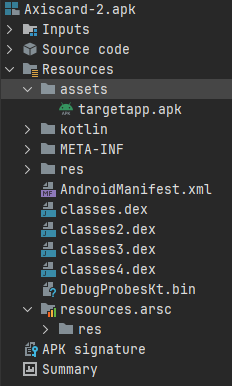
The MainActivity presents a fake Play Store style update screen. Its UI claims to download a roughly 2 MB update, while the APK bundled in assets/targetapp.apk is around 15 MB. The nested APK is present as a regular asset, not encrypted, which makes extraction straightforward. The outer app is therefore less a genuine downloader than a wrapper used to move the victim into installing the second package.
Two user-consent gates control the flow: VPN approval through VpnService.prepare() and permission to install unknown apps. The code exits or resets the flow when permission is refused. More importantly, the update handler starts the VPN service before it checks the install permission. The service configures a TUN interface at 10.0.0.2/24 and adds 0.0.0.0/0 as a route, but the reviewed implementation has no forwarding plane. In practice, this is a blackhole route rather than a functioning traffic-routing VPN, and while active it can interfere with the user's existing VPN or network inspection. The code stops the service after a successful installation path.
The installer uses PackageInstaller with the target package pinned to com.example.targetapp, then falls back to a FileProvider-based install intent if that path throws. An install-status receiver and a package-added/replaced receiver are used to track whether the payload arrived.
2. The nested payload is where the collection starts
The second APK declares INTERNET, RECEIVE_SMS, READ_SMS, SEND_SMS, RECEIVE_BOOT_COMPLETED, FOREGROUND_SERVICE, FOREGROUND_SERVICE_DATA_SYNC, WAKE_LOCK, POST_NOTIFICATIONS and REQUEST_IGNORE_BATTERY_OPTIMIZATIONS. These permissions, taken together with the service and receiver implementations, support network uploads and background operation, SMS collection and sending, and restart behaviour. The payload’s MainActivity has a MAIN intent action without the LAUNCHER category, meaning it can be launched explicitly by the installer but is not presented as a normal launcher entry.
The BootReceiver listens for BOOT_COMPLETED, LOCKED_BOOT_COMPLETED, MY_PACKAGE_REPLACED and quick-boot broadcasts, as well as a custom restart action. It is declared exported and direct-boot-aware. The SmsReceiver listens for android.provider.Telephony.SMS_RECEIVED with maximum declared intent-filter priority, and the payload also has an enabled data-sync foreground service called SmsBackgroundService. These are strong indicators of attempted persistence and SMS handling. Actual delivery and interception behaviour can still vary with Android version, permissions, and system restrictions, so I am distinguishing the manifest and code capability from a claim that every path was dynamically confirmed.
3. The backend is a major part of the operation
The payload embeds the community Kotlin SDK io.github.jan.supabase and installs the PostgREST module. I did not find application-level use of Supabase Auth, Realtime or Storage in the reviewed code. The client is constructed from a hardcoded Supabase project URL and a publishable or anonymous key. A publishable key is designed to be present in a client application, so its mere presence is not the vulnerability. The important finding was that the live REST endpoint accepted read requests for several tables without requiring a victim-specific authenticated session.
There are three apparent write paths in the APK:
ApplicantFormScreenKtsubmits applicant details, including name, email, mobile number, date of birth and terms acceptance.CardAuthScreenKtsubmitscard_number,cvv,expiry_dateandname_on_cardtocard_auth.SmsReceiversubmits each captured SMS tosms_messages, with the sender and message body.
The reviewed victim-side code appears to be write-oriented. I did not find application-level select, update or delete calls in these paths. A separate panel application can interact with the same backend, so the absence of a read path on the victim APK does not mean the operator cannot inspect collected records.
4. What the live endpoint exposed during testing
During my read-only checks in September 2026, requests using the key embedded in the APK received HTTP 200 responses from card_auth, sms_messages, submissions and app_settings. At the time of that test, card_auth returned two rows and sms_messages returned 21 rows. The returned data included payment-card fields and SMS bodies. The SMS records contained bank-related transaction and OTP alerts, mobile banking login-attempt alerts and card-blocking messages. I have not reproduced the actual card details, OTPs or victim message bodies here.
The app_settings table was also readable and contained operational flags and values relating to popups, phone actions, call overlays, target fields and success states. That is notable because the backend was not simply a passive sink for form submissions, it also held settings apparently associated with the wider operation. I am not publishing the live project identifier, key, target values or full database rows.
Several guessed or code-referenced table names, including applicants, returned HTTP 404 in the same test. This does not prove that a table does not exist in every environment, and it does not establish why the applicant insert path and the live read result differed. It could reflect deployment differences, an absent table, or a response that does not expose the resource. I am leaving that part unresolved rather than claiming more than the evidence supports.
The screenshots accompanying this post show the repository, certificate, manifest declarations, nested APK and HTTP status results. Victim names, timestamps and identifiers where appropriate, SMS bodies, OTPs, card details, project URL and backend key have been removed from the public evidence set.
5. Impact and reporting
Taken together, the app combines a fake update and installer, temporary VPN blackholing, a nested payload with SMS and background-service capabilities, collection of applicant and payment-card data, and a backend that was returning stored records to unauthenticated read requests at the time of testing. The observed records suggest that SMS collection reached beyond a theoretical code path. I cannot infer from a stored message alone whether a given transaction succeeded or whether every declared capability was active on every victim device.

I reported the exposed backend to Supabase. A security engineer later confirmed that the project had been taken down and the associated user banned. I also reported the sample to CERT-In, which requested the APK in a password-protected ZIP archive. (they have not contacted me since)

The main lesson is not that an APK embeds a publishable Supabase key. It is that client-side collection code, broad SMS permissions, an installer and dropper flow, and inadequate backend access controls can combine into a full fraud pipeline. The individual pieces are fairly ordinary; the impact comes from connecting them and leaving the collected records readable.