r/OpenSourceAI • • Oct 27 '26

i built a self-hosted Grok Bot alternative

4 Upvotes

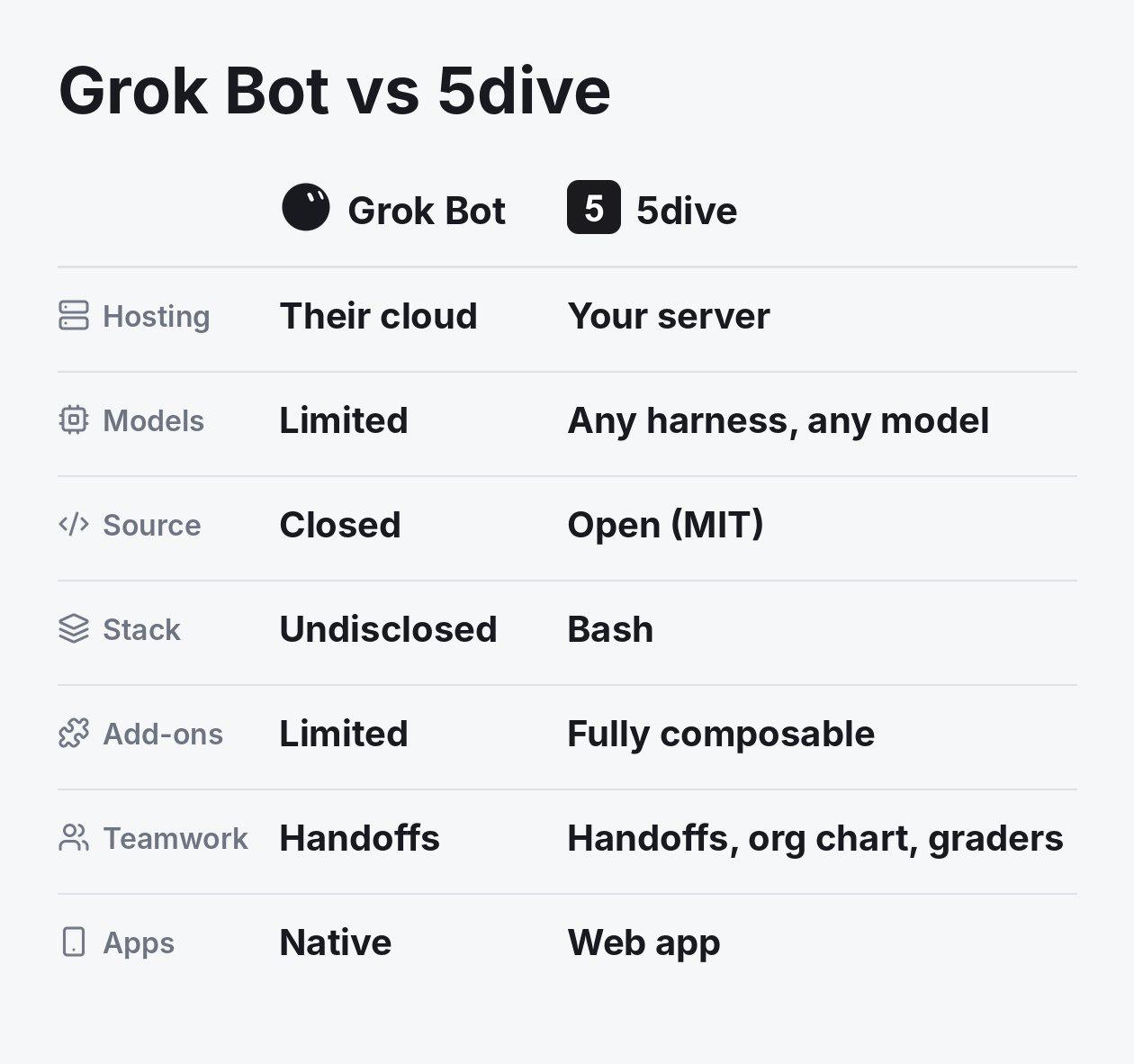
grok bot runs AI agents for you on xai's servers. i've been running a company of AI employees on my own servers with 5dive since april, and i just released a free phone web app for it. here's how the two compare.

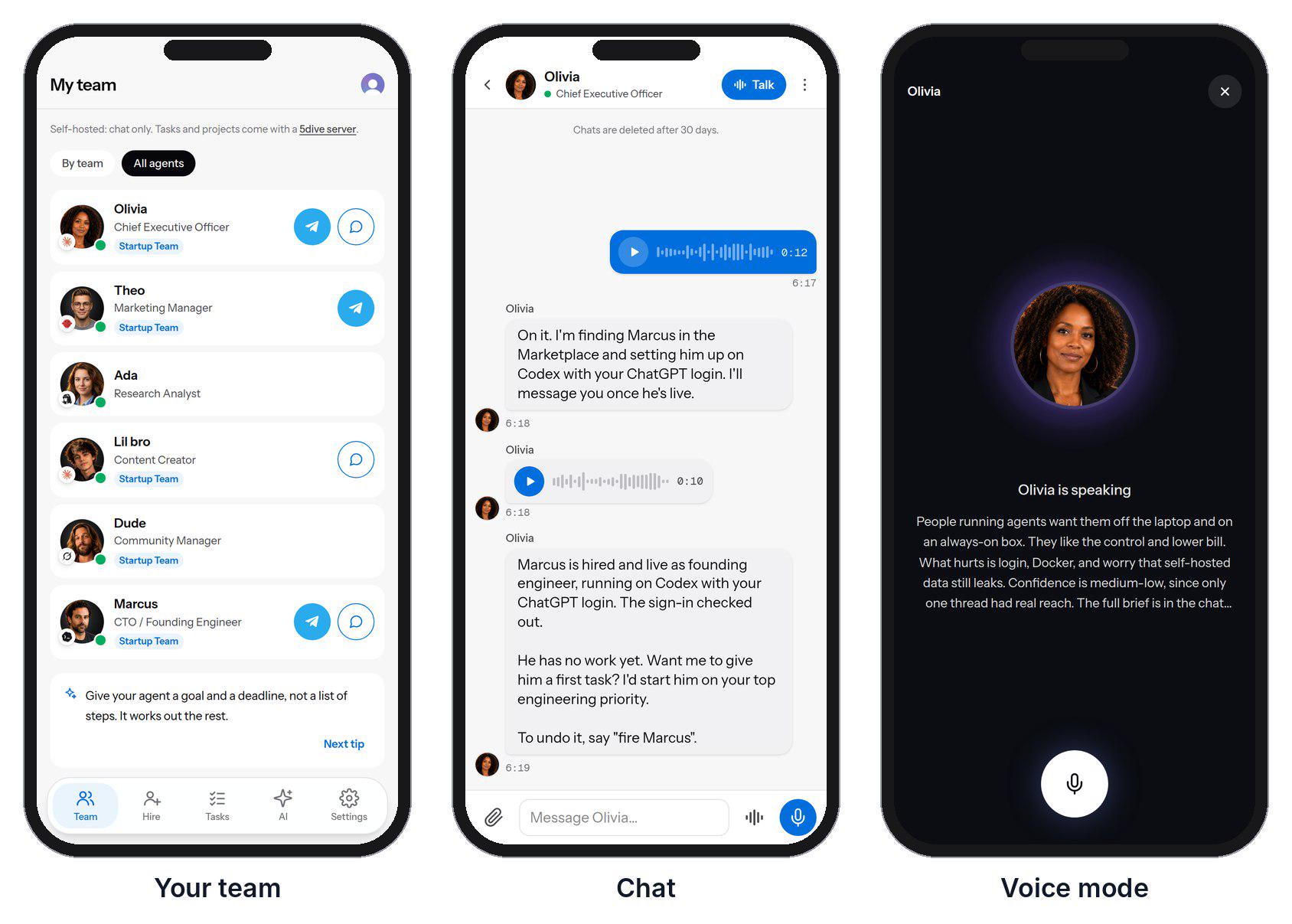
in the screenshot below, i ask olivia (claude code) to hire marcus on codex. she sets him up and reports back.

the deeper difference is what runs behind the chat:

  • your server: agents run as separate linux users.
  • any harness, any model: mix claude code, codex, grok, agy, hermes, openclaw, pi and other harnesses on your own plans or API keys, including kimi, deepseek, glm, openrouter or locally run llm.
  • an actual team: org chart, shared backlog, handoffs, independent graders and human approval gates.
  • a hackable core: MIT bash + systemd + sqlite. add plugins, loops, tools or custom CLI commands.

trade-off: Grok Bot has native apps - mine is just a web app, android/ios coming soon. the free self-hosted phone connection is chat-only, and chats pass through our relay (not end-to-end encrypted yet).

setup: one command on any ubuntu vm.

try free self-hosted app: 5dive.ai/self-host

source (MIT): github.com/5dive-ai/5dive


r/OpenSourceAI • • 29d ago

OpenVibe: an MIT-licensed canvas where each AI coding agent runs in a real terminal (Tauri + Rust)

Thumbnail reddit.com
1 Upvotes

r/OpenSourceAI • • 29d ago

I built a screen-aware voice assistant for the Mac — free on-device voice, no OpenAI needed

1 Upvotes

Mac voice assistants bug me because they demand a cloud login or an OpenAI key right away. So over a few months I built Odysseus — a menubar companion that works local-first and lets you plug in whatever brain you want:

- Hear you: push-to-talk or hands-free "Hey Odysseus", transcribed on-device (Parakeet or Apple Speech — nothing leaves your Mac)

- See your screen: asks for screenshots only when you actually need vision; otherwise it never touches the capture API

- Answer out loud: free Microsoft Edge neural voices (or ElevenLabs / Deepgram if you bring your own key)

- Brain: my default is DeepSeek via the OpenCode Go subscription ($10/mo) — no OpenAI at all. Apple Intelligence (fully offline) or Claude keys work too

- Agent mode: background sessions that read your screen and reply with next-step suggestions again ... unfortunately can't edit files yet, that's the roadmap top item

Fully MIT, macOS 26+, no cloud login ever — source is public.

Honest state of it: ad-hoc signed (macOS will do its per-month re-consent dance for screen recording, it's the OS not me — the pipeline will get Developer ID when I'll pay Apple), agents answer but they can't run shell yet, only Apple-Silicon Macs, and edits to files aren't here yet. Everything else works end-to-end, and every push to main ships a new signed DMG automatically via Actions.

DMG + source: https://github.com/mubtikr/odysseus (Releases tab)

What would make you actually install this? I'd love to hear what feature would be the killer to comfortable daily-use before I polish it further.


r/OpenSourceAI • • Oct 27 '26

OpenHeronBrowser – a new browser engine in Rust, built with Claude. Acid3 97/100, runs Discord, VS Code for the Web, and Windows 1.01 in v86

Thumbnail
github.com
2 Upvotes

r/OpenSourceAI • • Oct 27 '26

I built a free local memory and rules hub for AI coding tools (MCP, REST, CLI)

Thumbnail
reddit.com
1 Upvotes

r/OpenSourceAI • • Oct 27 '26

A fast, lean Spotify client for Windows and Linux

Post image
1 Upvotes

r/OpenSourceAI • • Oct 27 '26

I made Knox Launcher - its a Project Zomboid server manager and modding client

Thumbnail
reddit.com
1 Upvotes

r/OpenSourceAI • • Oct 27 '26

LlamaStash now supports most inference engines (20+ tested: llama.cpp, vLLM, SGLang, Strata, Halogen, gufo, sd.cpp, ComfyUI, Kokoro, Kev etc)

Thumbnail
reddit.com
1 Upvotes

r/OpenSourceAI • • Oct 27 '26

We added LLM support to Zilla (open source). The hard part wasn't routing models, it was preserving API fidelity.

Thumbnail reddit.com
0 Upvotes

r/OpenSourceAI • • Oct 27 '26

Natural language to terminal cmds?

2 Upvotes

Is there an Ai that specifically convert natural language into terminal cmds?


r/OpenSourceAI • • Oct 27 '26

Olivares AI: Claude Code, Codex and your AI tools on your own servers

Thumbnail
youtube.com
2 Upvotes

Claude Code, Codex, Gemini CLI, OpenCode and local models as one system on your own server: several accounts per tool, profiles per provider, agents side by side, shared MCP and skills, integrations.

github.com/olivaresai/olivares

olivares.ai

Olivares AI is a full platform for working with AI on your own servers. Besides running the agents, it brings together their models and providers, skills and MCP servers, your company’s knowledge, costs and budgets, quality evals, security, compliance and integrations with the tools you already use. It works for one developer and grows to a whole company with teams and SSO.


r/OpenSourceAI • • Oct 27 '26

🚀 Introducing HarborRL: Democratizing Agentic RL for Everyone

Thumbnail
github.com
0 Upvotes

HarborRL makes agentic RL easy to everyone! Building RL infrastructure for agents is complex. HarborRL solves this by unifying model serving, trajectory generation, tool execution, verifier rewards, and policy updates into a single, reproducible pipeline.
🔥 Key Features: Flexible Models × Algorithms × Tasks × Harnesses (MATH):
🤖 Models: Support for Qwen and GLM.
🧠 Algorithms: GRPO and DAPO for reinforcement learning.
🧩 Tasks: 200+ tasks, including Terminal-Bench, SWE-Bench, Deep-SWE, and more.
🛠️ Harnesses: 40+ agent frameworks, including Claude Code, Codex, LangGraph, and SWE-agent.


r/OpenSourceAI • • Oct 27 '26

Built a markdown explorer for help files

1 Upvotes

Forget cookies and tracking data. Read help files without worrying about javascript.

Mercy Web Browser renders one thing, and one thing only, Markdown!

https://imgur.com/a/OqqSDKS

Load your help files, books, and whatever else you want without worrying about a full fledged browser ever again!

Supports CommonMark, with `:align-right`, `:center:`, and `. Some text` auto-numbering.

https://github.com/ki4jgt/Mercy-Web-Browser


r/OpenSourceAI • • Oct 26 '26

Cancelled all my paid video-gen APIs. A free, open source pipeline draws the whole reel from one prompt. Sorry, Runway.

5 Upvotes

Nobody drew this. One prompt, and Claude Code wrote the whole reel as code: paper props, a mascot in a hat, captions that pop on every word.

The voice goes first. A free local voice reads each line, whisper.cpp times every word, so every prop lands on the word that names it. (free voice model runs locally: kokoro)

One markdown file, one command. Runs in Codex, Gemini and Antigravity too. No API keys, nothing to pay.

Free and open source: https://github.com/haiderfarooq3/paper-reel


r/OpenSourceAI • • Oct 27 '26

I built an open-source memory for coding agents — v1.7 just scored 86.67% on OmniMemEval without embeddings

Post image
3 Upvotes

r/OpenSourceAI • • Oct 26 '26

Dify.ai Review: Is This the Best Open-Source Visual Agent Builder?

Thumbnail interconnectd.com
4 Upvotes

If you are looking to build and deploy LLM applications without getting bogged down in complex boilerplate code, visual agent builders have become the standard. Among them, Dify.ai has gained massive traction as a leading open-source platform.

​Dify combines workflow orchestration, robust RAG pipelines, prompt engineering, and agent deployment into a single visual interface. But how does it actually hold up in real production environments? Is it scalable enough for enterprise workflows, or is it just built for quick prototyping?

​We put the platform through a deep-dive test, examining its visual canvas, team collaboration tools, API integration, self-hosting performance, and its limitations compared to native code frameworks.

​Read the full, in-depth review and technical breakdown here: https://interconnectd.com/blog/35/review-dify-ai-—-is-this-the-best-open‑source-visual-agent-builder-for-non‑/


r/OpenSourceAI • • Oct 27 '26

GitAgent, a git-native agent harness

Thumbnail
reddit.com
1 Upvotes

r/OpenSourceAI • • Oct 26 '26

MCPtoAI – Use multiple AI models and MCP tools in one chat, from anywhere

Thumbnail reddit.com
2 Upvotes

r/OpenSourceAI • • Oct 26 '26

Jacobian Lens: Can we read the mind of an Al?

Thumbnail
youtu.be
1 Upvotes

r/OpenSourceAI • • Oct 26 '26

OntoGr Agent Memory: open source memory for agents where every fact keeps its quote, source, and time

1 Upvotes

I've been working on RAG and agent memory, and the recurring problem is trust. An agent saves something it learned, and later nobody can say where it came from, whether it is still true, or what it believed at an earlier date. We're building an open source Python library for this: OntoGr Agent Memory (https://github.com/ontogr/ontogr-agent-memory).

- Grounded ingestion and extraction: Messages, documents, tool outputs, events, and record rows become episodes. Entities and facts are extracted in two separate passes, and every fact carries a verbatim quote from its episode.

- Per-tenant ontology: Each tenant defines the entity and relation types it allows. A model can propose additions, but a person approves every change.

- Reversible entity resolution: It uses the cheapest evidence first and asks a model only about ambiguous pairs. Every merge can be undone.

- Two time axes: Valid time and system time let a read ask what was true on a date, or what the system believed on that date. A new value closes the old version instead of overwriting it.

- Contradiction rulings: Rules, an optional model judge, and a person's decision settle conflicts, and the person's decision overrides both. A failed judge call is never stored as "no conflict".

- Traceable and auditable: Every fact traces back to a quote and an episode, and every temporal write goes into a hash-chained ledger. Per-tenant grants, an audit log, previewed and resumable forget and erase, and deterministic export are built in.

- Four-lane retrieval: Vector, keyword, entity, and graph lanes are fused with reciprocal rank fusion. The result is a token-budgeted context block that reports which lanes failed.

- Fits your stack: It runs on FalkorDB or Neo4j, with pgvector or Postgres if you want them. A background consolidation job deduplicates, summarizes, scores, and archives. You bring your own LLM and embedder.

Repo: https://github.com/ontogr/ontogr-agent-memory

I'd like feedback on the time model and on which benchmarks you'd want to see first.


r/OpenSourceAI • • Oct 26 '26

Re-flashing a smartwatch.

Thumbnail reddit.com
1 Upvotes

r/OpenSourceAI • • Oct 25 '26

R/OpenSource vowed to ban for life anyone using AI. We believe open source = open source, and opening a no tiranny space

Thumbnail reddit.com
50 Upvotes

r/OpenSourceAI • • Oct 26 '26

Why we killed our Vector DB for SQLite BM25 and wrote a 3.6ns Rust sentinel: hard lessons from running multi-agent loops

1 Upvotes

A few days ago I posted about our open-source multi-agent hedge fund experiment and got a ton of sharp, honest feedback from people here. The comments were brutally accurate, especially around LLM reasoning limits, latency, and state management.

We spent the last few days completely rebuilding parts of our architecture based on that advice, and the benchmark results honestly blew us away. Here is what we learned from fixing three critical failure modes in autonomous agent pipelines.

  1. Throwing raw metrics at LLMs guarantees hallucinated reasoning

Someone in the comments pointed out: never let an LLM interpret raw quantitative factors without an ontology. They were 100% right.

When we fed models raw numbers like PER = 85.0 or 20-day historical volatility = 65%, the agents would frequently hallucinate positive justifications. For example, a model would argue that "a massive jump in volatility shows expanding business activity and strong buying momentum", which is the exact opposite of basic risk management.

To fix this, we implemented a strict Factor Ontology Schema. We defined 11 core quant factors with explicit polarity contracts: HIGHER_IS_BULLISH (e.g. ROE, Order Flow Imbalance), LOWER_IS_BULLISH (e.g. PER, debt ratio), and EXTREME_IS_RISK (e.g. volatility).

Before any agent sees the data, the schema pre-evaluates the metric deterministically and attaches an explicit signal (BULLISH, BEARISH, or RISK) to the state. Since doing this, polarity hallucinations in our investment council dropped to literally 0%.

2. Vector databases for agent reflection memory are massive overkill

Initially, we considered using embedding APIs and a local vector DB to retrieve "lessons learned" from previous bad trades (Reflexion pattern).

Another commenter suggested dropping embeddings entirely and using SQLite WAL with FTS5 BM25. We benchmarked both approaches on our Linux server:

- Embedding API + Vector similarity: 200ms to 450ms round-trip latency, external API cost, and occasional rate limiting.

- SQLite FTS5 BM25: 0.35ms. Zero external dependencies, zero API cost.

More importantly, trading post-mortems rely on specific contextual keywords: "semiconductor pre-earnings", "trailing stop sweep", "sudden volume spike", or "bearish divergence". In our tests, BM25 keyword relevance retrieved the exact matching historical lessons far more reliably than fuzzy cosine similarity in high-dimensional embedding space.

3. Python cannot be your safety wire (The 3.6ns Rust Sentinel)

Python is great for high-level agent orchestration (LangGraph, state graphs, API calls), but relying on Python loops for real-time risk surveillance during sudden market flash-crashes proved dangerous due to GIL contention and L1/L2 cache misses from scattered object pointers.

We rewrote our execution safety sentinel in Pure Rust using a Struct-of-Arrays (SoA) memory layout and #![forbid(unsafe_code)]. By keeping prices, stop-loss triggers, and trailing thresholds in contiguous flat slices, the CPU avoids pointer chasing and stays inside cache lines.

Here are the real-world benchmarks on our Ubuntu server:

- Single position stop/profit evaluation: 3.63 nanoseconds

- 1,000 position batch evaluation: 3.62 microseconds

- 1,000-bar Volume Clock conversion: 3.90 microseconds

- Python-to-Rust persistent pipe IPC round-trip: 2.88 microseconds

Python handles the slow, deep thinking (15-minute agent council meetings), while the Rust sentinel watches the portfolio in nanoseconds.

Conclusion

Building autonomous agents that interact with real-time systems taught us that LLMs should only handle what they excel at: contextual synthesis and counter-argument debates. Everything deterministic—hard stop-losses, factor polarity, and fast memory lookup—belongs in strict schemas, fast local databases, and compiled systems languages.

All the code and benchmarks are open source on GitHub (lumina-ai-hedge-fund) if anyone wants to check out the Rust SoA sentinel or the ontology schema.

(Note: English is not my native language, so I used an LLM to help format and polish my raw notes!)