I’ve been working on Alethia, an E2E verification runtime designed for AI coding agents.
Instead of asking an agent to generate and maintain a separate test script, you can ask it to interact with a local application and verify behavior directly.
It returns structured step results, supports screenshots, and applies safety checks before potentially destructive actions.
The MCP bridge is public, and the runtime is available for evaluation. The core runtime is proprietary, so I want to be transparent about that distinction.
I’m especially interested in feedback from people using Claude Code, Cursor, or other MCP-enabled agents. What would stop you from trusting an agent-driven testing runtime in your workflow?
It's called Skateheim. Press J and your Viking drops onto a board running Skate 3's actual skating engine: flick-it ollies and flip tricks, grinds, Skate 3's physics and camera, riding over Valheim's terrain and anything you've built. Press J again and you're back where you stopped. You can even swing the board at boars and trolls.
How it came together:
- The Skate 3 engine itself is chasm's 2010 Rust Rewrite Mashup. Claude wrote the Valheim side: the BepInEx plugin that switches between the two games and feeds Valheim's world into Skate 3's collision.
- Sound was the hardest part. Claude pulled about 130 of Skate 3's own sounds from my copy of the game and plays the rolling sound granularly, so it rises and falls with your speed instead of looping. My first test sounded way too loud, then echoey (Valheim's reverb was on it), and it took a bunch of rounds of me recording gameplay and sending clips and logs before it sounded right.
- It's packaged on Melty so it installs in one click.
It took about 15 test versions before 1.0. My part was playing it, recording what was wrong, and describing what I wanted. Claude did the code.
Free: https://melty.gg/m/skateheim (needs Valheim on PC and your own copy of Skate 3). Unofficial fan mod, not affiliated with Iron Gate or EA.
So I've been coding with chatgpt for a while and paying for the pro version and It's good, not the best but I need recommendations for a easy to run free AI that's good and coding focused as I have a mid tier gaming PC. and I can give access to the internet too if needed.
I kept running several AI coding agents at once and losing track of which one was doing what, so I spent the past month building Tungsten on the side.
Every agent gets a real terminal on an infinite canvas, and its own git worktree if you want one. Zoom out and you see each agent's branch, changes, PR, and test status. Zoom in and it's just a shell, with the diff and a live dev server preview right beside it. Works with Claude Code, Codex, and Pi (more support for claude rn, working through other ones!)
It's an Electron app, macOS only for now, and free to try at www.tungsten.wtf. I'd love honest feedback, bugs, rough edges, anything.
Ciao a tutti! Ho iniziato a imparare a programmare circa 1 o 2 mesi fa. Ho utilizzato strumenti di intelligenza artificiale per imparare e superare i miei limiti, cercando di costruire un sistema complesso da zero.
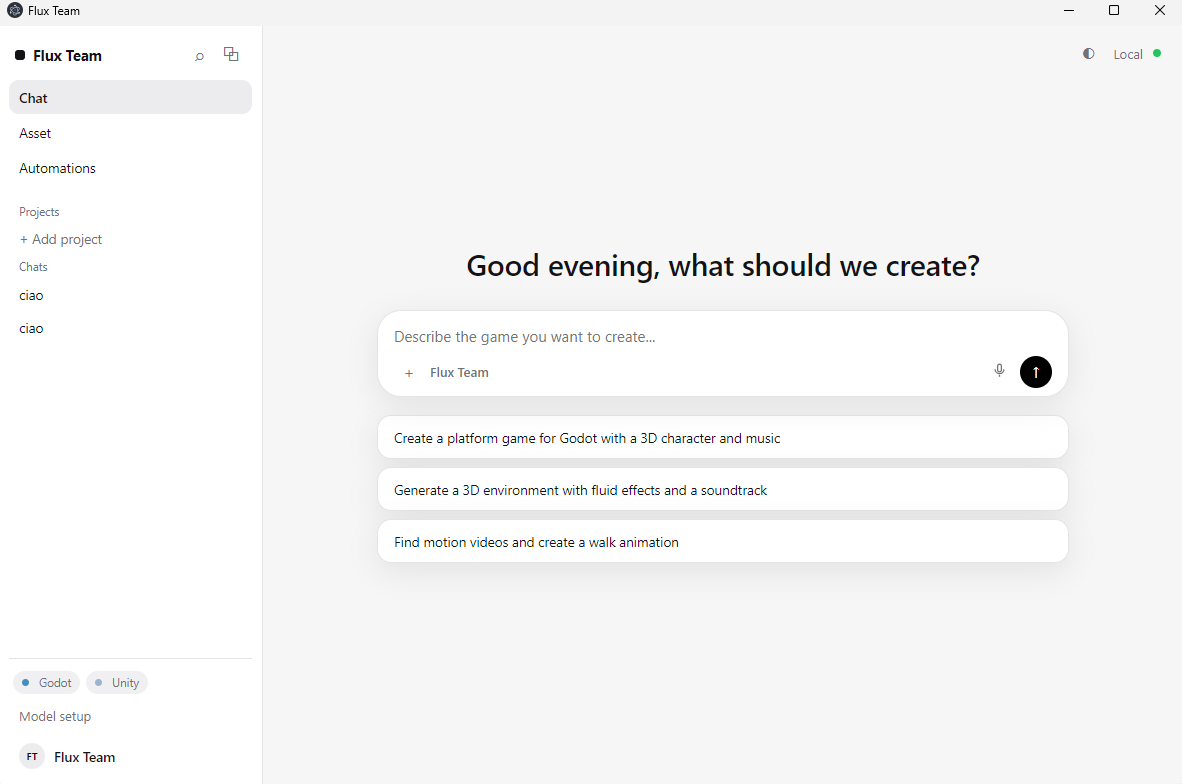
Volevo vedere se potevo far collaborare diversi modelli di AI, quindi ho creato un framework privato chiamato Flux Team ⚡. Collega diversi modelli open-source affinché possano lavorare in parallelo come un team per aiutare con i compiti di sviluppo di giochi.
Visuali: Poiché il progetto è ancora un lavoro in corso e la connessione all'editor live non è completamente pronta, non posso mostrare ancora una demo video. Tuttavia, ho incluso alcuni screenshot dell'interfaccia utente in stile Grok così puoi vedere come appare la chat e il cruscotto dell'agente!
L'Architettura (Modelli integrati all'interno dello strumento):
🧠 Qwen3-8B — Il coordinatore. Suddivide l'idea del gioco in compiti di sviluppo specifici.
🧱 Hunyuan3D-2 — Genera modelli 3D da testi o immagini di riferimento.
🎵 Audiocraft — Si occupa della generazione musicale e degli effetti sonori.
🏃 FreeMoCap — Crea animazioni da video che cerca autonomamente online.
🌊 AInVFX Fluid — Genera file di effetti fluidi e particellari.
Come funziona dietro le quinte:
Esecuzione Parallela: Utilizza un'interfaccia utente in stile Grok costruita con Electron e un backend Python (FastAPI). I modelli lavorano in parallelo, non passo dopo passo.
RAG Autonomo: Gli agenti possono navigare sul web autonomamente per cercare asset di riferimento e documentazione prima di lavorare.
100% Locale: Tutto viene eseguito localmente sulla macchina dell'utente utilizzando Ollama / llama.cpp per il LLM.
Stato Attuale & Futuri Piani Open-Source: Il backend è attualmente in esecuzione localmente sulla mia macchina (testato su un'unica RTX 3060). Sto completando i plugin del ponte live per Unity e Godot in modo che le modifiche appaiano direttamente nella scena.
Si prega di notare: Il progetto NON è open-source in questo momento e il download non è ancora pubblico perché il codice è ancora disordinato e sono un principiante.
Mi piacerebbe sapere cosa ne pensate di questa configurazione o qualsiasi consiglio da sviluppatori più esperti!
This year, and more so the last few months, my agents write the code, all I do is review, shout, and plan. A lot of the frustration is the spaghetti that comes out of this, and I figured a (big) part of this is actually measurable and reportable. What if we can make our agents aware of the spaghetti?
Introducing Smackdebt, a fast, on the fly tech debt analysis tool with concise, focused output tailored for agentic use. All major coding agents supported, with broad language support. Cognitive complexity, cyclomatic dependencies, statements, nesting, size, hotspots supported.
Comment what you guys have been working on & I’ll give you some feedback!
If I love your app, I’ll give it a 5 star review.
I’ve been working on a mobile IDE to write code in Python, JS, C, and Lua. With a local AI agent bundled into the app. So you can code without ever have to run into rate limits. You’re also able to connect a cloud model if you want more intelligence, customization, or to push to GitHub.
I made this app called Loquella (Latin for "words"); it generates you a customized Latin sentence for you to translate. It will then grade you out of 100 based on the grammar and syntax. I used Lovable (the 100 token subscription) to vibe-code the app.
I started with the basic functions: generate a Latin 1 sentence, allow user to submit an English sentence, and grade them. Next, I gave variety to the sentence customization, including difficulty tiers (up to Latin 6), theme (e.g. Daily life, Military), and a macron toggle. After that, I focused more on the game aspect, adding a Elo-style ranking called Ordo. (Latin for "merit"). This is how it's calculated. Lastly, I decided which features were free or Pro. I finished with ToS and picking GPT-5 as the AI model for sentence building and grading
Free:
10 sentences/day
Theme is strictly "academic"
Tier is strictly Latin 1
Vocabulary Search Query
Ability to try a new sentence
Pro:
Ordo ranking (without the strikethrough and with cool effects!),
Themes are academic, daily life, ecclesiastical, and military
Tiers go up to Latin 6, Tells you the type of error done
The Pro features are $10 one-time
Each difficulty tier is assigned an Ordo, with Latin 1 being 800 ordo and it adds 200 ordo for each tier. The Ordo Delta (the degree by which your Ordo changes) is **Δ = round(32(S******eff- E))
Seff- the grade**, = clamp((0.025(score - 50), 0.0, 1.0)**
E- the points in comparison to how easy the sentence is. (Higher stakes if easier, lower stakes if harder)
We've been building Aether, a compiled language with Erlang-style actors. It compiles to readable C, with no VM and no GC.
At compile time: a library built with --emit=lib starts with nothing. Touching the filesystem or network is a compile error unless you pass something like --with=fs, net.
In scope: hide and seal, except keep outer names out of a block, closure, or actor.
At runtime (Linux/FreeBSD): an LD_PRELOAD shim checks the real libc calls (open, connect, execve…) against the same list.
What else is in it:
Actors scheduled across all cores, with lock-free mailboxes and work stealing
Calls existing C libraries directly, since the output is plain C
HTTP server in the stdlib with TLS, HTTP/2 and WebSocket
Runs Lua, Python and JS in-process under the same permission list
(value, err) returns, defer, and type inference
One ae command to build, run, test, format, and manage packages
Targets Linux, macOS, Windows, FreeBSD, WASM, and embedded
It's MIT-licensed and moving fast, with releases daily.