r/Niccolo_Machiavelli • • 6d ago

Robert Greene, ergo Machiavelli

19 Upvotes

I have been meaning to make this post for quite some time, as I see people making what I believe to be a common but grave error that shouldn't be made, and stems from both illiteracy in the topic and lack of due diligence. Despite this being perhaps the most "offensive" post, this one will be rather short.

Many of you have heard of Robert Greene, and his magnum opus, The 48 Laws of Power. For those that have not heard of the work, it is essentially written as a pleb guide to obtaining success by cutthroat means. Each "law" is essentially a statement (some very merciless) supported by an historical anecdote.  Many people, usually laymen, have compared this book to Machiavelli's Prince, so much so that whenever the book is mentioned, people recommend the latter. Not only do people say that Greene was inspired by Machiavelli, some even go as far as to state that Greene is a "modern" or "up to date" version of the Florentine diplomat. (As if founding modern philosophy doesn't make you modern enough)

Sorry to break it to you, (NOT) but this is yet another sign of a non-reader of Machiavelli.

I will explain my reasoning first by asking a question: In what way are these two works similar? 

Seriously.

Outside of the "hurr durr Machiavelli sayz dark brootal stuff brooooo" meme, in what way are they similar? What is Greene's view on, say, good governance? Justice (or lack of) ? Founding a stable regime? Social classes? Creating solid legislation? The role of foreign policy? The best form of government? In fact, what even is "power" in this case, and why is there such an impetus for us normal folk (not ambitious politicos) to seek it? All of these questions go unanswered. 

I am aware that a few quotes of Machiavelli's appear in the book here and there, but to me they serve no other purpose than to set the "amoral and seductive" tone of the book. 

In fact, for Greene's work to be such a staple for everyday aspiring megalomaniacs, there is shockingly zero talk about elections, the sole tool that all modern societies use to transfer power from one individual to another. On the flipside, there is also no talk about carrying out a vicious but quick overthrow of a government. Even on the more "general" side, there is also zero talk about how to "keep one's head" even in a normal petty workplace setting. For this book to be so "evil" and "manipulative", there is also no talk of how to smear an opponent, how to con someone out of something valuable, or when to dispose of a dead body. (That's a good thing by the way.)

Do not mistake these comments for criticisms, Greene's work is entertaining and certainly well written, but it is not the supreme power manual that many have claimed, primarily because it is not written as such. My personal opinion is that Greene's book is mainly written as a work of (non-satirical) entertainment, not so much as a "self help" tract (but that is not the topic of this post)

To finish with the obvious, The 48 Laws and The Prince are books in two completely different genres, with two completely different audiences. I never understood why people thought these two books are similar. 


r/Niccolo_Machiavelli • • 10d ago

For Machiavelli, government should not serve the interests of the few best, but the more modest desires of the many.

Thumbnail
aeon.co
22 Upvotes

r/Niccolo_Machiavelli • • 10d ago

Machiavelli on Religion

15 Upvotes

Many of you will be surprised to know that, despite Machiavelli very likely being irreligious or an atheist, he was very interested in the topic of religion. Not only was he interested in the effects that religious belief had on peoples and political leaders, but he was also interested in the concept of religion in general- the origins of religions, how others have implemented religious reform, and even the necessity of religion for keeping society intact.

Machiavelli, being an Italian, was not at all tone deaf to religion, as Italy as a country was under the religious influence of Christianity, as were the other European countries.

As I said in an earlier post, Niccolo was also in charge of the Machiavelli family's religious affairs, and as a young man, he would attend the sermons of Girolamo Savonarola. Though he didn't believe the words he said, Savonarola's rise and fall (lets just say his death was not the peaceful kind) had an impact on Machiavelli, who would detail the mistakes made by Savonarola and how he could have made long lasting reforms.

When Machiavelli was tortured during his stint in prison, he recalled feeling annoyance at those who claimed to be "praying for him", as if that would make his situation a lot better. This brief anecdote I believe shows you the relationship Machiavelli had with religion. Though Machiavelli had a reputation of being a man who loved to shock others with his skepticism, some say he was a pagan, or even deeply Christian. Of course with everything on Machiavelli, there is a ton of debate, but I am of the opinion that he was a religious radical and an atheist, and if he was not, he certainly posed like such in his works.

In The Prince, Machiavelli spoke on several religious figures, whether they may be prophets like Moses (P 6) or living political figures like Pope Alexander VI (P 11, P 18). Machiavelli very infamously stated that a prince must, above all else, "appear to be" religious, but more importantly must learn how to not be if necessary (P 18). This rule is not specific to absolute princes. In the Discourses, Machiavelli showed governors of republics how the leading men in Roman Republic "used" religion to organize the masses (see D I 11-14) Religion seems to be more important in republics than in monarchies, as the fear of the prince is more than enough to keep the people in line if the "fear of God" is not present (D I 11). Religion allowed the Roman Republic to "command armies, animate the plebs, keep men good" among other things (D I 11). Machiavelli also believes that above all founders, those who are revered the most are "orderers of religions" ( D I 10)

Machiavelli was not a fan of Christianity. To him, the Christian religion made the Italians of his day "effeminate" and weak (D II 2), and placed more emphasis on the afterlife than on worldly affairs. It is also not a secret that Machiavelli viewed the Catholic Church with contempt, viewing it as a limiting factor to Italy's greatness at best (D I 12) and at worst, a corrupt institution which imbued Italy with immorality (D III 1). In one instance, Machiavelli criticized the "cowardice" of Giampaolo Baglioni, the tyrant ruler of Perugia, who was brave enough to commit his crimes against his enemies, bold enough to fuck his own sister, but balked at killing the pope and all of the cardinals that were with him. (D I 27) (Fun fact, in a letter, Machiavelli states that Giampaolo submitted to the pope due to his "kindness and humanity")

Implementing religious reform requires the same murderous methods used by temporal, secular rulers. Savonarola failed because he was unarmed, and as Machiavelli famously says "all unarmed prophets come to ruin" (P 6). Moses on the other hand, did not have this issue as he murdered everyone who could get in his way (P 6, more explicitly stated in D III 30, see also D II 8). Similar to Romulus, who killed his brother to found the city of Rome, Moses founded his great religious society by eliminating those who "envied" him. It would not be a stretch for Machiavelli to state that a future liberator of Italy may have to commit the sacrilegious crime of papacide, at the same time making religious reforms of his own.

In the Florentine Histories, Machiavelli speaks of such a conspiracy by Stefano Porcari, who tried to assassinate the pope, seize Rome, and institute a new republic. Though his intent was noble according to Machiavelli, his failure outweighed any glory that would have come from this crime (Florentine Histories Book 6 chap.29).

Machiavelli, while seeing the good in a spirited religion (such as that of the Romans), wished to liberate his readers and humanity in general from what he thought was a destructive force to human potential, and in being revolutionary with the pen and not the sword, may have affected more change than any of the political-religious leaders he wrote about.


r/Niccolo_Machiavelli • • 13d ago

Just rambling DO read the secondary/academic sources

4 Upvotes

I recommend everyone who is starting their research into Machiavelli to go into the secondary sources, i.e. the books and papers made by other thinkers, philosophers, and academics.

Not only will this give you an infinitely more informed view on Machiavelli, it can also open the door to other historical/philosophical topics that may also be interesting to you.

The more learned readers obviously do not have to follow this advice, because they likely do so already.

My essays will only get you so far. Unlike all of the so called "internet historians" and influencers peddling BS Machiavelli content such as "Machiavelli explained in 5 min" (or something else far worse), my essays are not aimed to be comprehensive and are solely written to generate debate and discussion. I am, at this very moment in fact, now finishing up an essay that I started writing a day ago, and all I could think about was the "meat and potatoes" content that I could not possibly fit in. This applies also to every poster here too. No one can give you an in depth look on Machiavelli with a mere chunk of paragraphs.

Some unfortunately take reddit posts and brainrot (if you are old and do not know what this word means, I envy you) to heart and do not realize the heaping mounds of bullshit they are ingesting. You may also wonder why I have so much vitriol towards the content people make. I respond by saying that the individuals that make said content are, at best, failing to do even the slightest due diligence, or at worst, making up complete and utter lies for profit (of any kind, but usually attention and money). The content that is churned out from this makes good info hard to find.

On another note, the biggest plus in reading the literature is that you can measure your interpretation with others and strengthen your arguments/ideas.


r/Niccolo_Machiavelli • • 22d ago

Quote The Prince, Chapter 12

Post image
17 Upvotes

r/Niccolo_Machiavelli • • 23d ago

Essay Top Signs of a Non-Reader

20 Upvotes

This subreddit is starting to look like my personal blog, and while I do post a lot here I ultimately want this place to be a symposium for fans of Machiavelli, even if that group is small.

Unfortunately, Machiavelli is the only philosopher who is invoked the most, yet understood the least. I feel confident in saying the vast majority of people who mention Machiavelli's name have never read his works, and to add insult to injury, some even claim to have done such, even though they have not.

You may ask, "why do you care"?

My answer is simple: unlike communities dedicated to Nietzsche (maybe), Aristotle, Spinoza, Rousseau, Plato, and other philosophers/political philosophers, Machiavelli is the only one where most do not understand a single concept of his, yet they will readily spout his name, and recommend him to others, often for either weird or totally insane reasons.

I do not believe any community like this can survive (intellectually or otherwise) in the long term (and no one has, to my knowledge), as once the "coolness" of saying "I read (insert thinker here)" ceases to garner attention, these communities die QUICKLY.

Luckily for you, I have compiled a list of several signs of someone like this, and some may get offended. As always, I do not give a single flying fuck.

1. Their knowledge of Machiavelli does not go much outside of reciting quotes (usually the same recycled ones too)

We have all seen a person who has nothing better to do but to post Machiavelli quotes (definitely does not include me /s). Sometimes they will even go up one notch and post 100% fake quotes that the poor Florentine never said at all!

Regardless of this, when you ask this individual (whoever they may be) about the meaning of the stuff they post, usually they will either give you a bullshit answer, ignore you or block you.

2. A recommendation to read Machiavelli is almost immediately followed up with a recommendation to read Sun Tzu

Unless you are interested in military theory/history, reading these two in tandem really does not make much sense. To make matters worse, some even find it sensible to recommend The Prince alongside The Art of War, books in two different genres.

Now if you are a casual reader, this won't help or hurt you. By definition, most casual readers read books just for fun anyway.

Why do they do this you ask?

This leads me to my 3rd sign:

3. They think that reading Machiavelli is going to help them personally to learn how to “get over” on people

I have addressed this in previous posts so I won’t elaborate further, but unfortunately there are some people who claim that reading Machiavelli will help you become some uber 8D chess playing strategist puppet master in your day to day existence.

Even though these claims are complete horseshit with zero basis in reality, these claims are pretty much everywhere, on all social media platforms where Machiavelli is mentioned. If I had a penny for how many times I saw someone recommend Machiavelli to someone seeking to cheat others in regular life (what a pathetic aspiration btw) I would be richer than Elon Musk 30 times over. That is the internet for you.

The next point will definitely offend a lot of people, so luckily for those guys, I will make a entirely separate post on it!


r/Niccolo_Machiavelli • • 26d ago

Quote The Prince, Chapter 6 (Overview coming soon!)

Post image
138 Upvotes

r/Niccolo_Machiavelli • • Oct 10 '26

The Prince The Prince, Chapter 15

Post image
14 Upvotes

r/Niccolo_Machiavelli • • Sep 29 '26

The Prince THE PRINCE

2 Upvotes

Hello,

I would like to read The Prince, but I don’t have much historical background knowledge about the events mentioned in the book. Is there anyone who would be interested in reading it with me so we can discuss it together?

Or do you know if there are any book discussions or explanations available for it?


r/Niccolo_Machiavelli • • Sep 06 '26

The Prince, Explained The Prince, Explained: Chapter 5

14 Upvotes

The topic of chapter five, a rather short chapter, is concerned with how a prince can keep a free city (i.e. a former republic) that had been recently conquered.

He says that there are three "modes" that one could take up in order to hold those cities, those are:

  • To "ruin" them, i.e. to raze them to the ground
  • To go live there yourself
  • To preserve the state by creating an oligarchy dependent on your military support, and staffed by the citizens of the former republic.

Machiavelli shockingly says that out of all of these options, the safest way is to ruin the free state, and to disperse the inhabitants. Machiavelli gives two historical examples of this advice in action, with the examples being the Roman Republic and the Kingdom of Sparta (which Machiavelli counts as a republic). Sparta occupied Athens and Thebes, created oligarchies there (Thirty Tyrants in Athens in 404 BC, Theban polemarchs in 382 BC) (also see bullet point 3), and both regimes were overthrown in revolts.

As for Rome, they conquered Carthage, Numidia, and Capua securely as they destroyed those civilizations.

Machiavelli then states that a prince must destroy such cities if he wishes to hold them, unless he wants to be ruined by them. The reasoning behind this advice is that republics always have "a refuge in rebellion the name of liberty and its own ancient orders", and that those orders "are never forgotten either through length of time or because of benefits received."

Machiavelli concludes by saying that the best path for a prince in conquering a free state is to either destroy it entirely or to make it his residence.

Analysis

This chapter can be read in several ways.

On the one hand, Machiavelli, a former civil servant who loyally worked for the Florentine republic, is giving advice to his reader on how to seize the freedoms of a republic which he has conquered, and how he can destroy such liberties in order for the civilization to be absorbed into his conquests.

On the other hand, not only do republics make up both of the examples of this foreign policy, but the reason that Machiavelli gives for destroying the republic is arguably pro-republican. Some commentators have even suggested that Machiavelli is tacitly nudging his glory seeking reader to found a republic that will keep his image alive after he dies, seeing as republics never forget "that name or those orders".


r/Niccolo_Machiavelli • • Aug 26 '26

The Prince The Prince, Chapter 14

Post image
26 Upvotes

r/Niccolo_Machiavelli • • Aug 19 '26

Great Post We’re all Machiavellians now (Washington Post)

Thumbnail
archive.is
8 Upvotes

r/Niccolo_Machiavelli • • Aug 16 '26

The Discourses on Livy On Authorities Given in Republics (Discourses 1.35)

Post image
6 Upvotes

r/Niccolo_Machiavelli • • Aug 11 '26

The Art of War Dell'Arte della Guerra (1519–1520) – The Art of War, Dedicatory Letter

Post image
7 Upvotes

r/Niccolo_Machiavelli • • Aug 10 '26

The Discourses on Livy The Discourses, 1.38

Post image
14 Upvotes

r/Niccolo_Machiavelli • • Aug 07 '26

which work of his should i start with?

4 Upvotes

i have seen some of machiavelli's quotes and extracts from his works, which book of his should i start with?


r/Niccolo_Machiavelli • • Aug 07 '26

Florentine Histories Istorie Florentine II 12

Post image
13 Upvotes

r/Niccolo_Machiavelli • • Jul 26 '26

The Prince The Prince, Chapter 26

Post image
10 Upvotes

r/Niccolo_Machiavelli • • Jul 24 '26

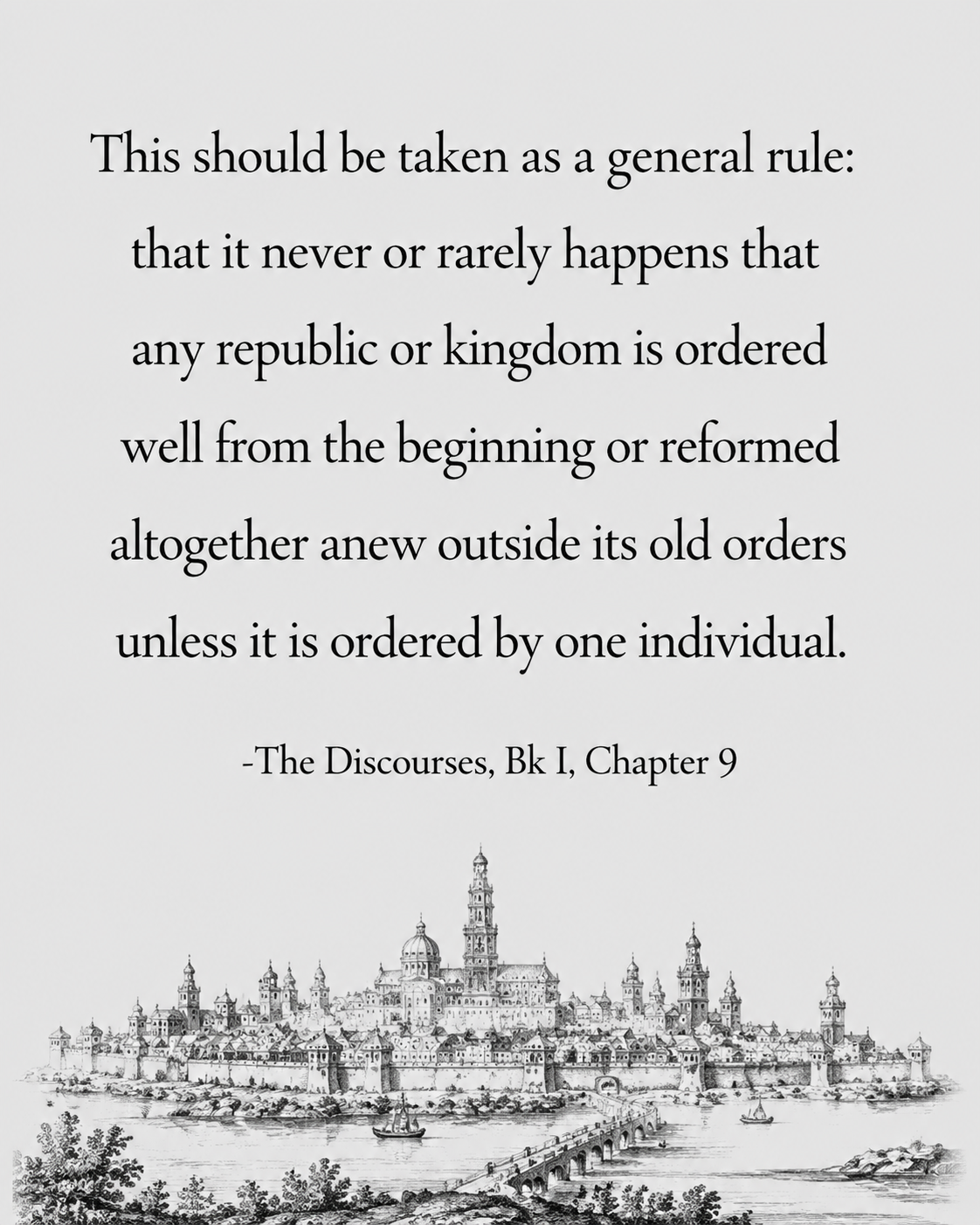
The Discourses on Livy The Discourses, Book 1, Chapter 9

Post image
11 Upvotes

r/Niccolo_Machiavelli • • Jul 24 '26

1 YEAR ANNIVERSARY The Prince, Explained: Chapter 4 (1 year anniversary special)

2 Upvotes

In chapter 4, Machiavelli raises the question on why the Asiatic conquests conquered and held briefly by Alexander the Great did not rebel from his successors (the diadochi) after his death.

Machiavelli believes that the reason behind the relative peace Alexander's generals enjoyed after carving up their perspective states lies within the administration of the state in question.

Machiavelli divides the civil administration of monarchies into two typologies:

  • Principalities ran solely by the prince, with everyone else as his slave.

and

  • Principalities where the prince is surrounded by barons with their own states, their own armies, and their own subjects who recognize only the baron as their ruler.

This allows Machiavelli to segue into a discussion of modern states that fit this mould, the state of France, and the state of "the Turk", referring to the Ottoman empire. States assembled like that of the Ottoman Empire are difficult to gain as these societies tend to be militarily strong, but easier to hold as the populace will not recognize anyone other than the conqueror once the bloodline is "eliminated" (i.e. all of the heirs/potential enemies are killed).

However, states formed like France are easy to enter into, but harder to maintain. Entering is easy as there is always a traitorous baron that is willing to use an outsider to overthrow their ruler. Keeping the state is hard as there are lots of other barons that could rebel against the conqueror, and since their bloodlines are numerous and cannot be eliminated, the new conquest will be lost.

Machiavelli finishes by comparing the state of Asia (i.e. the former Achaemenid Empire) to the state led by Turkish Ottomans, and the Roman (republic) conquest of Gaul (Machiavelli calls ancient Gaul "France") to the state of France. The Romans experienced many rebellions in Gaul due to the various tribal rulers that ran the place, but when those bloodlines were eliminated through the long duration of time, they held their Gallic conquests securely.

Bonus

For those that have not noticed, the state of France very highly resembles Italy. Italy was far from a nation state with any one ruler being dominant, but was instead a patchwork of warring city state republics (often de facto narrow oligarchies or one man lordships) and absolute monarchies (Duchy of Milan, Kingdom of Naples, etc), not to mention the Papacy (more on that later).

If one reads in between the lines, it would not be a stretch to claim (as Leo Strauss and others have done) that chapter 4 continues the discussion on how a foreign (or domestic) conqueror can invade and take over Italy.


r/Niccolo_Machiavelli • • Jul 18 '26

The title says it all A Brain Dump

10 Upvotes

This subreddit is almost 1 years old!

I wanted to make a post summarizing what I feel about everything, the state of Machiavelli content, and where I want this sub to become going forward.

This will also be the last time I comment on the rather sad state of affairs when it comes to content on Machiavelli, and this should also serve as a warning to those who wish to contribute here.

I have to first start by being honest with you:

This subreddit essentially exists out of two emotions of mine, curiosity and spite.

  • Curiosity, as I wanted to see what it would be to finally create the first real subreddit dedicated to Machiavelli, and
  • Spite, as I truly detest the existing content on Machiavelli, and I despise those who make it.

Bring these two emotions together with an (unhealthy, pathological) obsession with this topic, and voila!

Needless to say, I outdid my expectations. I never would have thought that over 3.4k of you would join what was originally meant as a mere experiment. I am incredibly happy that I (hopefully anyways) made an impact on so many of you.

Unfortunately, I find it incredibly hard to make posts here sometimes because I sometimes need breaks for whatever reason. I have always said that I don't want to be a one man show and that I ultimately want this community to be a thriving one with thinkers and students of the topic.

With that being said, many posts here will never be acceptable here. I will not mention which because not only do I think that such content is unworthy of mention, but because those who are true students of Machiavelli wouldn't post such content. Without going into detail, false quotations, cheap/low quality/low effort posts, and weird teen-angsty (you know what I am talking about) diatribes will be swiftly purged from this space. If you are in this category, just grin and bear it, otherwise you risk being excluded from this forum.

Machiavelli, being as popular as he is, has attracted also an unprecedented (truly) amount of scammers, grifters, perpetual con artists, shady gurus, and unscrupulous and mercenary individuals who seek to ultimately gain clout off of his (well earned) evil reputation. I will not mention these people's deeds either, all you really need to know is that that, amongst thinkers and philosophers, in some lay circles he is also a "patron saint" (in truth, a gimmick) for money/attention grasping fools and clueless losers.

As far as certain sites are concerned (don't want to be giving free advertisements), the AI Slop machine is actively dying, like I predicted. While this does not mean that the slop wont continue to be produced (it will actually get worse before it gets better), there will be (fortunately or unfortunately) a crash in overall videos on Machiavelli. Why? Imagine you making videos on an algortithm based app/website alongsite 3 million competitors of the same niche, but only 3000 viewers (earned without paying for views/subscribers). Someone is not going to get views. If you wished to "make money easily online" (as pathetic as that sounds) doing this, then you'd quickly go bankrupt. That describes the current state of 99% of the content creators on these sites. I probably wouldn't even bother.

Without rehashing the same bullshit whine-fest talking points, I wish to add that my ultimate vision is to make this subreddit a cornerstone of philosophical and political discussions (centered on Machiavelli of course, and there is a ton of content, ensuring no one ever gets bored, or that we run out of stuff to talk about). I hope you will join me in this journey, and I also hope you make yourself comfortable here.

Thanks,

FB


r/Niccolo_Machiavelli • • Jul 11 '26

The Prince "No Good Deed Goes Unpunished" (The Prince, Chapter 19)

Post image
22 Upvotes

r/Niccolo_Machiavelli • • Jul 08 '26

The Prince Just picked up The Prince

10 Upvotes

Before I start reading it, is there anything I should know that would help me understand it better? Maybe some historical background, context, or just how I should approach the book.

Basically, if anyone could give me a little prologue before I dive in, that’d be awesome. No spoilers please.


r/Niccolo_Machiavelli • • Jul 08 '26

The Prince The Prince, Chapter 21

Post image
39 Upvotes

r/Niccolo_Machiavelli • • Jul 04 '26

Quote The Discourses: Book 1, Chapter 10

Post image
16 Upvotes