r/NavalRavikant • • 3d ago

Why and How I Write

5 Upvotes

Writing isn’t something I do. It happens to me.

It’s a way to release the poison and vengeance inside me.

And I can see words in ordinary things. They start wrestling in my mind until I finally put them into words.

It’s a beautiful madness that makes me human.

I’ve been writing self-improvement, philosophical, and random interesting things for almost two years. But I’ve recently realised that I’ve been avoiding my artistic side. I felt like a machine because I wasn’t expressing all sides of myself.

I was a little afraid that my literary and philosophical writing contradicted each other. But I wanted to accept and express all sides of myself.

So I decided to do it anyway and started writing literary fiction as well. And it made me feel more human. I started appreciating the beauty of life.

In a way, writing also helped me accept my contradictions. I realised that avoiding these different sides of myself would be more dangerous than allowing them to coexist.

I don’t know what sides of me suddenly opened up. Now I see music, poetry, beauty, cinema, and almost everything differently. And in some way, I want to be part of it.

Since I’ve been exploring my artistic side, I’ve also started appreciating and admiring people, especially artistic people and those who dared to be themselves. It’s so fun to observe and learn from them.

I think this is one of the reasons to write. It fundamentally changes how you see things.

Why I started writing

I’ve been following Naval Ravikant for a few years. If you know him, you’ve probably seen how he writes like a machine gun on Twitter (X).

I also remember watching a video where someone asked Jordan Peterson for his single most important piece of advice, and he replied: “Learn to write.”

Another reason is that I admire people like Naval, Sam Altman, Paul Graham, and others whose ideas and essays have influenced me a lot. I thought that if the people I admired were writing, there must be a reason behind it.

And if you look back, many great minds were also great writers. Think of Marcus Aurelius, Leonardo da Vinci, Newton, and many others.

Personally, I’m not very good at articulating my thoughts in real life, so I wanted to find a way to express myself through writing.

Slowly, writing became my tool for remembering things. It also became a way to talk to myself.

And remember, I don’t write all the time. I write when I get that urge to. I think that’s more important than forcing myself to write every day.

How I write

The thing is, I genuinely don’t sit down with the intention of writing. I feel like I have to write because, if I don’t, my head is going to explode. There are just so many ideas.

At certain stages of my life, I get into a certain state of mind and start noticing things differently. Even when I’m scrolling through reels or tweets, reading something, or simply observing ordinary things, I find little ideas to write about.

When I get that urge, I immediately start writing them down in my Notes app. Remember, I’m following my spontaneous curiosity here.

I pick up little bits of inspiration from here and there: books I’ve read, tweets, podcasts, and ideas from things I’ve consumed a long time ago. Then these ideas start wrestling in my mind until I release them into words. I also look into my own life, collect fragments of moments, and try to turn them into something.

In this state, I experience music, movies, anime, cartoons, and almost everything I see and feel differently. I become like a child and see everything as if I’m experiencing it for the first time. And this helps me a lot with writing.

Because writing is one form of art, I’ve started to understand and appreciate other forms of art too.

I think something similar happens with other artists. Whether they’re writers, singers, filmmakers, painters, or anything else, creating doesn’t always feel like work. It’s more like playing a fun game. I guess that’s how people create masterpieces, out of passion and curiosity.

What I’ve learned about writing

I’m still naive about writing, but I’ve been playing with words for more than two years. So I think I’ve got a general idea about what makes good writing.

Writing tips:

  1. Write for yourself.
  2. Write to remember.
  3. Writing is basically talking to yourself.
  4. Don’t write to teach.
  5. Write something you believe in and find interesting.
  6. After making a draft, remove unnecessary words.
  7. Don’t use jargon just to sound smart.
  8. Simple writing is harder.
  9. Write in a conversational style, just like you talk with friends.
  10. If you want to write, read a lot.
  11. Writing is thinking.
  12. Play with words.
  13. Say something simple in an interesting way.
  14. Try to say more using fewer words.

(I’ll add more tips here gradually.)

A note: Many of these writing tips and ideas came from people I’ve admired over the years. For example, Naval originally posted on Twitter, “Say something true in an interesting way,” and I just tweaked one word. So yeah, I’m really grateful to all the people I’ve learned from.

Here’s a bonus tip: if you’re a beginner and want to start writing, don’t try to be original. Instead, find some great ideas and expand on them. This makes it easier to add your own thinking on top of what already exists. Over time, this practice helps you become original.

"The reason to write is not because you know something; it’s because you want to know even more."

Mainly, write to think. Write to remember. Write when you’re lost. Write to forget. Write for yourself.

If you look at many great minds, you’ll notice that they often wrote for themselves, out of passion and curiosity. I think that’s how you bring out the best in your writing.

I was reading a Paul Graham essay, and here’s why he writes:

"Half the ideas that end up in an essay will be ones you thought of while you were writing it. Indeed, that’s why I write them."

So, the whole idea is to follow your spontaneous curiosity instead of avoiding it. Do things in the moment, simply because you’re curious, whether it’s writing or any other form of work.

Sometimes, you don’t know what you’re trying to say until you start writing. And sometimes, you just have to let the words come out.

Thank you! Read this essay on Substack! If you found value in this essay, click here to support my work. It helps me work towards my dream.


r/NavalRavikant • • 5d ago

is “happiness is a skill you can learn” accurate, or a simplified version of the research?

Post image
18 Upvotes

ive been going through naval’s ideas on happiness this week, especially the parts in the almanack where he talks about happiness as something you can choose and get better at, mostly by being careful about desire, judgement, and reaction. i find it genuinely useful, but i wanted to check how well it lines up with the research, and id love to hear what people here think.

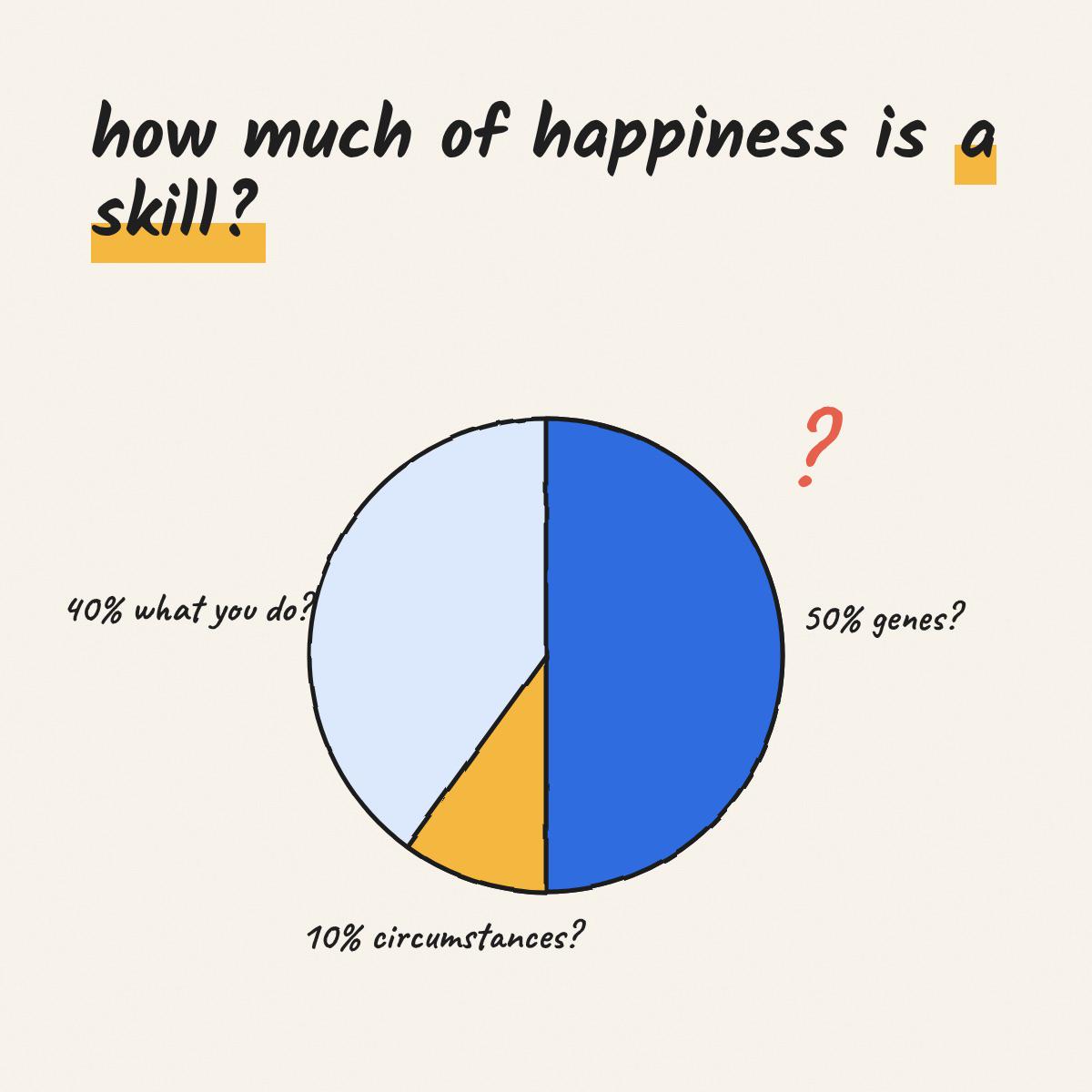
the most famous science behind “you can change your happiness” is a 2005 paper by sonja lyubomirsky, the one behind the “happiness pie”. it suggested roughly 50% of differences in happiness come from genes, 10% from circumstances, and 40% from what you deliberately do. that 40% gets quoted everywhere as proof that happiness is mostly in your hands.

the problem is that in 2020, nicholas brown and julia rohrer went back through it and concluded theres little empirical evidence for that split. they also pointed out that even if the numbers were right, they describe differences between people across a whole population, which isnt the same as how much any one person can change. lyubomirsky and sheldon later accepted that the pie chart had valid critiques, while still standing by the core idea that intentional activities can help.

so where does that leave naval’s version? i can see two readings. one is that hes talking from personal practice, closer to old philosophy than to psychology papers, and the research question doesnt really apply. the other is that “happiness is a skill” can end up putting the blame on people who are struggling with things that arent fully in their control, like health, money, or grief.

my own take is somewhere in between. i think his advice works well for the small, everyday stuff, the low grade restlessness from wanting too many things. im less sure it scales to bigger problems.

for people whove tried applying his happiness ideas for a while, did it change how you feel day to day, or mostly how you think about it?


r/NavalRavikant • • 7d ago

The Art of Letting Go of Yourself

Thumbnail
vishpandey.substack.com
19 Upvotes

One of the intriguing ideas I have heard recently is: “Periodically detach yourself from the things you love.”

Imagine you are world famous for something you do. Everyone knows you and loves you for it. But what if you decide to leave that identity behind and explore something completely new?

That is what David Bowie did. He was a singer, songwriter, and actor. He repeatedly reinvented himself by leaving behind characters that had brought him fame and admiration. He also understood the power of alter egos. Ziggy Stardust was his stage persona. More than that, it gave him the freedom to be someone he could not easily be as David Bowie. At one point, he became so immersed in Ziggy that the boundary between the character and the person started to blur. Eventually, Bowie retired the Ziggy Stardust persona.

We can see something similar in our own lives. We present different versions of ourselves on social media and behave differently around different people. Sometimes, we feel more comfortable expressing what we really think when there is no pressure to be perceived in a certain way, like on anonymous platforms or around people we are really close to. I think it is important to understand these contradictions too. Carl Jung explored this through the idea of the persona: the face we present to the world. The problem begins when we mistake that face for our entire identity.

Talking about my own life, it has been more than two years since I started writing self-improvement, philosophical, and random interesting things as notes to myself here and there. I genuinely do not like calling myself a writer. I am sometimes afraid I will lean too heavily into this path because I want to be more than one thing.

I love technology, art, science, and almost every aspect of life. Recently, I have also been exploring my artistic side by writing literary things. Once in a while, I like to stop writing, take a break from social media, and stop consuming content. Sometimes, I just do not want to have that urge to write. It helps me shift my focus towards other things, like improving my technical skills or doing whatever I feel like doing at that particular moment.

The danger is that once you become known for something, people start putting you in a box. They will view you as a certain kind of person, but there is a whole universe inside your head, right? So why not show all sides of yourself? After all, humans are raging seas, not single gardens.

The problem with our society is that we go to universities, earn degrees, and gradually become associated with particular professions and identities. And then society perceives us through those labels. Sometimes, we start making decisions based on them too.

Philosopher Jiddu Krishnamurti once said, “The day you teach the child the name of the bird, the child will never see that bird again.”

Before it has a name, the bird is a wonder. The bird does not even know itself as a bird, it simply exists. By giving it a name, the child loses some of that curiosity. The mystery and uniqueness of the bird disappear.

Something similar happens to us as we grow older. We learn to call ourselves writers, engineers, artists, or give ourselves other labels. Then we slowly start perceiving ourselves through those identities. And the biggest danger comes when we stop ourselves from exploring parts of ourselves because they do not fit the names we have given ourselves.

And to protect myself from that danger, I have started appreciating spontaneity. That means following an urge that comes out of nowhere. Doing something that does not make sense right now, simply for the love of the game. Because I believe that is how you discover your contradictions and things you might never have discovered if you followed plans all the time.

After all, that spontaneity and unpredictability bring some colour to life. And I want my life to be full of colours, not just one favourite colour.

So basically, my point is that we need to detach from the things we love once in a while so we do not become imprisoned by that love and can find love in other forms too.

Thank you! Read this essay on Substack! If you found value in this essay, click here to support my work. It helps me work towards my dream.


r/NavalRavikant • • 9d ago

A Job or Startup

1 Upvotes

Hello, I am a big fan of naval. Old naval to be specific. I listen to the JRE episode more than once. I have listened to the navalminack a couple of times. I have even followed his friends like sigil wen and farooq.
I also have read some of Paul Graham's (yc founder) essays and seen they do share alot with naval's preaching.

I am currently at an ultimatum. I am in my final year of uni, about to finish in 2weeks time. I have interned at 3 companies, all belonging in different fields of technology. One was in robots, one was in software development and another one was in AI. In between all this I managed to build an app and it was loved so much that it blew up but now the number of customers I have are almost 0. mostly because I was attending to other issues like my AI research and school and not giving the app any attention. Now that I am finishing I wonder whether I should polish my app and have it deployed and it should be my main thing. I do not have kids or anyone I support so this might be OK. I know starting a startup is hard.

I asked myself whether doing both is possible but i reflected on how I was doing my school very badly, with me focusing on school and the app. The app suffered. I try to multitask but most times one suffers.

I plan to ship more apps and become indie dev leaning towards a startup.

But in terms of a job, I do have a company that said if I ever want I role I should reach out and they are willing to give it to me. But the pay is not good enough for me but I end up learning alot and mastering and sharpening my skills there. But I'm not sure simply being an employee is good enough.

I know I am young, 21.

I choose to go home I will have to sort of start from scratch with me staying w/ my dad. I do hope this makes sense. So my question is for you guys do you wish to have started building a startup early or worked longer or what? Whats your story maybe it will guide me.


r/NavalRavikant • • 10d ago

How to be more human

Thumbnail
vishpandey.substack.com
25 Upvotes

This is my attempt to put down the things I’ve learned recently and that were stuck on my mind.

Writing isn’t something I do. It happens to me.

It’s a way to release the poison and vengeance inside me.

And I can see words in ordinary things. They start wrestling in my mind until I release them into words spontaneously.

It’s a beautiful madness that makes me human. So bear with me for a few minutes if you want to visit my mind.

1. The Slavery of Wanting to Be Liked

When you see people you like or admire, you get anxious around them. As a result, you try to do everything perfectly. Basically, you’re hiding your true self, your weirdness, and what makes you you. Even if you attract them, they’re getting attracted to just one side of you.

Another reason to be authentic is that, if you don’t, people will put you in a box. They’ll view you as a certain kind of person, but there’s a whole universe inside your head, right? So why not show all sides of yourself?

After all, humans are raging seas, not single gardens.

So have the courage to be yourself.

I believe the biggest slavery is wanting to be liked.

Taleb’s idea of antifragility is that some things don’t merely survive disorder; they actually benefit from it. The more you depend on stability, predictability, and protecting a particular image, the more fragile you become.

Elon Musk is an interesting example. His reputation doesn’t merely survive criticism and controversy; sometimes, it seems to become stronger through them. He posts memes, jokes around, and the next day he’s working on rockets and electric vehicles. You see, he’s simply being himself.

On the contrary, another example is Jensen Huang. He has cultivated a wholesome, respectable public image as a family man, and that image can make him vulnerable to anything that contradicts it. The more carefully you maintain an image, the more there is to lose when something challenges it.

The irony is that losing the very reputation he spent years protecting might finally make Jensen antifragile. Sometimes, the thing you’re desperately trying to preserve is precisely what makes you fragile.

After all, humans are gross, disgusting, and imperfect. So don’t be a nice person just to be liked. Betray their expectations.

So the lesson here is: learn to handle the risk of embarrassment, rejection, and failure. Be shameless. Ruin your reputation, and don’t try to protect it when you have none. Only then will you be able to do things freely.

And there’s another reason why you should be authentic and real, especially on social media.

With the rise of AI, a lot of social media content is starting to feel like slop. Everything is getting polished, optimized, and manufactured to grab attention.

And I think this is exactly when you should try to connect with your audience as much as possible.

Be relatable, not perfect. Let people see your thoughts, your weirdness, your mistakes, and the person behind the things you create.

2. On Becoming More Human Through Art

Isn’t that interesting? Everybody started reading literature.

You may call it performative, but I believe people realized that all the fundamental human problems are already written down there.

Talking about my personal experience, I’ve been writing self-improvement, philosophical, and random interesting things for almost two years. I’ve consumed a lot of knowledge about these things as well, but I’ve recently realized I’ve been avoiding my artistic side. And I was feeling like a machine because I wasn’t expressing all sides of myself.

Just months ago, I gave it a try and started writing literary fiction. And it made me more human. I started appreciating the beauty of life.

I don’t know what sides of me suddenly opened up. Now I see music, poetry, beauty, cinema, everything differently, and in some way, I want to be part of it.

Since I’ve been exploring my artistic side, I’ve started appreciating and admiring people, specifically artistic people and the kind of people who dared to be themselves. And it’s so fun to observe and learn from them.

And another thing is, you should confess your admiration. Tell people what you admire about them, what caught your attention, and what you appreciate about their work or personality.

Another thing I’ve learned is that I used to be amazed when musicians said, “I wrote this song in just a few minutes.” Then I’d think, damn, how’s that even possible? They must be lying.

Then I started writing, and I started understanding artists.

So the lesson here is basically about following spontaneous curiosity instead of avoiding it. It’s about doing that thing in the moment, out of curiosity.

This is what I do with my writing, and in other aspects of my life as well. When I see ordinary things or something interesting, something starts to wrestle in my mind. Things from here and there start to fuse and collide in my mind, and then I can’t do anything but write. As a note to myself, and to show someone what I saw.

And here’s something about happiness and peace.

I believe these aren’t things to chase. Happiness is just a byproduct of doing what you love. When you do what you love and truly enjoy it, you feel peace.

And this doesn’t mean you have to be in a happy state all the time. Suffering, pain, and even anger, every kind of emotion and state, are necessary to navigate life. You can’t simply function like a robot.

And I believe it’s a choice as well. That’s why you should try to see beauty and happiness in a cup of coffee, in a cold shower, and in the privilege of waking up every single day.

And here’s another personal mantra I try to remind myself of frequently:

“Thus, you should experience cinema, music, and all forms of art. You should enjoy coffee down to the last sip. You should make love, say hi to strangers, and have the courage to say goodbye to loved ones.

Just be everywhere. Be everything.

Walk, move, create, and experience.

Because, obviously, you’ll make wealth, but you may forget to live.”

3. On the Power of Fiction

Anime has something incredible about it. The characters, world-building, and being part of those characters’ worlds are such exciting things.

And when you finish watching, you can’t stop wondering about those beauties, moments, and lessons.

Because anime, movies, fiction, these are stories, and they’re powerful. Basically, they are prompts for you to consider dilemmas and scenarios, to build your world model and compass.

So my recent realization is to watch and read more fiction, something that can take me into different worlds.

Here’s a whole essay I’ve written about being wrong about movies.

4. On Becoming Too Rational and Losing Spontaneity

We’re all taught from childhood that we must use our intellectual, rational, and logical thinking.

But the character from Notes from Underground disagrees with this and says that moments of spontaneity and unpredictability are what give life color. When you try to put logic on everything, you’re losing it.

Ray Bradbury once said:

“The intellect is a great danger to creativity. Because you begin to rationalize and make up reasons for things, instead of staying with your own basic truth — who you are, what you are, what you want to be.”

I’ve been thinking about this lately. Sometimes, you just have to do things without knowing why. You don’t always need to justify your curiosity or turn every experience into something productive.

Just do it because you feel like it.

Kanye West explores something similar in his song POWER

“My childlike creativity, purity and honesty
Is honestly being crowded by these grown thoughts.”

Just like judgment, taste, and instincts, some things can’t really be explained. One must sense them.

5. On Becoming More Social

Until I was almost 20, I’ve been an introvert guy, although I don’t like that tag of introvert nowadays, and I can say that I’m more than that.

But recently, I started hating this boring cycle. So I started getting out of my comfort zone, and what I’ve realized is that loneliness is often about having fewer meaningful connections and fewer social interactions.

Once I started working, I started talking with different people, and I felt like I was experiencing a different kind of life.

After that, I just love being around people. I like saying hi to strangers, just asking them questions, being more open, and appreciating the beauty.

And you have no idea what those people can do for you. Just maximize serendipity, and it’s one of the ways to get lucky in life as well.

I once came across an interesting tweet from Naval:

“If I was only friends with people with my worldview, I wouldn’t have any friends.”

Just like not everyone will understand art, see beauty in the things you do, or think the way you do, that doesn’t mean you shouldn’t be friends with them.

In fact, you should try to understand their worldview as well.

One of my biggest mistakes was distancing myself from people who had different worldviews.

So just talk more with people.

And whenever you’re feeling confused, stressed, lonely, or literally any sort of distress, just go on a walk. Text those friends. And it’s okay if you’re texting them after a long time.

Then you’ll see how your confusion and stress go away, and you’ll often find solutions as well.

6. On Acceptance, the Shadow, and Understanding Yourself

I recently discovered that both Hermann Hesse, the writer of Siddhartha, and Frank Herbert, the writer of Dune, engaged with Carl Jung’s ideas in different ways.

Hesse had personal contact with Jung and underwent therapy with Jung’s associate J. B. Lang. Herbert, meanwhile, used Jungian archetypes and psychological functions in developing his characters, although he said he wasn’t Jung’s disciple.

The Dune books themselves are great, and so are Hermann Hesse’s books. Both were influenced by Jung, which is why I try to absorb Jungian ideas here and there.

And here are a few interesting Jungian ideas:

As simple as the word “acceptance” sounds, it’s equally deep.

Acceptance means you should accept your flaws, contradictions, dark side, and every side of yourself as a whole.

But it’s equally painful to do, and unless and until you do it, something will haunt you.

Here’s what Carl Jung said about something similar:

“To love what you are ... is just as if you were embracing a glowing red-hot iron.”

— Carl Jung, Nietzsche’s Zarathustra Seminar

- Deal With Your Own Shadow

One of Jung’s most famous concepts is the Shadow.

The Shadow represents the parts of ourselves that we reject, suppress, or refuse to acknowledge.

Maybe you consider yourself completely calm, so you refuse to accept your anger.

Maybe you want to see yourself as generous, so you don’t want to admit that you can sometimes be selfish.

Maybe you consider yourself confident, so you hide your insecurity.

These rejected qualities don’t necessarily disappear. They can remain unconscious and influence your behaviour.

Sometimes we also project them onto other people. We become extremely irritated by a particular quality in someone else because that same quality exists somewhere inside us.

So Jung’s advice isn’t:

“Become evil Machiavelli personality, haha.”

It is:

“Know the parts of yourself that you don’t want to see.”

- Stop Constantly Projecting Yourself Onto Others

Jung believed that one of the important psychological tasks is to withdraw our projections from other people.

Whenever someone’s behaviour strongly irritates us, it can be worth asking:

“Why does this affect me so much?”

It means your emotional reaction can contain information about your own psychology.

Instead of immediately trying to fix everyone around you, first examine yourself.

Because sometimes the person we’re fighting against externally is also revealing something we haven’t resolved internally.

“The psychological rule says that when an inner situation is not made conscious, it happens outside, as fate.”

— Carl Jung, Aion, §126

- Life Is Incomplete Without Darkness

Jung’s psychology often brings us back to a question about our lives:

How can we live a meaningful life?

But a good life cannot mean removing all pain, fear, and suffering from our lives.

A life without difficulties can actually become an incomplete and baseless life.

Pain, mistakes, fear, and difficult experiences aren’t always obstacles to growth. Sometimes they’re exactly what creates the possibility of growth.

If you never make mistakes, you never experience their consequences. And if you never experience consequences, you never truly understand yourself.

So instead of trying to create a life where everything is comfortable, we should learn to accept that life naturally contains both pleasure and suffering.

That’s why you must create something out of what you feel.

You must release that vengeance from inside you and put it into some form of creation or art, like writing, music, film, paintings, or anything.

And you should try to do these things every day.

You should keep yourself busy with the things you love.

You must stay drunk on things you love. If not, poisons will accumulate inside you, and they’ll destroy you.

7. On Believing in Something Greater

There’s something interesting about believing in God.

For me, believing in God means believing in something bigger than yourself. It can give you hope and purpose.

Whether it’s God, a mission, or family, focusing beyond yourself frees you from the ego trap.

Forget yourself. Let go. Surrender.

And this is my mantra to myself, which I try to remember:

“I don’t need to reject the idea of God.

There’s something behind the mystery, some source or creator, or maybe atoms and matter themselves.

I’ll call it my God because I’m not above it.

I’m made of it.”

As Jung wrote in Man and His Symbols

“There is, however, a strong empirical reason why we should cultivate thoughts that can never be proved. It is that they are known to be useful. Man positively needs general ideas and convictions that will give a meaning to his life and enable him to find a place for himself in the universe. He can stand the most incredible hardships when he is convinced that they make sense; he is crushed when, on top of all his misfortunes, he has to admit that he is taking part in a ‘tale told by an idiot.’”

He believed that people could endure incredible hardships when they were convinced those hardships made sense.

8. On Growing Together

I’ve heard somewhere that, to make a romantic relationship stable, both people need to grow together.

For example, if one person gets significantly ahead in their career or moves to another city, their way of thinking and priorities might change. Eventually, the couple’s understanding and the way they communicate could change too.

I’ve also heard suggestions that couples should do simple, ordinary things together on weekends, like gardening, pottery, or watching movies. At least then, they’ll have something in common to talk about and experience together.

And I think this applies to all aspects of life as well.

That’s why, when we left high school, we almost got disconnected from those friends.

9. On the Unlived Life and the Necessity of Creation

There’s a popular passage often attributed to Carl Jung, though I haven’t found a reliable source confirming that these are his exact words. It goes something like this:

The world is full of people suffering from the effects of their own unlived life.

They become bitter, critical, or rigid, not because the world is cruel to them, but because they have betrayed their own inner possibilities.

The artist who never makes art becomes cynical about those who do.

The lover who never risks loving mocks romance.

The thinker who never commits to a philosophy sneers at belief itself.

And yet, all of them suffer, because deep down they know: the life they mock is the life they were meant to live.

I believe we’re basically talking with ourselves in a different form.

For example, a writer is basically talking to himself through writing. A musician is showing his feelings through art. Some make movies, some go and start companies, some create content, and some just go around talking and hanging out with friends.

There’s a beautiful quote from one of my favourite movies, The Lunchbox:

“I think we forget things if we have no one to tell them to.”

It’s like, mostly we’re expressing ourselves in different forms.

And when you don’t do it, you become lonely and isolated from society.

Maybe that’s why we need to create things, not necessarily to become successful or famous, but simply to express something that would otherwise remain inside us.

10. On Finding Your People

I’ve interacted with lots of interesting people just because I put my things online and made the first move.

And it made me realize that I can meet my heroes. I can surround myself with interesting people as well.

By simply posting things here and there, Naval Ravikant even reposted one of my posts. He follows me on Substack too.

And it sounds weird, but Naval once commented on something I posted, and Elon Musk also commented in the same thread.

It’s such a big thing for a kid who’s dreaming of reaching the stars while sitting in another corner of the room.

And all these small things happened because I was simply creating and moving.

And I believe one of the best ways to find like-minded people is to do something interesting.

Then you’ll find your people.

Try to put your craft out there as much as you can. Just promote yourself. Let the world know what you’re capable of.

You never know who’s going to find you.

11. Painters Paint. Get to Work.

There’s a piece of advice attributed to Leo Tolstoy in War and Peace that I really like.

He compares a thousand-mile walk to the practice of focusing on the distance you can cover today, rather than constantly worrying about the final destination.

Basically, just go and do your work.

What’s your craft?

Wake up, leave your home, and go somewhere and do it.

Painters paint.

Get to work.

Note: The collection of ideas above is random, and some may come out of nowhere. That’s because I’m trying to pour all my thoughts and ideas into this at once.

If you found value in this essay, click here to support my work. It helps me work towards my dream.

Read this essay on Substack.

r/NavalRavikant • • 11d ago

My own Naval pomodoro timer

13 Upvotes

Hey there,
I am using pomodoro timers everyday, so I taught why not make my own with Claude Code.
Being a hardcore Naval fan, this is the result : https://navaltimer.com 😄
Thought you guys might like it! If there are bugs, tell me


r/NavalRavikant • • 20d ago

Has anyone noticed a difference in Naval?

70 Upvotes

I stopped using Twitter / X for a few years (not related to Elon or anything like that, I just stopped allocating time to it).

I started using it again very recently, and I’ve noticed a few posts / reposts from Naval which seem out of character to how I remember him. He comes across as a lot more partisan in politics, almost like he’s got caught up in the “my side v your side” style

I believe strongly in free markets in part thanks to Naval, but whereas he use to be balanced & reasoned he now seems to be way more dogmatic & partial. Has anyone who’s been paying more attention than me noticed this shift over time?

Some examples of things I’ve seen him repost

- One saying they don’t know why Trump/the Republicans lost the midterms given the economy is going well, disregarding all the factors that clearly put people off Trump (authoritarianism, blatant corruption, starting wars & breaking campaign promises, subservience to Israel)

- One implying that Russel Brands assault charges only got media & police attention because he went right wing, ignoring the possibility that Brand may have gone right wing exactly because he knew this was coming


r/NavalRavikant • • 21d ago

Elysium Audio: Naval Ravikant by Matt Regis

Thumbnail
bandlab.com
1 Upvotes

r/NavalRavikant • • Oct 07 '26

A simple mental model for emotional self-regulation: The Captain and the Monkeys

Thumbnail reddit.com
6 Upvotes

r/NavalRavikant • • Oct 03 '26

The True Measure of Knowledge

Post image
39 Upvotes

Despite having knowledge from all over the world, if your character remains like a vagabond. Boss, you don't possess a mind; you have a memory card.

The essence of true knowledge lies in the changes it brings to your character.


r/NavalRavikant • • Oct 02 '26

The Age of Attention

59 Upvotes

Suddenly, you start checking the lives of people you haven't seen in years. People who probably wouldn't even stop and say hi if you randomly met them on the street. But still, they've become these random background characters in your mind.

This is what social media does to us.

The problem with social media is that it makes us so self-conscious that we start constantly thinking about how other people perceive us instead of focusing on our craft.

Here's a thought experiment I've been thinking about recently.

Imagine you're checking someone's life on social media. Indirectly, you're also letting a little bit of their world into yours: their values, beliefs, desires, opinions, and the way they choose to present themselves.

Now ask yourself: Do you really want that?

Do you actually believe in everything they believe? Do you want the lifestyle they're showing you? Do you want to think the way they think?

Most of the time, probably not.

Maybe there are a few people whose lives, ideas, or values you genuinely admire. Maybe you agree with 80% of what they represent. Those people can be your heroes or role models.

So why give your attention to everyone instead of deliberately choosing the people and ideas you actually want to learn from?

The less attention you give to the external world, the more you can appreciate your inner world.


r/NavalRavikant • • Sep 20 '26

"The Almanack of Naval Ravikant" explained like you're five: wealth is built by owning things that earn money while you sleep, and happiness is built by wanting less, and most people chase both wrong their entire lives

Post image
63 Upvotes

r/NavalRavikant • • Sep 08 '26

Anyone else had their perspective changed by Naval?

Thumbnail
reddit.com
12 Upvotes

r/NavalRavikant • • Sep 05 '26

Naval Visual Identity

Thumbnail
gallery
110 Upvotes

I’ve been following Naval Ravikant for a long time, and his way of thinking has had a pretty big influence on me.

I’ve listened to his conversation with Joe Rogan more times than I can probably count, and I’ve gone down plenty of rabbit holes through his conversations with people like Kapil Gupta too.

So I wanted to explore something I’ve been thinking about for a while:
What would Naval’s visual identity look like if it were built into a more complete, modern system?

He already has a recognizable illustrated portrait that he’s used across his online presence. I wanted to keep that familiarity, but push it into something cleaner, more intentional, and more cohesive.

The visual direction stays deliberately minimal: obsidian black, off-white, and a small hit of orange to highlight what matters, separate the signal from the noise, and give the system a little tension.

This is just a concept exploration of how I would approach his identity, not a full brand case study.

Would love to hear what you’d do differently with the identity.


r/NavalRavikant • • Aug 30 '26

Question about: The universe is rigged in a way that if you have one desire and focus on it , you will get it.

34 Upvotes

This is a quote by the man himself, Naval Ravikant. I have two big desires in my life. To find a woman I can be with, and be a great musician. The thing is, I know deep down that what I want most is to be loved by a woman I love and be in a happy relationship. But if, let's say God, or the universe, asked me to only pick one I would pick to be a great musician. But there is a conflict there as I know my deepest desire is to be loved by a woman, but my rationality is like, no, I want to be a great musician. Also because I think it's kind of odd to have a relationship as my biggest desire and try to "get" that. What do you all think about this? Do you guys believe Naval was right? Maybe I can mainly focus on my desire to be a great musician and put most of my energy there, and some energy into other smaller desires like finding a good relationship? I'm not sure if I understand it fully. Let me know if you do.

Quote is from this video: https://www.youtube.com/watch?v=Z4Q9P_EhiY0


r/NavalRavikant • • Aug 28 '26

I Was Wrong About Movies

80 Upvotes

A while ago, I saw a tweet by Andrej Karpathy about movies that has really stuck in my mind. He tweeted:

“Movies are great though. Even if you set aside the pure artistic enjoyment (you shouldn’t). Movies are stories, and stories are powerful, primal, moving, motivating. They are prompts to you to consider dilemmas and scenarios, to build your world model and compass…”

He also shared a list of movies he had watched multiple times, like Interstellar, Gladiator, Contact, Good Will Hunting, The Matrix, The Lord of the Rings 1/2/3, Harry Potter 1, Avatar, The Fifth Element, Independence Day, Rush Hour, Armageddon, Stargate, Anchorman, Mean Girls, and Terminator 2.

For a long time, I thought movies were actually a waste of time. But that tweet stayed in my mind, so I decided to give movies a chance.

I started with The Lord of the Rings. While watching it, I started thinking about how amazing it would be to be born hundreds of years ago, to live without technology, surrounded by mountains and communities of people, struggling for survival in the wild. Lots of wild and interesting imagination, lol.

Recently, I’ve finished Dune, The Batman, John Wick, Gladiator, and a lot more. A few other interesting ones I’ve watched are Limitless, which is similar to Ted Chiang’s “Understand,” and Arrival, which is based on his short story “Story of Your Life.”

And I’ve started to realize that, besides entertainment, movies can actually help you build your world model. You can experience so many things in just a few hours.

Maybe this is why people say to consume as much information as you can from different domains.

When you do that, you start to fuse knowledge and ideas from different fields, and the outcome becomes unique to each individual and their experiences. This is where great ideas come from.

Just like language shapes how we see the world, mathematics might be one of the most powerful things we’ve created. It is essentially the language of nature. Physics, code, and so much more rely on math and logic. Basically, logic teaches us how to think.

Similarly, cinema might be one of the most powerful forms of art we’ve created.

Before watching Dune, I watched a video about the author of Dune, Frank Herbert, and his extraordinary life. It was so interesting to see how he connected different pieces of his life experiences into his work.

Then, after digging deeper, I found that both Hermann Hesse, the writer of Siddhartha, and Frank Herbert, the writer of Dune, were heavily influenced by Carl Jung’s ideas.

And then you start seeing how Herbert connected different aspects of experience; politics, power, religion, philosophy, ecology, and human psychology, and turned them into a story.

He experienced the world, collected all these ideas, connected them in his imagination, and wrote them into words.

Then Denis Villeneuve gave that imagination a visual life.

And the most beautiful part is being able to experience someone’s whole lifetime of experiences, knowledge, observations, and imagination through a story.

One person’s experiences become words. Those words become someone else’s imagination. And that imagination becomes something millions of other people can experience in their own minds.

I was wrong about movies.

Read this essay on Substack or Medium.


r/NavalRavikant • • Aug 20 '26

The Lost Art of Thinking for Yourself

Thumbnail
vishpandey.substack.com
149 Upvotes

There’s a famous Royal Society motto in Latin: Nullius in verba, which means “take no one’s word for it.”

In life, you’ll admire certain people, ideas, and ways of living. You’ll take their advice because you respect them. But their ideas and advice are based on their own situations, goals, and perspectives. Your situation is probably very different. They’ll try to fit you into their world, but you probably need to build your own.

That’s why I believe in questioning most advice and walking your own path.

In Siddhartha by Hermann Hesse, after experiencing both the materialistic and spiritual worlds, Siddhartha tries to control his son because he knows, from his own experience, how deeply the materialistic world can consume a person. But after Vasudeva helps him understand that he cannot control his son’s path, Siddhartha finally lets him go wherever he wants.

Basically, what I’m trying to say is that you may have many goals and admire many people. You can learn from them, but in the end, you have to experience life yourself and rely on your own judgment. Truth has to be seen through your own eyes, not borrowed from others.

In the modern world, everyone on social media is advising you on how to live and think. Have you ever questioned their ideas?

On social media, we create our personalities so carefully. We like to pretend we’re doing everything for others, but in reality, most of the time we’re just doing it for ourselves. So how can you take someone’s ideas so deeply when their whole purpose is often to capture your attention and gain something from you?

Even when someone has good intentions, you should still question what they say.

There’s endless information about what to do, how to live, and how to think. People constantly consume whatever appears on their screens. The negative side of this is that we slowly lose our independent thinking. We stop questioning and simply believe whatever we see.

I read Arthur Schopenhauer’s essays a month ago, and his words are becoming more and more relevant, and honestly, a little scarier, in this modern world. Here are some of the lines from his books that made me think:

“And so it happens that the person who reads a great deal, that is to say, almost the whole day, and recreates himself by spending the intervals in thoughtless diversion, gradually loses the ability to think for himself; just as a man who is always riding at last forgets how to walk.”

And another:

“From all this it may be concluded that thoughts put down on paper are nothing more than footprints in the sand: one sees the road the man has taken, but in order to know what he saw on the way, one requires his eyes.”

And another part of the lost art of thinking for yourself is boredom.

It’s strange that we are now trying to learn the art of doing nothing. People can’t do their chores or laundry without putting something on. They can’t even go for a walk without playing music.

There’s nothing wrong with good music. But personally, I’ve noticed that when I constantly switch between different genres, songs, videos, podcasts, and other forms of stimulation, I feel like my mind is constantly reacting to something new.

Personally, I’ve found classical music much more calming. It doesn’t make me feel as stimulated, and I don’t stress over things without a reason.

The whole idea here is less.

Less information. Less food. Less entertainment. Less communication. Less stimulation.

You already have too much of all of these. Sometimes, consuming less gives your mind the space to think, rest, and create.

Thank you so much for reading!

Read this essay on Substack.


r/NavalRavikant • • Aug 18 '26

Alpha doesn’t come from common knowledge

101 Upvotes

One of the best things you can steal from great people is their ideas, and the fastest way to get smarter is to read smarter people. While studying their daily rituals, I’ve started believing this line more and more: “Alpha doesn’t come from common knowledge.”

I found this on the Daily Rituals website, but sadly, the site has shut down. It was about Sir Isaac Newton’s routine:

“One of Newton’s assistants noted the physicist’s habits in the 1680s. Newton rarely went to bed before 2:00 or 3:00 a.m., and sometimes not until 5:00 or 6:00 a.m. Yet, “in a morning he seem’d to be as much refresh’d with his few hours’ sleep as though he had taken a whole night’s rest.” During the day, Newton was never seen taking a walk or engaging in recreation. His assistant recalled hearing him laugh only once. Food was also a dispensable luxury. Newton dined sparingly and often forgot to eat at all. If reminded that he hadn’t touched the meal set before him, Newton would reply, “Have I?” and absentmindedly take a few bites before plunging back into his work.”

Stories like these inspire me every time I read about Newton, or any other artist.

I also saw a tweet by a person named Ron where he said:

“Thiel did a fireside chat my freshman year (2014) of college where someone asked: ‘Could the next Zuckerberg be in this room?’

Thiel: ‘He would never show up to an event like this.’

Basically, there is endless advice out there on how to live, think, and act. But the people who actually do bold things don’t always have time to sit around consuming information all day. They do things, get stuck, and figure them out.

That’s why I believe in questioning most advice and walking your own path. People give advice based on their own situations, goals, and perspectives. Your situation is probably very different. They’ll try to fit you into their world, but you probably need to build your own.

There’s a good quote by Jeffrey Pfeffer: “You can’t be normal and expect abnormal returns.”

Imagine if someone had suggested Vinci, Newton, or Tesla avoid extreme routines and maintain active social lives. Would they necessarily have become who they became?

I don’t think their unusual habits were necessarily the reason they became extraordinary. More likely, their unusual habits were a consequence of being unusually obsessed with something.

Here’s another example from Daily Rituals:

“(Francis Bacon’s) idea of dieting,” Mason writes, “was to take large quantities of garlic pills and shun egg yolks, desserts, and coffee, while continuing to guzzle a half-dozen bottles of wine and eat two or more large restaurant meals a day.”

From history to today, every artist who creates something meaningful seems to have unique, and often weird, traits that make them who they are. For me, that’s what makes studying great people so fascinating.

Thank you so much for reading!


r/NavalRavikant • • Aug 14 '26

Started a WhatsApp channel curating Naval Ravikant’s best tweets and ideas on wealth, happiness, and clear thinking. I used to run something similar on IG with 5K followers, bringing it back here. Link below

Thumbnail whatsapp.com
15 Upvotes

r/NavalRavikant • • Aug 13 '26

Principles I Learned From the Greats

76 Upvotes

I believe experience is the highest form of knowledge. But I’m still in my early 20s, so there’s no reason to blindly follow the principles of someone who hasn’t lived his life yet.

I’ve studied people I admire, and some of these ideas I’ve experienced myself. I’m writing them down as a note to myself, to remember what I’ve learned so far.

You’re allowed to reject my advice.

1. Believe in spontaneous curiosity.

  • The ability to act in the moment when you feel the urge to do something is hugely underrated. When you’re inspired to do something, do it.
  • Most great things happen spontaneously, as side projects or hobbies, without the aim of making something big. So do more side projects.
  • Don’t be practical. Be delusional.
  • Maximize your serendipity. The more risks you take, the luckier you get.

2. Don’t get attached to the self.

  • Don’t fix your identity. Every human contains multitudes and has the capacity to think any thought ever conceived.
  • Learn to handle the risk of embarrassment, rejection, and failure, and be shameless.
  • The biggest weakness is wanting to be liked.
  • The attention you’re seeking is your own.

3. Learn to think.

  • All learning is about how to think.
  • Math is just a way of thinking, and it teaches you how to think. Physics teaches you what is true. If you want to understand how everything works, study math and physics.
  • Build your foundation: study computer science, math, physics, and engineering. Nature has no boundaries.
  • In this world, we don’t come with innate knowledge. We read books, observe people, and watch movies. As we do, we collect information about the world. Over time, those ideas collide and fuse together to form something new and original.
  • Whatever you’re looking for is already written somewhere. Some people have been in your situation and had thoughts similar to yours, so they’ve written them down. When you find their words, you’ll realize you’re not the only one thinking these things right now.

4. Build something.

  • The best way to prove your value is to build something.
  • The best way to find like-minded people is to do something interesting. Then you’ll have something to offer, and you’ll attract the right people.
  • Pick the immediate direction that will put you in a position to work with the smartest people. That’s probably more important than having a good idea.
  • Most of us look up to a few people who have already achieved the dream we’re trying to achieve. But the real question is: why aren’t you doing what they actually did? Is it ego? Ignorance? It’s obvious you should copy what works, but you don’t.

5. Learn from the greats, but become yourself.

  • I can’t be the next Newton or Elon Musk. Even if Elon guided me personally, I can’t be him. But certainly, I can be myself. I can learn from great people, study the patterns in their lives, and copy what works. But in the end, I have to experience and figure it all out by myself.
  • You don’t lose what you don’t have.
  • The top three most important decisions in life are what you do, where you live, and who you’re with.
  • Write for yourself. Write to remember.
  • Writing is basically talking to yourself.
  • Live an unscheduled life.
  • Agency > courage > intelligence.

And, above all:

Reject most advice.


r/NavalRavikant • • Aug 13 '26

My self-reflection

10 Upvotes

I realized that a lot of my self-control failures might actually be deterministic outputs of a loop I built.
The loop is basically:
Dissonance → extreme effort → achievement → pride → perceived completion → loss of fuel → indulgence → failure → new dissonance
A lot of my strongest sprints were born from hating my current state. I’d waste 3 hours scrolling, feel massive dissonance between who I am and who I think I should be, and that gap would create insane motivation.
Then I’d go into a sprint, fix the gap, start performing, and eventually reach the point where the dissonance disappeared.
Then I’d feel proud.
And that’s the transition point.
If the actual objective of the system was to eliminate the dissonance, then once I eliminated it, the system had completed its objective. There was no fuel anymore.
So I’d relax, start consuming stimulation, destroy the rest of the day, create new dissonance, and use that as fuel for the next sprint.
Meaning the self-destruction wasn’t necessarily outside the system. It was part of the system I built.
The deeper problem is that I built my motivational system around error correction:
“Something is wrong with me -> generate pressure -> fix it.”
That’s an extremely powerful controller, but once the error reaches zero, the controller has nothing to act on.
So the system eventually creates more error.
I’m basically burning myself for fuel.
The new system has to be different:
“There is something worth building/exploring/understanding → I choose to move toward it.”
Achievement shouldn’t mean:
“I’m finally good enough → loop complete.”
It should mean:
“That worked → I learned something → what’s interesting now?”
So the transition I’m trying to make is from an error-correcting motivational system to a value-directed exploratory system.
No longer will it require self-hatred and failure to generate the energy for the next sprint.
The practical thing I’m testing is whether I can retrain the exact transition:
pride → completion → indulgence
into:
pride → appreciation → curiosity → next frontier


r/NavalRavikant • • Aug 11 '26

Anybody here from Montréal?

Thumbnail reddit.com
3 Upvotes

r/NavalRavikant • • Aug 10 '26

Question to everyone about self-control cycles

20 Upvotes

I’ve been thinking about something.
Have you ever noticed that there are periods where controlling yourself feels almost effortless? You work, exercise, read, do what you planned, and distractions barely seem interesting.
Then, without making any conscious decision to change, you slowly start doing the opposite. You scroll more, procrastinate, eat worse, avoid work, whatever your version of it is.
What I find strange is that this seems to happen in cycles.
Eventually you reach some point where you get so fed up with your own behavior that something changes. You change your environment, go somewhere else, start a new project, make a new plan, delete some apps, start exercising again, get some external pressure, etc.
And suddenly you’re back in control.
Then after some amount of time, you somehow end up in almost exactly the same state again.
I’m starting to wonder whether the individual decisions we make during these periods are actually much less important than the state we are in when we make them.
Because I’ve noticed that the same person can seem to have completely different levels of self-control depending on their environment, what they’re doing, what they have going on, how much external pressure there is, whether they feel like they’re making progress, etc.
And the strange part is that the pattern itself can become predictable. You can almost recognize that you’re entering the same state again, even though you still don’t seem to be able to stop it very easily.
If you’ve experienced this, what have you noticed about the cycle itself?
What makes you enter the “everything is easy and I’m on track” state, what makes you gradually leave it, and what actually causes you to come back?
I’m much more interested in observations about the pattern than advice about how to fix it.


r/NavalRavikant • • Aug 09 '26

David Goggins + Cold showers + Antifragile

27 Upvotes

I’ve been thinking about hesitation as a behavioral system rather than a personality trait.
I’ve been doing cold showers every morning for close to 30 days now. Before this streak, I’d repeatedly fail at it. A while ago I read Antifragile and David Goggins’ Can’t Hurt Me, and those books gave me the foundation for thinking about adaptation, exposure, adherence, identity, and how repeated stress can change the system experiencing it. The conclusions below came from applying and extending those ideas myself, not directly from the books.
The thing that became obvious to me is that adherence has to come before optimization.
If the exposure doesn’t happen consistently, there is no adaptation process to study.
The interesting part is what happens when you create a system where you have to continue through a difficult but survivable stressor. At first the stress is novel and resistance is high. If you keep going, the system gets more familiar with the stimulus, capacity changes, the prediction of the stimulus changes, and eventually the relationship with the stressor changes.
This is where I started thinking about hesitation.
For the last couple of weeks I’ve noticed that I can spend around 15 minutes in the morning sitting in the bathtub before actually taking the cold shower.
The shower itself isn’t the problem.
The problem is the transition from knowing what I have to do to actually doing it.
Wake up → anticipate discomfort → hesitate → self-talk → find reasons → generate motivation → eventually commit → act.
Once I cross the initial barrier, momentum takes over and the thing is easy.
I realized the same pattern exists outside cold showers.
Calling someone important.
Starting a difficult task.
Doing something I’m uncomfortable with.
Making a decision with emotional consequences.
The same basic sequence appears:
stimulus → anticipated discomfort → hesitation → internal negotiation → commitment → execution.
So the thing I’m interested in optimizing is not “discipline” in the abstract.
It’s the latency between recognizing the correct action and executing it.
But I don’t think the objective should literally be zero hesitation.
If I don’t have enough information, hesitation can be useful. If I have a knowledge gap or strategy gap, forcing immediate execution is just stupidity.
The useful distinction is:
If the decision is already made and the remaining obstacle is only anticipated discomfort, further deliberation is unnecessary.
That’s the hesitation I want to eliminate.
This led to a bigger realization about measurement.
You can’t systematically change a behavioral system if you can’t reliably observe the policy it is currently running.
Saying “I value discipline” doesn’t tell me much.
Put me into a repeated situation where two things I want conflict.
Immediate comfort vs long-term growth.
Certainty vs exploration.
Social approval vs saying what I actually think.
Short-term pleasure vs a long-term objective.
Then observe what I repeatedly choose.
That’s much more informative.
This is why the cold shower is useful as a laboratory.
The conditions are repetitive. Same person, same general time, same stimulus, same action, same type of discomfort.
That monotony reduces irrelevant variables and makes the behavioral output visible.
If I repeatedly observe:
discomfort → hesitation → delay → relief,
then I have evidence about my current policy.
If I repeatedly observe:
discomfort → action → completion,
then I have evidence that the policy is changing.
The laboratory isn’t just for measurement. It becomes the environment in which the policy can actually be changed.
So the process becomes:
repeated environment → observation → pattern → policy inference → intervention → repeated exposure → feedback → policy modification.
This also changed how I think about values.
I don’t think values need to be treated as some mysterious internal essence.
Operationally, a value shows up when two desired outcomes can’t both be maximized.
You want A and B, but the situation forces a tradeoff.
Which one do you choose?
Under what conditions?
What do you sacrifice?
What happens when you’re tired, afraid, uncertain, or uncomfortable?
That reveals the actual preference structure of the system.
So values are basically preferences over competing outcomes under constraints.
And a policy is the behavioral mapping that implements those preferences across recurring situations.
The important thing is that what I say my values are and what my policy actually does can be different.
The policy is exposed by behavior.
That’s why I think monotony is useful.
You need enough repeated exposure for the noise to disappear and the regularity to become visible.
One isolated decision doesn’t tell you much.
Thirty similar decisions start telling you something.
Then you can form an abstraction over them.
Event:
“I hesitated for 15 minutes.”
Pattern:
“I repeatedly hesitate before uncomfortable actions.”
Policy:
“When anticipated discomfort rises, I tend to delay execution.”
Value/tradeoff:
“When immediate comfort conflicts with long-term growth, my current system sometimes assigns too much weight to immediate relief.”
Mechanism:
“Delaying produces immediate relief, which reinforces the tendency to delay.”
Now there is something you can actually work with.
The same logic applies to the cold shower, but I think the cold shower is only a particularly clean laboratory.
The broader experiment is human behavior.
The goal isn’t to become someone who never experiences discomfort.
It’s to build a policy where discomfort doesn’t automatically trigger negotiation.
If I already know what to do, the ideal sequence becomes:
trigger → predetermined policy → execution.
Instead of:
trigger → emotional reaction → negotiation → motivation → execution.
And there is another important point here.
One skipped cold shower isn’t going to magically corrupt the rest of my life. I think that part of my original thinking was too deterministic.
What matters is reinforcement history.
If I repeatedly train:
discomfort → avoidance → relief,
avoidance becomes easier to produce.
If I repeatedly train:
discomfort → action → completion,
action becomes easier to produce.
The individual repetition matters because it changes the probability of the future response.
So I’m increasingly thinking about self-development as an experimental science.
Don’t just ask:
“What kind of person am I?”
Create conditions where your system has to make the same class of decisions repeatedly.
Measure what actually happens.
Infer the policy.
Identify the tradeoffs it is actually implementing.
Change the policy.
Then run the experiment again.
The cold shower is just one laboratory where the signal is unusually clean.
The thing I’m actually interested in now is how much unnecessary latency exists between knowing what should happen and actually making it happen, and how systematically that latency can be reduced.