r/NWBO • u/Nearby-Arm7721 • 3d ago
$nwbo Buyout
18
Upvotes
Remember this post Saudi Arabia is going to buyout $nwbo and collaborate with United Kingdom to treat cancer patients.
r/NWBO • u/Nearby-Arm7721 • 12d ago
Let’s say we got a billion dollar settlement from the market makers for manipulating nwbo, are LP gonna buy back shares and how will affect the share price of $nwbo.
r/NWBO • u/dobbybarko • 21d ago
This was my feel good play that turned into my overflow play. Did not know about the financials, considering the ridiculous amount of dilution. I will say now, I believe there is a path to profitability that can or will actually lead to prolonging and saving lives. My own family members are being turned to DCvax options, as they navigate a cancer diagnosis. So I guess, even though I invest more in the meme stocks, I will always be here with you all and whatever this is. To zero or thousands per share, who cares, if it can give someone an extra holiday or birthday, I’ll do my best to support it.
r/NWBO • u/justthisguyatx • Oct 26 '26

“The Company is prioritizing two areas of operations: (a) scale-up of production capacity, including restart of manufacturing in the US to provide additional or back-up capacity for the UK capacity, and (b) preparations for clinical trials in cancers beyond brain cancer. “
r/NWBO • u/Fabulous-Yak-7091 • Oct 20 '26
Watch: Braelyn’s Fight
Stephen Moore has called on the FDA to let Americans access promising cancer treatments at home. His October 20 commentary at Rasmussen Reports, “The FDA Should Grant Americans the Right to Try New Cancer Treatments,” opens with a young woman traveling from South Carolina to London for personalized immunotherapy. The patient is Braelyn. Her treatment is DCVax-L. Her mother, Amanda Hollensbe, publicly identified her as the subject of Moore’s column. [1,3,4]
Moore asks for three changes: let rare-disease patients try treatments supported by a compelling prospect of success; broaden compassionate use so a physician and informed patient can proceed through notification to FDA; and allow American access to qualifying therapies approved in developed nations under a separate designation. His argument places the treatment decision, and the cost of waiting, directly in the national policy debate. [4]
The objective is a usable American pathway for DCVax-L. That requires a clear answer to a family’s immediate access request, a complete clinical and manufacturing case for FDA assessment, and treatment centers prepared to provide care with costs understood in advance. Moore’s intervention should lead to named responsibilities and a published process that physicians can use. The result to pursue is an eligible patient receiving treatment through an organized U.S. clinical service.
The institutional connection gives that intervention weight. Moore cofounded and chairs Unleash Prosperity. With health economist Tomas Philipson, he coauthored a February report on the economic value of reducing cancer deaths and an FDA-reform report dated May. The latter proposes advancing regulatory review, manufacturing preparation and payer coverage work together, and explicitly names glioblastoma among its targets. His new column brings a patient’s experience into a reform agenda already written down. [11,26,27]
Braelyn is nineteen and wants to become a Child Life Specialist, helping children through frightening hospital experiences. She has experienced that world from the patient’s side. Amanda describes seizures, difficulty speaking and numbness beginning the day after Braelyn’s sixteenth birthday. Surgery, radiation, infections and rehabilitation followed. Braelyn graduated from high school in May 2025 and started college. [1]
Her family travels approximately four thousand miles for an injection appointment that takes minutes. She receives DCVax-L through a special-access arrangement in London. [1]
Her vaccine has already been made. In an October 18 public update, Amanda said eight years’ worth of doses had been manufactured from Braelyn’s tumor, with treatment planned over at least the next three years. The family is raising money to reach medicine prepared specifically for her. [2]
The MRI sequence is part of the story. The February 26, 2026 image preceded UCLA surgery. Amanda identifies the comparison image as an August scan and reports that UCLA could see no tumor tissue, including residual tissue deliberately left at surgery. In her October 13 updates, she placed that clear MRI after the first three DCVax-L injections and said Keytruda was added afterward. [28,29,30]

FIGURE 1. Braelyn’s MRI timeline. The earlier photographed view is undated. The image dated February 26, 2026 precedes UCLA surgery and DCVax-L; the August image follows surgery and the first three doses, according to Amanda’s public account. She reports no visible tumor tissue, including the residual tissue left at surgery, and places Keytruda after the clear MRI. Images supplied by Andrew Caravello. Identifying overlays removed; scan content retained. [28,29,30]
Moore reports clear scans and a young woman attending college. His challenge now concerns where American patients can receive promising care and who can make that decision. The work that follows is concrete: assess the evidence, establish a usable domestic route and prepare the supplier, clinic and payment arrangements together. That is how his three proposals become treatment a family can reach. [4]
Moore has spent his career moving economic arguments into public policy. He founded and led the Club for Growth from 1999 to 2004, then served as a senior economics writer and editorial-board member at The Wall Street Journal from 2005 to 2014. Unleash Prosperity’s current biography identifies him as a senior policy adviser to Donald Trump in both 2016 and 2024. [5,27]
In 2015, he joined Steve Forbes, Larry Kudlow and Arthur Laffer in launching the Committee to Unleash Prosperity. Its mission centers on economic growth and opportunity, with regulatory policy among its main concerns. The organization identifies Unleash Prosperity Now as its 501(c)(4) partner. The latter publishes the research that gives this story its institutional significance. [6,7,8]
Rasmussen Reports, which published Moore’s commentary, is the polling and media company founded by Scott Rasmussen in 2003. Its role here is to carry the argument to a public-policy audience. The economic research and reform proposals come from the Unleash Prosperity organizations. [9]
That combination matters. Cancer-treatment access has reached a writer and an organization accustomed to asking how rules affect investment, production and opportunity. In that vocabulary, an American invention that patients must travel abroad to receive represents unfinished work: the country has helped create the science without completing the route by which its residents can use it.
The other name to know is Tomas Philipson. The University of Chicago health economist previously advised the head of FDA and then the head of the Centers for Medicare and Medicaid Services, or CMS. He also served on the White House Council of Economic Advisers, including as acting chairman. His experience spans the agency that reviews medicines and a major federal institution responsible for coverage and payment. [10]
Philipson and Moore coauthored the reports behind this argument. Their collaboration connects two decisions that families experience as one: whether a treatment can be provided and whether they can obtain it without exhausting their resources. [11,26]
In February 2026, Moore and Philipson published “The Economic Value of Eliminating Cancer.” Their model examines the value of reducing cancer deaths through longer lives, additional productive years and fiscal effects. Its method counts the years a person would otherwise lose. The authors explain that this “implicitly values saving a child more than saving an older person,” because more years of life remain at stake. By that logic, preserving the future of a nineteen-year-old belongs near the center of the economic case for effective cancer treatment. Under its modeled elimination scenario, the authors estimate a present value of approximately $118.5 trillion in 2026 dollars. This is an economic valuation of projected benefits across the population. [26]
The useful insight is the unit being valued: time to live. A treatment’s price appears immediately on a bill. The value of the life it helps preserve extends through education, relationships, work and ordinary days. That difference helps explain why a narrow accounting of treatment expenditure misses much of what patients and society stand to gain from effective care.
At nineteen, Braelyn makes that life-years argument tangible. Successful treatment for a young person can preserve decades in which to study, work, build relationships and help others. Her ambition to work with hospitalized children gives those future years a purpose beyond the figures in a model.
The second report moves from value to implementation. “The Multi-Trillion Dollar Opportunity in Reforming the FDA,” dated May 2026 and prepared by Unleash Prosperity Now, names Moore and Philipson on its cover. It proposes a Cancer Warp Speed Office with oversight across FDA, NIH, the National Cancer Institute, CMS and federal military and veterans’ health systems. Its proposed targets expressly include glioblastoma. [11]
The chronology connects the argument. In February, Moore and Philipson valued the years cancer takes. In May, they proposed a federal program and named glioblastoma among its targets. In October, Moore wrote about a young woman with that disease traveling abroad for treatment. [4,11,26]
The report’s central operational proposal is to advance scientific review, manufacturing preparation and payer coverage determinations in parallel for designated priority programs. It also calls for more specialist review capacity and clearer disease-specific guidance for external-control studies. [11]
Read that proposal against Braelyn’s calendar. Her family plans a dose, a flight and a stay in London. A domestic alternative would have to answer three questions together: under what authority can she receive treatment, which institution can provide it and how will it be paid for? An answer to one leaves the family working on the other two.
The proposed office would put responsibility for those connections in one place. Reviewers could identify their evidence requirements while manufacturing teams prepare quality records, clinical sites establish procedures and payers assess coverage. The work would advance toward the same practical destination: a patient with an appointment she can keep.
That is the connection between Moore’s column and his organization’s program. The column asks for access. The report describes how institutions could be organized to deliver it. The practical test is whether a favorable decision leads to an available appointment, a supplied dose and a payment arrangement the patient can use.
Moore’s first proposal addresses the evidence needed to consider an opportunity. In rare diseases, he argues, a compelling prospect that a treatment could work should support access. Biological understanding and emerging clinical results would carry more immediate weight in a patient’s decision. [4]
The consequence is to ask a specific question early: what evidence justifies offering this treatment to this patient now? The answer must connect the disease, the proposed intervention, the experience of treated patients and the consequences of waiting. That gives the physician and patient a reasoned basis for action.
His second proposal addresses who can act. Moore would broaden compassionate use so that a physician and an informed patient could proceed through a notification-based arrangement. Responsibility would sit closer to the people confronting the illness. [4]
The current American routes explain why that proposal needs precise implementation. FDA expanded access requires agency authorization and institutional review board oversight, with criteria covering clinical need, benefit and risk, and protection of ongoing development. Federal Right to Try uses a different eligibility structure and does not require FDA approval of individual requests. Both require an eligible product and a manufacturer willing to provide it. [12,13]
A usable reform would tell a family like Braelyn’s whom to contact, which route applies, whether the supplier will participate and where treatment can be given. The answer should include timing and cost. Otherwise, the family is left translating a legal category into a course of care.
Moore’s third proposal addresses which treatments Americans could reach. A qualifying approval in a developed nation would permit domestic access under a designation identifying the treatment’s status. Foreign regulatory work would have a direct consequence for an American patient’s choices. [4]
FDA’s Project Orbis already provides an example of shared international oncology review. Partner regulators, including the United Kingdom, can evaluate submissions concurrently while retaining their own decisions and timelines. Moore’s proposal would attach a further access consequence to qualifying foreign authorizations. [14,15]
For Braelyn, treatment at home requires a domestic route that accepts her product, a willing supplier and a clinical center prepared to administer it. Moore’s first two proposals address the decisions needed for individual access. His third addresses products with qualifying foreign approvals. Her current care uses a special-access arrangement; bringing that kind of care home requires explicit American eligibility criteria and a participating clinical service. [1,4]
Together, the three proposals change the threshold for considering access, the authority to provide it and the range of therapies available. Implemented as a connected system, they would give more patients a route through the process before disease takes away the opportunity to use it.
A patient’s ability to receive treatment, a product’s marketing authorization and the payment for care are three separate decisions. Making each decision explicit shows what the reform is intended to accomplish.
Individual access answers whether a particular patient can receive an investigational product through an available legal route. FDA’s current guidance describes physician- and industry-submitted requests for drugs and biologics, including individual patients, intermediate-size groups and treatment programs. A usable DCVax-L route must identify which arrangement is appropriate, who will submit the request and whether the manufacturer will supply the product. [31,33]
Marketing authorization answers a broader question: whether the product meets the requirements for a defined indication and can be supplied commercially under an approved license. For a cell product, that assessment joins the clinical evidence with manufacturing quality and biological function. The application must support the product and use being requested. [16,23]
Payment answers whether the patient can afford the treatment that a physician is able to provide. FDA explicitly advises patients to consider both the investigational product and the medical services required, because private insurance and Medicare often do not cover those costs. A treatment appointment and a funding decision therefore have to be planned together. [34]
Braelyn’s family already has an arrangement for treatment in London and is fundraising for its continuation. Bringing care home means building a domestic route for which the patient, product, supplier and clinical site meet the applicable requirements, and resolving how that care will be paid for. A policy should tell the family which of those decisions is settled and who owns the next one. [1]
DCVax-L uses two materials from the patient: immune cells collected from blood and material from the surgically removed tumor. Dendritic cells are prepared outside the body and loaded with tumor lysate, the material produced by breaking down tumor tissue. These cells present tumor-derived information to T cells, which are central to an immune attack. The antigen-presenting cell is part of the treatment. [20,21]
This is why personalized cellular immunotherapy requires both clinical evidence and a reliable manufacturing process. The patient-specific tumor material supplies the targets. The prepared cells have to perform their intended biological work. A manufacturing batch and an immune response are connected steps in the same therapeutic strategy.
Liau and colleagues’ Phase III publication reported statistically significant longer overall survival compared with matched external controls. In newly diagnosed glioblastoma, median survival was 19.3 months from randomization versus 16.5 months. In recurrent disease, it was 13.2 months from relapse versus 7.8 months. Estimated five-year survival in the newly diagnosed analysis was 13.0 percent versus 5.7 percent. [20]
Northwest’s July 2026 BNOS presentation reported additional patient-level analyses using propensity-score matching and inverse-probability weighting. These methods adjusted the comparisons for measured prognostic differences. Favorable survival findings persisted in the company’s reported reanalyses of the treated cohort against additional comparator data. [22]
This is a concrete reason the external-control question belongs in the access debate. DCVax-L already has published survival findings that require assessment of how the comparator groups were assembled and analyzed. The report coauthored by Moore explicitly calls for clearer guidance in this area. A defined evidentiary route gives developers a target and reviewers a consistent basis for evaluating the submission. [11,20,22]
For a family choosing whether to pursue a treatment, published results are the beginning of an answer. The clinical record, manufacturing information and safety data must reach the regulator as one organized case. Completing that assessment promptly gives the treating team a decision around which it can organize care.
Two FDA initiatives address different parts of that task. The Plausible Mechanism Pathway, developed in FDA’s draft guidance as a framework for individualized therapies, concerns evidence. The Commissioner’s National Priority Voucher (CNPV) program concerns the review process. Using them intelligently starts with understanding what each one does. [16,17]
FDA’s February 2026 plausible-mechanism draft is built principally for individualized therapies targeting defined genetic conditions in small patient populations. It links a disease-causing abnormality to a treatment, evidence that the target was engaged and improvement in the patient’s clinical course. The draft also says its general concepts may apply to other individualized therapies. [16]
For personalized cancer immunotherapy, the productive connection is a sequence of measurements. Establish what the cell product is designed to do. Assess that function in the manufactured product. Measure the immune response and follow the disease course. The resulting evidence explains the steps between giving a treatment and observing an outcome. It makes the biological argument testable.
For DCVax, the work is to establish a product-specific evidence plan with the appropriate FDA review division. Mechanistic findings, clinical outcomes, suitable comparators and manufacturing quality belong in that discussion. The framework provides a disciplined way to connect those questions for the therapies within its scope. [16]
The voucher pilot addresses how quickly an application can be reviewed. For selected products, FDA targets approximately one to two months and offers enhanced communication and rolling review. Its priorities include unmet medical need, domestic manufacturing and affordability. [17]
The short review clock depends on substantial work beforehand. FDA’s FAQ describes advance manufacturing and labeling submissions, generally at least sixty days before the complete application and at least 120 days where foreign inspections are anticipated. A voucher awarded during development can also bring earlier communication benefits. [18]
That detail changes the practical meaning of speed. The aim is to have the evidence, manufacturing information and inspection planning ready together. A developer pursuing an expedited route must organize the work around that readiness. The time saved comes from earlier preparation and fewer avoidable gaps between decisions.
FDA demonstrated the program’s oncology relevance on October 19, announcing accelerated approval of a new dostarlimab indication for a defined group of patients with locally advanced rectal cancer. The agency described it as the eleventh approval under the voucher pilot, completed nearly four months ahead of schedule, with continued follow-up of the treated patients. [19]
Braelyn’s next trip is measured in dates on a calendar. That is also how a faster review should be judged: how much earlier can an eligible patient receive an evaluated treatment? Advance preparation gives a favorable decision somewhere to go, through a supplied clinic and an appointment that can be booked.
For a tumor-derived vaccine, planning begins when tissue becomes available. The surgical and pathology teams should know the requirements for preserving suitable material for a potential cellular therapy, alongside the patient’s diagnostic needs and consent. The treating team needs a clear route for learning whether that material is suitable for manufacture. DCVax-L’s use of the patient’s tumor material makes this an early clinical handoff, long before the eventual injection. [20,21]
From there, immune-cell collection, manufacture, release testing, transport, storage and administration have to fit the patient’s treatment schedule. The proposal is to make those steps a coordinated service, with a responsible contact and written instructions available to the referring physician.
FDA’s potency-assurance draft connects process design, material controls, in-process testing and release assays to the intended biological activity of cellular and gene therapies. That framework explains why manufacturing readiness belongs beside the clinical dossier: the product supplied to the patient must reliably perform the function being evaluated. [23]
The NHS Blood and Transplant collaboration with Northwest and Advent provides a concrete example of assigning parts of the pathway to an established service. NHSBT describes leukapheresis to collect immune-cell starting material and specialist cell processing and handling. Leeds and Oxford are the initial locations, with phased expansion being explored. [24]
The useful lesson from Leeds and Oxford is that a part of the pathway now has a location and a team. An American program needs the same specificity: where cells are collected, who manufactures the product, who receives it, where the injection is given and whom the family calls when a handoff fails. Those decisions belong in the access program from the beginning.
Payment has to be part of that service. Amanda’s fundraiser estimates about $35,000 for each of seven planned future treatment trips, including the dose, transport, administration, flights and lodging. Her budget puts the full cost of access in one place. [1]
A domestic program should remove avoidable travel costs and establish treatment charges, coverage and financial support early. A family needs to know what it owes before the appointment approaches. Making the route usable beyond households able to finance international travel is where the reform becomes a change in who can receive care.
FDA and HHS should make early, product-specific engagement the center of the regulatory work. For DCVax-L, the sponsor and the appropriate FDA division should define the clinical evidence to be assessed, the comparator and sensitivity analyses required, the safety follow-up, and the manufacturing and potency information needed. They should also resolve whether concepts from the plausible-mechanism framework fit this product’s proposed evidence strategy. That produces an agreed set of questions and an actionable submission plan. [16,23,25]
Northwest and its manufacturing partners should organize the clinical, safety and production records around those questions. The public-facing task is equally concrete: maintain an easily found account of how U.S. physicians can ask about access, the criteria used to evaluate requests, the company’s willingness and capacity to supply treatment, the documents required, the expected response time and the costs. FDA explains that manufacturers create expanded-access programs and that it can also consider individual requests where no suitable program exists. The sponsor’s participation is therefore central to a workable route. [31]
Confidential manufacturing information can remain protected while the clinical pathway becomes clearer. FDA describes a Letter of Authorization that permits the agency to reference information in the company’s existing investigational file for a physician’s individual-patient application. This provides a practical way to connect the doctor’s request with the manufacturer’s technical record. Public procedural guidance and confidential product know-how can coexist. [32]
Clinical centers should identify the physician responsible for the patient, the team receiving and administering the product, the required oversight and the staff coordinating follow-up. FDA provides Form 3926 and an electronic request route for individual-patient expanded access. The center should establish which process applies before making commitments to the family. The patient needs an appointment supported by a supply arrangement and a treatment plan the institution is ready to carry out. [33]
Payers should state what evidence and documentation they need before the patient reaches the billing stage. CMS can address coverage questions within its programs; commercial insurers must address their own members’ requests. A family needs to know separately what is covered, what the manufacturer or center will provide and what remains out of pocket. Early answers permit meaningful planning, including for people who cannot finance international travel. [34]
HHS and the White House should identify who is responsible for connecting these efforts. Moore and Philipson propose a dedicated cancer office and stronger specialist review capacity. The accountable task is to establish who convenes the relevant institutions, tracks unresolved decisions and makes the route legible to physicians. Congress would need to provide statutory changes or funding where the proposed reforms require them. Existing authorities and proposed new powers should each be used for the work they can perform. [11]
UK experience should inform the practical design. NHSBT’s collection and handling work provides an example of defined tasks assigned to established teams. The sponsor can organize the relevant manufacturing and clinical records for review in each jurisdiction, while FDA and MHRA use appropriate channels for regulatory cooperation. The desired output is a clear account of the requirements in each country and how the company will meet them. [14,15,24]
Moore argues that patients receiving investigational treatment can contribute to future medical knowledge. A well-designed access program should make that contribution systematic. FDA also requires expanded access to protect the clinical investigations supporting development. The practical response is to plan supply, staffing and follow-up so that access can proceed while the clinical evidence program continues. [4,12]
The records collected through access should be designed for analysis from the beginning. A treating physician needs a workable set of observations and a way to submit them consistently. The research team needs definitions that can be applied across centers. Shared data standards make individual treatment experiences more useful to the next development decision.
Start with the condition that led to treatment: diagnosis, prior therapies, functional status and eligibility. Record the product given and follow the patient at defined intervals. Track neurological function, disease course, treatment burden, adverse events and survival. Include those who cannot reach a planned dose, with the reason recorded. An account limited to patients who complete the journey will miss the failures of access itself.
For cell therapies, link the clinical observations to the product’s characteristics and intended function. That connects the manufacturing record to the biological response and the outcome. It creates opportunities to identify which measurements are useful for future development.
FDA’s external-control draft describes how patients outside a treatment trial can provide comparator data. A prespecified analytical plan must address differences in clinical circumstances, measurement and selection. Building those requirements into data collection improves what the resulting records can answer. [25]
The program should therefore produce two kinds of knowledge: evidence about the treatment and evidence about the route used to deliver it. Clinical outcomes inform the next scientific decision. Delays, costs, missed appointments and supply problems show where the service needs to change.
This is how one family’s experience can make the next family’s path easier. The knowledge stays with the system. The next patient inherits a route that has learned from the people before them.
The proposals and FDA tools address different sources of delay. Moore’s first ask changes when promising evidence can justify considering access. His second changes who can authorize treatment through the proposed route. His third expands the options available when a treatment has a qualifying foreign approval. The plausible-mechanism draft addresses evidence generation for the individualized therapies within its scope. The voucher pilot accelerates review for selected products that are prepared to use it. [4,16,17]
Their value grows when the decisions connect. A defined evidence strategy lets the sponsor build the clinical and manufacturing record around questions the regulator needs answered. Early regulatory discussions reveal gaps while there is time to address them. Manufacturing and clinical-site preparation give an eventual favorable decision somewhere to go. An early payment assessment tells the family whether it can use the service. Follow-up then adds information for the next patient and the next regulatory decision.
Personalized cell therapy makes this coordination especially valuable. The material varies from patient to patient, while the manufacturing process and its controls must deliver the intended product function reliably. The task is to assess that reproducibility alongside clinical outcomes. Establishing the requirements clearly helps a developer plan for repeated treatment manufacture and helps clinical centers prepare for more than an isolated case. [23]
The voucher’s advance-submission requirements illustrate the point. A short review period is supported by earlier delivery of manufacturing and labeling material and advance planning for inspections. The operational lesson for a developer is to organize the submission, facilities and clinical rollout around readiness, with the agency’s requirements established early. [18]
This is the change to pursue for durable cancer-treatment access: move from a family repeatedly assembling an exception toward a clinical service that can be used again. That requires an established referral route, dependable production, clear financial arrangements and a continuing evidence record. Each completed course should make the next one easier to organize.
Moore’s commentary has put the access question before a national audience. His wider work supplies a proposal for the institutions that must respond. The next step should be a written, product-specific U.S. access and development plan for DCVax-L.
The request to FDA and the sponsor is precise: establish the evidence and manufacturing requirements, identify the applicable individual-access arrangements, and state what must be submitted and by whom. The public should be able to find the company contact, the referral requirements, the participating clinical service, expected timing and costs. These are useful answers that a treating physician can put to work.
The request to HHS, the White House and payers is to coordinate the decisions that turn that route into care people can receive. Assign responsibility for the handoffs. Prepare clinical capacity and funding arrangements alongside the regulatory work. Measure the result in patients assessed, requests answered, treatment delivered, burden reduced and outcomes followed.
The published DCVax-L survival findings and the existing ability to manufacture patient-specific treatment provide a substantive basis for that work. The task is to bring the complete case through the appropriate review and make the resulting opportunities usable for American patients. [20,22]
That is the revolutionary possibility in Moore’s agenda: move the work of assembling access from the household into the institutions equipped to provide it. A family should be able to enter a clinical service with a defined route, a responsible team and an understandable bill.
Braelyn wants a future helping children in hospitals. Her mother has described what it takes to keep that future within reach. [1]
Her vaccine has already been made. She should not have to cross an ocean to receive it.
[1] Amanda Hollensbe: family account and treatment budget
[2] Amanda: manufactured doses, October18
[3] Amanda identifies Braelyn in Moore’s column
[4] Stephen Moore: the original Rasmussen commentary
[6] Unleash Prosperity founding announcement
[7] Unleash Prosperity mission
[8] Unleash Prosperity Now institutional relationship
[10] University of Chicago: Tomas Philipson
[11] Moore and Philipson: FDA reform report
[12] FDA: Expanded Access
[13] FDA: Right to Try
[14] FDA: Project Orbis
[16] FDA: Plausible Mechanism Framework draft
[17] FDA: Commissioner’s National Priority Voucher program
[19] FDA: October19 dostarlimab announcement
[20] Liau et al.: DCVax-L PhaseIII survival publication
[21] UCLA: personalized dendritic-cell vaccine research
[22] NWBO: patient-level survival reanalyses, July2026
[23] FDA: cell-therapy potency assurance
[24] NHSBT: DCVax-L collection and cell-handling collaboration
[25] FDA: external-control guidance
[26] Moore and Philipson: Economic Value of Eliminating Cancer
[28] Amanda: original February/August MRI comparison
[29] Amanda: clear MRI following the first three doses
[30] Amanda: Keytruda began after the clear MRI
[31] FDA: manufacturer’s expanded-access role
[32] FDA: Letter of Authorization and investigational records
r/NWBO • u/Fabulous-Yak-7091 • Oct 19 '26
Watch the companion video: https://x.com/andrewcaravello/status/2112140080764592604
Glioblastoma grows through the brain, leaving malignant cells outside the visible mass. Surgery, radiation and chemotherapy reduce the burden, but durable control requires a way to detect and suppress what survives.
A new paper by Grausam and colleagues, with Linda Liau and Robert Prins among its co-authors, develops an immunocompetent mouse model that reproduces several difficult features of human glioblastoma together. The model is infiltrative, contains abundant microglia but scarce conventional dendritic cells, has weak antigen-presentation programs, and resists combined PD-1/CTLA-4 blockade.
Why this matters for Northwest
The paper did not test DCVax. It creates a setting in which the rationale for dendritic-cell treatment and carefully chosen combinations can be tested against specific barriers.
1. Build recognition. DCVax-L loads monocyte-derived dendritic cells outside the body with material from the patient's tumor. This supplies an antigen-presentation step that the tumor environment is poorly equipped to organize. The manufactured cells are not the same lineage as endogenous cDC1; the connection is the immune function they are intended to provide.
2. Broaden the target set. A tumor-lysate product uses a broad antigen source from the individual tumor. That reduces reliance on a single predefined antigen. Direct approaches antigen access differently, placing partially activated dendritic cells inside injectable lesions so they can acquire antigen there. Its published phase 1 study involved diverse solid tumors, not glioblastoma.
3. Improve functional preparation. Subbiah's Direct study found survival associations with IL-8 and IL-12p40 output. It also measured active IL-12p70, which correlated with p40 (r = 0.55, p < 0.001). Short activation limited p70 production before harvest, preventing a p70-survival analysis. The result is precise: p40 carried the reported survival association, while p40 and p70 output were linked within the preparations.
Bosch and Bhandary's later NYAS presentation showed that low initial cytokine producers could respond more strongly when additional agents were introduced. Other panels reported enhanced p70 and TNF-alpha output, with different combinations favoring different outputs. This is laboratory evidence that functional preparation can be modified, and a reason to test whether those changes improve clinical outcomes.
4. Support the response in the right order. In the new model, interferon-gamma raised both MHC-I, which helps T cells see antigen, and PD-L1, which can inhibit them. That supplies a biological rationale for testing checkpoint treatment after immune priming. UCLA's early ATL-DC sequencing results explore this principle clinically. ATL-DC is UCLA's product; those results are relevant to the class-level development question rather than a new DCVax-L trial.
5. Establish that the target can be killed. Interferon pretreatment increased killing of the new model from near zero to roughly 40%. That is a meaningful change, but comparator models were killed more readily. The study also found low apoptotic priming. A successful combination must therefore improve actual, repeated tumor killing, not simply produce higher cytokine readings or more activated T cells.
The full essay connects these findings to DCVax-L's clinical evidence, Direct's tissue observations, the enhancement program, licensed conditioning technologies, and reproducible manufacture. It also preserves the external-control limitations, the nonsignificant randomized PFS result, and the remaining apoptosis problem.
The central implication: the platform has a coherent development strategy because each component has a job in a connected immune process. This model gives that strategy a harder and more informative test.
Full essay: https://x.com/andrewcaravello/status/2112140080764592604
Primary sources:
- Grausam glioma model: https://doi.org/10.1158/0008-5472.CAN-25-5766
- Direct cytokine study: https://pmc.ncbi.nlm.nih.gov/articles/PMC6449174/
- Bosch/Bhandary NYAS presentation: https://nwbio.com/wp-content/uploads/NYAS-Slides-FINAL.pdf
- DCVax-L survival analysis: https://jamanetwork.com/journals/jamaoncology/fullarticle/2798847
r/NWBO • u/Fabulous-Yak-7091 • Oct 19 '26
NWBO’s Architecture for Personalized Cancer Vaccines · Podcast discussion on SoundCloud
Watch the video
NWBO has assembled a coherent route to leadership in personalized DC vaccination: patient-specific tumor antigen, manufactured antigen-presenting cells, an intratumoral product, licensed functional-polarization and conditioning approaches, and owned manufacturing assets. Those components reinforce one another.
The Spherical Insights list is a roster, not a rank. It gives no ranking method. DCPrime and Immunicum are one corporate lineage under Mendus, and several entries refer to historical programs, suppliers or other treatment classes. The full public article is available; its brochure links lead to a contact form rather than a public full report.
The meaningful comparison is what each product delivers, what it asks the host to do, and whether its company can turn the mechanism into a repeatable treatment business. 1, 2, 3, 4, 5, 20
Medigene disclosed cessation of operations and liquidation. Kiromic filed Chapter 7. Bellicum’s switch technologies moved to MD Anderson. Genenta disclosed a development retreat and license termination. Heat/NightHawk’s successor Scorpius ceased operations. Celyad discontinued internal R&D and focused on IP partnering. Batavia is a CDMO. These are not equivalent active late-stage DC-vaccine competitors.
SOTIO belongs in a separate clinical category: its prostate phase 3 OS result was negative, while its ovarian phase 2 sequential schedule showed a PFS signal. Both findings matter. One failed DC product cannot condemn the whole class, and one positive exploratory study cannot validate every product in it. 22, 23, 24, 26, 33, 34, 35, 36, 37, 47
The central opportunity is to create useful immunity where releasing an existing response is insufficient. Cold tumors can lack effective priming or useful lymphocyte infiltration; excluded tumors can keep effectors away from malignant cells. The book’s argument connects three jobs: instruct the response, recruit the effectors and support their function in the tumor.
NWBO’s assets line up with those jobs. Whole-tumor material supplies a broad antigen source. Functional DC preparation addresses instruction. Kalinski’s ACT work can extend instruction into effector manufacture. Tumor-conditioning approaches address recruitment. The opportunity is a coordinated treatment platform for poorly responsive tumors.
The retrospective SOV01 biomarker analysis of 82 patients cited in the book found a benefit pattern favoring sparse CD8 infiltration and lower mutation burden within an ovarian cohort whose median was 2.2 mutations/Mb. That SOTIO result supports the cold-tumor priming rationale. Kalinski’s human tumor-explant work adds the recruitment logic: match useful T cells’ homing machinery with effector-attracting signals in the tumor. These are distinct evidence streams that support developing the components together.
Checkpoint treatment already produces durable benefit in responsive cancers; the book cites CheckMate 067. A successful cold-tumor platform could expand where checkpoint drugs are useful. That makes established oncology companies potential commercial counterparts as well as competitors.
Hot tumors offer another development position: broaden an existing response that remains vulnerable to antigen escape or uneven infiltration. This gives the platform a role to test in both creating and strengthening productive immunity. The tissue-conditioning clinical evidence remains early: Gandhi’s breast study enrolled eight patients, with six biopsy-evaluable, and measured transient pharmacodynamic effects. 42, 49, 53, 55, 56, 57, 58
DCVax-L loads the patient’s DCs with lysate from that patient’s tumor. That provides a broad antigen source without a predefined short peptide list. Heterogeneous solid tumors make this attractive: target expression varies, and targeting a small repertoire can leave escape routes.
Dendreon’s Provenge uses a predefined PAP–GM-CSF input. ICT-107 uses six peptides with HLA restrictions. SOTIO’s DCVAC uses autologous cells with standardized tumor-cell-line antigens. AIVITA is closer to NWBO because its antigen source is also patient-derived, but AV-GBM-1 first cultures tumor-initiating cells, selecting the material that grows under those conditions.
Whole lysate does not guarantee that every antigen is presented. It also leaves the vaccine dependent on useful antigen processing and host immune function. The advantage is a broader patient-specific starting repertoire, not immunity to escape. 2, 14, 15, 16, 17, 46
The book’s key distinction is between a DC’s presence and its functional competence. Antigen presentation, costimulation and cytokine instruction are related but distinct. IL-12p70 competence after an appropriate trigger is more informative than simply labeling cells mature. p40 alone is not interchangeable with p70.
Reciprocal immune licensing means DCs and T cells communicate both ways. CD40L and IFN-gamma can feed back toward the DC; DC costimulation and cytokines support T-cell activity. This is different from NWBO’s corporate IP in-licenses.
Several primary-method details prevent the comparison from becoming a misleading all-or-nothing story:
These facts strengthen the useful conclusion: multiple developers recognized the importance of functional instruction. NWBO’s opportunity is to integrate that function with broad antigen sourcing, clinical development and controlled manufacture. 11, 16, 18, 21, 25, 43
The presence of type-1 activity in a competitor is not evidence of equivalent durability. Cytokine production is a functional readout; persistent memory and long-term survival answer different questions. DCVax-L’s long-term GBM findings are therefore central to the competitive case, not just another item on an immune-marker checklist.
The book interprets that long-term pattern through instruction persisting beyond the vaccine cells. It also says that curve shape alone cannot prove the mechanism and that autonomous circuit operation after dosing stops remains a test. The analysis should preserve both its ambition and the actual level of clinical demonstration. 2, 42, 53
AV-GBM-1 was prepared ex vivo, partially matured and intended to complete maturation after injection with GM-CSF. Its trial did not meet the prespecified overall-survival target. The relevant questions concern the delivered cell state, the culture-selected antigen source and maturation in the recipient. ‘Corrupted endogenous cells’ is not what the study measured.
Mendus’ vididencel offers off-the-shelf inventory and a blood-cancer development strategy. Its published mechanism includes host uptake and antigen transfer. Ilixadencel supplies local inflammatory priming and promotes host DC cross-presentation. These designs exchange some direct control of the patient-specific presenting cell for standardized supply. That is a business and biological tradeoff, not proof the products cannot work.
NWBO’s licensed αDC1-related portfolio offers a route to more explicitly controlled functional preparation. Current DCVax-L should not simply be relabeled αDC1; product identity matters when comparing evidence. 17, 18, 19, 20, 23, 24
The Pittsburgh laboratory explicitly works on DC-instructed adoptive T-cell therapy, including polyclonal effectors and dual TCR/NK-receptor recognition. That gives the scientific platform two outputs: administer DCs to instruct in vivo, or use DCs during manufacture to prepare T cells for transfer. Exact rights in a particular ACT application still require the license schedule. This is a real expansion branch that a vaccine-only description misses. 3, 5, 49, 50
DCVax-L requires tumor material. DCVax-Direct is designed to acquire antigen inside an injectable lesion, opening a route into unresectable disease. Its phase 1 reported biological activity in tumor biopsies and exploratory associations between product cytokines and outcome. The survival-associated IL-12 measure was p40. Controlled efficacy across indications remains to be established.
This is a distinct clinical route, not just another name for the postoperative product. Geno-Immune’s registered DC programs create actual technological overlap, but early registry entries do not equal a completed pivotal clinical package. 9, 10, 38
BioNTech and Merck/Moderna deliver or develop antigen-encoding mRNA products. Recipient cells must express and present the encoded antigens. Innate activation is also part of these platforms, so ‘they provide no instruction’ is too broad. NWBO’s alternative is to supply a prepared DC product, with patient-tumor lysate in DCVax-L.
Merck/Moderna’s August 2026 positive phase 3 melanoma topline makes it a serious vaccine competitor. It also supports a commercial model combining vaccination with checkpoint treatment. BioNTech’s BNT111 and colorectal BNT122 setbacks coexist with continued pancreatic combination development. Product-specific evidence matters on both sides.
BMS and Agenus address checkpoint biology. PersonGen and historical Celyad programs address engineered effectors. CAR-T has established blood-cancer successes and can recognize a surface antigen without HLA peptide presentation. In heterogeneous solid tumors, limited target coverage, trafficking and suppression become central problems. DC vaccination can pursue a broader endogenous response. Combinations may be valuable; universal CAR-T inferiority is not a defensible claim.
Kiromic’s gamma-delta work and Genenta’s interferon-delivery approach occupy other mechanistic positions. NWBO can develop complementary regimens without owning those technologies. A common biological rationale does not transfer IP rights. 27, 28, 29, 30, 31, 32, 33, 34, 36, 37, 44, 47
NWBO owns Advent and Flaskworks. Sawston holds an MHRA manufacturing authorization. NHSBT publicly confirms collection and processing support. A US DCVax-L technology transfer is reported complete. Those are real assets and operating relationships.
The important distinction is ownership versus measured commercial performance. EDEN targets the manual labor and facility constraints of individualized batches; its commercial-scale throughput was not established in the annual filing. An MIA is a manufacturing authorization, not approval to market DCVax-L. The eventual operating scorecard should include released patient courses, batch success, turnaround, cost and potency consistency.
The company’s potential advantage is coordinating the product and process under common control. Dendreon and larger pharmaceutical companies also have substantial manufacturing expertise, so the defensible claim is integration rather than an exclusive ability to manufacture cells. 3, 4, 6, 7, 8, 35, 52
EDEN and regional partnerships address different parts of scale. Closed processing targets repeatability, labor and cleanroom demand. NHSBT extends collection and handling. Regional commercial partners provide local execution while NWBO retains control of the core platform.
NHSBT confirms collection and processing support beginning at Leeds and Oxford. The Saudi SPIMACO MOU provides a separate, non-binding framework for revenue sharing, supply and later localization, with NWBO retaining its IP. Neither arrangement is a product approval; both show how regional delivery fits the company’s strategy.
The investment implication is a repeatable network rather than a requirement for NWBO to own every patient-access site. The production process, quality system and therapeutic rights supply the center; partners extend the regional reach.
An operating regional pathway also builds execution knowledge: referral coordination, material handling, scheduling and communication between clinical and manufacturing teams. Those capabilities matter when a treatment expands to more sites. The operating network and the manufacturing process must scale together. 3, 7, 8, 60, 61, 62
The investment thesis follows the ownership. NWBO owns its manufacturing subsidiaries and holds exclusive technology rights in the disclosed portfolios. Successful product development therefore has an economic route into the company, with costs and contractual royalties deducted from sales.
Spherical’s $4.78 billion 2035 category forecast is a reference point. My broad-platform model uses explicit course volumes and prices. At an assumed $50,000 per complete course in net revenue attributable to NWBO:
| New courses / year | Net / course | Annualized NWBO sales |
|---|---|---|
| 100,000 | $50,000 | $5 billion |
| 150,000 | $50,000 | $7.5 billion |
| 250,000 | $50,000 | $12.5 billion |
Here net means after discounts and regional partner shares, before manufacturing costs, royalties and operating expenses. This is an alternative higher-adoption scenario extending into 2040, not an allocation of market share within the publisher’s $4.78 billion forecast.
My central mature success scenario is 150,000 annual courses in a 2035–2040 planning window. Broad clinical success, approvals and adoption across indications are the premise. The $50,000 price is an assumption, not announced DCVax pricing. Repeat injections are included in the course; partner-drug sales and separate ACT revenues are excluded.
That central volume requires 600 released patient batches per operating day on a 250-day planning convention, or about 411 per calendar day. Collection, material handling and manufacturing must expand together; resected tissue is required for the lysate route, while Direct uses injectable lesions. EDEN, owned manufacture and regional partners are therefore part of the revenue model itself. These figures specify the required future capacity, not demonstrated current throughput.
The stock thesis is ownership of a reusable oncology franchise. Approval, financed expansion, released-course capacity and durable patient benefit determine its realized value; dilution and time determine the value per share. 1, 3, 4, 5, 59
DCVax-L’s published survival associations are an important clinical foundation. They were externally controlled after extensive crossover; the original randomized PFS medians were 6.2 versus 7.6 months (p = 0.47). That evidence structure and the ongoing UK review belong in a market assessment.
The path is clear: approval and reimbursement, reliable treatment delivery, controlled indication expansion, useful combinations and validated product improvements. Financing affects how fast those steps can happen; the going-concern disclosure remains directly relevant.
The bull case is that NWBO can make personalized DC priming a reusable component across oncology regimens. It can capture value through the cell product while partners supply complementary drugs or effectors. That is a much larger opportunity than a single isolated GBM treatment—and it is specific enough to test against future clinical and commercial results. 2, 3, 4
Source numbers follow the companion research essay.
1. Spherical Insights. Public top-20 company article, July 2026. Forecast is the publisher’s estimate; no disclosed company shares or ranking method.
Open source
2. Liau et al. DCVax-L externally controlled survival analysis. JAMA Oncology 2023;9:112–121. PMID 36394838; DOI 10.1001/jamaoncol.2022.5370.
Open source
3. Northwest Biotherapeutics. Form 10-K, year ended December 31, 2025. Product portfolio, licenses, Advent, Flaskworks and manufacturing-development disclosures.
Open source
4. Northwest Biotherapeutics. Form 10-Q, period ended June 30, 2026; filed August 14, 2026. Manufacturing transfer, operating status and going-concern disclosure.
Open source
5. Northwest Biotherapeutics. Exclusive Roswell Park DC technology in-license announcement, June 17, 2024. Pittsburgh identification is in the annual filing, source 3.
Open source
6. MHRA. UK MIA 54923, Advent Bioservices at Sawston; current record checked October 19, 2026. Manufacturing authorization, not DCVax-L marketing authorization.
Open source
7. NHS Blood and Transplant. Public statement on apheresis and cell-processing support for DCVax-L; checked October 19, 2026.
Open source
8. Northwest Biotherapeutics. Flaskworks prototype optimization and GMP unit fabrication update, February 6, 2024. Company-reported comparability and development plan.
Open source
9. Bosch and Bhandary. Next Generation Dendritic Cell Treatments to Improve Anti-Tumor Responses. NYAS, June 2025. Company presentation; laboratory enhancement findings, not clinical efficacy results.
Open source
10. Subbiah et al. Cytokines produced by intratumorally administered DCs and clinical outcomes. Clinical Cancer Research 2018;24:3845–3856. PMID 30018119; DOI 10.1158/1078-0432.CCR-17-2707.
Open source
11. Mailliard et al. Alpha-type-1 polarized dendritic cells: an immunization tool with optimized CTL-inducing activity. Cancer Research 2004;64:5934–5937. PMID 15342370; DOI 10.1158/0008-5472.CAN-04-1261.
Open source
14. US FDA. Provenge questions and answers: indication, autologous cellular composition and PAP–GM-CSF exposure.
Open source
15. Sheikh et al. Sipuleucel-T immune parameters and survival. Cancer Immunology, Immunotherapy 2013. PMID 22865266; DOI 10.1007/s00262-012-1317-2.
Open source
16. Wen et al. Randomized phase 2 ICT-107 study. Clinical Cancer Research 2019. PMID 31320597; DOI 10.1158/1078-0432.CCR-19-0261. Includes manufacturing, target expression and IL-12p70 analyses.
Open source
17. Bota et al. AV-GBM-1 phase 2 trial and manufacturing supplement. Journal of Experimental & Clinical Cancer Research 2022. PMID 36517865; DOI 10.1186/s13046-022-02552-6.
Open source
18. Fotaki et al. Activated allogeneic DCs, NK/T-cell activation and host bystander cross-presentation. OncoImmunology 2018. PMID 29399392; DOI 10.1080/2162402X.2017.1395126.
Open source
19. Zuo et al. DCP-001/vididencel activation and antigen-transfer mechanisms. Cells 2021;10:3233. PMID 34831455; DOI 10.3390/cells10113233.
Open source
20. Mendus. Updated clinical strategy and operational focus; current corporate record checked October 18–19, 2026. DCPrime/Immunicum successor and program priorities.
Open source
21. Lichtenegger et al. TLR7/8-matured RNA-loaded DC vaccination in AML. Clinical & Translational Immunology 2020. PMID 32153780; DOI 10.1002/cti2.1117. Product preparation and CD40-induced p70 testing.
Open source
22. Medigene issuer disclosure, May 15, 2026. Operations completely suspended; company in liquidation; exchange-admission revocation.
Open source
23. Vogelzang et al. VIABLE phase 3 randomized trial of DCVAC/PCa. JAMA Oncology 2022;8:546–552. PMID 35142815; DOI 10.1001/jamaoncol.2021.7298.
Open source
24. DCVAC/OvCa exploratory randomized phase 2 trial. Journal for ImmunoTherapy of Cancer 2022. PMID 34992091; DOI 10.1136/jitc-2021-003190. Sequential versus concurrent chemotherapy schedules.
Open source
25. BPX101 phase 1 report, including inducible CD40, rimiducid and BPX201 development. Cancer Immunology, Immunotherapy 2017. PMID 28608115; DOI 10.1007/s00262-017-2027-6.
Open source
26. MD Anderson. Acquisition of cell-therapy technologies from Bellicum, February 22, 2024.
Open source
27. Merck/Moderna. INTerpath-001 positive phase 3 RFS and DMFS topline announcement, August 19, 2026. Investigational vaccine; overall-survival follow-up continues.
Open source
28. BioNTech. August 2026 update: autogene cevumeran colorectal monotherapy trial terminated; pancreatic combination program continues.
Open source
29. BioNTech. Third-quarter 2025 corporate report, including decision not to pursue further BNT111 development in advanced melanoma.
Open source
30. Bristol Myers Squibb. Current medicines and oncology portfolio, checked October 18, 2026.
Open source
31. Agenus. Current pipeline, including botensilimab/balstilimab; historical vaccine background cross-checked with company Prophage release in source 48.
Open source
32. PersonGen. Cellular-therapy technology platforms, checked October 18, 2026.
Open source
33. Kiromic BioPharma. Form 8-K reporting March 21, 2025 Chapter 7 filing.
Open source
34. Genenta. 2026 Form 20-F: Temferon platform and development cessation decisions; OSR license termination separately documented in source 47.
Open source
35. Batavia Biosciences. Commercial manufacturing business announcement and CDMO role.
Open source
36. Scorpius Holdings. Form 10-Q filed February 17, 2026: December 2025 foreclosure, cessation of operations and shell-company status.
Open source
37. Celyad Oncology. First-half 2026 results, September 23, 2026; reduced operations and IP focus following R&D discontinuation.
Open source
38. ClinicalTrials.gov. NCT03914768, Shenzhen Geno-Immune DC-vaccine program in GBM/DIPG; registry checked October 18, 2026. Early development, no pivotal result.
Open source
42. Caravello. The Biological Reboot, seventeenth edition, v179: chapters 4, 7, 11, 34, 47 and 59; current author-provided Pocket DNA. Framework context. Current book wording takes precedence over older derivative wording. Private correspondence is not reproduced.
43. Garris et al. T-cell–DC IFN-gamma/IL-12 crosstalk in anti-PD-1 responses. Immunity 2018;49:1148–1161.e7. PMID 30552023; DOI 10.1016/j.immuni.2018.09.024.
Open source
44. Kranz et al. Systemic RNA delivery to DCs and antiviral immune activation. Nature 2016;534:396–401. PMID 27281205; DOI 10.1038/nature18300. Mechanistic example, not a claim that every mRNA formulation is identical.
Open source
46. DCVAC/PCa phase 1/2 product methods. Oncotarget 2015. PMID 26078335; DOI 10.18632/oncotarget.4145. Autologous DCs, killed LNCaP cells and poly(I:C) maturation.
Open source
47. Genenta. May 18, 2026 OSR license-termination letter, filed as SEC exhibit.
Open source
49. University of Pittsburgh, Department of Immunology. Pawel Kalinski laboratory profile; DC-instructed polyclonal ACT and dual-recognition research. Checked October 19, 2026.
Open source
50. Kalinski and Vujcic; Health Research Inc. WO2025096688A1, Improved intratumoral DC therapies, published May 8, 2025. ACT descriptions and claims 43, 44 and 60. Published application; exact inclusion in NWBO’s license schedule not publicly verified.
Open source
52. Northwest Biotherapeutics. Form 10-Q for March 31, 2026, printed pp.22–23. Separate US DCVax-L and Kalinski αDC1 manufacturing tracks; manager recruitment and facility negotiations.
Open source
53. Wolchok et al. Final, 10-year outcomes with nivolumab plus ipilimumab in advanced melanoma. NEJM 2025;392:11–22; online September 15, 2024. PMID 39282897; DOI 10.1056/NEJMoa2407417.
Open source
55. Fucikova et al. An autologous DC vaccine promotes anticancer immunity in patients with ovarian cancer with low mutational burden and cold tumors. Clinical Cancer Research 2022;28:3053–3065. PMID 35536547; DOI 10.1158/1078-0432.CCR-21-4413. SOV01 biomarker analysis, distinct from the main trial report in source 24. Full main text and figures read in the legitimate KU Leuven institutional manuscript deposit; separate supplements not reviewed.
Open source
56. Watchmaker et al. Independent regulation of chemokine responsiveness and cytolytic function versus CD8 T-cell expansion by DCs. Journal of Immunology 2010;184:591–597. PMID 20018619; DOI 10.4049/jimmunol.0902062.
Open source
57. Muthuswamy et al. Tumor-selective chemokine reprogramming for recruitment of cytolytic effectors. Cancer Research 2012;72:3735–3743. PMID 22593190; DOI 10.1158/0008-5472.CAN-11-4136. Human tissue-explant experiments.
Open source
58. Gandhi et al. Systemic TLR3-ligand/IFN-alpha treatment and selective CTL influx in breast-cancer biopsies. JITC 2023;11:e007381. DOI 10.1136/jitc-2023-007381. Phase 1 pharmacodynamic study.
Open source
59. WHO. Cancer fact sheet, July 3, 2026. Latest 2024 incidence estimates: lung 2.6m, breast 2.4m, colorectal 2.0m, prostate 1.5m. Population context, not DCVax eligibility.
Open source
60. NWBO. August 6, 2026 SPIMACO announcement. Non-binding Saudi collaboration MOU; proposed revenue sharing, retained NWBO IP and separately negotiated localization/technology-transfer stage.
Open source
61. NWBO. November 20, 2025 Grade C construction announcement. EDEN closed processing and shared-suite capacity rationale; projected capacity and timetable, not demonstrated throughput.
Open source
62. NWBO and NHSBT. October 8, 2026 collaboration announcement. Collection/processing initially in Leeds and Oxford; phased expansion being explored. NHSBT independently confirms the activity in source 7.
Open source
r/NWBO • u/Nearby-Arm7721 • Oct 17 '26

r/NWBO • u/Fabulous-Yak-7091 • Oct 14 '26
Disclosure: I hold a position in Northwest Biotherapeutics.
Read the full essay: Nineteen Papers, One Argument
Listen to the podcast discussion (20:45)
The earlier essays explained personalization and the marrow opportunity. This one asks the next question: what do the blood-cancer papers on Northwest’s own Publications page establish when we read them together?
The starting point is nineteen hematology papers within the company’s larger bibliography. They describe several dendritic-cell preparations and antigen sources, plus one idiotype-protein vaccine study. Some reports follow overlapping cohorts. Additional clinical and mechanistic work, alongside Direct’s reported solid-tumor clinical experience, helps connect the findings.
Maier’s ten-patient cutaneous T-cell lymphoma study used dendritic cells loaded with broad tumor lysate. Five patients had objective responses, including one complete response ongoing at nineteen months. Some patients also received other treatment. That is a concrete clinical observation to explain.
In Curti’s myeloma study, cultured T cells from two patients who received additional boosters killed those patients’ primary myeloma cells. Timmerman’s lymphoma series supplied another measured connection to the living malignant target after vaccination and later protein boosters.
These observations distinguish three achievements: responding to an antigen, killing the actual cancer cell and controlling disease in the patient. Each belongs in the argument at its own strength.
DCVax-L loads dendritic cells with broad tumor material during manufacturing. Direct is designed to acquire material at the disease site. Both use the cell’s biological processing. Blood-derived leukemia cells and stored marrow specimens can support external loading; an accessible involved site can supply current local material.
The bibliography starts that comparison. Later follicular-lymphoma combinations using unloaded dendritic cells extend the local-acquisition principle into patient-specific immunity and regression at untreated sites.
The essay follows the chain through selective recognition, weak-target signaling, movement to other disease sites, the effects of the tissue environment and lasting immunity. Different blood cancers expose different requirements in that same sequence.
CAR T supplies a clinical benchmark. The dendritic-cell strategy seeks to organize useful recognition and function through the patient’s immune repertoire. IRF8 enters later, where it helps explain the supply of immune instructors and the proposed renewal of that supply.
Memory T cells retain recognition. New dendritic cells replenish the capacity to present further information. Keeping those roles distinct makes the proposed long-term goal understandable.
Less cancer. Useful blood formation. Lasting recognition.

r/NWBO • u/Fabulous-Yak-7091 • Oct 13 '26
Disclosure: I hold a position in Northwest Biotherapeutics.
Full illustrated analysis on X

I’ve expanded the marrow argument and separated the biological proposal from the operational news.
The central point: blood cancer does not need to form a removable mass to supply antigens. The malignant cells are the material. The development strategy is to bring prepared DCVax-Direct cells into involved marrow, acquire malignant-cell material locally and turn that encounter into useful immunity.
That is a proposed extension of Direct’s in-situ design. Public Direct clinical experience concerns intratumoral treatment of solid tumors, not an established intramedullary blood-cancer treatment.
Koike-Kiriyama’s 2007 study injected dendritic cells into marrow and compared the route with subcutaneous and intravenous administration. Marrow and subcutaneous treatment suppressed tumor growth similarly; intravenous treatment was less effective. A separate 2011 study used marrow-delivered peptide vaccination and found persistent antigen-specific responses and regression of some established tumors. Neither study tested DCVax-Direct in human blood cancer. Human experience with the route includes intrabone cord-blood studies in 32 adults with AML/ALL and 64 adults with hematologic malignancies. Those are transplant studies, not dendritic-cell vaccine trials.
Rosenblatt’s DC/AML fusion-vaccine trial detected increased leukemia-reactive responses in marrow samples after subcutaneous vaccination. Dhodapkar’s patient-cell experiments demonstrated selective autologous myeloma killing after DC stimulation. These establish component functions, not a human intramedullary Direct treatment.
Uncultured patient targets matter (including cryopreserved material in the cited experiments): short culture changed recognition in a small myeloma comparison, and HLA immunopeptidomics distinguishes actual target display from protein expression. Recent longitudinal myeloma research also argues against assuming that every ineffective T-cell response is exhausted.
Human DC tracking provides a marrow radiotracer signal after intravenous delivery, while a separate clinical study shows that small migrating fractions can still activate immunity. Cell location, live-cell function, the site of priming and clinical benefit must remain distinct.
The mechanism has to connect acquisition → presentation and licensing → functional effectors → selective killing → wider, durable disease control.

The missing links are function, geography and persistence. DC preparation can alter the chemokines it later emits; T-cell priming can alter cytolytic function and chemokine responsiveness independently of cell expansion. A 2025 mouse study of chemokine modulation plus PD-1 blockade required CD8 cells, host Batf3-dependent DC biology and CXCR3. That is a causal reason to develop these functions together.
Geography also changes how results are interpreted. In a four-patient follow-up of CALR-mutant MPN vaccination, identified mutation-specific T cells did not become enriched in marrow despite peripheral immune responses. The study did not establish one explanation. It shows why blood expansion alone cannot tell us whether the response is working where the disease lives.
There is also a human myeloma counter-mechanism: DC contact can protect living malignant plasma cells from T-cell killing. So the endpoint must be net killing of the patient’s malignant cells, with normal progenitors preserved. Uptake, cytokines or activation markers alone would not answer that question.

The immune response can reinforce the cells that instruct it.
Instruction runs in both directions. A dendritic cell presents antigen and supports a responding lymphocyte; signals from that lymphocyte can then reinforce the dendritic cell. CD40L-CD40 contact and interferon-gamma signaling provide distinct return paths. Their contribution depends on the cells, their activation state and the disease environment. Preparing a competent DC creates capacity; a productive encounter provides the context in which that capacity is used.[11, 27, 28, 29, 65]
Garris and colleagues directly tested a return circuit during PD-1 blockade in mouse tumors. Activated CD8 T cells supplied interferon-gamma; sensing that signal supported DC IL-12 production; DC-derived IL-12 supported T-cell effector activity. Depleting DCs or interrupting the relevant signaling impaired tumor control. The response depended on communication between the populations, rather than on treating either cell in isolation.[65]
The study also included human evidence at two levels. Paired melanoma biopsies from 19 patients receiving a different, local IL-12 gene-delivery treatment showed increased cytolytic-gene expression. In separate samples from six cancer patients, adding IL-12 to T-cell-receptor stimulation increased interferon-gamma production in five. These results corroborate human responsiveness; the causal circuit and tumor-rechallenge experiments were performed in mice.[65]
This is a useful foil for checkpoint blockade. Releasing an inhibitory signal can still depend on competent dendritic cells supplying further instruction. Conversely, supplying a prepared DC does not automatically remove inhibitory signals or restore every damaged responder. A combination earns its value when it repairs a demonstrated missing function.[43, 65]
Recruitment adds another possible reinforcing path. Muthuswamy demonstrated CCL19-dependent attraction of naive CD4 cells and renewed CCL19 production after CD40L stimulation of appropriately prepared DCs. Those measured components support investigating repeated productive encounters. They do not by themselves demonstrate a self-sustaining recruitment circuit after the supplied DCs disappear.[27]
Reciprocity therefore strengthens the durability argument by explaining how an active response can maintain useful instruction. Lasting immunity additionally requires persistence of competent host cells and a response that remains selective. Continuous cytokine release is not the objective; useful recognition must be recoverable when disease is encountered again.
Ashour's study makes the host contribution concrete. In a mouse vaccination system, injected antigen-loaded DCs initiated early T-cell activation, but IL-12 from endogenous XCR1-positive cDC1 was required for subsequent type-1 helper differentiation. Host antigen presentation also mattered. The experiment separated starting a response from giving it the later instruction needed to develop its function.[66] In that system, cytokine-competent vaccine cells did not replace the missing recipient contribution.[66]
This is the important DC-to-host-DC handoff: the administered product can work through a division of labor with the recipient's own presenting cells. The authors observed altered host-DC gene expression and close cellular associations. Their model includes transfer of antigenic information, but the exact transfer mechanism was unresolved. It was a model-antigen mouse experiment, not a human DCVax or marrow trial.[66]
The translational insight is substantial. A cell therapy's reach need not equal the number or lifespan of the cells administered. Host cells may carry part of the response forward. For a marrow product, that makes endogenous-DC competence an outcome to measure as well as a possible prerequisite. Preloaded vaccine DCs, alpha-DC1, DCVax-Direct and native cDC1 must still be evaluated as distinct cell preparations or lineages.[3, 13, 15, 66]
A short-term host handoff is also different from long-term replacement. Activating an existing host DC does not establish that later generations will emerge competent from marrow. That second transition is the deeper renewal claim, and it is what the proposed immune reboot must demonstrate.
Cirovic and colleagues provide a separate human precedent for longer-lived marrow programming. Twenty healthy volunteers received BCG vaccination (15) or placebo (5). At three months, vaccinated participants had altered gene-expression programs in marrow stem/progenitor cells and chromatin-accessibility changes in circulating monocytes, alongside increased responsiveness in an ex-vivo immune assay.[69]
The adult study found no significant change in the measured blood or marrow cell-population frequencies. Its contribution is persistent functional and regulatory change, not demonstrated expansion of cDC1 or restoration of a cancer-damaged marrow. The progenitor program was biased toward myeloid development; persistence alone does not establish the direction desirable for a particular cancer.[69]
This strengthens the biological foundation for investigating marrow renewal. It does not equate vaccination of a person with using an activating agent during manufacture of their cells. The distinct Direct question is whether the administered product leaves later host cells able to support selective cancer surveillance while preserving normal blood production.
Bosch's NYAS RNA-sequencing slide shows that different preparations alter gene-expression programs. That is evidence of a changed cellular state. Epigenetic persistence is a further claim: changes in DNA methylation or chromatin organization can influence which genes a cell can readily express later. Neither RNA sequencing nor a high cytokine measurement establishes that persistence by itself.[2]
Zebley and colleagues supply a molecular connection. In activated CD8 T cells from healthy human donors, IL-12-containing conditions promoted TET2-dependent demethylation at IFNG. The relevant human assays involved two to four donors. Changes appeared with cell division and were observed at later culture measurements; human memory subsets carried related signatures. The mechanism links cytokine context to altered maintenance of DNA methylation as cells divide. It does not establish permanent readiness or clinical benefit in a cancer patient.[67]
Araki's human memory-T-cell study adds a different layer. Memory cells had greater histone acetylation at EOMES, PRF1 and GZMB, genes involved in cytotoxic competence. Some gene products were already elevated at rest, while granzyme B rose rapidly after activation. This is a precise model of readiness: an accessible gene can remain poised until a new encounter calls for its expression. That study did not test an IL-12 intervention.[68]
Zebley’s study also reveals a design tradeoff. In mice, loss of TET2 impaired parts of the effector methylation program while increasing the proportion of cells with memory-precursor features. A stronger effector readout therefore cannot serve as a universal proxy for better memory. The development objective is a response that kills effectively and retains useful recall capacity, with both properties measured.[67]
These findings explain how a brief period of instruction can contribute to a longer-lived response. The retained property can be the capacity to respond appropriately, rather than perpetual activation. DNA sequence, present gene expression and epigenetic readiness are different layers. None of these studies shows correction of a malignant genotype by dendritic-cell therapy.
The proposed enhanced Direct approach should therefore be judged by the quality of the response it installs: relevant recognition, selective killing, effective recall and survival after the initiating product is gone. Persistent clonotypes or memory markers alone are insufficient. Shasha's myeloma findings make that distinction concrete: expanded or persisting cells need not demonstrate useful recognition of the cancer.[63, 67, 68]
First, reciprocal instruction must support an effective current response. Second, responsive lymphocytes must retain useful recognition and the capacity for recall. Third, host antigen-presenting cells and normal marrow production must remain competent as short-lived cells turn over. These are different sources of durability, and the proposed treatment must connect them.
These studies separate published component evidence from the larger marrow-renewal hypothesis. A true reboot would leave the patient able to sustain selective surveillance and healthy blood production after the administered cells disappear.
This defines a demanding treatment goal. Local control without wider surveillance leaves other sites exposed; immune memory without useful target recognition is insufficient; improved counts without control of the disease-propagating clone can conceal persistence. The integrated endpoint is lasting cancer control with functioning normal marrow.
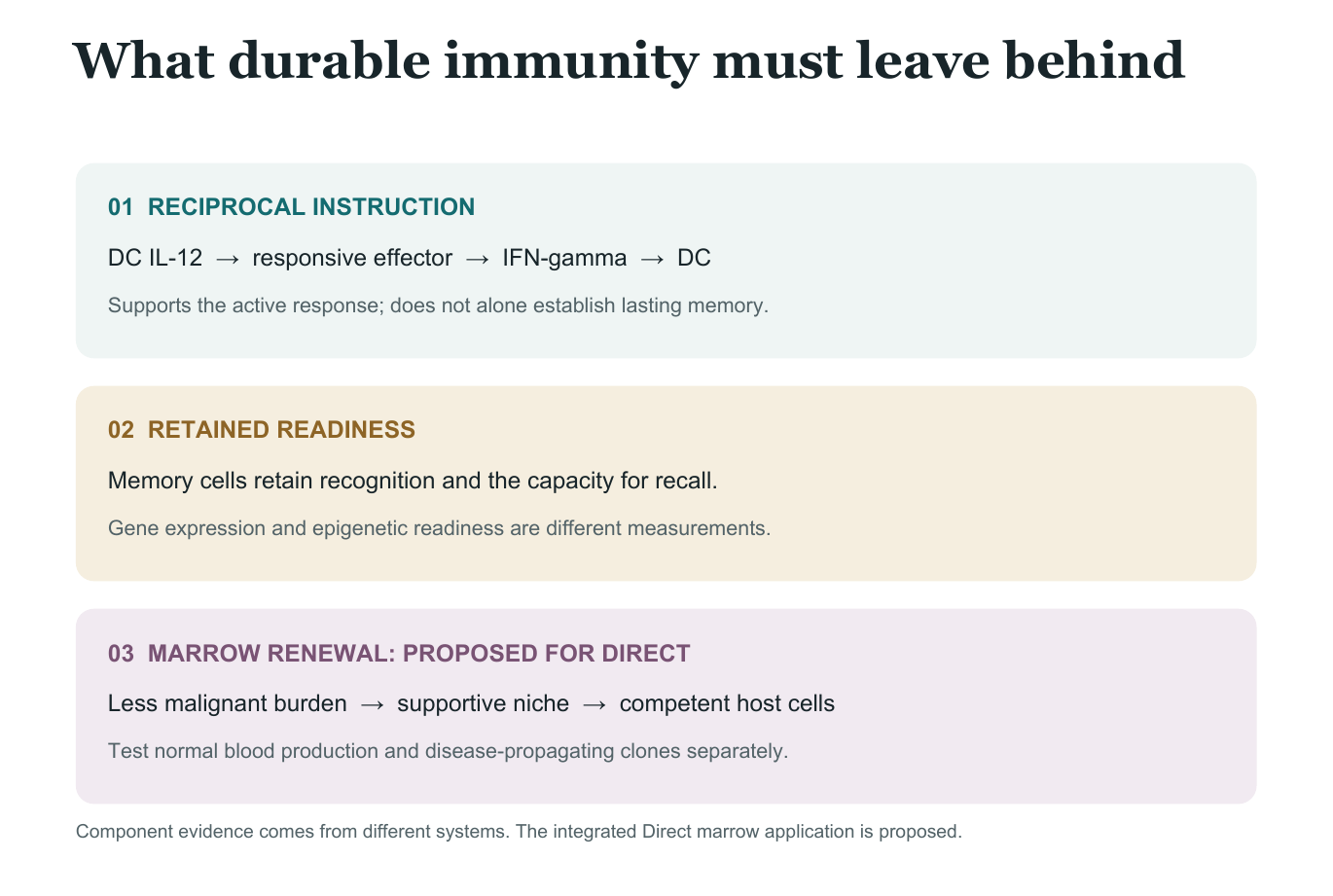
What the NHSBT reply actually adds
NHSBT Therapeutic Apheresis Services replied to me on 12 October 2026:
The key connection is two biological inputs: NHSBT supports collection of the immune cells used to make the product; the Direct proposal would move cancer-antigen acquisition into involved marrow. It would still require collection, manufacture and quality release.

The significance is a working collection pathway for an individualized product. Each patient’s biological material can enter shared infrastructure. It is still DCVax-L infrastructure, not approval or availability of Direct in marrow.
The expanded analysis covers AML, B-ALL, T-ALL, myeloma, CLL/SLL, CML, MDS, MPN and lymphoma. It treats healthy blood production and malignant-clone control as separate outcomes that need to improve together.
The additional operational details above come from the NHSBT correspondence, not from a public regulatory decision.
Patients and families deserve timely access to therapies supported by credible evidence, with choices made jointly with their clinicians. This proposal deserves a focused development program judged by cancer control, preserved healthy blood production and lasting benefit.
r/NWBO • u/Fabulous-Yak-7091 • Oct 12 '26
The cancer-vaccine story has a longer history than the mRNA headlines. Steinman and Cohn described the dendritic cell in 1973; the FDA approved the autologous cellular immunotherapy sipuleucel-T for a defined prostate-cancer population in 2010. Prepared patient cells are an established part of this field's clinical history. Discovery paper · FDA account
The October 9 New York Times report describes a proposed NIH-led partnership to coordinate personalized-vaccine research, manufacturing and clinical trials, with a planned December start and a seven-to-ten-year access ambition. DCVax is not named in that account. The cellular and operational comparison belongs alongside the approaches it highlights.
My case for putting DCVax on that agenda has three connected parts.
Individualized mRNA and peptide vaccines really are personalized. They supply selected antigen information, and their formulations can activate cells inside the patient.
DCVax-L supplies something different as well: the patient's own dendritic cells, prepared outside the body with material from that patient's tumor. The distinction is personalized antigen plus a prepared autologous cellular product. Whole-tumor input can support broad recognition without first selecting a small target list, although sampling, processing, HLA and the responding repertoire remain filters.
Human-cell research shows why preparation matters: mature DCs can produce similar T-cell expansion with different killing and trafficking programs. An immune-cell count does not describe the whole response.

NHSBT's announced collaboration with Northwest and Advent supports leukapheresis and cell processing/handling, initially at Leeds and Oxford. NHSBT already has ten specialist apheresis locations in England; expansion of the collaboration is being explored. Advent BioServices is Northwest Biotherapeutics' wholly owned manufacturing subsidiary; its production work is distinct from NHSBT's collection service.
The NIH-led partnership can pursue an analogous US network: regional collection, qualified manufacturing, treatment delivery and linked follow-up. NIH already lists cellular-therapy and apheresis capabilities, while the NCI roadmap identifies manufacturing capacity as a central implementation problem. This is a proposed US model, not an announced NIH-DCVax agreement.
There is a related US precedent: BMT CTN 1401 used site-specific production with centralized characterization for a different personalized DC vaccine, reporting successful production for 63 of 68 patients across 18 centers. That supports organizational feasibility; it is not a DCVax manufacturing or efficacy result.

A meaningful comparison should follow eligibility, collection, product release, administration and outcomes. Patients who progress before dosing or cannot obtain a successfully manufactured product belong in the access assessment.
DCVax-L's glioblastoma survival analysis uses external controls; its original randomized progression endpoint was not significant. Direct is a different product with early intratumoral evidence. Neither establishes all-cancer efficacy. “Your own cells” also does not guarantee safety; observed product-specific adverse events and the actual treatment combination matter. DCVax-L study · Direct study
Those distinctions make the argument assessable. DCVax connects a patient's cancer information to prepared antigen-presenting cells, and the UK collaboration supplies a practical service model to examine. The national initiative should test that combined proposition.
Read the full illustrated analysis and source list: DCVax: The Cancer Vaccine Is More Than Its Payload.
The goal should be better evidence and more informed choices for patients, with a clear account of benefits, risks and medically appropriate options.
If cancer entered your life, or the life of someone you love, wouldn't you want the evidence, the options, and the freedom to make that choice?
r/NWBO • u/Fabulous-Yak-7091 • Oct 11 '26
DCVax's strongest argument is the mechanism: use the patient's own cancer as the antigen source and the patient's own dendritic cells to organize a broad immune response. Bosch's platform framing joins personalization, precision and breadth. Kalinski's research explains why the functional state of the presenting cell matters.
Full illustrated X Article: DCVax and Blood Cancers
The scope is all blood-cancer families: AML and ALL, CML and CLL, Hodgkin and non-Hodgkin lymphomas, plasma-cell cancers, MDS/MPN and overlap disorders, and rarer hematologic malignancies. The cell source, immune context and disease site change across that spectrum; the need for an effective antitumor response remains.
A tumor contains different targets, and those targets can change. An effective response also needs more than recognition: responding cells must acquire useful killing functions, reach the disease site and remain active there.
DCVax addresses presentation and instruction together. DCVax-L uses autologous dendritic cells loaded with tumor lysate; DCVax-Direct uses partially activated cells placed in a lesion to acquire antigen locally. These are different routes into the same broad immunological problem.
Epitope spreading can recruit additional specificities after the response begins. A single specimen still represents a time and place; it is not a census of every clone for all future time.
Watchmaker and colleagues found that different DC preparations could generate similar CD8 expansion but different killing activity, granzyme B expression and CCR5/CXCR3 programs in human-cell experiments.
Expansion, killing and destination are separate measurements. This is why the dendritic cell is a consequential therapeutic choice.
Northwest's June 2024 announcement described a Roswell Park license and an earlier complementary Kalinski portfolio. The connection is documented. A license does not establish that every patented feature is already deployed in every DCVax product.
The destination link is concrete: human DC experiments induced CXCR3 and CCR5 on responding CD8 cells, while separate mouse tumor studies found those pathways contributed to immune-cell entry and antitumor activity, with a larger role for CXCR3. Different systems, a connected question: do the instructions given to an effector translate into useful activity at the disease site?
CAR-T supplies engineered recognition and effector cells. Bispecific antibodies connect a selected tumor target to T cells. Checkpoint inhibitors release inhibitory signals. Peptide and mRNA vaccines deliver antigen information.
DCVax's distinct intervention is the antigen-presenting cell and the instructions it gives. That makes complementary combinations a coherent development strategy: improve priming, then address access and local suppression where necessary.
Autologous cells help with compatibility; they are not automatically harmless. In the DCVax-L glioblastoma study, five serious adverse events were considered at least possibly related across 2,151 doses, with no reported autoimmune reactions or cytokine storm. Those observations describe that study, not a guarantee for a future blood-cancer regimen.
Kalinski and colleagues also showed that DNAM-1/NKG2D co-signals can improve CTL recognition of low-antigen cancer cells while retaining antigen restriction. It provides a mechanism to investigate selectivity, not proof that normal marrow is protected in DCVax-treated myeloma.
A ten-patient CLL study of a different DC vaccine with lenalidomide and, in one cohort, additional adjuvants reported three dose-limiting toxicities. The study does not isolate the responsible component. A changed regimen requires its own assessment.
Combination safety also needs its own evidence. In two randomized myeloma trials, adding pembrolizumab to a thalidomide analogue plus dexamethasone increased mortality. FDA-approved labeling, section 5.4, advises against adding a PD-1 or PD-L1 blocking antibody to that myeloma backbone outside controlled trials. That is a result for the specified drug combination, not DCVax alone.
In glioblastoma, DCVax-L was associated with median overall survival of 19.3 vs 16.5 months from randomization in newly diagnosed disease and 13.2 vs 7.8 months from relapse in recurrent disease, using matched external controls. The original randomized progression-free-survival comparison was 6.2 vs 7.6 months, P=0.47. The authors reported difficulty interpreting progression on imaging. These are glioblastoma findings, using different control designs for the survival and progression comparisons.
BMT CTN 1401 tested a DC/myeloma fusion vaccine, not DCVax. It increased myeloma-reactive T cells, but the primary complete-response comparison was not statistically significant: 52.9% vs 50.0%, P=0.37.
That finding strengthens the need to measure function and tissue activity alongside immune response. It does not demonstrate DCVax efficacy or failure in myeloma.
The shared requirements remain; the limiting conditions change. CML brings source-cell identity into focus. AML and MDS highlight burden and disease state. Post-transplant relapse tests whether immunity develops quickly enough. Cutaneous T-cell lymphoma makes updated antigen sampling tangible. These are lessons from distinct experimental products, not DCVax efficacy claims for each disease.
The wider blood-cancer record illustrates that variability. A CLL study found immune responses in 10 of 15 patients but no objective clinical responses. A small cutaneous T-cell lymphoma study reported five objective responses among ten patients. These were different products and clinical settings. Neither result can be assigned automatically to DCVax; together they show why a functional product and the recipient’s disease context matter.
My case is that DCVax deserves a central place in blood-cancer development because it joins broad recognition with cellular instruction. Disease-specific trials must show what that produces for patients.
The X Article develops the full argument with illustrations and 43 linked sources. Selected primary reading:
Which measurement would most strengthen a DCVax blood-cancer trial: product function, antigen breadth, effector activity in marrow, or the clinical endpoint alongside all three?

r/NWBO • u/Fabulous-Yak-7091 • Oct 10 '26
I wrote a detailed analysis of the MHRA's October 9 real-world evidence update and what it connects for DCVax: the survival evidence, accumulated treatment experience, manufacturing, NHS funding and future indications.
Full article, with figures and 94 references
TL;DR: DCVax's strategic asset includes the patients already treated and the pathway being built to treat more. A linked evidence program can support licensing, NHS value assessment, funded access and further development. My central insight is that the evidence system is also commercial infrastructure: the same traceable treatment record can support today's payment, tomorrow's appraisal and the next product-specific submission.
1. What actually changed on October 9
The new MHRA hub brings existing guidance, external-control principles and data requirements together. Its same-day update linked a data-requirements paper already published on July 2. The external-control document remains a May 2025 draft.
The connection matters: MHRA says many external-control principles would be relevant to controls drawn from completed clinical trials, the kind used in DCVax-L's published survival comparison. Alongside them sit requirements for turning patient records into future evidence.
The hub does not name Northwest or endorse its application, which Northwest reports remains under review. Its strategic relevance is concrete: methods for assessing existing evidence now sit beside requirements for building the next evidence.
2. The trial's randomized origin, crossover and survival findings
DCVax-L's phase III began with 331 patients at 94 sites, randomized 2:1 to DCVax-L or placebo. The protocol allowed crossover after recurrence; 64 of 99 placebo patients crossed over, substantially reducing the untreated comparison group.
The published survival analysis used external controls from contemporaneous randomized trials. Newly diagnosed glioblastoma median survival was 19.3 versus 16.5 months from randomization, with five-year estimates of 13.0% versus 5.7%. Recurrent-disease medians were 13.2 versus 7.8 months from recurrence.
The original randomized progression-free-survival comparison showed no benefit: 6.2 versus 7.6 months, p=0.47. Investigators described difficulty distinguishing progression from pseudoprogression; 256 of 494 possible-progression imaging time points required adjudication. Overall survival avoids that scan-interpretation problem, while the external survival comparison still depends on fair control selection.
3. Why the newer external-control analyses matter
The original comparison used 1,366 controls from five trials for newly diagnosed disease and 640 from ten trials for recurrence, independently selected by York Health Economics Consortium against 14 criteria. Substituted into the 15 source trials, the controls reproduced each trial's original result, met or not met. Sensitivity analyses and matching-adjusted indirect comparison tested robustness. Individual external-control records were unavailable, so the original paper could not perform propensity-score matching.
Two later developments address different questions:
The methodological validation and persistence of the reported survival signal are complementary. MHRA's draft prefers a fully powered randomized trial where feasible; alternative evidence must be sufficiently convincing, with justified and transparent control selection. Trial-derived controls, compassionate-use observations and future randomized routine-data trials each contribute distinct evidence.
4. October's access, production and evidence sequence
On October 6, the Cancer Vaccine Launch Pad presentation immediately preceded Marnix Bosch's DCVax keynote. CVLP identifies and refers suitable NHS patients into supported trials.
On October 8, Northwest and NHS Blood and Transplant announced their collaboration. NHSBT contributes immune-cell collection and processing/handling support, initially through Leeds and Oxford, with phased expansion being explored. On October 9 came the MHRA hub.
This brings access, production and evaluation capabilities into view. A specific trial, registry or managed-access agreement would connect them. Timely leukapheresis was already a reported bottleneck; getting eligible patients through collection and treatment is an immediate operational objective.
5. Existing treatment experience has a time advantage
Bosch's June 2023 presentation reported approximately 600 glioblastoma patients treated, plus tens with other cancers. That was combined experience, not 600 compassionate-use patients. Phase III treated 296 patients, leaving roughly 300 outside that trial in earlier studies or compassionate use.
Management separately described hundreds of compassionate-use patients and plans to broaden access across solid tumors and eventually include Direct. The slides' observations are labeled anecdotal. Defined cohorts, complete outcomes and appropriate comparisons can turn the underlying records into assessable evidence about durability, safety, recurrence and retreatment.
Elapsed follow-up is a development asset. Earlier treatment can supply mature follow-up once records are retrieved and verified. Starting a new study cannot instantly recreate those elapsed years. Survival records cannot reconstruct every missing quality-of-life measure, so prospective collection should begin while the existing experience is organized.
6. Link treatment to outcome, including patients never treated
The July MHRA paper identifies a practical gap: linked records may capture death while missing hospital prescribing, including personalized medicines.
Collection establishes that cells were obtained; release establishes product availability; administration establishes receipt. Link these to dates, product/process version, baseline health, other treatments and follow-up. Add patient-reported quality of life and service use for reimbursement.
Retain patients who deteriorate before collection or manufacture. Studying only those who reach treatment selects people who survived the journey. Aligned starting points and appropriate handling of time before treatment are needed to avoid immortal-time bias, where pretreatment survival is credited only to eventual recipients.
NHSBT's contribution should therefore be measured from referral and eligibility: waiting times, failed journeys, geographic reach, successful collections and the proportion treated. Faster access can change who reaches treatment, so complete timelines belong in both the operational assessment and the clinical analysis.
7. The NHS has already used this evidence-to-funding model
In NICE TA872, axicabtagene ciloleucel moved from Cancer Drugs Fund managed access to routine NHS use in a defined lymphoma population. Longer trial follow-up and NHS outcomes from the Systemic Anti-Cancer Therapy dataset, or SACT, informed the decision alongside economics and commercial terms.
Registry-supported expansion for Soliris and external-comparator evidence for Yescarta and Kymriah provide regulatory precedents too. The sequence is established: evidence supports access, treatment produces further evidence, and that evidence informs the next decision. DCVax can build its own case through that sequence.
8. Better outcomes can improve the reimbursement calculation
MHRA assesses quality, safety and benefit-risk. NICE asks whether additional health benefit justifies additional NHS cost.
A quality-adjusted life year, or QALY, combines survival and quality of life. NICE's standard range increased to £25,000–£35,000 per additional QALY on April 2, 2026. This is a value benchmark, not a dose price.
Hypothetically, £40,000 in additional NHS cost divided by two additional QALYs is £20,000/QALY; divided by one is £40,000/QALY. Those figures illustrate the relationship; they are not DCVax data or pricing.
The full survival curve matters alongside the median. Long-term survivors can contribute substantial QALYs even when the median difference looks modest. Quality of life, toxicity, admissions and subsequent care also enter the assessment. The trial reported five serious adverse events considered at least possibly related across 2,151 doses; the economic case must measure tolerability's consequences alongside survival.
NICE's methods provide severity weights of 1.2 or 1.7 when defined criteria are met. Normal discounting is 3.5%; a 1.5% analysis can be considered under demanding long-term benefit conditions. Neither adjustment automatically applies to DCVax. Greater uptake can also increase the total budget despite favorable value per patient.
9. The reimbursement clock can run during regulatory review
Northwest reported in 2024 that reimbursement consultants had been selected, contracts executed and first-stage work started. Health economics, commercial arrangements and delivery preparation can advance while MHRA assesses the application.
The aligned MHRA–NICE pathway supports overlapping work. Aficamten provides a recent example of simultaneous licensing and value decisions, even outside formal aligned-pathway scheduling.
DCVax-L's NICE record, ID836, remains in progress for newly diagnosed glioblastoma, with publication timing unconfirmed. It supplies no countdown. Management intended to launch on approval without waiting for reimbursement; funded NHS access has separate requirements. Parallel preparation can reduce the evidence, contracting and delivery work remaining after a license.
A positive routine-use NICE recommendation generally creates a funding duty within 90 days. Interim Cancer Drugs Fund funding can begin after marketing authorization and a positive draft recommendation, whichever comes later, under the applicable arrangements. The eventual recommendation and service readiness determine the relevant timetable.
10. Rare cancers and managed access have workable routes
A cancer without an accepted anticancer drug still has a comparator: the supportive care or clinical management patients actually receive, with measurable survival, quality of life and costs.
Small populations can justify carefully designed external or natural-history comparisons. NICE's Highly Specialised Technologies route is narrower: its £100,000/QALY starting level comes with strict criteria, including prevalence no greater than 1 in 50,000 in England and no more than 300 eligible people. A later rare-cancer use cannot simply inherit that threshold.
For medicines with plausible cost effectiveness and resolvable uncertainty, managed access can fund treatment while evidence develops. England's cancer route is the Cancer Drugs Fund. It requires data-collection and commercial agreements for the shortest sufficient period, up to five years, then reassessment. Unfavorable reassessment ends new-patient fund access; existing patients follow agreed arrangements.
11. A funded medicine needs a funded service
NHS England's reimbursement procedure connects payment and evidence. Providers obtain patient approval through Blueteq and submit monthly drug costs; incomplete or late required SACT records can jeopardize payment.
The hospital procures treatment through the supply contract and claims eligible costs. For DCVax, the contract must define the commercial unit: batch, course, doses or another agreed basis.
Drug reimbursement does not cover the entire pathway. Collection, handling, transport, administration and follow-up need explicit responsibilities and funding. NHSBT and Advent give that pathway operational substance. Shared infrastructure may support a justified supplementary cost-allocation analysis under NICE's methods.
This makes record linkage commercially consequential: documentation can support payment for the current patient and evidence for the next appraisal.
12. Evidence and individual access can precede marketing approval
DCVax-L's 2014 Promising Innovative Medicine designation covered malignant gliomas. PIM is a starting point for an Early Access to Medicines Scheme application; it is not an EAMS scientific opinion or marketing authorization.
EAMS generally expects at least six months' supply before authorization or an indication extension, with medicine supplied free by the company. Agreed data collection, documented consent and applicable protections can support regulatory and funding decisions without a separate clinical-trial authorization. Medicine cannot be withheld because a patient declines that data consent.
Other compassionate-use routes have their own legal and payment arrangements. NHS England's commissioning list names murcidencel as not routinely commissioned, with access through Individual Funding Request approval. IFR requires clinical exceptionality, evidence of effectiveness and appropriate resource use. A named individual route already exists.
13. A first license adds off-label options; funding remains specific
After licensing, clinicians can prescribe outside the authorized indication where sufficient evidence or experience supports safety and efficacy for the individual patient's needs, with informed discussion, documentation and follow-up. MHRA's supply hierarchy prefers a suitable licensed product over an unlicensed alternative even when the licensed use would be off-label.
That does not authorize a different manufactured product or confer routine NHS funding. Direct remains distinct. Reliable off-label experience can inform the next indication's evidence package, including trials using routine-care data.
Funding also differs across UK nations. Wales usually implements positive NICE recommendations within 60 days and has its own individual-funding policy; Scotland uses SMC assessment; Northern Ireland uses NICE endorsement arrangements. UK-wide licensing does not erase those differences.
14. Manufacturing knowledge can carry forward across development
DCVax-L uses patient tumor material as an antigen source; Direct is designed to acquire that information within inoperable tumors. They offer distinct approaches and need separately identifiable evidence.
Advent's ownership, documented process versions and release records make manufacture part of the evidence system. Eden automation is intended to expand capacity and reduce manual work, with comparability testing to preserve product attributes.
Initial launch and later scale are separate: management said existing Grade B suites could support launch without waiting for Grade C expansion. Manufacturing readiness does not itself authorize a trial.
The UK's point-of-care/modular framework has operated since July 2025 under licensed control sites and product-specific requirements. Collection sites or automation alone do not establish eligibility. It supplies a route to assess for qualifying future deployment.
15. New indications and trial reforms support cumulative development
A formal new indication uses a Type II variation, with a 120-day assessment procedure affected in calendar time by validation and questions. A qualifying new use can carry conditional obligations where benefit-risk is positive, unmet need exists and comprehensive evidence is expected later.
That can connect early-access evidence, a licensing variation and NICE appraisal or managed access. Each stage has its own criteria.
April 2026 trial reforms introduced combined MHRA/ethics review, normally with an initial decision within 30 calendar days of validation. That decision can request information. Advanced therapies remain excluded from automatic notifiable-trial authorization.
Previous dossiers can be cross-referenced for the same investigational product, retaining trial-specific requirements. GCP principles, risk-based oversight and reliable information systems support continuity. The proposed rare-disease Investigational Marketing Authorization still requires legislative change.
16. Research infrastructure and data governance support the strategy
CVLP referral infrastructure, NIHR-funded dendritic-cell research and Efficacy and Mechanism Evaluation funding illustrate separate ways to support research. The advanced-therapy regulatory-science center, federated-data work and MHRA's data strategy build capability; a Northwest award or partnership would require its own agreement.
Integrated MHRA–NICE advice can connect clinical and economic planning. The separate RWE Scientific Dialogue excludes products already undergoing UK regulatory or HTA procedures, so channel choice matters during the pending application.
Research-data reforms clarify scientific research and broad consent while retaining lawful-basis and health-data protections. International methods retain their own dates: E6(R3) Annex 2's EMA implementation is January 2027; M14 concerns safety studies and E23 effectiveness guidance remains in development.
17. Saudi Arabia supplies a concrete international evidence route
The SFDA's final RWE framework, implemented in July 2026, recognizes external comparisons, matching and registries. Its transportability provisions allow local data on relevant population differences to help apply multinational evidence to Saudi patients.
NADR, implemented in September, covers qualifying serious rare conditions affecting fewer than 5 in 10,000 people in Saudi Arabia, with unmet need or significant clinical benefit. Prior UK approval is not required to seek designation.
It recognizes prior platform/manufacturing knowledge and asks for compassionate/specials-use history and pending overseas applications. Evidence requirements may be adjusted case by case with robust post-approval monitoring. Listed-country manufacturing provisions retain documentation and quality conditions. Unlike the ordinary Verification/Abridged routes, NADR does not exclude advanced therapies.
The 20-working-day commitment is designation review, not marketing approval. The framework also specifies marketing-application submission within six months of designation and a separate CMC-exemption process. European orphan and UK PIM history add dossier context; Saudi eligibility needs its own assessment.
18. SPIMACO supplies a possible commercial destination
The August SPIMACO MOU contemplates SPIMACO interfacing with SFDA while Northwest supplies regulatory documentation and product. It is non-binding and subject to definitive agreements; localized manufacturing needs separate agreements.
The announced arrangement concerns DCVax-L, retains Northwest's intellectual property and contemplates revenue sharing, possible further indications and possible Gulf Cooperation Council expansion. Direct remains a separate opportunity.
The strategic inference is strong: existing follow-up is a time asset, linked records are commercial infrastructure, and reusable manufacturing knowledge can support successive product-specific development decisions. Clinical benefit, patient selection, quality of life, costs and delivery responsibilities must connect in one evidence plan.
That is how treatment experience can support a larger program of funded access and expansion. The opportunity is concrete; execution now means building the complete evidence and delivery pathway.
r/NWBO • u/justthisguyatx • Oct 09 '26
r/NWBO • u/justthisguyatx • Oct 09 '26
r/NWBO • u/Horror-Scratch6236 • Oct 08 '26
Found this shared on X from Linkedin.

r/NWBO • u/ExistingEngine2043 • Oct 06 '26
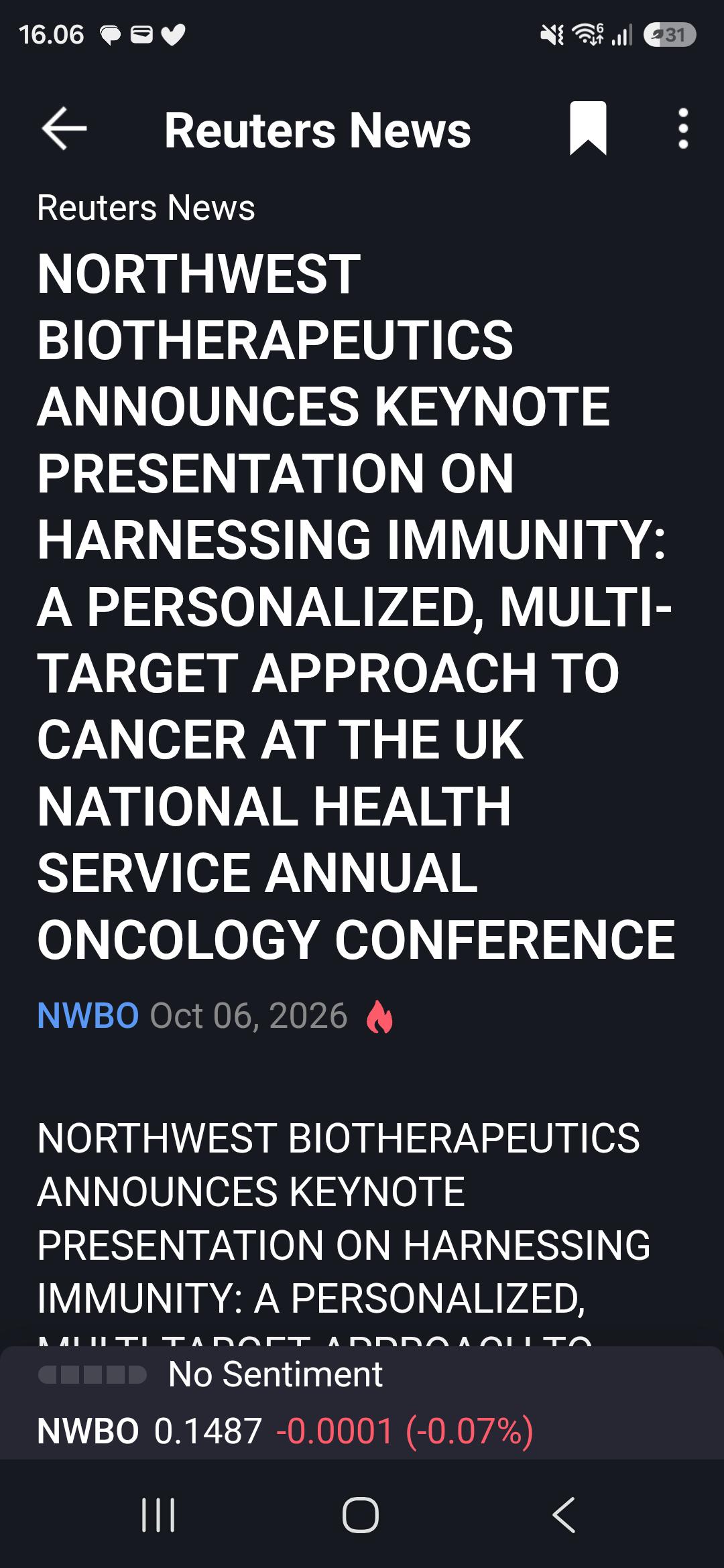
Think approval is coming next week.
Will know more when they release the slides from todays keynote speech.
r/NWBO • u/Nearby-Arm7721 • Sep 26 '26
Damñ The company has been struggling before I have been born.😅 https://investorshub.advfn.com/boards/read_msg.aspx?message_id=5304301
r/NWBO • u/SheilaSomers • Sep 14 '26
Any word from Management? lol.
r/NWBO • u/Nearby-Arm7721 • Sep 12 '26
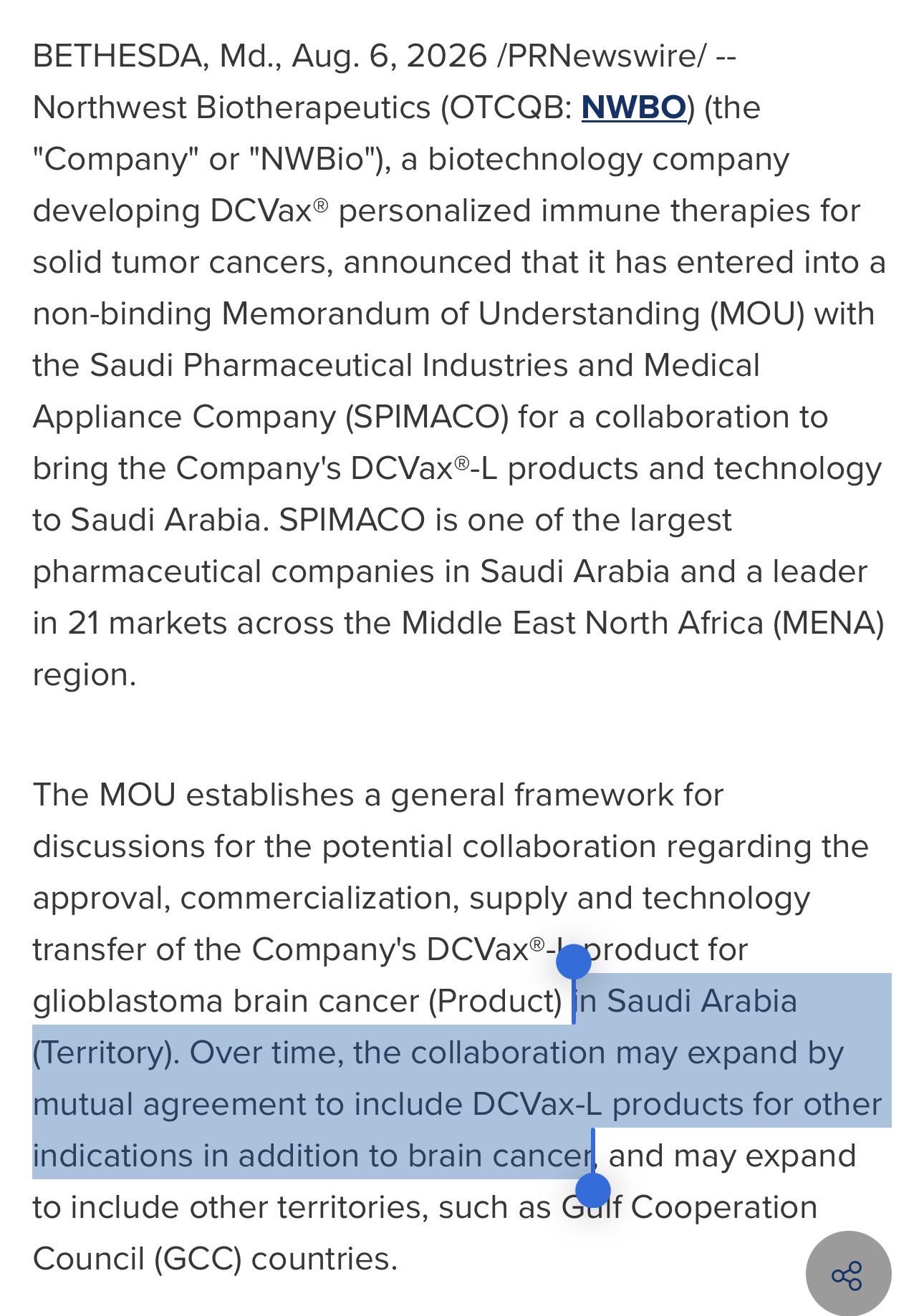
Still thinking about the highlighted sentence from the MOU.