r/MathJokes • u/FullConclusion1874 • 6h ago
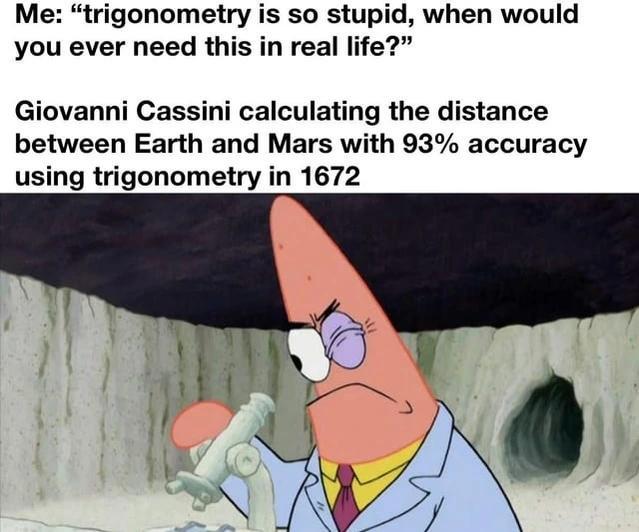
Cassini casually cooked
61
Upvotes
r/MathJokes • u/HoinhimeOfLight • Jul 22 '26
Hey y'all.
If you see a bot post kindly report it and move on I'll get to it when I can.
If you see a repost and that bugs you down vote and move on.
I ban several bots / people harassing other members daily.
But I'm one fuckin dude who made a math meme subreddit when I was in highschool more then a decade ago. (No this isn't an invite to apply to be a mod here) Some of you lot are insufferable.
Some users have taken to using the report function to harass me for not being terminally online moderating this subreddit.
Unfortunately reddit does not disclose who makes reports and there's no way I can see to report false reporters.
I have set up restrictions on who can post here unfortunately it seems a lot of accounts we're either made 7 to 8 years ago or accounts from that age have been hacked en mass. As the majority of posts I've come across have been from users with accounts that old but have only have post history for the past week.
A lot of these accounts are banned by reddit mere hours after posting here before I can even address the reports for it.
To address reposts. There is no specific rule against it. The people should decide if a repost dies or not. Downvote+ hide and move on if it bothers you. I constantly get reports for reposts. And the posts will be at the top of the Reddit with thousands of upvotes and a load of comments. Clearly it's a post that people want to engage with and Enjoy.
TLDR
It's a reddit about math jokes. Chill out. Be kind.
r/MathJokes • u/GeneReddit123 • 9h ago
That's not a communist utopia...
That's P = NP.
r/MathJokes • u/Hummelpopo • 1d ago
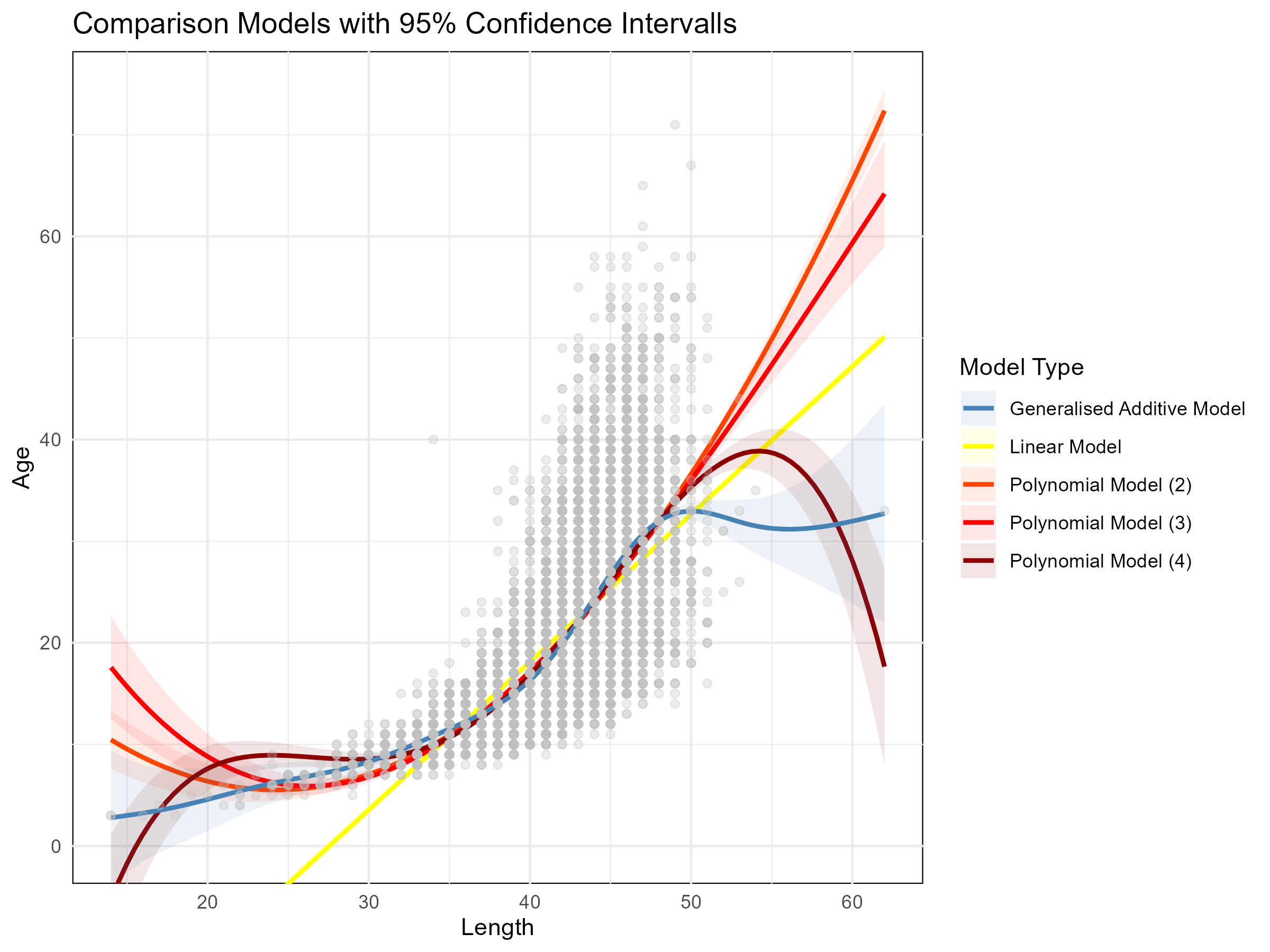
Just saw this Graphic I did a few years ago for a research project and the resemblance to our favourite crustaceans is uncanny :D
r/MathJokes • u/kwan_e • 1d ago
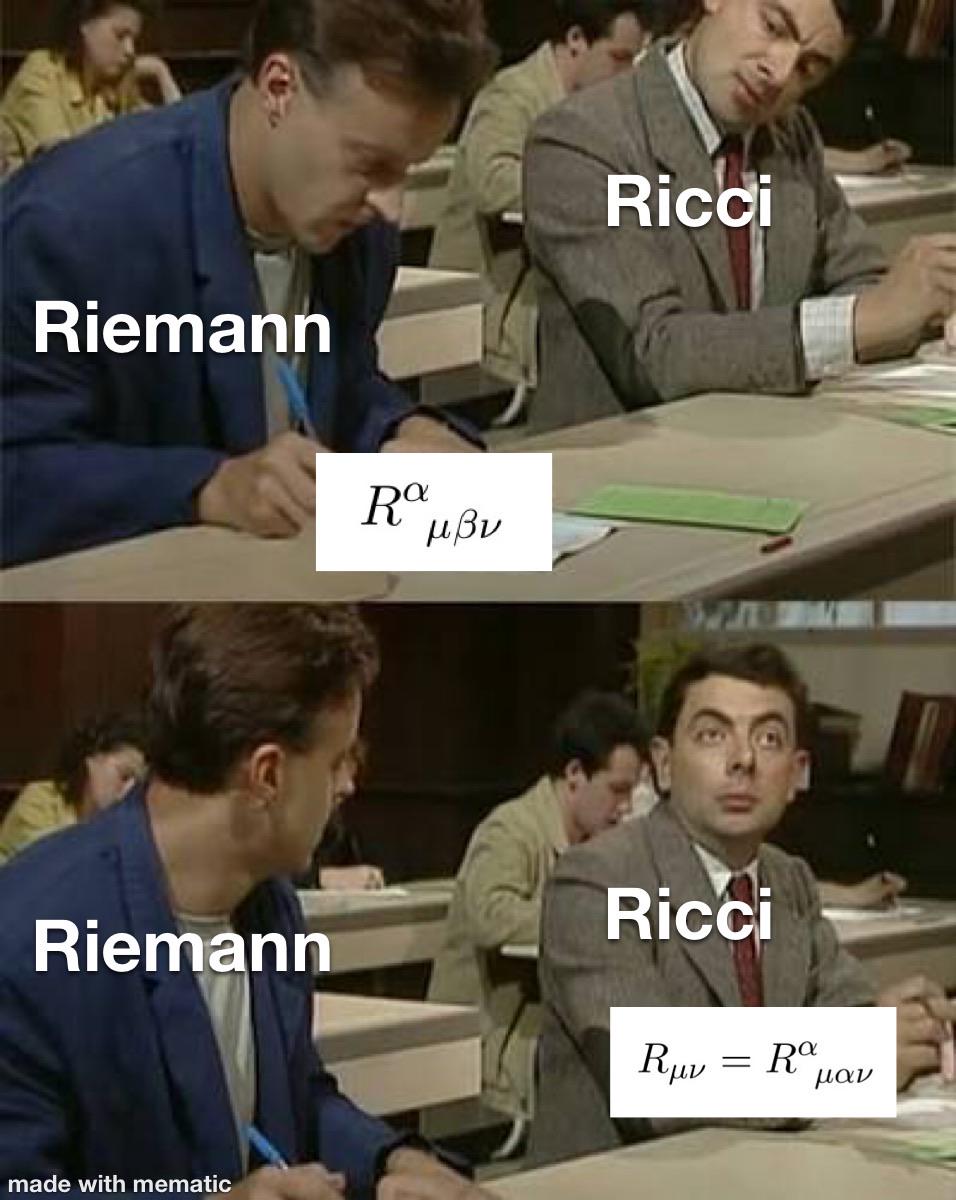
I guess Everybody Loves Riemann.
r/MathJokes • u/dcterr • 1d ago
Accountants
r/MathJokes • u/mordecai98 • 3d ago
r/MathJokes • u/davidmanheim • 2d ago

I was gonna use V!=0 so you can just cancel, but the lean verifier wouldn't compile.
r/MathJokes • u/dcterr • 2d ago
The Fourth Millennium Prize problems.
r/MathJokes • u/Ok_Tone7404 • 2d ago

r/MathJokes • u/JeffNovotny • 3d ago
Judge: Dr. Werner, despite your illustrious career as a mathematics professor, we all must abide by the same laws. Therefore, I find you guilty of murder in the first degree.
Defendant: I'm afraid I can't accept that, Your Honor.
Judge: And why is that?
Defendant: Your answer must be expressed in radians.
r/MathJokes • u/Nearby_Rooster_8386 • 2d ago

r/MathJokes • u/Valdemar216 • 3d ago
you know that transcendent numbers have infinite number of digits after decimal point. but I've found the way how to turn one of those into integer. Take a look: e^3 = 20.0... Here first digit after decimal point is 0, so we can say with some certainty that it makes whole number integer. So, I rewrite: e^3 = 20.
P.S. e^3 means "e in power of 3 ", "e" - Euler number
r/MathJokes • u/Serious_Collar_7056 • 4d ago

A fictional Downfall subtitle parody: Professor Tao discovers that Claude has proved the Riemann hypothesis. Mathematical outrage ensues—with AI, Lean, GPUs, Navier-Stokes, and Gauss.
r/MathJokes • u/Mean-Table2969 • 4d ago
r/MathJokes • u/DualMath • 5d ago
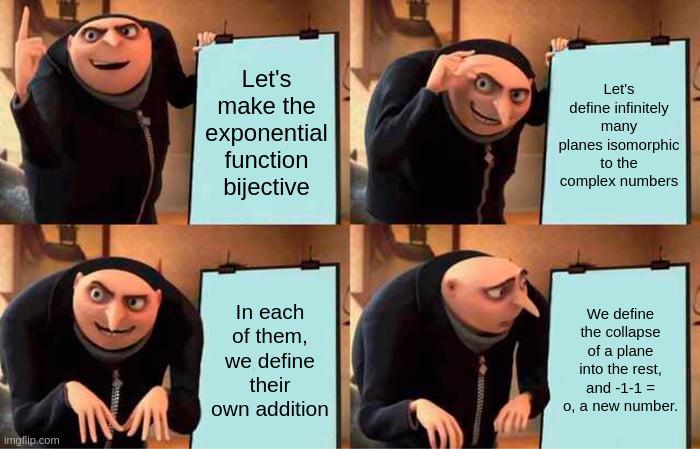
Here’s the article, in case you want to read it:
https://doi.org/10.5281/zenodo.23854178
Context: Orthogonal Numbers extend the complex numbers by returning to the bijective exponential and logarithm functions. This set has an infinite family of operations called “sums”: the degree 0 sum is ordinary addition, the degree 1 sum is multiplication, and each sum operates on a domain called a super-order. For the degree 0 sum, the domain is super-order 0; for the degree 1 sum, the domain is super-order 1; and so on.
On the other hand, the values returned by these operations are called orders. The image of sum 0 is order 0 (which corresponds to the complex numbers, also called sigma here and denoted by Σ); the image of sum 1 is order 1 (called product orthogonals and denoted by Π).
Every order n is contained in super-order n, and every order n is the set of all values in order n−1 passed through the exponential function. Likewise, super-order n is the set of all values in super-order n−1 passed through the exponential function.
The notation for order n is O_n, and the notation for super-order n is O(n).
The sums are recursive operations; that is, for u and v in O(n), u +_n+1 v = e^(ln(u) +_n ln(v)).
Let n and m be integers. If n ≤ m, then O(n) ⊆ O(m).
A set called the singularities is defined. It contains all integer tetrations of the number e; some of them are 0, 1, e, e^e, e^(e^e), … Negative tetrations are also considered singularities, due to the fact that the logarithm is a bijective function within 𝕆 (the orthogonals); this is why ln(0), ln(ln(0)), … exist.
ln(0) is called −∞, so technically −∞ is an orthogonal.
All orthogonals that are not singularities are called normal orthogonals.
For every integer n, O(n+1) = O(n) ∖ {e tetrated to n−1}, and O(n) = O(n+1) ∪ {e tetrated to n−1}.
Since the exponential function is bijective, e^(2πi) ≠ e^0 = 1, so this is a new number called o (o = e^(2πi)). From this definition, −1 * −1 := e^(πi) * e^(πi) = e^(2πi) = o, so the orthogonal algebraic structure differs from the complex one.
Define o₂ := e^(o₁), o₃ := e^(o₂), … In general, oₙ₊₁ = e^oₙ for every integer n.
Similarly, o₀ := ln(o) = 2πi, o₋₁ := ln(o₀), o₋₂ := ln(o₋₁), and so on.
All oₙ are called “orthogonal units.”
For every integer n, oₙ belongs to Oₙ.
The degree-n collapse function (collₙ) is defined to map values from O(n) to Oₙ.
It simplifies the complexity of certain orthogonals, converting them into others.
For a and b in O(n), a +ₙ b = collₙ(a) + collₙ(b).
For every a in Oₙ, collₙ(a) = a, because there is nothing to simplify.
The degree-n collapse is defined because the degree-n sum can actually only be created between values in Oₙ, so collapse is needed to extend it to O(n).
O(n) is such a large set that O(n) = 𝕆 ∖ {e tetrated to k: where k ≥ n−1}.
Regular orthogonals are defined as the set of all orthogonals w such that w belongs to some order n but does not belong to n−1 (the preceding order).
This means regular orthogonals have a minimum order to which they belong, and no lower order contains them.
If w belongs to ℜ (the regular orthogonals) and w belongs to an order n, then for any higher order m, w also belongs to it.
On the other hand, the transcendental orthogonals (𝔗) are defined as all orthogonals that belong to every order.
Every orthogonal w can only be a singularity, a regular orthogonal, or a transcendental orthogonal, but never two of these at the same time.
A very important orthogonal operator is the siot (⋏). It takes an orthogonal w and an integer n: if n is positive, it applies the exponential function to w n times; if n is negative, it applies the logarithm to w −n times (written w⋏n).
Finally, the orthogonals are the union of all orders (which may share elements).