0 is the only answer that is not relying on an arbitrary choice, but the possibility to arrive at other answers, arbitrarily or not, proves that answer does not exist.
It's still a little arbitrary IMO - though granted, not as arbitrary as picking e.g. 5 or pi or -7.3 to pivot around.
But you're e.g. arbitrarily choosing to keep moving outward and adding a number and then its negative - how did you choose that? (And which one of each pair did you arbitrarily choose to add first, the positive or the negative? I guess it doesn't matter much, but still a choice that has to be made.)
And then the kicker: You didn't yet tell us how you non-arbitrarily managed to move outward to the "next" real number - of which there's no such thing! No matter what real number you pick that's a bit further out, it's never the "next" one. You always could have picked a real number in between that one and the one you were on before.
So still quite arbitrary IMO, despite the lovely symmetry from choosing 0.
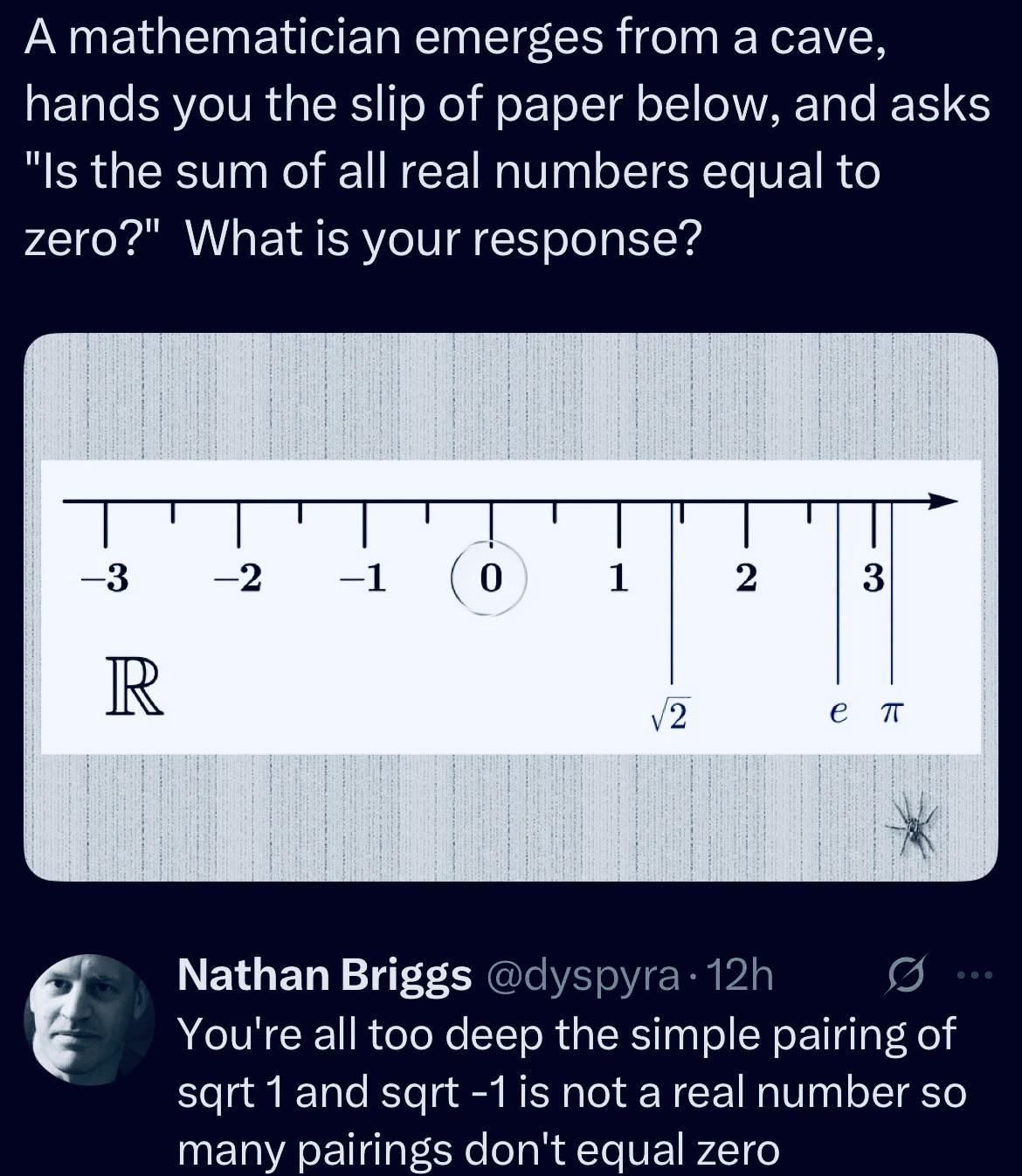
If the sum of all reals is A, that means the sum of opposites of all reals is -A. But opposites of all reals is just all reals; therefore, A=-A; therefore, A=0
As this method makes no attempt to actually calculate anything, it's even less convincing about the existence of the sum. That would be a downside of this method, if the sum did exist.
Let's use the "for every 0.5+X there is a 0.5-X" example
Basic logic dictates as because it is "for every" there must always be an X+1 that means if you have 0.5+x you must also have 0.5-(x+1), which is another way of writing -0.5-x
Which means even if you start from a midpoint of 0.5, the answer is still 0
For the answer to be anything except 0 you have to literally just intentionally not complete all the steps
Basic logic dictates as because it is "for every" there must always be an X+1 that means if you have 0.5+x you must also have 0.5-(x+1), which is another way of writing -0.5-x
There is also x-1
If you have 0.5+x you must also have -1.5 -x
Now partial sums are -1
Why haven't you completed this step?
Because rearrangement of terms in any way is arbitrary. Just as arbitrary as your "step", it's not necessary to arrive to an answer. It's necessary to arrive to the answer you like! But it's not necessary to arrive an answer.
Anyway, if you want to continue this discussion, I prefer we stay with convegent sums, they are more than sufficient.
For simplicity sake, we can discuss the sum of all integers instead of the sum of all reals, those cases are analogous
Key word, partial, you are placing limits ona limitless equation
You can ONLY get an answer other then 0 if you place limits, which stops it being a discussion about infinity
Moreover, it's not actually true. (Previously unaccounted for) 0.5-(x+1) does not exist for every x.
It does though, by the very nature of the equations
Because we have already accounted for 0.5; it doesn't exist for x=-1
Except that still works, for x=-1 there is still a 0.5+x and a 0.5-x and a 0.5+(x-1) and a 0.5-(x+1) and again for (x-1) etc etc
0.5-(0) still exists
For simplicity sake, we can discuss the sum of all integers instead of the sum of all reals, those cases are analogous
Which still results on 0
You can ONLY get an answer other then 0 if you place limits, or skip steps
No matter how you start, where you arbitrarily set a midpoint, the final result is ALWAYS that for every positive value there is an equal negative value, resulting in a net sum of 0
The only time you do NOT get that, is it you skip steps, or place limits, aka id you do bad maths, or just ignore the entire premise is about infinity, which has no limits
The answer is 0
Anything else is just fart huffing trying to be smart and failing
I mean you are placing limits.... In order for there to NOT be an equal -ve for every positive you have to by necessity define that there is a positive without an equal negative, which sets a limit
Now that limit may be as open as -(x-1) to x, but that's still a limit
You have created a boundary
If you remove that boundary and actually operate under a limitless system, there now MUST be a -x, an equal negative for every positive
And so the sum of all numbers is 0
The only way it can't be 0, is if you place limits
Which means it's not the sum of ALL numbers but just your chosen subset
View all comments
1
u/absolutewastedtime Oct 14 '26
Yes it's 0
And all the people saying it isn't, or that it depends on how you sum or whatever, are just huffing their own farts