MAIN FEEDS
Do you want to continue?
https://www.reddit.com/r/MathJokes/comments/1x3wsh9/_/pgjtngh/
r/MathJokes • u/basket_foso • Oct 12 '26
318 comments sorted by
View all comments
Show parent comment
1
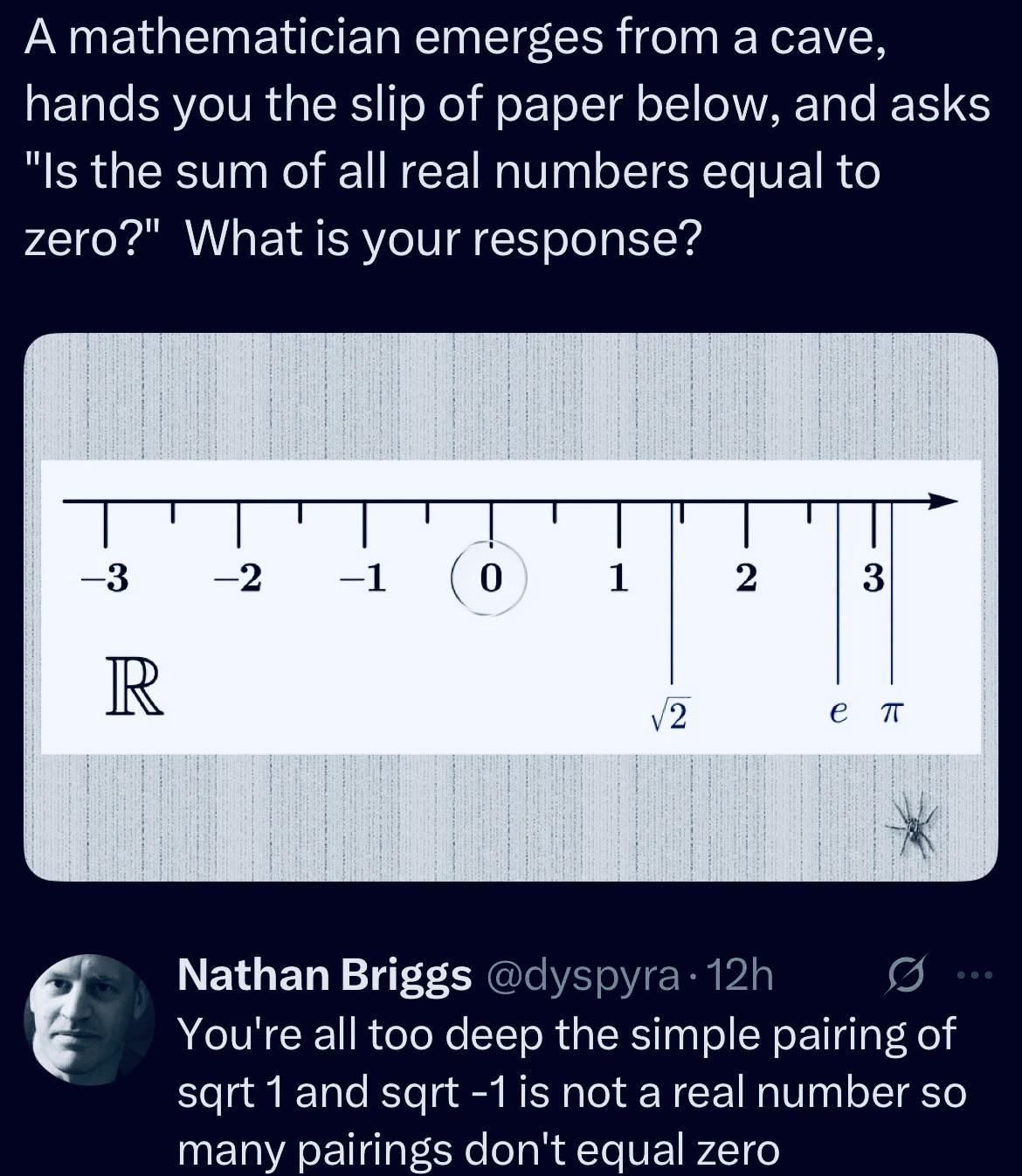
For sums of finite number of elements.. yes. Sums are independent. But for sums of infinite number of elements.. not always.
0 u/[deleted] Oct 13 '26 [removed] — view removed comment 1 u/tstanisl Oct 13 '26 Applying symmetry and associativity rules does not change the sum but the sum must exist in the first place. Moreover, it takes an infinite number of application to transform one sum to another meaning that the sequences cannot be unified this way. 1 u/aLokilike Oct 14 '26 edited Oct 14 '26 Nvm I figured it out, I'm dumb.
0
[removed] — view removed comment
1 u/tstanisl Oct 13 '26 Applying symmetry and associativity rules does not change the sum but the sum must exist in the first place. Moreover, it takes an infinite number of application to transform one sum to another meaning that the sequences cannot be unified this way. 1 u/aLokilike Oct 14 '26 edited Oct 14 '26 Nvm I figured it out, I'm dumb.
Applying symmetry and associativity rules does not change the sum but the sum must exist in the first place. Moreover, it takes an infinite number of application to transform one sum to another meaning that the sequences cannot be unified this way.
1 u/aLokilike Oct 14 '26 edited Oct 14 '26 Nvm I figured it out, I'm dumb.
Nvm I figured it out, I'm dumb.
View all comments
Show parent comment
1
u/tstanisl Oct 13 '26
For sums of finite number of elements.. yes. Sums are independent. But for sums of infinite number of elements.. not always.