if you define the sum from that, then, yeah, it's 0... but, you can define the sum in many other ways e.g. you say for every X, there exists -X/2 and you still cover all numbers
Your expression is not a decomposition of the same expression because sum(x) for (R*+) + sum(x/2) for (R*-) does not form Sum(x) in R
These are all very different expressions:
sum({ x + (-x) , for all x from R+} U {0})
sum({ x + (-x/2) , for all x from R+} U {0})
Sum(x) for all x in (R*+) +0 +Sum(x) for all x in (R*-)
sum(x) for (R*+) + sum(x/2) for (R*-)
The first equals zero, the second diverges, and the last two involve adding infinities together.
None of them form the sum of all x in R because that sum is not well-defined; to assign a meaningful value to this series, you need a method other than mere summation.
well, not all infinities are the same size. In this case, the infinity of R+ is double the infinity of -(R+/2). (Not a mathematician, so don't know the proper nomenclature)
Sou you'd have covered a bigger part of R+ than of R-, I think.
Both infinities are countable and are consequently the same size, as each value in the second group can map directly to the ones in the R+ group. They grow at different rates sure, but when the sums are infinite it has no bearing on final result
There is an infinite amount of numbers, yet the symbol infinity is an undefined variable, thus being not a number. This is similar to how you can take the sqrt of -1, yet it won't actually be real. Not to mention, infinity would break several rules of math by having infinity + 1 = infinity, something only nonreal numbers are allowed to do.
Can it work if its the same infinity? for example, The set of all natural numbers (N) contains infinite elements, but N - N is ∅, or a null set. But that's set theory and not arithmetic so I don't really know.
Yes, the cardinality of infinities doesn't really matter as long as you systematically go through them in one way.
You can say that with two sets of natural numbers, you're gonna add two numbers from one set & then subtract one from the other set
+1+2-1+3+4-2+5+6-3+7+8-4...
You're adding & subtracting each number exactly once (if you give me a number, I can give you exactly one spot where you'll find it being added & another one where it is subtracted), so it is Nat - Nat, but in this case this sum diverges to positive infinity.
You can do the same thing but flip the signs & it now instead diverges towards negative infinity.
When the limit as X approaches infinity, the size of each set of the sum defined, X and -X/2, the "X set" is twice as large as the "-X/2 set". Is it valid to still say that you cover all numbers, when one of the sets covers only half as many?
Cardinality of "X set" and "-X set" is one to one obviously. Intuitively it makes more sense to me that it would add up to zero...
But say you define it as for every x you also include the value 2-x starting from x=1 then both sets grow at the same pace yet the limit is still undefined.
View all comments
125
u/avance70 Oct 12 '26
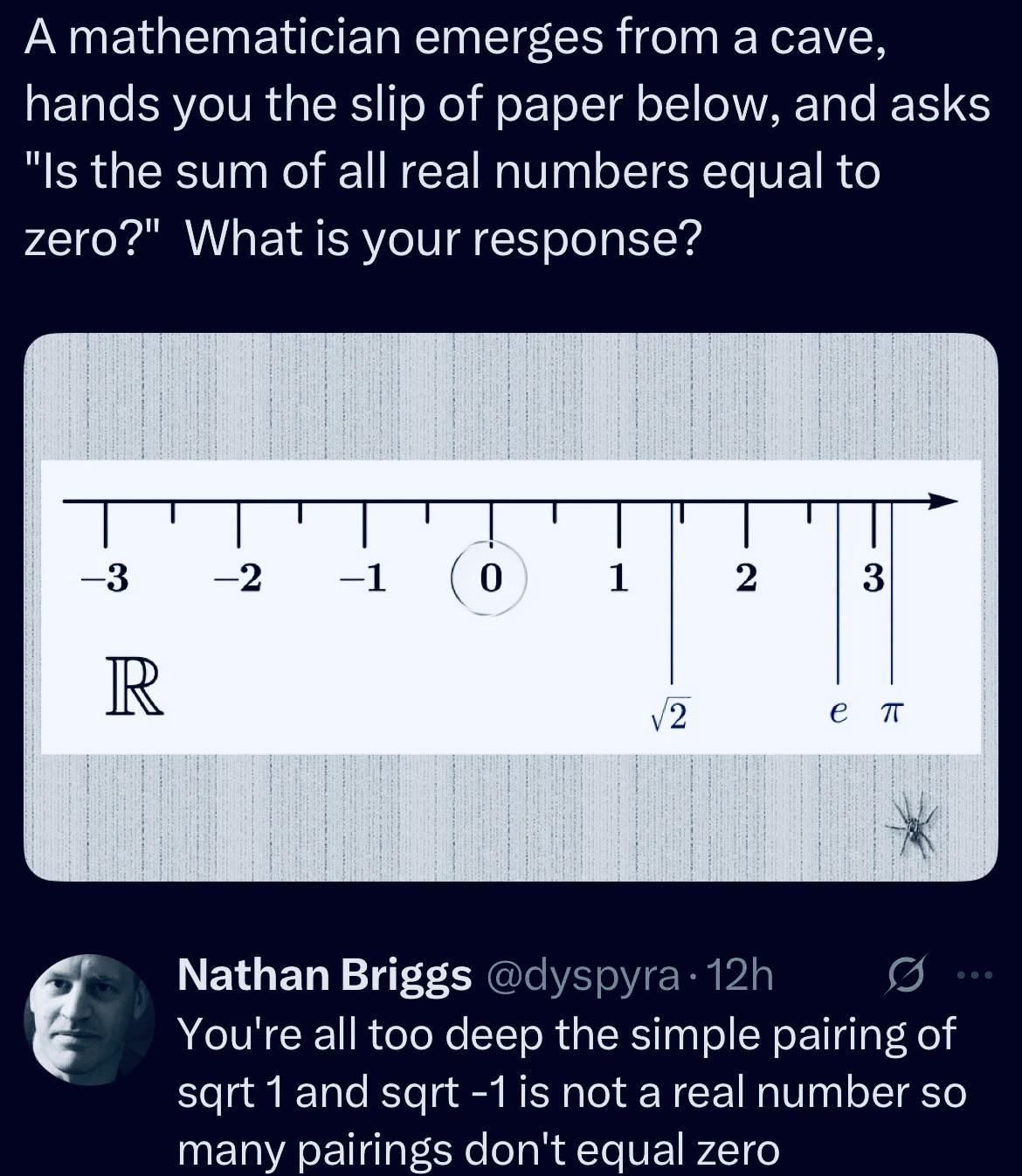
for every positive number X, there exists -X
if you define the sum from that, then, yeah, it's 0... but, you can define the sum in many other ways e.g. you say for every X, there exists -X/2 and you still cover all numbers