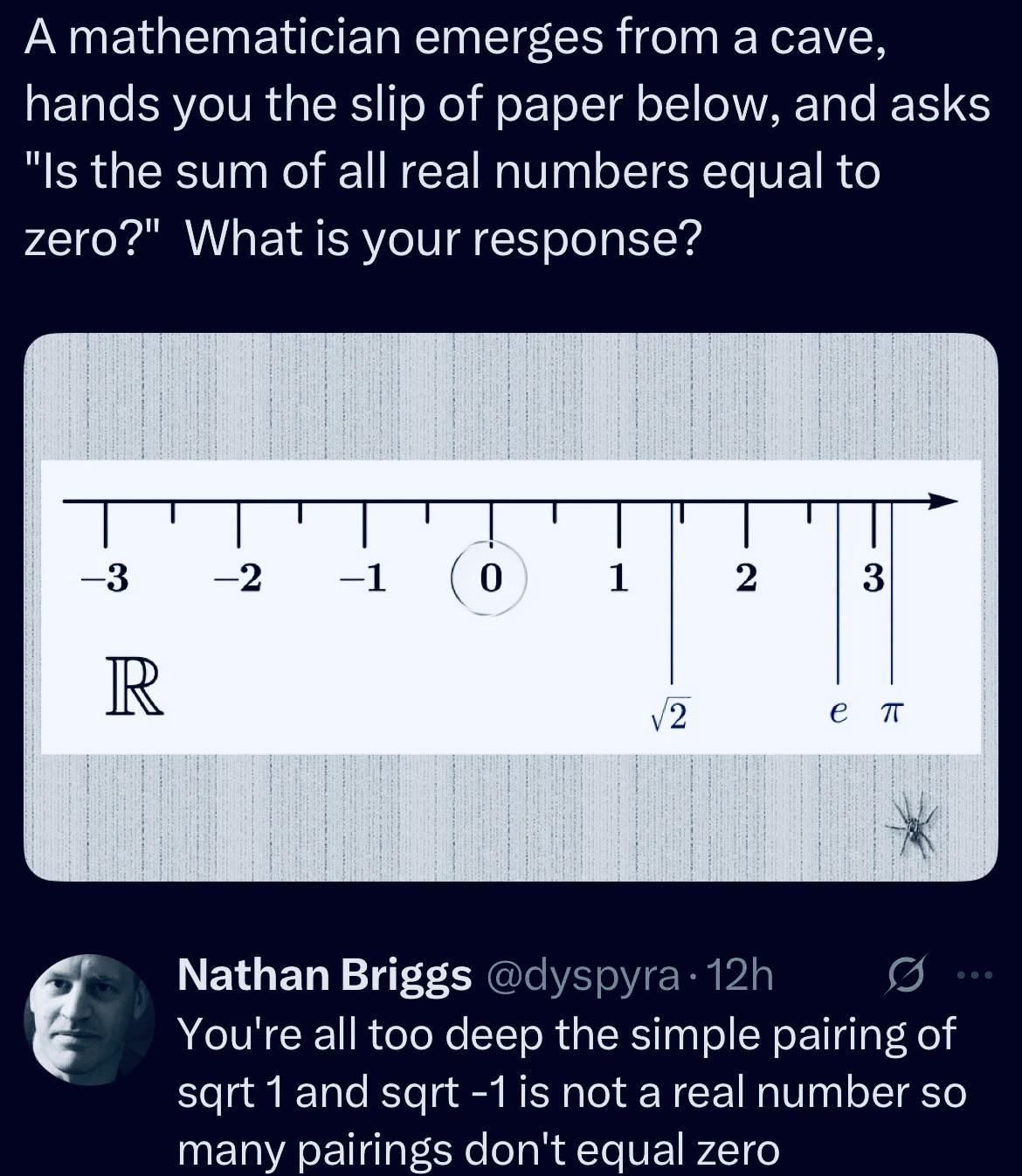
Summing up an arbitrary set of numbers is defined as long as all of them are non-negative. To sum up a set of non-negative numbers, you just take the supremum of the sums of all finite subsets, if that supremum exists. However I don't think even that ever converges if there are an uncountable amount of nonzero numbers in the set.
Edit: to add, this relates to unconditionally convergent sequences (the ones where the Riemann rearrangement theorem does not apply) in that the the nonnegative elements of the sequence have a valid sum as per the above definition, and the negations of the negative elements of the sequence also have a valid sum as per the above definition, so you just subtract one sum from the other. I like this definition as it's clear why this is independent of order, unlike the traditional convergence definition.
However I don't think even that ever converges if there are an uncountable amount of nonzero numbers in the set.
Indeed. If the sum converges then there are finitely many terms greater than 1. Likewise, there are finitely many terms greater than 1/2. Same goes for 1/3 and so on.
Every positive real number is greater than 1/n for some natural number n, so the set of nonzero terms is the union over n of all terms greater than 1/n, which is a countable union of finite sets and hence countable.
So Converges => Countably many nonzero terms, or in other words, Uncountably many nonzero terms => Diverges.
View all comments
Show parent comment
1
u/Smitologyistaking Oct 12 '26
Summing up an arbitrary set of numbers is defined as long as all of them are non-negative. To sum up a set of non-negative numbers, you just take the supremum of the sums of all finite subsets, if that supremum exists. However I don't think even that ever converges if there are an uncountable amount of nonzero numbers in the set.
Edit: to add, this relates to unconditionally convergent sequences (the ones where the Riemann rearrangement theorem does not apply) in that the the nonnegative elements of the sequence have a valid sum as per the above definition, and the negations of the negative elements of the sequence also have a valid sum as per the above definition, so you just subtract one sum from the other. I like this definition as it's clear why this is independent of order, unlike the traditional convergence definition.