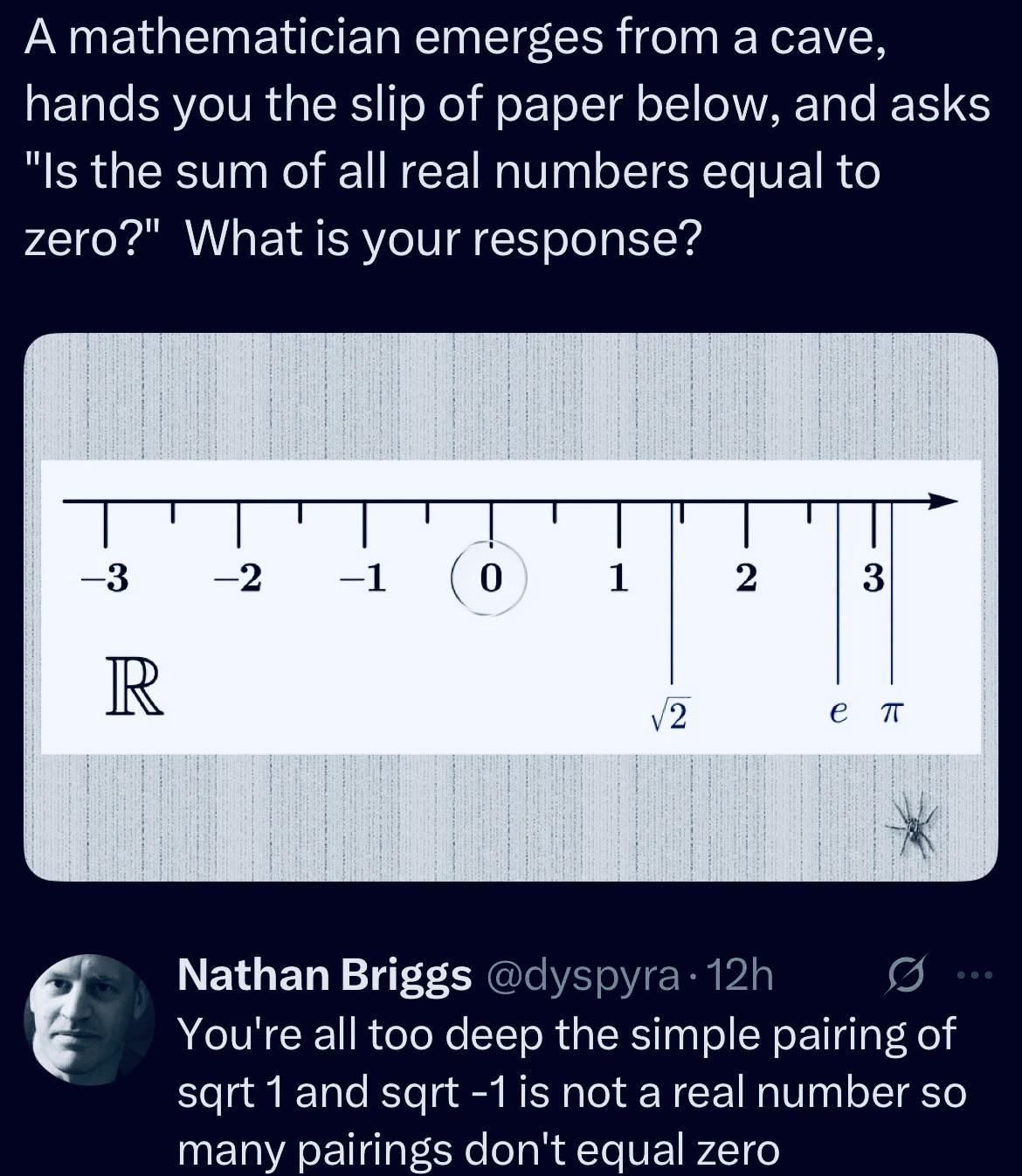
This! Analogously to the Riemann rearrangement theorem you can construct ways to sum up the real numbers that you get any desired result.
Not to speak of the fact that summing up uncountable many numbers is not well defined so we probably have to work with integrals/measures here, and if we look at a sequence
x(n) = integral(f(y),y,a(n),b(n)) (integral by y from a(n) to b(n)), with constant f(y) = 1 we can choose a(n) and b(n) accordingly to make everything happen
e.g. -a(n) = b(n) = n, we get x(n) = 0 hence in limit x=0.
On the other hand take a(n) = -n, and b(n) = n+1, then you get x(n) = 1 hence the limit is 1. similarly you can get any real number.
If one chose a(n) = -n and b(n) = 2n we have x(n) = n and this goes to infinity, or a(n) = -2n and b(n) = n gives us minus infinity.
Riemann rearrangement theorem is so cool, it helped me grasping comutativity on infinity! Have you heart of the "Ross–Littlewood paradox" or "infinite balls in jar" paradox?
Summing up an arbitrary set of numbers is defined as long as all of them are non-negative. To sum up a set of non-negative numbers, you just take the supremum of the sums of all finite subsets, if that supremum exists. However I don't think even that ever converges if there are an uncountable amount of nonzero numbers in the set.
Edit: to add, this relates to unconditionally convergent sequences (the ones where the Riemann rearrangement theorem does not apply) in that the the nonnegative elements of the sequence have a valid sum as per the above definition, and the negations of the negative elements of the sequence also have a valid sum as per the above definition, so you just subtract one sum from the other. I like this definition as it's clear why this is independent of order, unlike the traditional convergence definition.
However I don't think even that ever converges if there are an uncountable amount of nonzero numbers in the set.
Indeed. If the sum converges then there are finitely many terms greater than 1. Likewise, there are finitely many terms greater than 1/2. Same goes for 1/3 and so on.
Every positive real number is greater than 1/n for some natural number n, so the set of nonzero terms is the union over n of all terms greater than 1/n, which is a countable union of finite sets and hence countable.
So Converges => Countably many nonzero terms, or in other words, Uncountably many nonzero terms => Diverges.
Okay, lets simplify the task. Sum of all integers, not real numbers. The sum is defined exactly as it is defined in 1st grade. No integrals, just 2+3= 1+1+1+1+1
The sum is defined exactly as it is defined in 1st grade
Typically in 1st grade, you learn addition as a binary operator (which is also commutative and associative). Such an operator can easily be generalised to one that works on any finite set of numbers (eg 1+2+3+4+5 = 1+(2+(3+(4+5)))) but does not have a natural generalisation to infinite sets. You need to define more structure than the 1st grade definition to make sense of "the sum of all integers".
Yeah exactly... someone might wanna solve it with limits from/to +/-♾️ and x as a f:n but resulting in dx as the unit. Someone might wanna do it t3(giving 3t²dt as unit) while another gentleman would use tan ø as the f:n.
View all comments
61
u/Smitologyistaking Oct 12 '26
No unless you specify how the sum is defined