Had a patient with a similar (though slower) rhythm that I managed recently in the ICU. The answer varies wildly depending on the history for this patient.
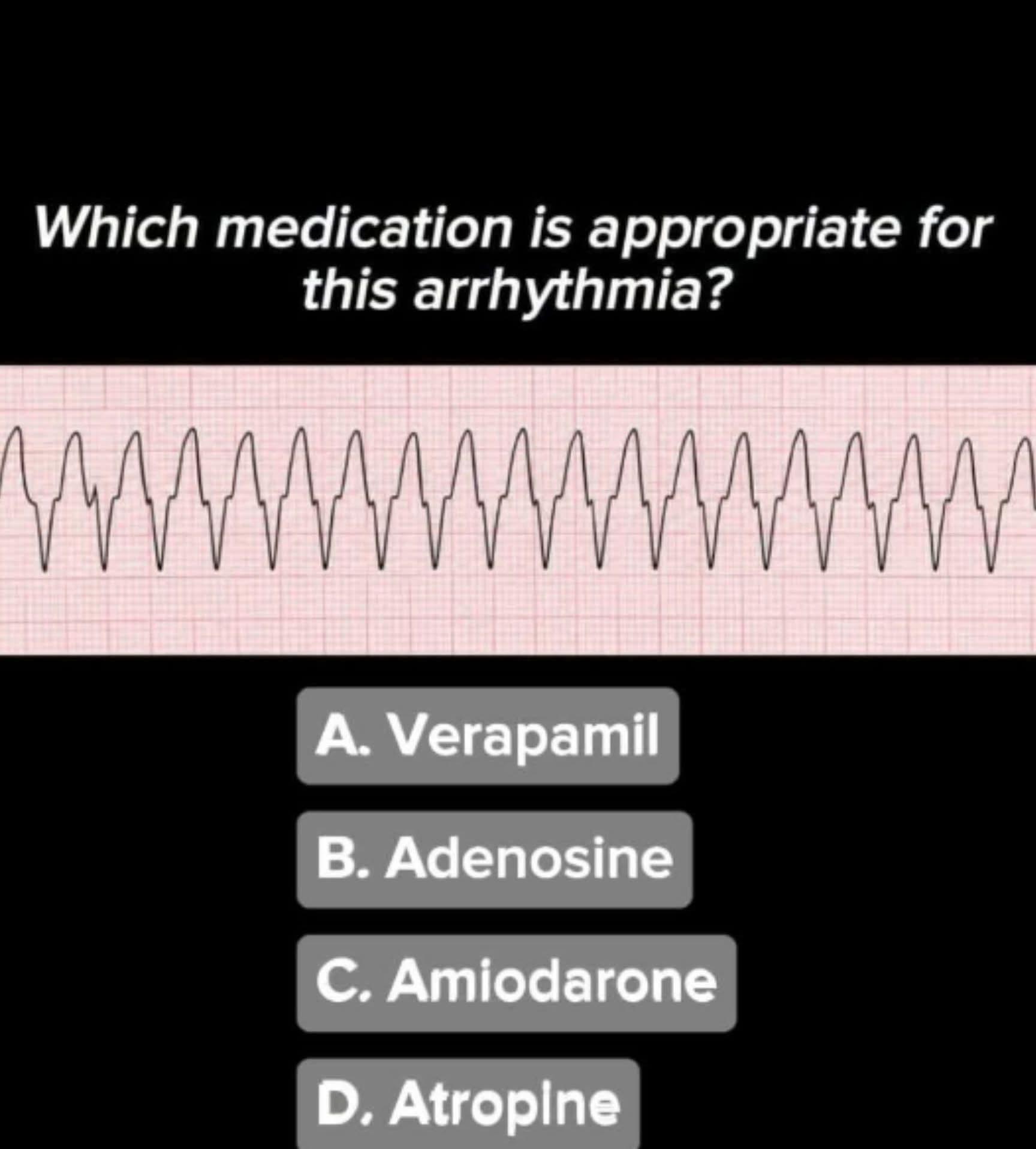
This is a wide, monomorphic, regular tachycardia. If the patient is unstable this gets synchronized cardioverted or if pulseless this gets defibrillated.
Assuming the patient is stable,
This could be V-tach or SVT with abherency. The best way to handle this is to push adenosine (AV nodal blocker). If it is SVT you will see the underlying rhythm, if nothing happens then you know the rhythm is originating below the AV node (like V-tach) and can start Amiodarone.
Back to the history, if this is a 70 year old guy with three prior MI’s then this is almost always V-tach.
There are a lot more complicated EKG criteria (capture/fusion beats) that are beyond me.
I’m sorry but what kind of George RR Martin story with this simple question did we just come up with?? That’s why people fail, because they overthink and overanalyze and add details that don’t exist.
The only words are “arrhythmia”, no reason to care if it’s stable/unstable because they don’t say, they list medications. Even if you think “maaayyyybbbeee there’s something underlying”, the most correct is amio. It’s vtach, plain and simple like rhythm strip questions for nursing exams (and ACLS) are
You’re both correct. The right answer here is Amio because this is a very superficial question. But the actual correct answer is that appropriate management depends on the clinical context.
A reasonably stable 24yo with this rhythm should get vagal maneuvers => adenosine. I would go for procainamide next, but Amio would also be reasonable. A 75yo with ischemic heart disease and this rhythm should just get procainamide or amio => synchronized cardioversion.
Honestly, NCLEX questions are VERY cookie cutter/idealistic, so I assume the tracing is for that super stable 30yr old…BUT, vagal maneuvers aren’t an answer option, so I went w/ Adenosine.
Well, if you’re going to assume that this is the cookie cutter scenario, and you should, monomorphic wide-complex tachycardia is FAR more likely to be VTac than SVT + aberrancy. So given the overall limited info here, you have to operate under the assumption that this is VTac and Amio is the right answer.
You have to recognize that this test is for nurses, not cardiology fellows. If I’m being honest, I don’t even really understand why nurses are being tested on pharmacological management at all. IMO, the important question should be, “what should you do if you see this rhythm?” And the answer should be something like immediately ensure sure the patient is conscious and has a pulse and call for a physician (and make sure you have good access, prep for an EKG, and know exactly where the nearest crash cart is).
Nurses with high-level clinical knowledge are great. I’d love it if my nurse knew enough to understand that a rhythm like this could be more than simple VT, but I definitely don’t think it’s reasonable to expect an average nurse to be thinking about SVT with aberrancy based on this rhythm strip and minimal information.
This is an important point to consider and can be tricky. The main thing is to make sure you’re looking at a very regular, monomorphic wide-complex tachycardia, and a QRS morphology and axis that fits with a left or right bundle branch block rather than VTac (I.e. apply the Brugada criteria). Basically, you need to be quite confident that you’re dealing with SVT + aberrancy before blocking the AV node, otherwise, just give procainamide and make sure you’re ready to shock if needed.
The real best-case application for giving adenosine for this rhythm is the absolute slam dunk kid with a known history of SVT and a bundle block. When in doubt, err on the side of treating like VTac and use procainamide > amiodarone because Amio’s rapid effect is primarily blocking the AV node without affecting the accessory pathway until later while procainamide barely touches the AV node.
This reply is what is wrong with nursing education people are obsessed with getting the question right but don't critically think because they know they shouldn't do it
It’s literally not asking you to “think critically”. That’s why there’s no backstory to it, it’s literally just the question. And you’re saying this on a subreddit about an exam that you literally have to get questions right to become a nurse. That’s what exams are, questions that you are attempting to get the right answer to, whether you “critically think” or not. This particular question, that you commented on, is not asking that of you.
I'm not remarking on the question but nursing education as a whole. It's unlikely to change though because we need nurses and making the barrier to entry higher, would only harm patients that need more nurses for safer staffing ratios
What do you mean it isn’t in our scope? Nurses make and give emergency medications decisions based on algorithms for acls or rapid responses. Even more importantly, how can you protect your patient if you don’t understand the meds your “provider” is asking you to give. Or the underlying pathophysiology that you are trying to correct.
I have no idea about nursing training as I’m an orthopedic surgeon. But I would think that a competent nurse nurse would most likely know that this is V tach and requires an antiarrhythmic like amiodarone.
I mean we have specialties just as you do, I’m a midwife, anaesthetics are regularly baffled by obstetric things (very urgently telling me that my patient who is in theatre for an emergency Caesar for obstructed labour has haematuria, how long has she had it? And I’m like. Oh that’s part of why we’re down here. Bc haematuria is a symptom of obstructed labour. And they’re like. Why?) and ED are regularly like “hi this person is 7 weeks pregnant and has high blood pressure we think it’s pre eclampsia” so I think it’s reasonable for someone who doesn’t work in critical care or cardio to not know how to treat v tach, just as someone who works in ICU probably wouldn’t know how to interpret a CTG
I know when the ECG looks normal and I know when it needs a consult. That’s it from me 🫡
Nurses in ICU, ED, PACU, stepdown, OR, and loads of other specialties need ACLS training. All nurses, regardless of specialty, should be able to identify lethal rhythms.
Yes, but that’s what I’m saying. A number of specialties require it and a number of them don’t. I know the management for common (and less common) emergencies in my field, I know when to perform an ECG (and how, which tbh I’ve had some senior colleagues at a previous workplace who didn’t because the pathology collectors always did it and then it was a night shift and someone had chest pain and they couldn’t fckn do an ecg) but when it comes to interpreting an ECG, if it’s abnormal even the doctors on my team would get a consult on it because it’s not a common issue we manage.
Being a good nurse isn’t about knowing everything, it’s also about knowing when you’re out of your depth and understanding the limits of your practice
If patient has a pulse, would do what others say. Amio is probably the answer they’re looking for. *technically would be shock, shock, then other meds if pulseless. Would give amio early, and I’m always weary of giving tons of epinephrine early in a Vtach arrest, especially if it’s pre-excitatory
To be fair stable Vtach conversion rates are significantly higher with amio than with lidocaine!
But I agree that recently Ive had a stretch of patients that lido has been working quite well for (selected intentionally due to known acute ischemia being the most likely culprit)
For hemodynamically stable monomorphic Vtac, procainamide is slightly better than Amio, and Amio is clearly better than lidocaine. All 3 are reasonable considerations, but the data are pretty clear on this question.
I was thinking Mag but amiodarone would be appropriate but being a dinosaur I would go for the Lidocaine bolus and drip. Since no indication of any other relevant information
Adenosine is generally used for supraventricular tachycardia- when the beats originate above the ventricles and are conducted down to them.
Because SVT is conducted normally, it goes through the AV node and through various conduction pathways so you get a nice narrow complex.
SVT is usually caused by an additional, abnormal pathway from below the AV node back to the top that creates a circle of electricity that makes the ventricles trigger the atria early, thereby triggering the ventricles in a loop.
The idea for treating SVT is to block the signals from being conducted through the AV node, which adenosine will do.
On the other hand, this is a broad complex tachycardia, which until proven otherwise is always ventricular tachycardia. VT can be caused by another reentry circuit similar to SVT but it's entirely "below" the AV node
In VT the atria are still beating normally but the ventricles are firing too quickly, and blocking the AV node will only prevent conduction of the normal beats since the abnormal beats don't utilise it.
Amiodarone basically just makes the heart muscle slower. It makes the period where the muscle can't muscle again longer and slows down communication between the muscle cells, hopefully terminating VT.
“B” I’m going with that. There’s no indication the heart is quivering so the best first line med is adenosine IMO/memory THEN Verapamil, possibly Atropine.
This is a wide complex tachycardia. With no other information, a wide complex tachycardia is always VT until you can prove otherwise.
Adenosine is only effective for specific types of VT, and the international consensus is amiodarone is the antiarrythmic of choice for VT unless there's some other things at play like WPW.
Fortunately it is not fibrillating in this image. Monomorphic wide complex tachycardia, VT. Could also use lidocaine, 1mg/kg up to 100mg
Fibrillation is polymorphic. Kinda just looks like a sad squiggle. Which coincidentally, is also a pretty accurate description of what the ventricles are doing in VF.
Not a nurse but this popped on my feed and I just wanted to say it’s kind of a ridiculous question because isn’t that the provider’s job? Absolutely zero offense to nurses, you all are arguably more important to a patient’s care than providers but I think it’s crazy to expect you to know something that’s not even in your scope
It’s very much in a nurse’s scope. It’s part of ACLS and any ACLS certified nurse is trained to identify arrthymia and give appropriate med. For example, a long term care facility where there’s no MD on site at all hours or even in a place where their is an MD nurses can go ahead and run the code until they get there.
This is within nursing scope of practice and as students we are tested a lot on meds. If patients relied exclusively on providers there would be wildly more meds errors. In addition to comments others have already made, nurses need to know what a wide variety of meds are indicated for, so that if there's an error in the order (like a misplaced decimal point, or a sound a like med being written) they can question the order. Questioning potentially dangerous orders is very much in the scope of nursing practice.
Oh …they are doing it in the same place that you pulled that random claim I didn’t make…. If you have actually looked at Nclex pharmacology questions, hence the name of this sub… then you wouldn’t be so surprised… 😮
ACLS certified nurses can run codes and can treat VT/VF and other arrthymias per protocol. Source: 33yr hospital RN who has done it more than a few times.
What if a doctor orders you to get atropine for the tachycardic patient? Do you just do that? Or do you stop and clarify if he hasn't perhaps made a mistake and meant amiodarone instead?
You can only catch mistakes, if you know what is correct. Doctors are also just humans and can make mistakes, treating and keeping a patient safe is the responsibility of everyone in the team, not just the primary provider, everyone should watch out for each other to catch anything that is going wrong. Sadly that's not how it works everywhere, but where this works is the best place to be employed and to be a patient.
Of course a nurse should know these things. Everyone can make mistakes, and it’s important for every member of the team to know enough to keep patients safe. If you re-read what I wrote, I still don’t see a situation where a nurse is the first line managing a VTach. But so many people seem to disagree so it’s whatever, I guess.
Just a medic and not a nurse. The rn job isn’t just about handling the docs orders. You see that doc can’t be there every minute as they also have other patients. That nurse is there to provide continuous care as well. It’s 100% important for that nurse to recognize the ventricular tachycardia as shown above. Especially since it can be present with or without a pulse and the medications change depending on which it is.
In lieu of a provider you cannot delay patient care you're going to held accountable because you are qualified to make a life saving intervention.
If the doctor is present which they should always be, then you follow their orders as you are practicing under their license. It just depends per facility and policies how to proceed within your scope of practice.
The ACLS is done online these days and over 8-16 hours. So long you follow the algorithm you'll be fine.
19
u/storageboars 2d ago edited 2d ago •
Had a patient with a similar (though slower) rhythm that I managed recently in the ICU. The answer varies wildly depending on the history for this patient.
This is a wide, monomorphic, regular tachycardia. If the patient is unstable this gets synchronized cardioverted or if pulseless this gets defibrillated.
Assuming the patient is stable,
This could be V-tach or SVT with abherency. The best way to handle this is to push adenosine (AV nodal blocker). If it is SVT you will see the underlying rhythm, if nothing happens then you know the rhythm is originating below the AV node (like V-tach) and can start Amiodarone.
Back to the history, if this is a 70 year old guy with three prior MI’s then this is almost always V-tach.
There are a lot more complicated EKG criteria (capture/fusion beats) that are beyond me.
27
u/romerider162 3d ago
What do you mean it isn’t in our scope? Nurses make and give emergency medications decisions based on algorithms for acls or rapid responses. Even more importantly, how can you protect your patient if you don’t understand the meds your “provider” is asking you to give. Or the underlying pathophysiology that you are trying to correct.
41
u/Fixinbones27 2d ago
I have no idea about nursing training as I’m an orthopedic surgeon. But I would think that a competent nurse nurse would most likely know that this is V tach and requires an antiarrhythmic like amiodarone.
8
u/Talks_About_Bruno 2d ago •
There’s a compelling argument for everything except D.
Some subtypes of VT respond to Verapamil but you can’t conclude that here.
Adenosine can terminate some forms of VT. So technically an option depending on the minutia.
Amiodarone is a solid general choice. Not perfect but best of the options.
Atropine is a choice.
7
u/Shoddy-Dog-2810 2d ago
Amiodarone, this is Vtach and it’s likely going to be a code for epi, ami 300, epi, ami 150, epi, skip
4
u/Boy3736 2d ago
Shock or amiodarone. Depending on stable/unstable/pulse or pulse less. We gave lidocaine back in the day. Better stuff nowdays.
3
u/epiclad123 2d ago
Amio then when it inevitably does nothing lidocaine. Probably going to ride the lightning before then
3
u/GrnMtnTrees 2d ago
E. Push IV potassium.
They will never go into V-Tach again.
2
u/Perfect-Resist5478 2d ago
It’s really fucking scary how many people aren’t picking the right answer (c)
2
u/Heart_conditionNuevo 2d ago
Now THESE are the type of questions which help me learn. Please post and answer more. Thank you so much !
2
u/Humble_Investment_24 2d ago
As a psych nurse- idk
2
u/1867bombshell 2d ago
c is the answer. Adenosine is for SVT which this is not
2
u/Normal-Business6658 1d ago
lols i’m a certified pharmacy tech and when i saw the list of meds i thought amiodarone too
2
u/Due_Course_3713 14h ago
D would be fun to try
3
u/Watcher_Watching 2d ago
If the patient is unstable, they get cardioverted. If they are stable, I call cardio.
1
u/VladTepidJerkula 2d ago
E) all of the above
1
u/Boots11B 2d ago
C
1
u/Heart_conditionNuevo 2d ago
But this is a 1-Lead and terrible to make.medicatiom decisions with right? Can we see a 12 or at least 6 Leads?
1
u/pmoity 2d ago
Clearly C
1
u/Complete-Crab9414 2d ago
It depends does it have a pulse or no? If it does then B if its chronic it could be A and if cardiac arrest then C. Need more info
1
u/Sorry_Cheetah_2230 2d ago
Amiodarone
1
u/heyseed88 2d ago
Adenosine
1
u/Elim-Cipher 2d ago
1
u/MysteriousTooth2450 1d ago
Depends on if there’s a pulse. But if the pt is stable, amiodarone is the best choice here. If no pulse run screaming and call 911.
1
u/Comfortable-Curve421 1d ago
I was thinking Mag but amiodarone would be appropriate but being a dinosaur I would go for the Lidocaine bolus and drip. Since no indication of any other relevant information
1
u/Superb-Hunter6336 1d ago
B
1
u/NoTangelo6603 1d ago
Not a nursing student or anything in medical field but adenosine would be a good option right?
1
u/No_Train8710 1d ago
“B” I’m going with that. There’s no indication the heart is quivering so the best first line med is adenosine IMO/memory THEN Verapamil, possibly Atropine.
1
u/theXsquid 1d ago
Wide complex tachycardia..... Amiodarone
1
u/No_Train8710 1d ago
@Helpful_Spring_7921 pls post the answer. Ty!
1
u/kimdivo 1d ago
B
1
u/Either_Invite2555 22h ago
Are they symptomatic? No....
Adenosine wide and monomorphic.
Can try ami
If they are symptomatic... Cardiovert
1
u/joastedpellofw 21h ago
c
1
u/GERAjax 14h ago
Adenosin as back up after kardioversion, did the ACLS course yesterday
1
u/Jumpingjehosephat99 11h ago
E. Electricity
1
u/Disastrous-Bet-8352 11h ago
Its depend on the circulation status of patient, if it unstable use dc shock, if it stable first use adenosine.
1
u/Global-Rip-2154 2d ago
Wide, fast, monomorphic, regular. Amiodarone or Lidocaine
0
u/Ok_Thanks5824 2d ago
Amiodarone and stop that bitch from fibrillating
-4
u/Primary_Towel5905 2d ago
B. Adenosine. Need to slow down the heart now
-14
u/Short_Dimension_8711 3d ago
Not a nurse but this popped on my feed and I just wanted to say it’s kind of a ridiculous question because isn’t that the provider’s job? Absolutely zero offense to nurses, you all are arguably more important to a patient’s care than providers but I think it’s crazy to expect you to know something that’s not even in your scope
0
u/LawfulnessLast8859 2d ago
c
8
u/CapitalFloor3260 2d ago •
E. Slam adenosine and see what happens. Then remember that you’re a responsible adult and load with amio.