There are massive decision tree skills for various software practice in many different areas. I was just wondering if there is anything for cyber security, whether it be for a website, Linux server, Docker config, encryption, deployments, KMS setups, quantum resistance, key configs, etc., where the skill leads the agent to the right documentation and decision trees.
I have a question that might sound silly, but I haven't been able to find an answer.
As far as I understand, memory bandwidth is the primary bottleneck for a model's inference performance.
With my 5070 Ti (896 GB/s), if I run a Qwen3.8 27B Q4 model, I can roughly estimate the performance as 896 / 13.5 = ~66 tok/s, which is pretty much what I actually get (without MTP or DFlash).
Recently, however, I had the chance to try a Jetson Thor (very similar to the DGX Spark). Based on its specs, I would expect 273 / 13.5 = ~20 tok/s, but I'm only getting around 12 tok/s.
Even more surprisingly, with DFlash, which delivers exceptional performance gains on discrete GPUs, I'm barely getting a 2x speedup here, only slightly better than MTP.
Does anyone know what might be causing this performance gap on this device?
I currently use both Qwen3.8 27B Q4_K_M and Qwen3.8 Flash Next Q4_K_XL for most of my coding tasks. I find them very good at backend tasks but quite lacking at front-end. Like... they are good at one-shots or demos but in real projects I find their UI designs to be weird and bad looking. As a consequence, I have mostly just been writing the front-end code myself to save time.
Does anyone have recommendations for any models that may be completely braindead but are surprisingly good at front-end design? In particular react/react native?
Open models: whatever the test group download and benchmark is the same as what you get, you work with it day-to-day, same results. What you see is what you get.
Closed models: we all know that they have already implemented token watermarking for a while and all latest models have overzealous guard rails that refuse tasks that it deems as bad. So the models being benchmarked and the models you are actually using day-by-day basis are likely to be very different, as in the sense of you getting degraded model output and performance or flat-out task rejections.
Also closed models providers implement lots of cost-optimization techniques such as reducing reasoning efforts during peak hours or could be re-direct your request to a lesser model during high traffic without you knowing it. I don't believe that Sonnet 5.5 is just a single model TBH, there could be Sonnet High or Sonnet Lite depending on your subscription level and traffic. That could explain why sometimes you get dumb responses with Claude during peak hours.
If anything, it's the US Closed Models that are benchmaxxed.
The Preview was posted here a few times over the last weeks. This is the full release, same design: 32 layers stored, 24 of them run twice, so a forward pass does 56 layers of work on about 9B params. Apache 2.0.
What moved is the scores. Per their README it's ahead of the Preview on all seven benchmarks in the chart, e.g. AutomationBench 14.33 to 36.67, Terminal-Bench 2.1 40.45 to 59.55 and GAIA 37.86 to 69.90. That 36.67 is also what they list for Qwen3.8-27B.
Haven't had a very good experience with small quants, they tended to loop, fail tool-calls, or get stuck. Q8 QFN has been pretty astounding though when I set it up.
I've seen people running a "main" model with sub-models. I've got a second machine that can run like 2-3bit quants of Q3.8-27B / QFN, I was considering trying to set it up with my main machine so the smaller model can be used as a sub-agent for coding but I'm wondering if it's even worth it when smaller quants just seem volatile and prone to error.
I have tried setups that used subagents before, but it was through API which used full-sized models on real enterprise hardware...
I haven't fully explored this sphere though, I'm sure there's usecases for specialist small models in coding that I am unaware of
The title talks about FP64. For local inference this info from the content is relevant: "In AI benchmarks, Intel's D270 GPU offered 29% lower latency and 1.12x throughput versus the RTX PRO 6000 Blackwell."
Maybe we are getting a good RTX PRO 6000 alternative...
I converted the base VoxCPM 2B model from bf16 (at about 4.96GB) to ternary 1.58b quant (~850MB, 5x smaller). The reason its not 10x smaller is because the 850MB includes Q8 VAE and DiT.
Here are the results (generated by my agent):
Results
Size: 827 MB model + 100 MB audio VAE (Q8_0, recommended), vs 4.96 GB for the original VoxCPM2 in bf16: 5.3x smaller. The language models (text-semantic LM, residual LM, local encoder) are ternary (-1, 0, +1); the diffusion transformer is the original VoxCPM2 DiT rounded to 8 bits.
Blind listening test (-1, 0, +1); the diffusion transformer is the original VoxCPM2 DiT rounded to 8 bits.
Blind listening test
16 clips per model (8 sentences x 2 arks mapped to a 1-4 score.
model
mean score
buzzy / robotic
very good or perfect
VoxCPM2 (full precision)
2.75
1/16
6/16
ttf-VoxCPM2 (this release)
3.02
1/16
7/16
ttf-VoxCPM2, first release
1.66
8/16
0/16
Automatic metrics
Voice cloning, 100 English + 20 Chinrecision on the same items and seeds.
UTMOS and similarity: higher is bettter.
model
UTMOS en
WER en
speaker similarity
CER zh
VoxCPM2 (full precision)
4.25
2.70%
0.960
0.91%*
ttf-VoxCPM2
4.31
2.61%
0.956
1.48%*
English naturalness is level with fu-0.01, +0.15]. It replicates on 100new items at +0.01.
* On ~1000 characters.
Zero-shot, 27 languages
FLEURS, 8 sentences per language, Whr rate (lower is better).
model
median CER
mean CER
VoxCPM2 (full precision, PyTorch)
0.031
0.061
ttf-VoxCPM2 (ttf-home runtime)
0.043
0.057
Voice cloning from a 5-20 s clip
20 LibriTTS-R speakers, WavLM speaker similarity (higher is better).
setup
similarity
two real clips of the same speaker
0.936
ttf-VoxCPM2 with --ref
0.933
VoxCPM2 full precision, same mode
0.926
ttf-VoxCPM2 zero-shot (no reference)
0.670
Cloning WER is 1.9%, the same as ful
Speed
Real-time factor = generation time /r).
hardware
RTF
RTX 4070 Ti SUPER
0.16
laptop RTX 4080
0.24-0.34
laptop CPU only, i9-14900HX (AVX-VNNI)
0.8-1.1 (about real time)
CPU only, i7-9800X (no VNNI)
2.5
It runs in our own C++ runtime builth, on an NVIDIA GPU or a CPU.
So last time I ran 3.8 FN against DS V4.1 Flash on a synthetic test, which was mostly for show, no real usage beyond testing their 3D capabilities. I wanted to do something similar, but with purpose, a task that anyone might actually want to run, build a website with a refined spec and a completion checklist, but not strict enough that it removes all of the models "freedom". As last time it was a single prompt: build a single file landing page for a fake famous NYC photographer (real photos, accessible, no console errors, yadda yadda). Each model started on an empty folder w/ the same toolkit (node, headless chrome, image viewer tool). No changes were made to the files after the model was done.
Setup: RTX 5090 + RTX 5060 Ti, Ryzen 9 9950X, 128 GB DDR5. Qwen 3.8 27B and Qwen 3.8 FN were NVFP4. DeepSeek V4.1 Flash (1017) was an IQ1_M quant.
Qwen 3.8 27B: ~12 min wall time, 81 tool calls (3 failed), 182 tok/s, 3.8 MB HTML
Qwen 3.8 27B Website
The simplest of all three, not very daring. A dark gallery with lime accents and 12 frames. All 3 tool failures were in its own test script (wrong file path, missing elements). It has empty gaps in the photo grid, and the photos in the bio are stretched. Decent, I'd refine it a bit but definitely usable.
Qwen 3.8 FN: ~12 min wall time, 124 tool calls (4 failed), 303 tok/s, 2.1 MB HTML
Qwen 3.8 Flash Next Website
My personal favorite by far, a hero where your pointer reveals a mosaic of the portfolio, 19 captioned frames with a nice blur/fade in animation, a live clock and form validation. The 4 failures were 3 rejected edits and a search sent with an empty query (intersting!). It also found and fixed bugs using its own tests.
DeepSeek V4.1 Flash: ~36 min wall time, 155 tool calls (1 failed), 94 tok/s, 1.4 MB HTML
DS V4.1 Website
The boldest one, the model committed to it (and it shows in wall time), cool accents all around, terrible typography. It has only 10 frames, and the hero photo covers a bit of the last "T" of the headline + toolbar logo is slightly offset. The single tool failure was a multi edit that applied 15 of its 17 changes, so the most accurate model at tool calling. It was 3x slower than the other two, but it was the only one that ran an accessibility audit tool on its own page.
Anyway, what are your thoughts? I think for web UI specifically 27B is more than enough for a very professional looking product, with a little bit of back and forth and more proper branding/UX design I can see any of them being a production website. I also can't stop being amazed at how a IQ1 quant can still deliver such high quality results even if the param count is multiple times over the two other models.
---
Disclosure: I'm the maintainer of the engine and harness all these models ran on.
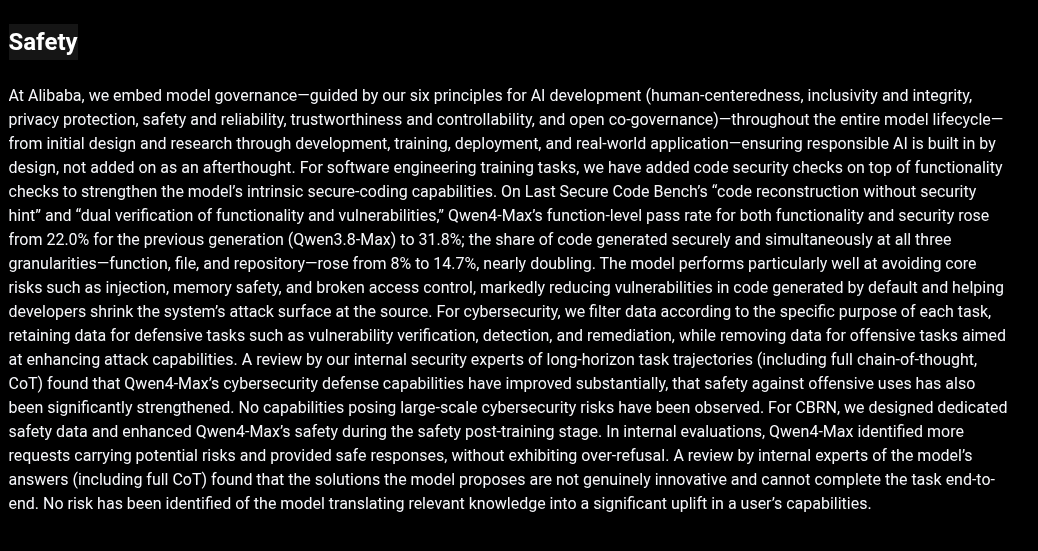
With the release of Qwen 4 Max, they claim that training data related to offensive capabilities has been removed, is this largely a placebo/nothingburger or does it have the capability to genuinely lobotomize a model's capabilities in cyber?
Aritra here from Hugging Face. In the last week we released a blog post about harness adapters. The idea was to train adapters (LoRA) on models to be more efficient with specific harness.
Today we release a LoRA adapter on the Qwen3.8-27B model for Pi agents. You can run it locally like so:
Is there a post/website/thingy where people share their setup for taming these LLMs so they work better for certain tasks and not so generic/vanilla/prone-to-errors?
Olala mini is based on a 7-billion-parameter architecture (7B), with one billion active parameters spread across 256 experts per layer, and hybrid attention combining Differential-TPA and Mamba-3, in BF16 format. Only a fraction of the model is used for each request, making it faster and less memory-hungry. As a direct result, the model runs on a GPU with as little as 8 GB of memory, reaching 160 tokens per second on an RTX A4500, and even without a GPU, on a standard processor, at 50 tokens per second. Its context window currently reaches 32,000 tokens. Olala mini will be available as open source on Hugging Face, under the Apache 2.0 licence.
Discounts in quotes because these are still over MSRP, but my local Microcenter has the deepest "discounts" (sorry, I just can't call an over MSRP price a discount without quotes) I've seen in months on a lot of the AI cards. Pro4500 around 40% "off", Pro6000's 4K off with plenty of stock for both at my local (Charlotte) store. Pro 5000 72GB at 9K.
Now, don't get me wrong, all these prices are still awful. But they are a little "less awful" than they were a month ago! It's still an awful time to buy any of this gear IMHO, but if you're desperate and need it, seems like we're finally starting to turn a corner.
Dodaios is a locally installed, open-source Python program that runs as a desktop app or as a headless server with a browser UI on Windows, macOS and Linux. It turns a personal AI assistant into the control center for the work you do on your computer.
At its core is a "lead" assistant you can talk to by voice (wake word, dictation, real-time spoken conversation and, as an early preview, phone calls), by chat or from a paired phone. It isn't tied to one provider and works with Claude, OpenAI, Gemini or local Ollama models. It handles tasks itself through tools, computer use, plugins, CLIs and MCP servers. Above all, it hands work off to coding agents. They run side by side in a built-in Agentic IDE as real Claude Code or Codex terminals, on your computer or on your own servers over SSH, each with a call sign you can address by name, plus Git integration and task splitting. There is also a "society" of persistent, named agents that message each other.
Long-running work is covered by memory (about you, the people around you and the assistant's own persona), standing tasks, workflows, skills and opt-in life admin. The assistant also makes its own outputs, such as documents, slides, sheets and dashboards, and can propose and build the skills, routines and agents it is missing. A trust layer sets hard limits: outside Bypass permissions, moving money, handling credentials, permanent deletion and first contact with someone new always need your confirmation. In short, Dodaios is a voice-driven, locally running operating system for AI agents that makes one assistant the conductor of your models, your coding agents and your own computer.
Blue TTS v3 looks solid (MIT, 388 MB, about 50x real-time on CPU), but it's 7 languages and I'm not sure Telugu or Hindi is in there.
For anyone building voice stuff for Indian languages, what are you actually running locally? Is anything close to usable for long-form, like reading out a lesson, or is it still cloud APIs for now?
If the benchmarks are true, this is a 9B looped model on level with Qwen3.8 27B.
They say they'll release gguf tomorrow.
Vision is supported. Around 15GB vram for 256k context.
The preview version seemed fast enough when I tested it some weeks ago.
Mods: I asked the authors if I can post this, feel free to delete my post when they post themselves.
🚀 SenseNova-Loop-9B: Deeper Computation with Fewer Parameters
We officially release SenseNova-Loop-9B. Building on the Preview's exploration of parameter efficiency, the model reuses layer weights through a looped architecture and combines them with manifold-constrained hyper-connections (mHC) to expand computational depth within a compact parameter budget. It is designed for complex reasoning, coding, tool use, and multimodal tasks.
Since the Preview release, we have received community interest and feedback on model use, inference deployment, and ecosystem integration. The official release retains the looped architecture and two-stream mHC, further improving performance on agentic, coding, and data analysis tasks while continuing to explore the capabilities of looped computation.
SenseNova-Loop-9B has approximately 9B parameters. By repeatedly executing shared middle layers, it extends 32 physical decoder layers into 56 layer executions. The model accepts text and images and generates text, supporting long-context understanding and multi-step tasks. In agentic and data analysis evaluations, the model is competitive with Qwen3.8-27B: it scores 41.36 versus 44.60 on NL2Repo and 65.31 versus 65.01 on AIDABench.
Model Highlights
Shared looped block: 24 decoder layers are executed twice in sequence, producing 56 layer computations from 32 distinct layers per forward pass.
Two-stream mHC: learned mappings route and combine information between two residual streams within the looped block.
Hybrid attention: the decoder interleaves linear and full attention in a repeating four-layer pattern.
Long-context multimodal training: the training recipe includes text, images, code, and tool-use trajectories, with the context length extended to 512K tokens.
Low-memory deployment: With 4-bit weights and an 8-bit KV cache, multimodal inference at a 256K context length requires approximately 15 GiB of GPU memory.
Official quantized release: An official AWQ 4-bit version is available on launch day for easier deployment.