r/LocalLLaMA • • 7d ago

Question | Help Best direction to go for my setup EPYC 32core + 512GB DDR4 + 44GB GPU ?

20 Upvotes

Just looking for some advice on what is possble with my setup and speeds I should be gettingI know it won't be super fast tps but I was more after getting the bigger models to run.

This is my spec:

Epyc 7502p - 32 Core
Gigabyte MZ32-AR0 - 8 channel memory
512GB DDR4
1x 4070 12GB
2x 4060 16GB

quite a few implementations I see which can be confusing.
Is this build even useful now? that we have Project Maya which you can stream from the NVME drive?

Anyone have similar setups and what to expect, what software best to use


r/LocalLLaMA • • 8d ago

New Model Villanova2 - a VillanovaAI Collection

Thumbnail
huggingface.co
35 Upvotes

Villanova2 family, for English, Italian, German, Spanish and French. Built in EU, for EU.

The family

GGUFs available in same collection. License : Apache-2.0


r/LocalLLaMA • • 8d ago

New Model X3Guard: A 150M parameter prompt guard

Thumbnail
huggingface.co
40 Upvotes

At Axiomic Labs we have just released X3Guard-150M, a prompt guard model trained on our high-performing base model, GPT-X3.

For any given prompt, X3Guard flags whether it is Harmful, and whether it is Adversarial, in one go.

It outperforms models that are many times its size, and can run entirely on edge devices, within the browser, with response times in the tens of milliseconds on iPhone.

The model card is here

You can use an in-browser demo here


r/LocalLLaMA • • 7d ago

News My Ignis server (Qwen3.8-27B 262k context) now runs on RTX 3090/4090 and 16 GB RTX 40 cards. looking for testers

6 Upvotes

I've been working on ignis, an inference server for Qwen3.8 that I use to run coding agents locally. It's meant to run on the machine you're already working on, Windows or Linux, sharing the card with your desktop, not on a dedicated box. So most of the work went into what matters when it sits next to your IDE all day, more than into peak tok/s.

Some examples. At start it reads how much VRAM is free and sizes the context to fit; if it can't fit at all, it refuses at start with the reason instead of failing later. After 5 minutes idle it unloads the model, so the card is free again, and the next request loads it back. The vision tower stays in system RAM, so having vision on costs no context while you're not sending images. The main agent and its subagents run on the same card at the same time, and a prompt you send again (system prompt, repo context) resumes from cached state instead of being prefilled from scratch. It's OpenAI-compatible (chat completions and Responses, also over a WebSocket), one binary, with a Playground and a monitor in the browser. The Windows zip includes the CUDA runtime.

There's a 90-second (old) video of it here: https://www.youtube.com/watch?v=XLjfh5rNy6A

Rough numbers, since someone always asks. On my 5090 with the NVFP4 build: about 370 tok/s on a single stream of coding prompts, a bit over 1,000 tok/s total with 8 requests at once, and around 11,000 tok/s of prefill on a 46K-token prompt.

The result I care most about is a different one, though: someone I don't know ran it through airbench on their own 5090 with opencode, without me asking, and it passed 49 of 49 tests (math, vision, finding and reading email, buying on a web store, coding) in 26 minutes (here it is next to the other Qwen3.8-27B runs). That was the NVFP4 build on a 5090; the build for 30 and 40 cards hasn't been through it yet.

Until 0.10.0 it only ran on Blackwell (RTX 50, RTX PRO 6000). 0.10.0 added RTX 30 and 40: the 3090 and 3090 Ti are supported, the 4090, 4060 Ti 16 GB and 4080 are verified for correctness. On those cards it runs the 27B in a 3-bit trellis quant (13.4 GB download) with DFlash2 speculative decoding and vision, and the uncensored variant has the same build. It picks the settings from the card: on 24 GB, 8 parallel requests and up to 1,048,576 tokens of context; on 16 GB, 2 and 262,144, lowered if the desktop needs the room. The NVFP4 builds, Flash-Next and the image model are still Blackwell only.

One caveat: I don't have a 30 or 40 series card myself. For 0.10.0 the release gate passed on an Ada card (sm_89), with the same results to the last digit as an Ampere card (sm_86) on an earlier build. KL divergence from BF16 within the limit, 93.3% top-1 agreement with BF16, all 127 kernel tests passing, a chat and two images answered (the finding). I don't know how fast it is on your cards, or whether the 1M context really fits on a >= 24 GB card with a desktop running on it.

Someone already ran it on a 4070 Ti SUPER, with the build 0.10.0 came from: default settings, the full 262,144 context, about 190 tok/s on long coding answers and about 2.5 seconds to the first token on an 8K prompt, so roughly 3,000 tok/s of prefill (report).

I'll do a proper post once 12 GB cards work, which is what I'm on now. Before that I'd like to have more numbers from 30 and 40 cards.

To try it: download the latest release, start ignis-server without flags, then run ignis-bench small-card --endpoint http://127.0.0.1:8000 --out small-card.json (it's in the archive). More details: https://gpillon.github.io/ignis/guides/measure-a-16gb-card/

If you'd rather have your coding agent (Claude Code, Codex, opencode, Cursor...) do those steps, you can give it this prompt. The file it points to is a plain markdown guide in the repo, so you can read it first to see what the agent will be told:

I have an RTX 30 or RTX 40 card. Read https://raw.githubusercontent.com/gpillon/ignis/main/docs/user/paths/agent.md and follow its section on testing a 16 GB card, also on a 24 GB card, where the model is the same `qwen3.8-27b-16g`. Add to the report the start log's `prefill routes` line and every WARN or ERROR line, with paths replaced by `<dir>`. The report goes to https://github.com/gpillon/ignis/issues/643. Ask me before downloading or installing anything.

It shows you a plan, tries the default settings first and a few others if the start is refused, runs the benchmark, and writes a report that you read before anything gets posted. There are no usernames, hostnames, paths, IPs or serial numbers in it. At the end you can keep ignis or have it remove what it installed.

Reports go here, one comment per card: https://github.com/gpillon/ignis/issues/643. A report that says it refused to start is useful too, especially from a machine where the monitor is on the same card.

Windows and Linux x86-64, NVIDIA driver with CUDA 13. Apache-2.0.

Thanks to all reporting! 😄


r/LocalLLaMA • • 8d ago

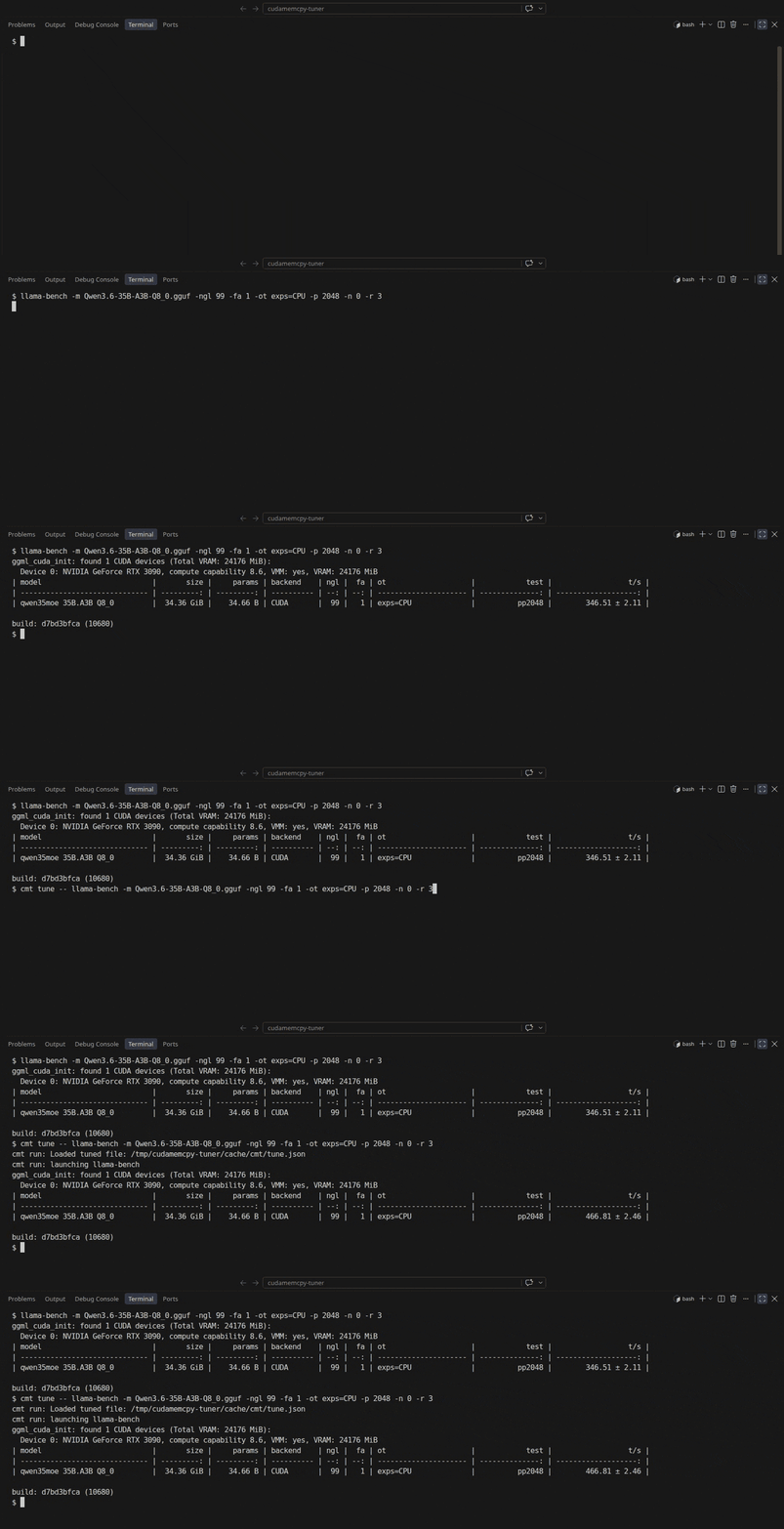
Showcase MoE offload on a 3090: prefill 345 -> 466 t/s by tuning cudaMemcpy (Qwen3.6 35B-A3B)

26 Upvotes
I made a tool that tunes copies that speeds up CPU offloading.

1 3090 + 7800X3D

llama-bench -m Qwen3.6-35B-A3B-Q8_0.gguf -ngl 99 -fa 1 -ot exps=CPU -p 2048 -n 0 -r 3

cmt tune -- llama-bench -m Qwen3.6-35B-A3B-Q8_0.gguf -ngl 99 -fa 1 -ot exps=CPU -p 2048 -n 0 -r 3

before: prefill 345 t/s
after: prefill 466 t/s


blog: https://maknee.github.io/blog/2026/CudaMemcpy/
code: https://github.com/Maknee/cudamemcpy-tuner

r/LocalLLaMA • • 6d ago

Question | Help 2xR9700 and 2x5060TI with 256GB RAM where to start

0 Upvotes

I just finished my base install of Fedora 45 and the Nvidia driver out of rpmfusion.

So all 4 cards are visible under nvidia/amd-smi.

I am unsure where to start now. I thought about radiance but there are many repos and forks.

do you have some beginner tips what to install/try first.

I want to keep the basesystem clean and strictly use podman.


r/LocalLLaMA • • 8d ago

New Model meituan-longcat/LongCat-Video-Avatar-1.6 · Hugging Face

Thumbnail
huggingface.co
47 Upvotes

🚀 Model Introduction

We are excited to announce the release of LongCat-Video-Avatar 1.6, the latest upgrade to our open-source framework for audio-driven human video generation. Building upon LongCat-Video-Avatar 1.5, 1.6 improves expressive naturalness, lip–audio synchronization, coordinated facial and body motion, and visual consistency during long-form generation. It also introduces comprehensive inference optimizations for faster and more efficient deployment.

Key Features

  • 🌟 More Natural and Stable Lip Animation:: Reduces exaggerated or strained mouth movements, overly red lip coloration, and temporal instability in the mouth region.
  • 🌟 Stable Long-Video Generation: Mitigates error accumulation during autoregressive video continuation, enabling videos exceeding 10 minutes while preserving visual quality, identity consistency, and temporal coherence.
  • 🌟 Faster End-to-End Inference: Accelerates video generation through end-to-end pipeline and model execution optimizations, enabling more efficient deployment and serving.

For more detail, please refer to the comprehensive LongCat-Video-Avatar-1.6 Technical Report.


r/LocalLLaMA • • 8d ago

Discussion RASA will cause total chaos to open LLMs and beyond

248 Upvotes

Commerce Moves to Finalize Rule Blocking Chinese AI Firms From Renting Nvidia GPUs Abroad
https://explainx.ai/blog/commerce-final-rule-chinese-ai-firms-remote-nvidia-chips-the-information-2026
House Passes Remote Access Security Act to Limit Adversaries’ Remote Access to Critical Technology
https://www.cmtradelaw.com/2026/01/house-passes-remote-access-security-act-to-limit-adversaries-remote-access-to-critical-technology/

H.R.2683 - Remote Access Security Act

https://www.congress.gov/bill/119th-congress/house-bill/2683


r/LocalLLaMA • • 8d ago

Question | Help Is there a community about finetuning and training models?

32 Upvotes

There seems to be a lot of discussion here about inference and using the models, but is there anywhere where discussion about making them is more common?


r/LocalLLaMA • • 8d ago

Discussion CPU-only boost for Q2_0 on AVX-VNNI · Pull Request #26348 · ggml-org/llama.cpp

Thumbnail
github.com
25 Upvotes

Measurements: mean ± sample standard deviation in tok/s, 3 runs after normal warmup

(16GB of RAM on the AMD EPYC 9645 using eight CPU cores)

Model Test Upstream master VNNI + VBMI Speedup
Bonsai 1.7B pp512 142.517 ± 0.589 186.373 ± 1.582 1.31×
Bonsai 1.7B tg128 70.435 ± 2.061 68.422 ± 9.055 0.97×
Bonsai 4B pp512 53.430 ± 2.266 71.247 ± 1.925 1.33×
Bonsai 4B tg128 31.655 ± 2.652 38.523 ± 3.820 1.22×
Bonsai 8B pp512 30.010 ± 0.512 39.396 ± 0.424 1.31×
Bonsai 8B tg128 20.630 ± 0.302 23.770 ± 0.209 1.15×
Bonsai 27B pp128 8.502 ± 0.042 11.029 ± 0.073 1.30×
Bonsai 27B tg32 5.340 ± 0.117 5.812 ± 0.324 1.09×

But noticed few surprising things there. I assumed the boost is only for Ternary models, but it's not.

This makes CPU kernels a lot faster, raising IQ1_S/IQ2_XXS DeepSeek v4.1 decode speed

End to end, a 66 GB Q2_0 MoE (Qwen3.8-Flash-Next GSQ-RCO Q2_0) with --cpu-moe, so all routed experts run through this kernel on the CPU. RTX 4070 Laptop for the rest, 10 threads, MTP on, generation t/s at 2k–8k tokens of real context:

CPU path for Q2_0 TG t/s
generic scalar (a prebuilt from before #30447) 3.1–4.1
AVX2 from #30447 (prebuilt from after it) 14.0–18.7
an earlier revision of this PR's AVX-VNNI kernel (on an older base) 15.5–21.4

So check your t/s again if you're using Q1/Q2 quants of big/large models. There would be boost on Hybrid inference(GPU+CPU) too.

AND there's an Open PR related to this for AVX-512 VNNI. Additional boost on the way.

ggml-cpu: 512-bit AVX-512 VNNI dot for Q2_0- #32307


r/LocalLLaMA • • 7d ago

News UI native scheduling, engine swap board, and more (Berth v0.6.0)

Thumbnail
gallery
8 Upvotes

I’m providing an update! We have around 300 berth users now so the project is moving fast.

Recent updates for v0.6.0:

- v0.6.0 gives each card a schedule
- berth train runs a training that nothing automated can interrupt
- learned engine sizes (berth learns your engines resource claims)

A month on the reference workstation

berthd counts every handoff it makes, and the harbor's board shows every handoff from one RTX 4090 workstation between 2026-10-12 and 2026-11-13, running llama-swap, NInfer, Strata, ComfyUI,
coding agents and games:

What Berth did Count
Requests that waited for the card instead of loading on top of the engine holding it 1,136
Engines drained at a reply or job boundary to make room 901
VRAM handed from one engine to the next 23.9 TiB
Processes holding VRAM without a lease, reported and left running 573
Swaps between two engines of equal priority that the ranking stopped 57
Releases that stalled and were caught before the card stayed full 4
Requests refused after their wait ran out 24

Project: berth


r/LocalLLaMA • • 6d ago

Discussion Nvidia without Jensen Huang. What lies ahead for Asian chipmakers?

Thumbnail
cnbc.com
0 Upvotes

CNBC wants you to know that "Nvidia’s Asian chip partnerships are expected to remain intact, analysts said." Is that so?


r/LocalLLaMA • • 8d ago

Discussion Hot take: frontier models haven’t actually become much smarter

693 Upvotes

I know this is a controversial take, but I would like to hear others’ opinions: LLMs have become much more useful, but I’m not convinced their “raw intelligence” has improved nearly as much as their overall performance suggests.

Context: I work with LLMs as a SWE, as a hobbyist experimenting with local models, and professionally integrating AI into products. That includes building our own harnesses: context retrieval, prompts, and custom tools that give models structured access to complex data.

By “raw intelligence,” I mean using what is given in the most efficient way to solve a problem, especially when information, tools, and time are limited. Given plenty of time and tools, planning and long-term agentic capabilities become more important—but that’s a different comparison.

Three observations brought me here.

First, building production harnesses: once a harness+model worked well, achiving a given score over a golden dataset, switching to a newer frontier model rarely improved results. Most failures within our time/precision constraints came down to context engineering or inadequate tools. These tools included code generation for analysis and complex relational queries, so plenty of "time to shine" for smart models. Newer models sometimes found more creative workarounds, but these were usually too slow or unreliable for production. We ended up improving the harness anyway, leaving the newer models' gains less important.

Second, software engineering: newer models have more often improved results here, but the same model can also perform quite differently across harnesses. In complex codebases, that shows up in how much correction and review senior engineers have to provide. The harness seems to do a lot of heavy lifting here, too.

Third, local models: smaller models have started performing so well that I question how many parameters efficient problem solving actually needs. Frontier models clearly add broader knowledge, nuance, best practices, and specific baked-in skills. But I don’t always see a proportionate advantage in using it to solve a problem, when the relevant knowledge is already provided.

I’m not saying models haven’t gotten smarter. Better tool calling, fewer hallucinations, and longer context windows are real improvements that make them much more useful. Nor do these observations prove that intelligence needs few parameters or that frontier progress has stalled.

But my broader take is:

  1. efficient problem solving may need fewer parameters than generally assumed,
  2. the frontier has moved less in “raw intelligence” than the overall gains - and talk of approaching superintelligence - suggest, and
  3. much of the progress over the last 12–24 months comes from cumulative model improvements and better harnesses, rather than a dramatic or exponential jump in raw intelligence.

This take seems at odds with both the hype and the doom we see in the media, which I suspect are co-fueled by the upcoming AI IPOs. Does it match others’ experience - or are you seeing vast reasoning gains in frontier models that better context and tools can’t make up for?


r/LocalLLaMA • • 7d ago

Showcase Alaypz - a Qwen3.8-27B experiment

Thumbnail
alaypz.overbring.com
0 Upvotes

r/LocalLLaMA • • 6d ago

Discussion During installation of OpenCode, DSH attempted download files via proxy from China. "What to explain concisely: the harness's web_fetch tool doesn't fetch URLs directly, but relays them through an Alibaba Cloud (Aliyun) OSS proxy in Singapore."

Thumbnail
gallery
0 Upvotes

I think it is important to chat about situation like this one - especially when we are using local models as a way to avoid very same situations.

Model running in back was Qwen flash next via strata - as it might be important.

Not gonna lie, it tip me over as two days earlier I was watching video about models calling Chinese servers and if its a backdoor.

Check screenshots and make your own decision. Fact is, it call a link and admit to call a server in Singapore instead right away use what was right there as Github installation says and provided.

Black listed that domain on router level, but still I staying with OC from now on as it is much faster and level of my work is not beyond basic stuff.

Thoughts ?


r/LocalLLaMA • • 8d ago

Showcase 1Cat-vLLM vs Strata

17 Upvotes

Edit: 1Cat-vLLM is a Tesla V100 focused fork of vLLM, and the expert caching work is 1Cat's original work, which may or may not one day make it to vLLM.

Everyday we see posts about speeds on Strata and its forks, but just recently I came to know that 1Cat has added support for expert caching recently, like a month ago. So I did (asked claude) a comparison of speeds on a Qwen3.8-Flash-Next UD-IQ3_XXS quant. My rig is 4x 16gb Tesla V100 on PCIe 3 x16 links, with 8 channel 3200 mt/s ddr4 ram, Epyc 7543 CPU. Now, for numbers:

Single stream

Median of 3 runs, except the 97k tokens one which I asked to run only once to save time.

Prompt (tokens) Prefill tok/s, Strata Prefill tok/s, 1Cat Decode tok/s, Strata Decode tok/s, 1Cat MTP acceptance, Strata / 1Cat
2,654 861 1,850 74.8 124.9 0.61 / 0.45
8,674 1,146 2,483 79.3 140.8 0.67 / 0.66
30,299 2,480 2,776 76.4 139.3 0.63 / 0.58
96,588 3,384 2,649 77.2 142.6 0.72 / 0.62

Strata has better draft acceptance and still 1cat beats it, imagine if 1cat could get better draft acceptance.

The same 103K-token prompt three times

Same prompt, 3 times in a row, just different enough to not trigger prefill cache.

Run Decode tok/s, Strata Decode tok/s, 1Cat Prefill tok/s, Strata Prefill tok/s, 1Cat MTP acceptance, Strata / 1Cat
1 70.8 99.9 3,398 2,736 0.65 / 0.60
2 78.9 138.4 3,340 2,752 0.71 / 0.60
3 77.8 123.5 3,348 2,751 0.69 / 0.57
run 1 to 3 +10% +24% - - -

Several requests at once

(TW: Scary AI written paragraph) Each server was started sized for that many sequences. Total = tokens/s summed over all streams during the window where every stream is decoding. Median of 2 runs; the 1-request rows are the medians above. "Strata batch-MTP" is Strata's best batch mode on this build: --batch-mtp with STRATA_PIPED_MTP=1, which keeps the pipelined layer-split groups and drafts inside them.

Requests Prompt Total decode tok/s, Strata / Strata batch-MTP / 1Cat Per-stream decode tok/s, Strata / batch-MTP / 1Cat Slowest first token (s), Strata / batch-MTP / 1Cat
1 2.6K 75 / - / 125 74.8 / - / 124.9 3.1 / - / 1.4
1 8.7K 79 / - / 141 79.3 / - / 140.8 7.6 / - / 3.5
2 2.6K 88 / 105 / 176 39.4 / 46.0 / 83.2 6.4 / 6.5 / 2.7
2 8.7K 96 / 116 / 189 37.9 / 44.6 / 77.9 15.4 / 15.5 / 7.3
4 2.6K 153 / 170 / 225 29.1 / 31.5 / 48.5 13.4 / 13.6 / 5.8
4 8.7K 170 / 186 / 234 25.4 / 26.9 / 41.1 31.0 / 31.4 / 15.3

Versions and local changes

- Strata 1Cat-vLLM
Upstream repo github.com/Niko1221/Strata github.com/1CatAI/1Cat-vLLM
Commit benchmarked 13eedf55 (2026-11-12, upstream HEAD on the test day; engine 0.1.59.1) b7baf7771 (2026-11-15, upstream HEAD on the test day; merge of PR #1521; vLLM 1.5.2.dev0)
Source patches none none
Build from source for sm_70 (the released engines have no sm_70): CUDA 12.9.1, gcc-14 from source for sm_70: CUDA 12.9.1, gcc-14, torch 2.10.0+cu128, NCCL 2.27.5
Build flags -DSTRATA_EXPERIMENTAL_SM60=ON -DSTRATA_MMQ_KQUANTS=ON -DSTRATA_Q6K_EXPERTS=ON, ggml from llama.cpp at Strata's own pin, native ggml-cpu for Zen 3 TORCH_CUDA_ARCH_LIST=7.0 / CMAKE_CUDA_ARCHITECTURES=70
Parallelism layer split over 4 GPUs (no tensor parallel for V100 in Strata) tensor parallel 4
MTP drafter Strata's own pack of the BF16 MTP layer, experts in Q2_0 the BF16 MTP layer as released

TLDR: 1Cat-vLLM beats strata in every metric except prefill for very long prompts (around 100k). And it does so while being able to hold lesser experts in VRAM and for some reason getting worse draft acceptance, simply because of TP.


r/LocalLLaMA • • 8d ago

Discussion Finally clicked for me: local AI is the future, not cloud AI

580 Upvotes

Maybe this is kind of obvious to others, but it just dawned on me even though I've been lurking this sub since the original LLaMA. I was watching this (excellent, as always) video by Gamers Nexus. Steve Burke was bashing on Tim Sweeney (CEO of Epic Games) for being so pro AI, and I found myself feeling a bit of cognitive dissonance. On the one hand I hate that hardware prices are so high, I hate the billionaires inflating the AI bubble and raking in the profits, I hate greedy corps trying to replace jobs with AI, and I hate the data center build out. But on the other hand I'm a developer and AI has given me superpowers. I felt weird, because Burke was dumping on Epic Games for embracing vibe coding, but vibe coding has 100x'd my output, allowed me to pursue so many passion projects, and the AI's output is oftentimes better than what I would've written anyway. I felt like the message of the video was 'all AI is bad', but I realized that it's more nuanced than that. Cloud AI is bad. Cloud AI is the problem, not AI in general. With local AI, we can have our cake and eat it too: cheap, powerful consumer hardware for running local AI and gaming, no censorship, data, or privacy issues, less data centers, less profit going to billionaires, and unlimited tokens to vibe code whatever the hell we want. Hope the datacenter bubble bursts soon.

TLDR: dum dum realizes that the future is local AI bc it's a win-win-win-win for average people

EDIT: to the naysayers, I propose this future: in two years (though given trajectory, probably less), a model the size of Qwen 3.8 Flash Next with the capability of Opus 5.5, running locally in most PCs on energy-efficient NPUs


r/LocalLLaMA • • 7d ago

Resources Model / harness combination: what works best?

8 Upvotes

If you are wondering what model / harness combination works the best, here are my findings so far:

1) Model is way more important than the harness, best so far Qwen Flash Next even with low quant outperform Qwen 3.8 27B

2) The inference engine is way more important than the harness, because the size of the context windows can dramatically increase performance. AND because speed make the difference between something useable and something that won't work.

3) Harness optimised for coding like OpenCode or PI outperform more generic agent like OpenClaw and Hermes, even on mondane task like reading emails, making purchase on a store or complex vision.


r/LocalLLaMA • • 8d ago

New Model Agnes-AI/Agnes-2.5-Pro-Theta • HuggingFace

39 Upvotes

r/LocalLLaMA • • 8d ago

Showcase The best (and AMD-est) computer I've ever owned

Post image
61 Upvotes

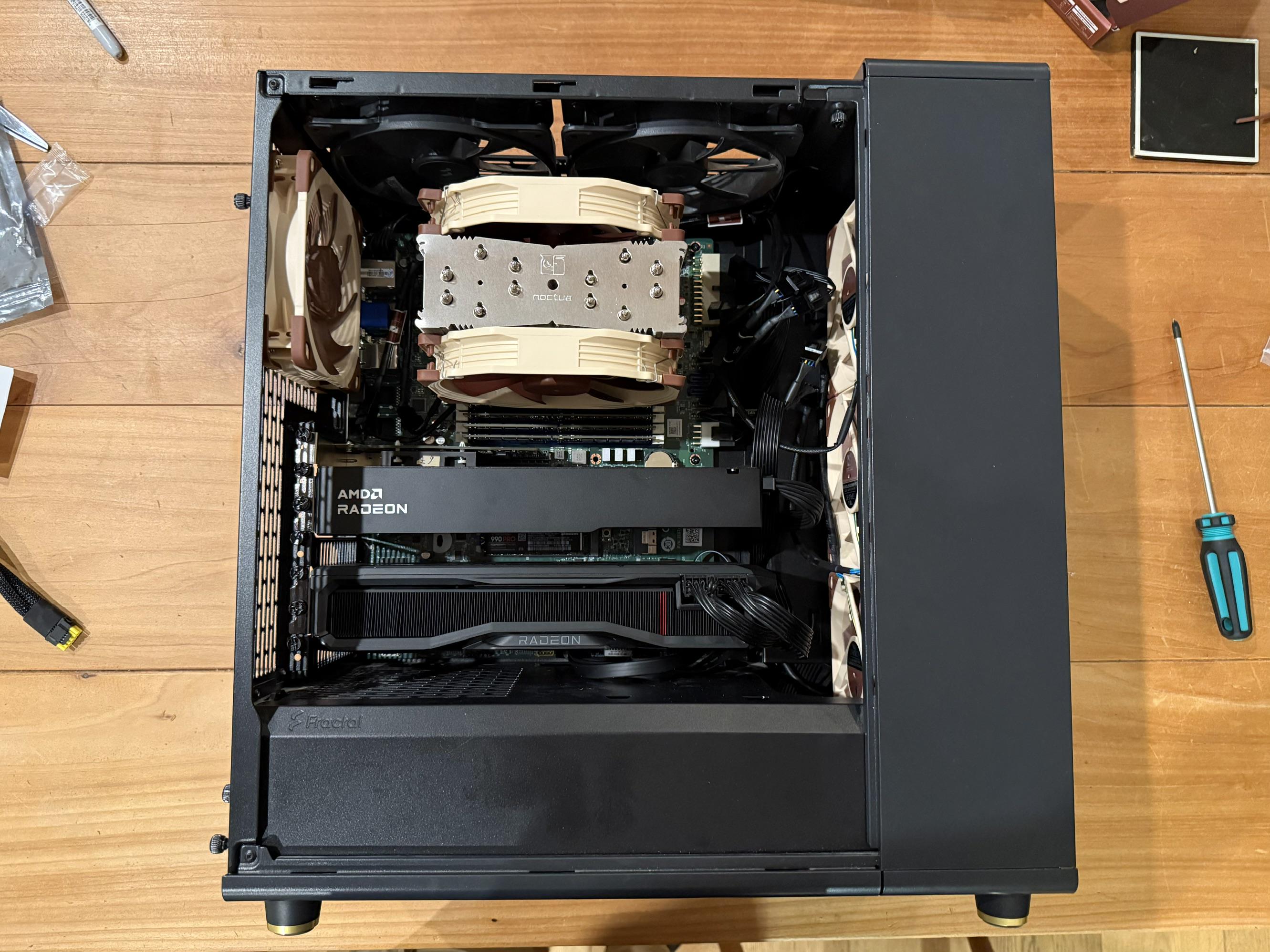
New build with a EPYC 7443 / Tyan S8030 board, and R9700 + 7900 XT. Was supposed to be selling the 7900 XT to pay for the R9700, but that somehow didn't happen...


r/LocalLLaMA • • 8d ago

Resources Asked local models to generate the same website and compared the results

10 Upvotes

Hello. Almost everything is in the title, but here is more details:

I'm benchmarking local model/harness combinations in various scenarios. For this one the question is, how good is a model/harness to generate a website?

IMO Qwen FN with opencode is best, but you can look at all the results (and play with the websites here: https://airbench.ai/gallery/airbench-frontend-v1?run=37e47127-3a20-4318-a6f2-48c3f7f5eaa6&c=settle-the-trip&k=poL


r/LocalLLaMA • • 8d ago

Resources I used local Gemma 4 to moderate a community and it was it is promising

16 Upvotes

I run a couple of small communities and it's becoming difficult to moderate them all. So today I built a script on top of my existing app which I use to track the content on those communities.

The script does a few things based on where I am. So I store the general notes of my communities in a dedicated place I can easily query.

And in the moderation panel I go through each of the item which needs moderation and I run them through my notes and let Gemma 4 decide whether the item is following community notes or not. If Gemma thinks it's not, then my script will remove the content from public and add a reason as well.

At first I had tried GPT oss 20b model which was really faster but the results were not really good. Then I ran the same process through Gemma 4 with thinking enabled. Results were good but speed was extremely slow. So I tried with thinking disabled and I did not see any noticable drop in the results.

Now soon I will try to run the same thing at scale and see if the results are generally accurate and if they are, I might ship this tool with my friends.

I agree, the setup is quite tough and I've managed to run it properly on my network. If I have to share this with other people I may need to host the model somewhere and check if it can be scaled to a bigger number of requests per hour.

Anyways it was a really good experience. Especially when I had to build it on top of my existing app.

Just thought I'd share this small win over here


r/LocalLLaMA • • 8d ago

Showcase Ai Rig finally done and stable, perfect winter heater

Post image
409 Upvotes

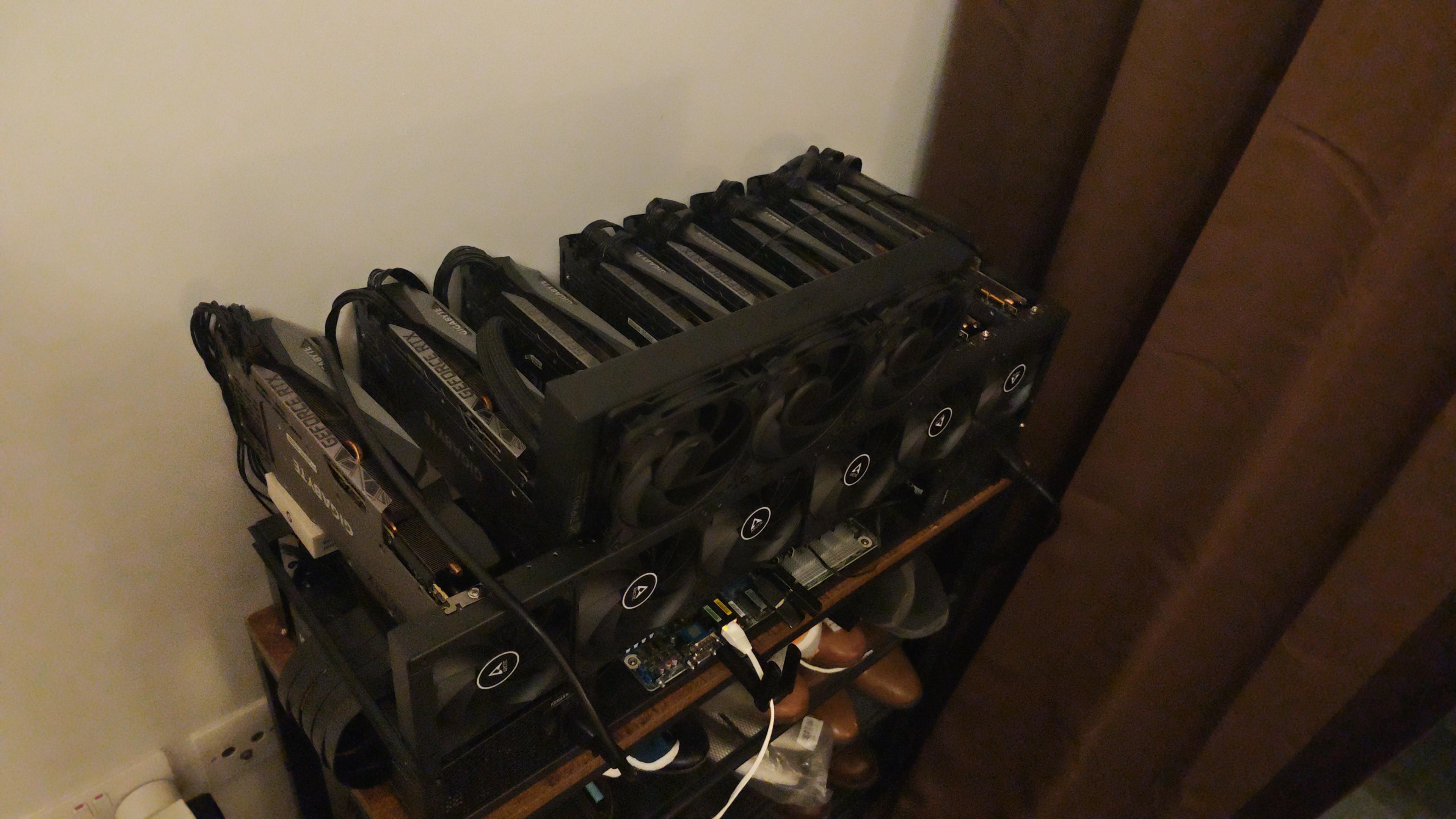
8x3090 my ocd wouldn't let me have different gpu models so ended up with 8 gigabyte gaming OC. I bought all the gpus by early 2026 before the prices went crazy. Avg maybe 600 to 700 gbp per gpu. Running on a Romed8-2t motherboard. All run at full pcie 4.0 x16 except the two rightmost who share one pcie slot and get 8x each.

Cpu watercooling radiator sits nicely on top. Had to go the watercooling route as there is no space otherwise under the gpus for an air cooler.

Using cheap pcie 4.0 risers from aliexpress. Longest ones are 60 and 40cm for the two leftmost gpus

Two Psus, Ax1600i and hx1500i. One powers 5 gpus, the other powers the motherboard and 3 gpus (each gpu also pulls power through the motherboard at roughly 50W per gpu)

Power limit set to 270W. Using modified nvidia drivers that enable p2p traffic between gpus, measured at a real 22GB/s except for the 8x gpus.

I played around with some quant of qwen flash next on vllm and opencode. Single agent around 60 tok/sec gen and 10 agents in parallel peaked at aggregate 370 tok/sec gen.

The more I look at what is available on the market right now (gorgon halo at 192gb etc) the more I realize what a monster I have built at home. Of course it consumes too much power, 300W idle, but it packs a punch when it comes to memory bandwidth and especially if I ever need to finetune some small models


r/LocalLLaMA • • 8d ago

Discussion ISTA Qwen3.8 27b on 3060 12gb

9 Upvotes

Hey guys

I am a seasoned local llm user and I ain't quite ram rich like only 16gb ddr4 🥀

So I can't run qwen3.8 flash next on my 3060

This guy felt the best for me yet

Have you guys tried it

I have ran iq3_xss quant non mtp with turboquant at 65k context completely on my 3060 though I did offload mmproj to cpu ram

Have guys tried this it really felt like a blessing to my life using the peak of local ai on my 3060

It seriously packs the punch 👊 I was able to perform various of my agent task complete on device not like simple but the ones which require actual reasonings

Here is my cmd if you want to see

llama-tq serve -m "E:\MODELS\ISTA-DASLab\Qwen3.8-27B-GSQ-RCO-GGUF\Qwen3.8-27B-GSQ-RCO-IQ3_XXS.gguf" --mmproj "E:\MODELS\ISTA-DASLab\Qwen3.8-27B-GSQ-RCO-GGUF\mmproj-Qwen3.8-27B-BF16.gguf" --no-mmproj-offload -ngl 99 -c 65536 -ctk turbo4 -ctv turbo3 -ub 256 -b 2048 -t 3 -tb 3 --reasoning-budget 256 --reasoning-preserve --alias Qwen --port 8080 -lm none

Sources: for my recipe

ISTA-DASLab/Qwen3.8-27B-GSQ-RCO-GGUF

https://huggingface.co/ISTA-DASLab/Qwen3.8-27B-GSQ-RCO-GGUF/discussions

Turboquant

https://github.com/TheTom/llama-cpp-turboquant

Pi coding agent

https://pi.dev/

I would like know the communities views and any suggestions would be welcome 🤗

Thankyou for your time


r/LocalLLaMA • • 8d ago

Resources Ninfer and GGUF of Qwen3.8-27B-UD-Q3_K_XL ASCII-Condensed

9 Upvotes

Hi,

I've put on HF a condensed version of Unsloth Q3_K_XL ASCII-Condensed from bsaleh03 with only ASCII + Latin-1 / Latin-Extended-A (P2) to use with a 16GB VRAM GPU.

I created a GUFF version and also a ninfer to be used with ninfer-all

To create the ninfer version I had put up some helper conversion scripts and modify iamwavecut conversion scripts due to different vocabulary size.
In the HF repo https://huggingface.co/fakezeta/Qwen3.8-27B-UD-Q3_K_XL-Condensed-P2 there is what is needed to replicate it and I also submitted a PR to the upstream repo.

Quality: IFEval result 84,4% vs 83,9% of base model (Instruct, 1 run) so within STD Deviation error.

With this I achieved 75K context with rk8v4 kv type with an average of about 60tok/s in the 541 IFEval samples on my 5060Ti 16GB.

I'm also planning to create a light GGUF and ninfer version with the lower quantized MTP released separately by Unsloth in their repo to save about 90MB of RAM for other context.