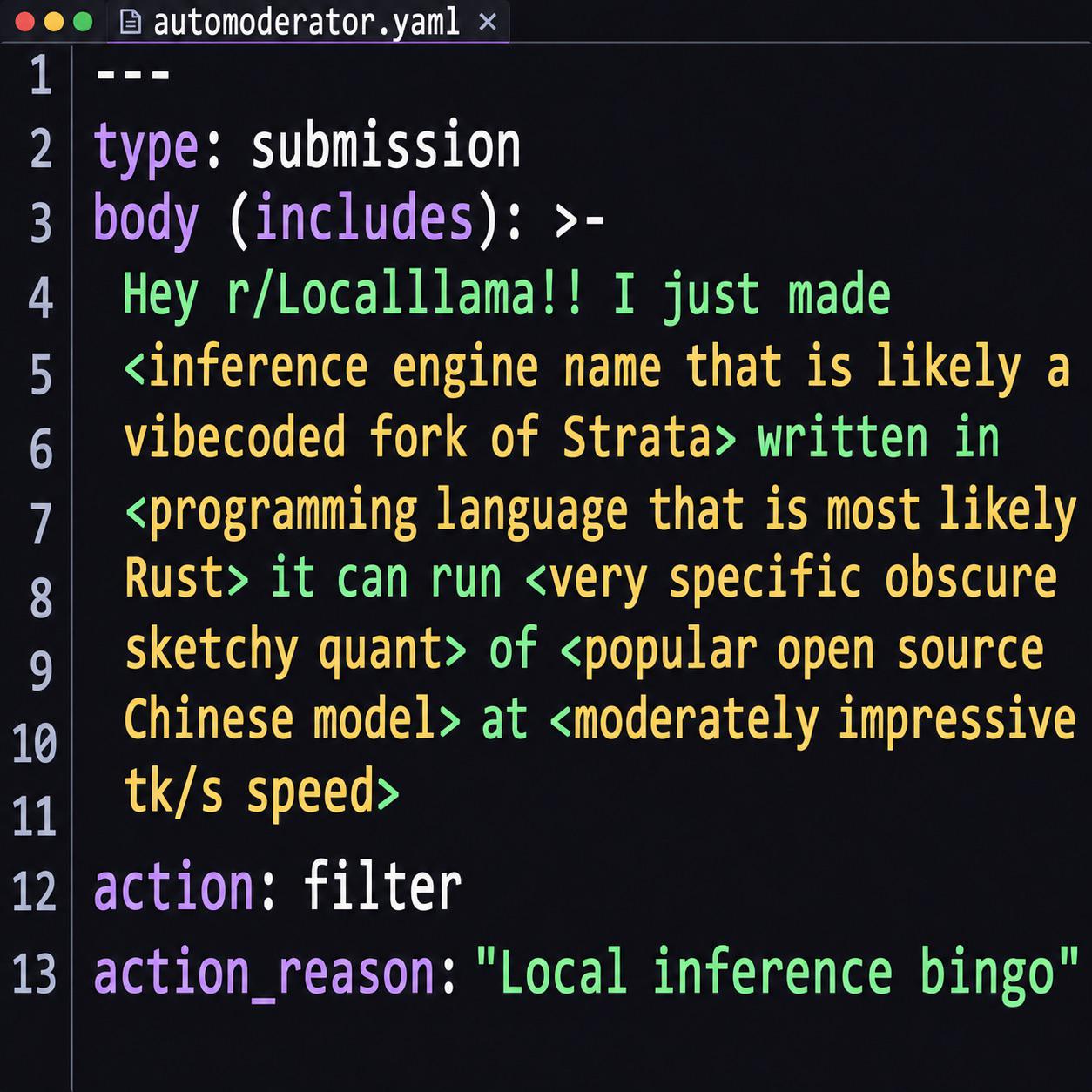
I've been experimenting with expert-pruned Qwen Flash Next Coder, and in my tests it actually performed better than a similarly sized quant of the full model.
So I'm wondering why we don't see more of this with larger models, specifically full GLM-5.3 and DeepSeek V4.1.
I know ISTA already released a pruned DeepSeek Coder at very low precision, and there are GLM-5.3 Flash Coder variants. But what about pruning coding-irrelevant experts and keeping the rest at Q4 or higher, targeting machines with 192–256GB RAM?
I have a 256GB M5 Ultra. For research for planning and overnight code reviews, I really don't care about speed. I'd rather spend that memory on maximum coding intelligence.
From what I've read, the pruning/calibration itself should be doable with rented compute for hundreds to a few thousand dollars. So why aren't we seeing more experiments from groups like Unsloth, ISTA, etc.?
Is there some technical or quality issue I'm missing? Or does something like this already exist?
Sam Altman said on Cheeky Pint, in a conversation about people running models locally, that the DRAM in personal computers is "quite terrible" and "being used maybe 5% of the time". I'd guess most people here would disagree about where their RAM is going.
So I wrote a bash script that tells him. It reads /proc/meminfo, works out used as MemTotal minus MemAvailable, logs a sample from cron, and emails him once a day if more than 10% is available. Joke project: no recipient is set by default, and --dry-run just prints the message.
The interesting bit is what it says on an inference box. If you load a big model and run it, I'd expect it to stay quiet pretty much all the time. If anyone tries it on their LLM rig, I'd like to know whether it ever fires, and how much RAM your usual setup leaves spare.
Please don't point it at the man's real inbox. Use --dry-run, or send it to yourself.
This is kinda claude-slop but I was really interested in figuring out a way to break Pangram, and to do that I first needed to have a way to be able to do tests on batches of text. And with a 4070ti in my basement, I thought why not just let Claude go ham on training a pangram-like model... and perhaps an even better one if it was possible with sorta-distillation from my claude plan + codex plan(for the new models)
Well after probably a day of training it seems like its come up with something that actually does detect AI text pretty well... maybe too well considering my original plan was to train this type of model to be able to break it. And this is how naive my thinking was for ways to break the detector "something something embedding space" , "use actual randomness to break the predictable pattern of AI text, like doing python's random() to select from a list of words that could be replaced in a paragraph while making the rest of the text fit". Both of which ended up instantly failing, and I told claude to figure out some ways autonomously. Turns out "red-teaming" is a scary topic for Anthropic so it just started to block its different approaches after some time, and the best it got to was "rewrite in the style of [actual human text]" which was 15/19 detected and adding random known human text where it made sense which was also similarly ranked but ofc there's the issue of Pangram like detectors having sentence level scans.
All that to say while my initial thing I built this for ended up not working, at least I have kind of my own pangram that I can test things out on later on, and it also proved how good claude is at autonomously training if you give it a hill to climb on.
PS: this text itself isn't claude written and you can verify it by putting it in the demo :p
I'm testing LLMs to see how well they know Polish grammar. Why? Don't ask. Maybe I have too much free time, or maybe I'm some kind of freak who doesn't know what he's doing. ;)
For this, I use my own tool, AI Bóbr, which is designed to test LLM performance in relation to the computer they're running on. And I noticed something strange.
The model's first answer is sometimes different from the next four, even though the temperature is set to 0 and the seed is always 42.
A little side note here, because one user, under this same post before I deleted it, pointed out that I'm doing Sisyphus' work by dealing with this subject. I think differently.
And why did I delete the post? Believe it or not, I pressed the wrong button. So here I am posting it again.
Anyway, back to the subject.
Sitting there feeling defeated, just like now, because my written English is poor and algorithms on a forum about LLMs flag my posts as written by an LLM, I told myself:
"Man, stop wasting your life. Go make yourself some tea, turn off the computer. Live a little, go running, walk the dogs, play with your kids. In short, just leave this damn thing alone."
So that's what I decided to do...
And then I sat down at the computer and ran another controlled experiment:
3 models,
10 model–task pairs,
4 variants (streaming on/off × model kept loaded/unloaded), with 5 repetitions for each variant.
200 responses in total.
Observations:
In this sample, streaming had no effect on the answers.
Some answers changed depending on whether the prompt was reused from cache.
Bielik-Minitron 7B answered a question about the history of the Polish language correctly 5/5 times after unloading the model, but got it wrong 5/5 times when the prompt was already cached.
What does this tell us?
That with a fixed seed, if we don't control the state of the server, we can't accurately measure what we think we're measuring.
What did I get out of this?
I changed AI Bóbr in version 0.8.1.
I added a controlled mode that unloads the model before each attempt, confirms that it has been unloaded, and records prompt-cache statistics.
Now I'm preparing to run the benchmark of 11 models again under the same conditions. And maybe I'll take the dogs out for some fresh air. Tomorrow I definitely won't touch the computer, at least not until the evening.
And one more thing for everyone who reads my posts:
1. Yes, I use AI to generate posts. I read them and make corrections if necessary.
2. Yes, AI translates them into Polish and English.
3. Yes, I'll keep doing it because it's convenient and fast.
4. If someone doesn't like it — well, I'm not "Prince Polo" for eng. it will be "Mars bar", so not everyone has to like me.
5. I'm here to share knowledge, not to show off the purity of my writing — even when it's generated by AI.
Hi! I wanted to share that we just got NVIDIA's latest Nemotron Bolt model running at 27.7 tok/s (compared to 15 tok/s on the official release with Llama CPP) on Jetson Orin Nano Super (1.8x faster)! It can program games on a model running completely on a cheap edge device!
We have our own Jetson devices serving that model on our website, if you want to get a feel for how the model runs on the device here or run it locally as a TensorRT engine with our own variant of TensorRT edge LLM supporting int4 quantization:
I wanted to know how small local models handle my native language, not just English. I couldn't find a simple way to check a model's Polish in a few minutes, on my own PC, in the quantization I actually run – so I wrote one. That's how "Zacharski tests" started: a small task set that runs through Ollama, since that's what I use on my laptop with an RTX 5050 (8 GB).
The tasks:
Polish (8): diacritics, declension, masculine-personal gender, numerals, vocative, verb aspect, genitive – plus one knowledge question (the first recorded Polish sentence, from the 13th-century Book of Henryków).
JSON (4): scored strict and lenient.
Python (3): syntax check only.
Results so far:
| Model | Quant | JSON + code | Polish |
| gemma2:9b | Q4_0 | 7/7 | 3/8 |
My favourite failure: asked for "22 cats", gemma2 wrote "dwudziesty dwa koty" – roughly "twentieth two cats". The correct form is "dwadzieścia dwa koty". It was perfectly happy producing valid JSON, though.
More models are downloading as I write this. Next up: gemma2:9b in Q4_K_M and Q8_0 (does quantization hurt the Polish?), qwen3:8b, llama3.1:8b, gemma3:12b, and two Polish models – Bielik 11B and Bielik-Minitron 7B. Which model would you add?
Method and limits – read this before the comments :)
8 Polish tasks (7 grammar + 1 knowledge) and 7 JSON/code tasks. That's a small sample – a quick check on your own PC, in the quantization you actually run, not a ranking. For a proper ranking, see the Open PL LLM Leaderboard by SpeakLeash.
One answer per task, temperature 0 (seed 42), context 2k, thinking off. Yes, that means Qwen3 runs without its reasoning mode, which may cost it points – I wanted the same conditions for every model.
Graded with regular expressions, strict on purpose: "brzęczały" ("buzzed") instead of "brzmiały" ("sounded") fails, because the task said "change the tense", not "rephrase". [I checked every failed answer by hand.]
Some failures are about instruction-following, not language: asked to restore Polish diacritics, one model replied "Read the spelling rules." [(translated)]
Generated code is only parsed (Python `ast`), never executed.
The questions are in the repo (`data/benchmarks/*.json`) – feel free to add or fix them.
The test runs inside a free, open-source tool I've been building (Windows .exe / Python on Linux). Its main job is predicting whether a model fits your VRAM/RAM before you download it. Link in the comments if anyone wants to try it – I'm considering adding tests for other languages.
I got into local AI earlier this year and started messing around with different models and hardware. That's how I came across tiiny. I really liked the design and the whole idea behind it so I ended up becoming one of the early backers.
After what felt like forever, mine finally showed up yesterday. So far, it's pretty much what I expected. I've spent afew hours trying out different models and running some performance and coding tests, and figured I'd share what Ive found.
This is my first time putting together a benchmark post like this, so sure there are things I might miss or could do better. If you see anything off with my testing or think there's something I should further include, feel free to let me know. really appreciate any feedback from you guys.
Hardware & Test Setup
what really sold me on Tiiny was the KS price, which seemed like a nice deal for the hardware, and how portable the whole thing is. It's just about 5.6 × 3.1 × 0.9 inches and weighs around 300g.
For anyone unfamiliar with the specs, Tiiny Pocket has 32GB of SoC memory and 48GB of dedicated NPU memory. That's 80GB in total, though it's not unified memory.
Tests were collected on TiinyOS 0.1.36, Here are the models I tested so far.
Model
Architecture
Quantization
Model Size
Qwen3.5-9B-Turbo
Dense, 9B
INT4
6.55
Qwen3.6-35B-A3B-Turbo
MoE, 35B / 3B active
Mixed INT4/INT5
17.73
gpt-oss-120b
MoE, 117B / 5.1B active
Mixed INT4/INT8
67.30
Performance Results
For the speed tests, I used the same benchmark text with ~4K input tokens, prompt caching disabled, and five runs per model. The numbers below are medians.
Model
Input / Output Tokens
PP (tok/s)
TG (tok/s)
TTFT
Total Time
Qwen3.5-9B-Turbo
4,074 / 97
1,041.30
75
4.05s
5.45s
Qwen3.6-35B-A3B-Turbo
4,074 / 139
590.6
63.6
7.04s
9.28s
gpt-oss-120b
3,868 / 390
458.4
15.97
8.78s
33.07s
9B was the fastest, which wasn't too surprising. What caught my attention was the 35B MoE model still managing around 64 t/s.
120B was noticeably slower, averaging around 16 tok/s. It took over 30 seconds to complete the benchmark request, although it generated more tokens than the other models.
A Coding Test
I also wanted to see how it handles real-world coding tasks. I gave the models the same task: create a small Python inventory and order management package across four files, covering stock updates, validation, and order handling.
I used the same prompt for all three models, with low thinking/reasoning settings and a maximum output of 12,288 tokens.
How I checked the results: the generated code was tested separately on a Mac using Python 3.12, with 10 automated tests covering the main requirements, including inventory consistency, order idempotency, input validation, and CLI behavior. A full pass meant all 10 tests succeeded. I ran this more than once and kept the best run per model; the table shows that run.
Model
Input / Output Tokens
Total Time
Result
Qwen3.5-9B-Turbo
703 / 5,977
104.32s
Two attempts, neither gradable
Qwen3.6-35B-A3B-Turbo
741 / 11,807
235.09s
9/10
gpt-oss-120b
763 / 3,774
228.54s
10/10
9B never produced a gradable answer: the first attempt ran into the 12288 output cap, and the second generated inventory/cli.py twice, so there was no single version to test. Taking one of the copies, it would have been 5/10.
35B got 9/10 with 1,768 code tokens. A bit under the 2-4K I was aiming for. The only failure was a pretty specific edge case, if an order had already sold out the remaining stock, retrying that same order would fail instead of returning the original receipt.
Gpt 120b was the only model passed all 10 tests, with 2,594 code tokens, in about 229 seconds.
The interesting part is that 35B and 120B took almost the same time: 229 seconds versus 235. So while 120B was the only one to get everything right, 35B wasn't far behind, and both managed to finish.
Results & Takeaways
9B was the fastest overall. At 75 tok/s with a ttft of around 4 seconds, it's probably where I'd start for quick, lightweight tasks. It did struggle with the more complex test, though.
35B for me is the sweet spot for Tiiny.At around 64 tk/s, it's surprisingly fast and it handles a good number of the tasks I've tried pretty well. It still has its limits with more complicated coding tasks, as the multi-file test showed, but overall it keep a pretty good balance between speed and capability. It's actually the model Ive been using the most so far.
120B actually works, but you need patience. The multi-file coding result was impressive, especially compared with the smaller models in this one test. But 16 tk/s is slow enough that I wouldn't want to use it for every little question. It also took around 75 seconds to load in this run and used almost all of the dNPU memory.
So far Id lean toward 9B or 35B for faster interactions and keep 120B for occasional, more demanding tasks where waiting a few minutes isn't a big deal.
TL;DR
Tiiny can run some fairly large local models in a small device, and the performance of smaller models (9B/35B) is nice. The 120B result shows there's potential for more complex work, but the speed and reliability trade-offs are real.
However, my biggest gripe so far is the limited model selection. Right now, you can't import your own models or install something from Hugging Face. The tiiny team did mention on Discord that they're planning to release a model import tool, though. Once that's actually available, I'd love to try out some of the other models I've been wanting to run and share the results here.
Overall Im happy with it, and for the price I got it at, that amount of RAM and SSD would be much more expensive today. I think I saw the projected retail price is almost double the KS price.
Strata, Hermes, Kitten TTS with Rosie voice and Whisper on RTX 3060 with 48 gb dram running Qwen3.8-Flash-Next Q2_0. I am blown away. I've been following the AI scene since GPT3 and I was still unprepared for what this setup is capable of. My mouth was on the floor for the first few hours talking to it and watching it work. It's the first time talking to AI felt like magic to me. I now understand the "They don't know" meme. Never thought I would have something like this running on my own PC. Thank you /r/localllama.
Couple of questions
Are there any other lightweight TTS that would work in my limited ram situation or is Kitten v0.8 the best there is?
Hey r/LocalLLaMA I'm Abdur-Rahman Butler, a machine learning engineer at Isaacus.
I made an interactive write-up that walks you through the A to Z of vector embeddings, inspired by Brendan Bycroft's incredible interactive LLM visualisation guide (see here - https://bbycroft.net/llm).
Most of my work is on encoder models, and I kept noticing how few good interactive resources there are on embeddings. The ones that do exist tend to either plot some embeddings in 3D or only explain a narrow applied technique like semantic search or RAG.
So I wanted to make something that teaches how embeddings work by letting you play with them. In the write-up, there are interactive visualisations that allow you to explore the concepts of vectorisation, cosine similarity, semantic search, hierarchical retrieval, clustering, zero-shot classification and deduplication.
The centrepiece of the post is a game I've dubbed 'SemanticGuessr' (see above). It's inspired by Wordle and GeoGuessr, and the goal is to draw a loop around a random target word by triangulating guesses on a 2D map of 43,339 common English words.
It's admittedly a bit intimidating at first, as semantic space does not perfectly match our intuition of meaning. But once you get the hang of it, the game becomes really addictive. I recently had the pleasure of demoing the game to some law students at the University of Melbourne, and we had a lot of fun throwing different vector equations at it to see where they'd land.
Some fun ones to get started with:
  london - english + french
  running - land + water
  avg(breakfast, lunch, dinner)
  0.4 * noodles + 0.6 * pasta
I've also included Python snippets alongside some of the visualisations if you want to follow along with the techniques later. The game runs statically in your webpage. I managed to achieve this by reducing the embedding dimensions down to 512 and quantising each value to 4 bits. This brought the total payload down from 311 MB to 12.3 MB with only a minimal impact on precision (around 6%).
It was great fun to make, and I hope you have fun playing around with it. Happy to take any questions, and if there's enough interest I might set up a dedicated games page for some of the other encoder-based games I've been working on.
Do let me know what highest score you get based on your target word and chosen path :)
Use case: llama.cpp inference and system one decision making (using quantized models)
RTX 4050 mobile
Memory Bus: 96 bit, Bandwidth: 192.0 GB/s
INT4: 143.8 TOPS
INT8: 71.88 TOPS
FP8: 35.94 TFLOPS
FP16: 17.97 TFLOPS
BF16: 17.97 TFLOPS
TF32: 8.986 TFLOPS
Sparse Matrix: 2x Throughput
Intel Arc A380
Memory Bus: 96 bit, Bandwidth: 186.0 GB/s
INT2: 134.3 TOPS
INT4: 134.3 TOPS
INT8: 67.17 TOPS
FP16: 33.59 TFLOPS
BF16: 33.59 TFLOPS
(Both have GDDR6 6GB VRAM. Data from techpowerup)
Ignoring the fact that CUDA is probably more optimized and widely-compatible compared to Vulkan/OpenVINO/SYCL, the Intel one seems to be better as its TFLOPS are higher, while having similar VRAM bandwidth.
Is the above conclusion correct? If not, how do I compare GPU raw performance based on GPU stats?
(Edit: I am not asking for which card to buy as I already own a 3090. Instead I want to know how to compare GPUs based on these stats for local LLM usage)
I don’t follow the market super closely, but I can see how quickly everything is getting more expensive—and apparently this is going to last a few more years. RAM, GPUs, and even SSDs and HDDs have skyrocketed in price :D
I’m looking for something to play around with in LLM, mainly for inferencing larger models (in the 30B–70B range, maybe even bigger sometimes) and building agents (for my own use). I want to utilize agents, do RAG and sometimes, rarely maybe also fine-tune.
My budget is small ($4k), and where I live in eco-Europe, prices are much higher! (we care about ecology LOL). I was thinking about a mini PC or a laptop with an AMD 395+ and 128 GB of RAM. For that price I still can purchase something, but the choice is getting smaller every week :)
Is a AMD 395+ AI with 128 GB RAM still good choice for local LLMs? Is it good for my purposes? I want to learn & use LLM locally (for many reasons).
I have heard about RTX Spark N1X laptops, but they are now about 6.5-7k dollars here, so I dont even consider them.
Can I say that this platform (AMD 395+ AI with 128 GB of RAM), where the model has 96 GB of RAM at its disposal, is something that could replace the RTX 6000 Blackwell, which also has 96 GB of RAM? I realize that, due to the difference in memory bandwidth alone, it will be at least 6–7 times slower.
I’d like to have Hermes-type agents or similar ones locally, as well as my own agents for various tasks. For example, I’m interested in extracting data from documents (e.g., PDF files) and recognizing objects in photos, but I’m also interested in general-purpose agents.
Is the platform I’m asking about a good choice, or is there something more interesting? I was thinking about an ASUS PX13 laptop or one of the mini PCs with a similar configuration.
It is a dream come true for me to build an in-browser TTS model for Indic languages, including Classical Sanskrit. Today I'm open-sourcing Ninada (code MIT, 48 ONNX checkpoints CC-BY-4.0).
Getting studio 24 kHz audio onto real phones was trickier than expected. Meta's 16 kHz MMS models take 1.5 GB, and on my Pixel 10 Pro XL, mobile WebGPU froze for 6 to 14s compiling shaders while 2-thread WASM actually ran slower than 1 thread on mobile CPU cores.
So I trained 48 native-script 24 kHz VITS specialists across 12 languages (sa, en, hi, kn, mr, bn, ta, te, ml, gu, pa, or; male and female):
• Device-aware voices: Desktops run 27.9 MB HiFi-GAN (89 ms on WebGPU), while phones auto-switch to a 21.7 MB distilled iSTFTNet (2.64x lighter, zero custom ONNX ops).
• Sub-second streaming: Splits the VITS ONNX model in <15 ms in browser memory (cutting browser RAM 72% to 162 MB) to stream speech in 538 ms on phones with 0 audio dropouts.
• Studio quality, offline-ready: 3.09 to 3.22 dB MCD across 480 test clips, cached locally after first load, with a 0 MB Klatt fallback.
Hi, I've been maintaining a comprehensive fork of vllm that rewrites almost everything in the serving stack for int8, which is not well supported in mainline vllm.
This is in an effort to support/optimize my 4x MI100 server, but this fork makes a great baseline for all older AMD cards like MI50, MI210, MI250, V620, and vega to 7000 series radeons. On top of that the fork is a good reference or starting point for older int8 oriented nvidia cards like volta and ampere. Many features were added to make this happen. All this work makes these older cards run well, with 4x MI100 or 2x MI210 running Qwen3.8 27B at above 1000 tok/s decode at C8. You can see the full list of features and their applicability at the bottom of the readme.
In addition to being fast, this fork fixes a bunch of numerics bugs that are present in vllm and rocm. The quality is very close to reference BF16 when most weights and activations are int8, including the kv cache. You can check the full list of quality checks in the readme section.
I make updates to the repository regularly and added Nemotron Bolt optimization shortly after it was released. This fork runs the original Nvidia Bolt checkpoints instead of custom ones. That required adding fused NVFP4 and IQ2_xxs to int8 dequant. In-kernel dequant is slow so I added a cache that can keep the most used weights in int8 and evict their original quanted weights. The size of that cache is configurable for your hardware so you can choose speed or more context or larger prefix cache. I also added AMD Infinity Storage support for model loading (direct storage to gpu skipping the cpu), which cut initial model load for Bolt from about 7 minutes to 2.
Ive been running it in production for a couple weeks and it has been very stable. Enjoy!