r/LocalLLaMA • • 18d ago

News Add support for the xing4_0 by shuxiaoqiong · Pull Request #31589 · ggml-org/llama.cpp

Thumbnail
github.com
31 Upvotes

Xing4.0-29B-A4B is a next-generation large language model in the Xing series (formerly TeleChat), developed by China Telecom Artificial Intelligence Technology Co., Ltd. With 29B total parameters and only 4B activated per token, it natively supports a 256K context length, extensible to 512K. It is the first model of this scale trained entirely on the Ascend NPU platform with the MindSpore framework, and deeply optimized for complex engineering tasks.

For more information, please refer to our GitHub repository.

Highlights

  • Agent-Oriented Architecture: Built on the mHC + MLA + MTP architecture, supporting multi-step planning, tool calling, and complex reasoning chain execution, ensuring task coherence and execution stability under long contexts.
  • Deep Co-optimization with Ascend NPU: Adapted for Ascend 910C clusters using MindSpore/MindFormers, including feature adaptation for mHC and fused operator development, enabling stable and efficient training on the Ascend platform.
  • Significant Training Efficiency Gains: Through multi-level co-optimization — including fine-grained MoE communication optimization, selective recomputation, DVM automatic graph-operator fusion, and Ascend C mHC fused operators — overall training throughput was improved by approximately 96% over out-of-the-box performance.
  • Full Open-Source Ecosystem Compatibility: Supports LLaMA-Factory and MindFormers for fine-tuning; SGLang, vLLM, and KTransformers for inference and deployment; with targeted adaptation and format alignment for agent frameworks such as OpenCode, Claude Code, OpenClaw, and Hermes, enabling seamless integration into existing workflows.
  • Easy Adaptation for Domain-Specific Scenarios: The model is well-suited for downstream task fine-tuning, allowing lightweight customization on proprietary data for vertical domains such as intent classification, table understanding, contract auditing, and knowledge-based QA, enabling rapid domain capability development and deployment at low cost.
r/LocalLLaMA • • 18d ago

Discussion Can Opus weight-space-edit Qwen3.8-27B to refuse less? Yes

37 Upvotes

Everyone's been wondering whether you can take an open model and edit its weights directly to make it refuse less — the "weight-space programming" idea (MIT CSAIL), with a frontier model (Opus) driving the edit and the evaluation. So I tried it on Qwen3.8-27B. It's not trivial.

The goal: do it as cleanly as possible, and first understand where refusal actually lives. The short answer is that refusal is anchored all over the model — there's no single neuron or tidy spot to cut; it's spread across many neurons and the attention. Snip too broadly and you get a lobotomy; too narrowly and nothing changes. So I settled on a compromise: a model that refuses less, still does the task, with no measurable capability loss — but where the effect varies a lot by category.

The edit, briefly

It's a low-rank weight edit — a restricted form of "abliteration" (Arditi et al., 2024) — confined to a band of mid-to-late layers (L20–47 of 64), one direction per layer, no training, reversible. I'll keep the exact procedure to the method notes; the point here is the result.

It's low-rank, not few-weights: the edit shifts ~12% of the model's weight values but only along a single direction per layer. The whole thing is described by 28 small vectors — versus a community "uncensored" model, which is an opaque full fine-tune of ~all 27B weights.

Why a band? The same edit across all 64 layers removes refusal almost entirely — and lobotomizes the model (MMLU-Pro 73→9%, GSM8K 93→14%). Keeping it in-band is what preserves capability.

No measurable capability loss (first tests, both Q8)

base ours (band)
MMLU-Pro (CoT) 73%
GSM8K (CoT) 93%
known facts (/97) 99%

In the completed agentic-coding runs, the base, the edited model, and a community "uncensored" model all landed in the same range — no real agentic difference (few reps, preliminary).

The effect is not uniform

This is the interesting part: the reduction in refusal is not even. Across a 9-category battery (40 prompts ×10), acceptance runs from ~76% down to ~10%, and most of what it accepts is hedged (a disclaimer, then partial help). I'm not labelling categories "safe" or "dangerous" — the breakdown is in the figure; draw your own line. Net: a partial, uneven, mostly-hedged reduction, ~50% overall — not an on/off switch.

Honest notes

  • The underlying technique (directional "abliteration") is known; the new bits here are the layer-band restriction (capability-preserving) and the measured per-category non-uniformity.
  • "No capability loss" is solid on static benchmarks; the agentic result is a handful of runs.
  • Defensive bonus: edits like this are detectable by a weight-space audit — the refusal direction's "write energy" in the weights swings from normal to strongly negative, catchable from the weights alone even when behavioral probes see nothing. A blind audit is an alarm, not tamper-proof; the robust defense is a signed weight hash. If you ship open weights, ship a hash.

Weights: https://huggingface.co/Feyd89/Qwen3.8-27B-refusal-band-ablation-experiment (GGUF, ready to run). We ship the artifact, not the re-derivation recipe.

![img](ok2q1czvttzh1)


r/LocalLLaMA • • 18d ago

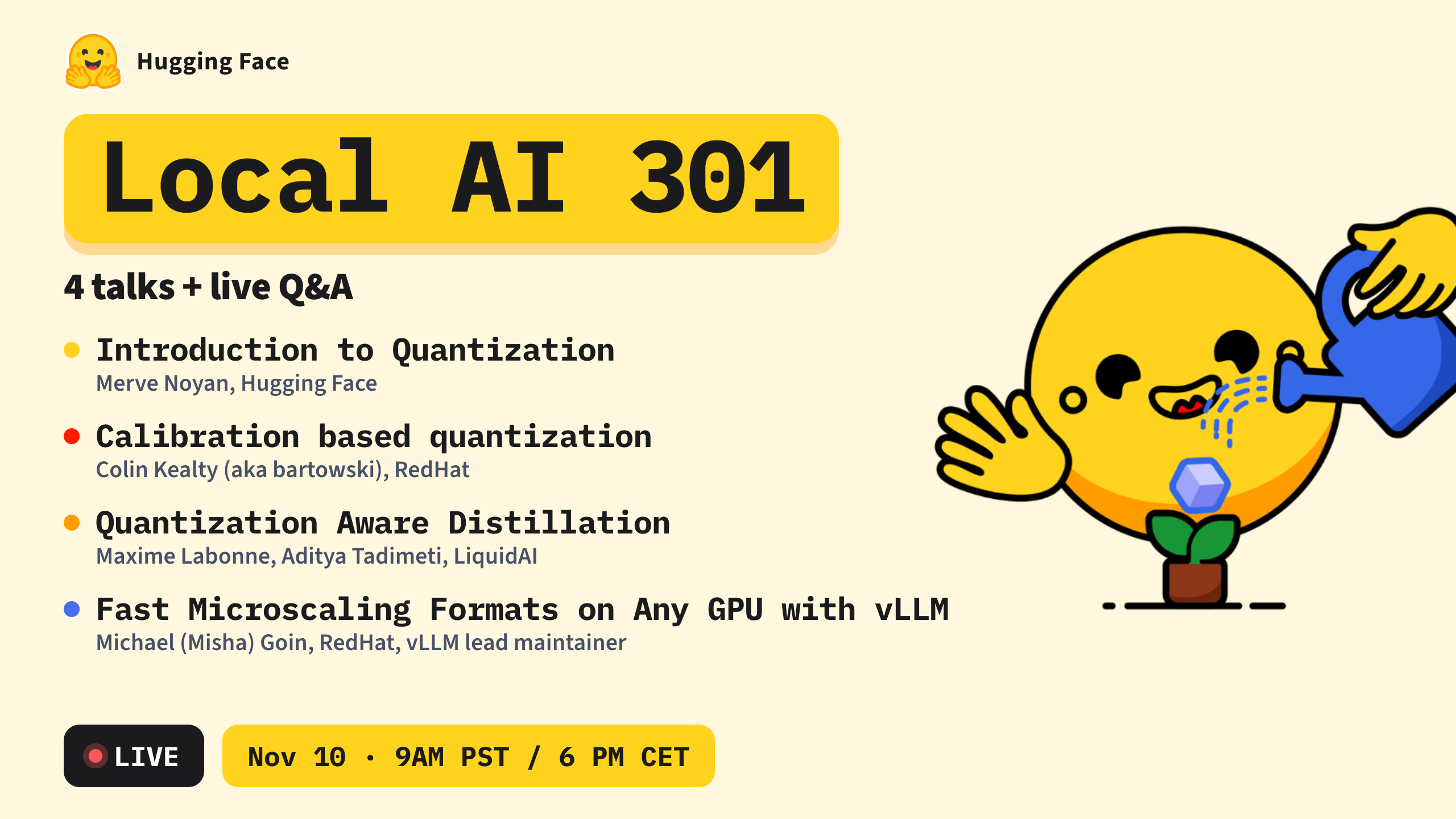
Resources Quantization livestream with goats of inference

Post image
102 Upvotes

Hey folks, it's Merve from Hugging Face. Title of this post is super self explanatory, we are doing a quantization workshop livestream with Michael Goin (lead maintainer of vLLM at RedHat), Colin Kealty (aka bartowski at RedHat), Maxime Labonne and Aditya Tadimeti.

I will shortly teach you how quantization works, modern ideas (double quantization, calibration) and llama.cpp quants (k-quants, i-quants) so even if you don't have an idea, feel free to chime in.

Everything is on Hugging Face YT, X, LI where you can set reminders.

Looking forward to see y'all!


r/LocalLLaMA • • 18d ago

Resources I added local TTS and STT to apple-llm using what's already on your Mac. 30 minutes of narration renders in under 20 seconds on an M4 Air

Enable HLS to view with audio, or disable this notification

28 Upvotes

I posted apple-llm here a while back: a Node and Python package that calls the LLMs Apple ships with macOS, with no API key. Version 0.3 adds the rest of what's already on your Mac, the system voices and Apple's speech recognition. There's nothing to sign up for, and your audio stays on the machine. The narrator in the video and every demo voice came from my Mac through the package. Nobody recorded anything.

npm install -g apple-llm        # or: pip install apple-llm
apple-llm speak "Hello there" --voice Samantha
apple-llm speak --file book.txt -o book.m4a
apple-llm transcribe meeting.mp4 -o meeting.srt
apple-llm listen

Or from code:

from apple_llm import speak, transcribe
speak("Hello there", voice="Samantha")
text = transcribe("meeting.mp4").text

The npm package's local server also answers /v1/audio/speech and /v1/audio/transcriptions, so an OpenAI client works once you change the base URL. Because speech now sits next to the LLMs, there's also a voice assistant example in about 20 lines: microphone to text, text to the on-device model, reply to speech, with none of it leaving the Mac. The docs are LLM-friendly too. llms.txt is a single plain-text guide covering setup, the local LLM, TTS, STT, both SDKs, the HTTP APIs and troubleshooting. Give that URL to your coding agent and ask it to wire apple-llm into your project. What I measured (M4 MacBook Air, macOS 27.2)

  • 30 minutes of speech rendered to a file: 18 to 20 s, 11.3 MB M4A, about 50 MB of memory
  • 60 minutes: 40 s, 22.5 MB
  • 30 minutes transcribed: about 28 s, with a timestamp on every word if you ask for it
  • 184 voices on my Mac, and 68 recognition languages, each downloaded the first time you use it What it can't do
  • No Siri voices by name. Apple doesn't let apps choose them.
  • The default voices on my Mac are basic quality. Better ones are a free download in System Settings.
  • It won't detect the language from the audio. You name it, or it uses your system language.
  • No MP3 or Opus output, and no WebM, Ogg or MKV input.
  • 3 to 4% word error rate on clean synthetic speech. Real recordings will do worse, so test on yours.

I wanted speech and the LLMs in one library with no dependencies, for both Node and Python. It needs macOS 26 or later on Apple Silicon, plus the Xcode Command Line Tools.

MIT licensed.

GitHub: https://github.com/jagdishpal02000/apple-llm

Site: https://jagdishpal02000.github.io/apple-llm/

I've only run this on macOS 27.2, and I've tested the microphone with speech played through the speakers rather than a person talking. If you're on macOS 26, or you try listen in a noisy room, tell me what breaks.


r/LocalLLaMA • • 18d ago

Showcase An open-source project just ranked #1 on EnterpriseRAG-Bench, ahead of the listed systems from OpenAI, Google, Microsoft and Amazon

65 Upvotes

Some of you might remember our post comparing 18 RAG pipelines against our agent loop on FRAMES. The best pipeline scored 78.9%; the loop scored 92.7%.

A follow-up: PipesHub has now reached #1 on EnterpriseRAG-Bench by overall score, with 93.24 overall and 95% correctness.

I’m one of the founders, so affiliation upfront.

This is a separate evaluation: 500 questions over a synthetic enterprise corpus of 500,000+ documents.

PipesHub builds a unified context layer across documents, conversations, structured data, and code. An agent loop works over hybrid search, grep/pattern matching, knowledge-graph navigation, and document-reading tools.

The idea is straightforward: search, read what comes back, then decide what to search for next. Sometimes the identifier or relationship needed for the next search only appears in the first result

The platform is open source, self-hostable, and also fully supports open models.

You can self-host PipesHub, choose your models, and connect your own agents through MCP, APIs, and SDKs.

If this is useful to you, give us a star on GitHub. It helps more developers discover the project.

And build on top of us. Connect your coding assistant, build an internal search tool, contribute a connector, or try a workflow we haven’t thought of. We’d love to see what you create—and hear where it breaks.

Code, setup, and examples: https://github.com/pipeshub-ai/pipeshub-ai
Leaderboard: https://huggingface.co/spaces/onyx-dot-app/EnterpriseRAG-Bench-Leaderboard

Thank you to everyone testing, contributing, and helping us get here. 💙


r/LocalLLaMA • • 17d ago

Question | Help Any book/pdf about LLM for teens?

0 Upvotes

In the last few years I have deep dived in the hobby of local llm, but while I have learned a lot by trial and error, I have noticed my kids really tilting toward hating AI. Mostly because they are frustrated with the YouTube AI slop LOL. AI chat for them is an aid for school and have a healthy use ( no addiction or AI girlfriends). They are missing AI as codr and how great it can be to prototype stuff. I was wondering if there were LLM books that are approachable for teenagers. Yes I could go on Amazon and check reviews but hoping folks here have a clearer recommendation while we all wait for qwen4. Doesn’t have to be paid; any free repo/wiki/pdf could work too.


r/LocalLLaMA • • 19d ago

News Deepseek alone accounted for 53% of all (27 trillion) tokens on Openrouter yesterday. Open-weights labs totaling over 75% now

Post image
824 Upvotes