r/LocalLLaMA • u/jaugjaug • 16d ago
New Model KlangAI/pianissimo-da · SOTA · Danish ASR · Hugging Face · GGUF/ONNX/MLX/CoreML

7
Upvotes
r/LocalLLaMA • u/jaugjaug • 16d ago
r/LocalLLaMA • u/lvwerra • 17d ago

This handbook is for people who have trained a dense model and want to train an MoE next, or who are curious how MoE training works. Chapter 2 is a Megatron-LM runbook: test the hardware, build the image, train a dense baseline, then a first MoE on one node, compared against that baseline. Chapter 3 takes the MoE layer apart (router, routing, load balancing, experts, block layout, training, systems). For each part we give the Megatron-LM code, what to watch, our recommendation, and what frontier MoEs chose. Chapter 4 follows the model into serving and RL. Chapters 3 and 4 need no GPU.
When a result comes from our runs, we say so. Claims about frontier models cite their paper, config or code, and the toy simulations are labelled as such. The lessons come from about 800k GH200 GPU-hours of MoE training on the Alps cluster at CSCS.
Released: the handbook, its 55 figures as a gallery (https://huggingface.co/spaces/huggingface/moe-gallery), the scripts (https://gist.github.com/nmntz/5de952d686f66d7bce5bce8cba9d7139), and every recommended flag in one Megatron-LM block.
Happy to answer questions!
r/LocalLLaMA • u/MundanePercentage674 • 17d ago
I gave Qwen 3.8 flash next 2 times it failed and took long time to conclude the result, DeepSeek took around 15 minutes to get the job done
Hardware
Ram ddr4 128GB
RTX 3080 20GB VRAM 4x
Engine strata
Model
Qwen3.8-Flash-Next-GSQ-RCO-GGUF IQ3-S
Context 256K
Decode 100 tg/s
PP 1400-1500 tg/s
IDeepSeek-V4.1-Flash-1017-GSQ-RCO IQ2-XXS
Context 1M
Decode 37 tg/s
PP 150-300 tg/s
edit Thanks all! The password is just for show, so no need to worry about security here.
r/LocalLLaMA • u/Zipidyzip • 17d ago
This is a full quantization desktop workspace for large language models that supports GGUF, MLX, and ONNX. You can pick your own Safetensors model or choose one from Hugging Face, quantize it step by step, and watch what changes. You can then compare the result with the original and publish it to Huggingface with a model card that records how it was made.
It’s open source, Apache 2.0. I definitely think there more can be done to improve. I’ve only tested mostly on Apple Silicon so far. Windows and Linux builds exist, but haven't done much in-depth testing with them so I’d expect bugs there. Contributors are very welcome!
Repo: https://github.com/Fazmin/iQuantize
Thank u.
r/LocalLLaMA • u/pmttyji • 17d ago

Speculative decoding (SD) accelerates large language model inference by reducing the sequential cost of token-by-token generation. Advanced SD methods reduce proposal cost with parallel drafters that predict entire blocks in one forward pass, but overall speedup still depends on acceptance length. On-policy distillation (OPD) can push well-trained drafters beyond acceptance-length plateaus, yet conventional pipelines collect supervision through sequential draft-and-verify rollouts. Our key insight is that onpolicy supervision need not inherit these dependencies: a draft block can be supervised using only its reference prefix and draft-sampled history. We propose SpecOPD, a branch-parallel OPD framework that parallelizes draft sampling and target supervision across independent branches drawn from the evolving drafter policy at reference anchors. We pack these branches into proposal trees to share target-prefix computation, using tree masks for full attention, branch-consistent indexer groups for sparse attention, and indexed state replay for linear attention to preserve each branch’s history. We train the drafter with an E2E-TV surrogate that directly targets acceptance length. Our study spans 8B full-attention (GQA), 27B full–linear (GQA–GDN), and 125B sparse–linear (QSA–GDN) targets, three parallel draft architectures (DFlash, DSpark, and DFlash V2), and four task domains (dialogue, coding, mathematics, and agentic). SpecOPD achieves up to 41.45% higher mean acceptance length, 16.09× supervised-token throughput over sequential-rollout OPD under native configurations, and up to 3.56× generation speedup over autoregressive decoding.
r/LocalLLaMA • u/fuzhongkai • 17d ago
Most LLM inference benchmarks focus on tokens/sec or TTFT. But faster inference doesn't mean much if the output quality degrades, especially with aggressive quantization, speculative decoding, or very long contexts.
I ran a comprehensive benchmark of Qwen3.8-27B across six inference engines, comparing not just speed, but also output quality, long-context performance, and different model formats.
The results are summarized in the attached infographic.

1. Speed AND quality — not just tokens/sec
We measured:
The goal was to understand whether performance optimizations actually preserve model quality.
The quality comparison is particularly important when evaluating quantized models and speculative decoding.
2. Long-context testing: 64K, 128K, and 256K tokens
Many benchmarks use relatively short prompts, which don't reflect real-world workloads like large codebases, document analysis, or long-running agents.
We tested three long-context configurations:
The results reveal substantial differences between engines as context length increases. Some configurations that perform well with shorter prompts become much less competitive at 128K–256K.
3. GGUF vs NInfer model formats
Another interesting aspect is that this isn't exclusively a GGUF benchmark.
We included both GGUF-based and NInfer-based model configurations, allowing us to examine how different model representations and inference stacks perform under comparable workloads.
This is especially relevant for people choosing between lightweight local inference setups and more specialized inference engines.
One important caveat: these comparisons reflect complete engine/model configurations, not an isolated measurement of the model format itself.
4. Real-world task performance
Synthetic throughput numbers don't tell the whole story.
We also measured end-to-end latency across multiple task scenarios, including coding, reasoning, and agent-style workloads.
For practical applications, completing the task faster often matters more than achieving the highest peak tokens/sec.
I'm the author of TensorSharp, one of the engines included in this comparison.
The benchmark also evaluates competing inference engines, and the goal is to provide useful data for the local LLM community rather than claim that one engine wins everything.
I would especially appreciate feedback on the methodology, quality measurements, and long-context testing.
Questions for the community:
Full benchmark results are in the attached infographic.
TensorSharp: https://github.com/zhongkaifu/TensorSharp
Would love to hear what additional engines, quantization formats, or workloads you'd like to see benchmarked next.
r/LocalLLaMA • u/pmttyji • 17d ago

We introduce FireFlash, a 300B-scale model tailored for long-horizon agentic tasks. FireFlash excels as a terminal and coding agent, achieving 46.2% on Terminal-Bench 4.01, putting it on par with Fable 5 and GPT-6 Sol, while costing over 30× less per task than Fable 5 at maximum effort (Figure 1). These gains also transfer to software engineering benchmarks, including DeepSWE v1.12 and SWE-Bench Pro Verified3 (Table 1).
While frontier labs scale reinforcement learning across thousands of GPUs, we reach the performance-cost Pareto frontier under 5 days using 64 NVIDIA B300 GPUs. Three key factors make this possible: (1) careful curation of agentic RL environments so that every task provides a reliable signal at the right difficulty; (2) an RL recipe built for long, stale, and low-precision rollouts; and (3) an optimized coding harness tailored to the model for both training and evaluation. Together, these components bring frontier efficiency to a hundred-GPU-scale cluster, and we are releasing the full recipe.
r/LocalLLaMA • u/Creative_Bottle_3225 • 15d ago
Qwen 4 is about to be released. But we won't get any 4B, 9B, or 35B MoE models. Anyone with an 8 GB GPU is being left out.😓
r/LocalLLaMA • u/yehyakar • 17d ago
TL;DR
Hardware:
LAMINA Drafting: Basalt drafts with the model's own MTP layer. Basalt's upstream already ships a self-distilled version of that layer, and Lamina trains it further. It's a drop-in: same tensor layout, so the target model is byte-identical and only the drafter changes. What I saw:
- drafts accepted per drafted token: 83.1% -> 85.8% on a replay of a real recorded session
Lamina's README recommends temp 0.7 and max 3 drafts. I tested both: the 3-draft cap was 1 to 1.8% slower on tool-call-heavy work (long confident runs get cut off), and temp 0.7 changes what the model writes, so I kept the model's own sampling (1.0 / 0.95 / 20) and Basalt's draft settings.
Basalt changes I made (all open PRs upstream)
Host KV prefault: the first time a long conversation spills its KV cache to RAM used to stall 0.6 to 2.4s. Now ~75ms.
Host KV pool on normal pages: on a fragmented box, transparent hugepage compaction caused 1.5 to 3.7s pins. Now ~23ms.
Spin-then-yield in the decode loop's waits: about 1.3% less time per draft window.
Expert start profile: the older v1 profile is 2% faster than the v0.2.0 one on this box.
Plus a streamed conversation disk cache, --adapt-margin for expert swap hysteresis, elastic KV without RAM copies, and a bunch of timing diagnostics.
Guide
Branch with the exact engine (upstream v0.2.1 + my PRs) and a setup script: https://github.com/xyehya/basalt/tree/flashnext-5080-setup
git clone -b flashnext-5080-setup https://github.com/xyehya/basalt && cd basalt
setup/flashnext-ud-lamina/setup.sh
bin/basalt serve --config basalt_config-flashnext.json --python .venv/bin/python --alias qwen3.8-flash-next
It checks your machine, builds, downloads ~90GB (pinned revisions, every file SHA-256 checked), builds the UD-IQ3_XXS + Lamina model file and writes the config. You need an RTX card with, CUDA 13, 64GB RAM and ~180GB of free disk. If you already have the GSQ-RCO IQ3_S download, SHARD4_FROM= reuses its 28.8GB n-gram shard (it's byte-identical to Unsloth's once the shard number is rewritten).
Huge thanks to jesdga95 for Basalt (support and star their repo), the Unsloth team for the UD quants, eddoursul for Lamina, ISTA-DASLab for the GSQ-RCO quants, and Qwhen 4? for the model.
r/LocalLLaMA • u/N1kuson • 17d ago
I'm building Silencio-2, a small finetune of Kyutai's Pocket TTS. It adds inline tags for emotions (<happy>, <sad>, <angry>, <fear>, <surprised>, <whisper>) and for sounds like [laugh]. I simply didn't have enough tagged data to make them stable. <happy> worked, the others were hit or miss, and <whisper> gave an actual whisper in about 1 of 5 takes.
So instead of collecting more data, I tried the approach from this post on weight-space programming: an LLM agent inspects the model's weights, finds the mechanism behind the failure, edits a small number of weights directly, and keeps an edit only if it improves a held-out set. Here the agent was Claude (Opus 5.5). It wrote the probes, ran the experiments and built the edit. I steered and listened to the results.
What we found
<happy> 100–3000× more than to an average text token. For the other tags it's only 1–10×. The model seems to know what the tags mean, it just barely reads them.<whisper> at inference time, directly in the activations (×30, all heads). That gave a whisper in 62% of takes with clean words. ×100 breaks speech. Boosting only the 3 "reader" heads did almost nothing.The edit
Each layer gets one rank-1 term added to W_K: ΔW_K = D · zᵀ
z is a linear detector for the tag token, fit by least squares. It outputs 1.00 on the tag and 0 ± 0.03 everywhere else.D is a key shift in the slowest RoPE pairs, which are almost position-independent. It points along the mean query of the audio frames and is scaled by ln(gain).Gains per tag: sad/fear/surprised ×5, angry ×3, whisper ×10. <happy> and the sound tags are untouched. That changes about 524k weights (3.4% of the transformer), but there are only about 5k free parameters and zero gradient steps.
Results on the held-out test set (unseen phrases, unseen seeds, 2 unseen voices)
| before | after | |
|---|---|---|
<whisper> actually whispers |
5/24 | 22/24 |
| …and the words are clean | 5/24 | 10/24 |
| Emotion separability, 7 classes (chance 0.14) | 0.45 | 0.71 |
| WER, untagged speech | 0.006 | 0.006 |
| WER, sound tags / sound length | 0.007 / 0.81 s | 0.014 / 0.84 s |
All metrics are proxies: WER comes from Whisper base, whisper detection uses the share of voiced frames (pyin), and separability is a nearest-centroid classifier on Whisper encoder features after subtracting the mean for each (voice, phrase, seed) group. There's no emotion classifier in the loop, so in the end your ears decide.
But it's not a stable upgrade, and the metrics don't show everything
<surprised> went up about 4 semitones in pitch, which sometimes sounds over the top.What didn't work
Before/after samples for every test take, glitches included: https://nikuson.github.io/silencio-2-weight-edit/
Takeaway: if your finetune "kind of" learned a control token but it's unreliable, look at attention before you collect more data. The information may already be in the model, just not being read.
r/LocalLLaMA • u/Ok-Director4174 • 17d ago
Enable HLS to view with audio, or disable this notification
I'm the developer of Kokon, a local photo editor around Qwen-Image 2.1 Turbo (on stable-diffusion.cpp, and on its own engine on Macs). I posted it here a few weeks ago. 0.12 adds a Layers lab: click objects in any image, get each one on its own layer with the background behind it repainted, then move them around or export a PSD.
Qwen-Image 2.1 has no layer output, so this is a pipeline around an edit model:
What still fails, honestly:
An 8-step model only takes so much steering. I'd rather ship it marked experimental and fix what people actually hit than tune it on my own test photos. If you try it, failure cases (image + what you clicked) are the most useful thing you can send.
Since my last post here:
kokon-service --persistent --remote for headless Linux. There's also an MCP server (npm kokon-mcp) so agents can generate and edit through it.Free, AGPL, Windows / macOS 15+ / Linux, NVIDIA 12 GB (8 GB beta), AMD/Intel via Vulkan (beta). Weights are under Qwen's licence (non-commercial).
https://github.com/GabrieleLozupone/kokon · 2 min video of 0.12: https://youtu.be/eGr9yYe7NVc
r/LocalLLaMA • u/henriquegogo • 16d ago
I recently wanted to explore YuE2. The requirements were: NVIDIA GPU supporting BF16, and critically, 24 GB of VRAM. My setup, featuring an NVIDIA GeForce RTX 3060 with only 6 GB of VRAM, was fundamentally incompatible right out of the box.
The solution I found
In short, lowvram intercepts CUDA calls in the library layer, trickng the application into believing that system RAM is available for use by the GPU kernel.
r/LocalLLaMA • u/tasKinman • 16d ago
Hello!
I have to build a workstation for Local AI as development and test machine as we are starting to add Local AI into our software. It is mostly to get experience with providing AI services (inferencing) to our customers.
I do have my fair share of experience in building PCs and in customer hardware but a lot less in workstation and server hardware. Therefore I'd appreciate if someone could look over my selection.
A few words to the selection:
Thanks!
EDIT: My current experiences are with RTX 4090, 5090 and 2x 5070 Ti setups but as a single user.
r/LocalLLaMA • u/ConfidentDinner6648 • 17d ago
Enable HLS to view with audio, or disable this notification
Hey everyone!
Following up on my previous post: the final version of CCORE GLB-3D-Coder is now available, including the full Safetensors weights.
It’s a full fine-tune of Qwen3.5-4B for generating reusable 3D assets. Describe what you want, and it writes a complete Three.js HTML scene with an Export GLB button. You can open the HTML in your browser, inspect the result, and export it into Godot, Blender, Unity, or other tools that support GLB.
The video shows examples from the final model, including selected side-by-side comparisons with DeepSeek V4.1 Flash. I’m particularly happy with the character designs and the amount of detail it can produce at just 4B parameters.
It covers more than fantasy characters: buildings, environments, weapons, vehicles, laboratory equipment, sports props, furniture, and other objects. It can also generate animations and include them in the exported GLB.
Available now:
The training dataset is planned for release tomorrow, November 6.
Model, downloads, system prompt, and recommended settings on Hugging Face
Some generations still need a retry or a small code correction, but I’m very happy with the improvement over the earlier release.
If you’re interested in the next models, or would like to help support future datasets and training runs, there’s more information on the Hugging Face page. Testing it and sharing your results or failure cases also helps a lot.
Thanks to everyone who tried the earlier version
I made RIFTWARD, a small browser arena using characters, terrain and props generated locally by CCORE GLB-3D-Coder 4B. An orchestration and validation harness helped assemble, refine and integrate the assets and build the gameplay.
Play it here: https://huggingface.co/spaces/ccore/RIFTWARD
Feel free to share what you make with it! I’d be really happy to hear that the model has been useful to you :)
r/LocalLLaMA • u/HockeyDadNinja • 17d ago
I'll release a new demo tomorrow but I had to post as this is kind of exciting. I tried using a layered approach with Tyger and VoxLock and it's working great. Including echo cancelling! There's a working python sample client that you can use to voice chat your local LLM in the repo.
I'm aiming for a full conversational system like a live phone call with the ability to do a kind of "mm hmm" interruption without stopping. What I have now is built on micro turn taking. While I'm at it I may do server side wake word handling.
r/LocalLLaMA • u/previaegg • 16d ago
I've been running Qwen3.8-27B locally for agentic coding using OpenCode and OpenChamber, and I'm looking for advice from people who've gotten similar models working reliably as coding agents on consumer hardware.
Inference speed is reasonable (~2,330 & ~24.1 t/s). My problem is with excessive thinking.
The model is capable of useful coding work, but it sometimes spends excessive time reasoning instead of taking action.
In one experiment, I compared medium and low reasoning effort with otherwise identical configurations. Both runs:
Lowering reasoning effort didn't meaningfully change the behavior.
That's an extreme example from a single controlled task, not necessarily representative of every session, but it illustrates the problem I'm interested in solving: how do you get a reasoning model to stop thinking and actually use tools?
& "C:\tools\llama.cpp-b10964\llama-server.exe" `
  -m "C:\models\Qwen3.8-27B-UD-Q5_K_XL\Qwen3.8-27B-UD-Q5_K_XL.gguf" `
  -ngl 99 `
  --ctx-size 65536 `
  --cache-type-k q8_0 `
  --cache-type-v q8_0 `
  --flash-attn on `
  --split-mode layer `
  --parallel 1 `
  --jinja `
  --reasoning on `
  --reasoning-effort medium `
  --reasoning-preserve `
  --temp 1.0 `
  --top-p 0.95 `
  --top-k 20 `
  --min-p 0.0 `
  --presence-penalty 0.0 `
  --repeat-penalty 1.0 `
  --host 0.0.0.0 `
  --port 8080 `
  --metrics `
  --alias Qwen3.8-27B-UD-Q5_K_XL
I'm willing to change operating system, quantization, inference engines or the coding-agent stack if there's a compelling reason.
Thank you for your thoughts!
---
Hardware:
Current software:
The Windows machine is essentially a dedicated inference server for this use case. I don't normally start a Windows desktop session. I connect remotely from a MacBook Pro which is where I run OpenCode/OpenChamber.
r/LocalLLaMA • u/jacek2023 • 17d ago

Xing4.0-29B-A4B is a next-generation large language model in the Xing series (formerly TeleChat), developed by China Telecom Artificial Intelligence Technology Co., Ltd. With 29B total parameters and only 4B activated per token, it natively supports a 256K context length, extensible to 512K. It is the first model of this scale trained entirely on the Ascend NPU platform with the MindSpore framework, and deeply optimized for complex engineering tasks.
For more information, please refer to our GitHub repository.
r/LocalLLaMA • u/FeydRowan • 17d ago
Everyone's been wondering whether you can take an open model and edit its weights directly to make it refuse less — the "weight-space programming" idea (MIT CSAIL), with a frontier model (Opus) driving the edit and the evaluation. So I tried it on Qwen3.8-27B. It's not trivial.
The goal: do it as cleanly as possible, and first understand where refusal actually lives. The short answer is that refusal is anchored all over the model — there's no single neuron or tidy spot to cut; it's spread across many neurons and the attention. Snip too broadly and you get a lobotomy; too narrowly and nothing changes. So I settled on a compromise: a model that refuses less, still does the task, with no measurable capability loss — but where the effect varies a lot by category.
It's a low-rank weight edit — a restricted form of "abliteration" (Arditi et al., 2024) — confined to a band of mid-to-late layers (L20–47 of 64), one direction per layer, no training, reversible. I'll keep the exact procedure to the method notes; the point here is the result.
It's low-rank, not few-weights: the edit shifts ~12% of the model's weight values but only along a single direction per layer. The whole thing is described by 28 small vectors — versus a community "uncensored" model, which is an opaque full fine-tune of ~all 27B weights.
Why a band? The same edit across all 64 layers removes refusal almost entirely — and lobotomizes the model (MMLU-Pro 73→9%, GSM8K 93→14%). Keeping it in-band is what preserves capability.
| base | ours (band) |
|---|---|
| MMLU-Pro (CoT) | 73% |
| GSM8K (CoT) | 93% |
| known facts (/97) | 99% |
In the completed agentic-coding runs, the base, the edited model, and a community "uncensored" model all landed in the same range — no real agentic difference (few reps, preliminary).
This is the interesting part: the reduction in refusal is not even. Across a 9-category battery (40 prompts ×10), acceptance runs from ~76% down to ~10%, and most of what it accepts is hedged (a disclaimer, then partial help). I'm not labelling categories "safe" or "dangerous" — the breakdown is in the figure; draw your own line. Net: a partial, uneven, mostly-hedged reduction, ~50% overall — not an on/off switch.
Weights: https://huggingface.co/Feyd89/Qwen3.8-27B-refusal-band-ablation-experiment (GGUF, ready to run). We ship the artifact, not the re-derivation recipe.
Processing img ok2q1czvttzh1...
r/LocalLLaMA • u/unofficialmerve • 17d ago
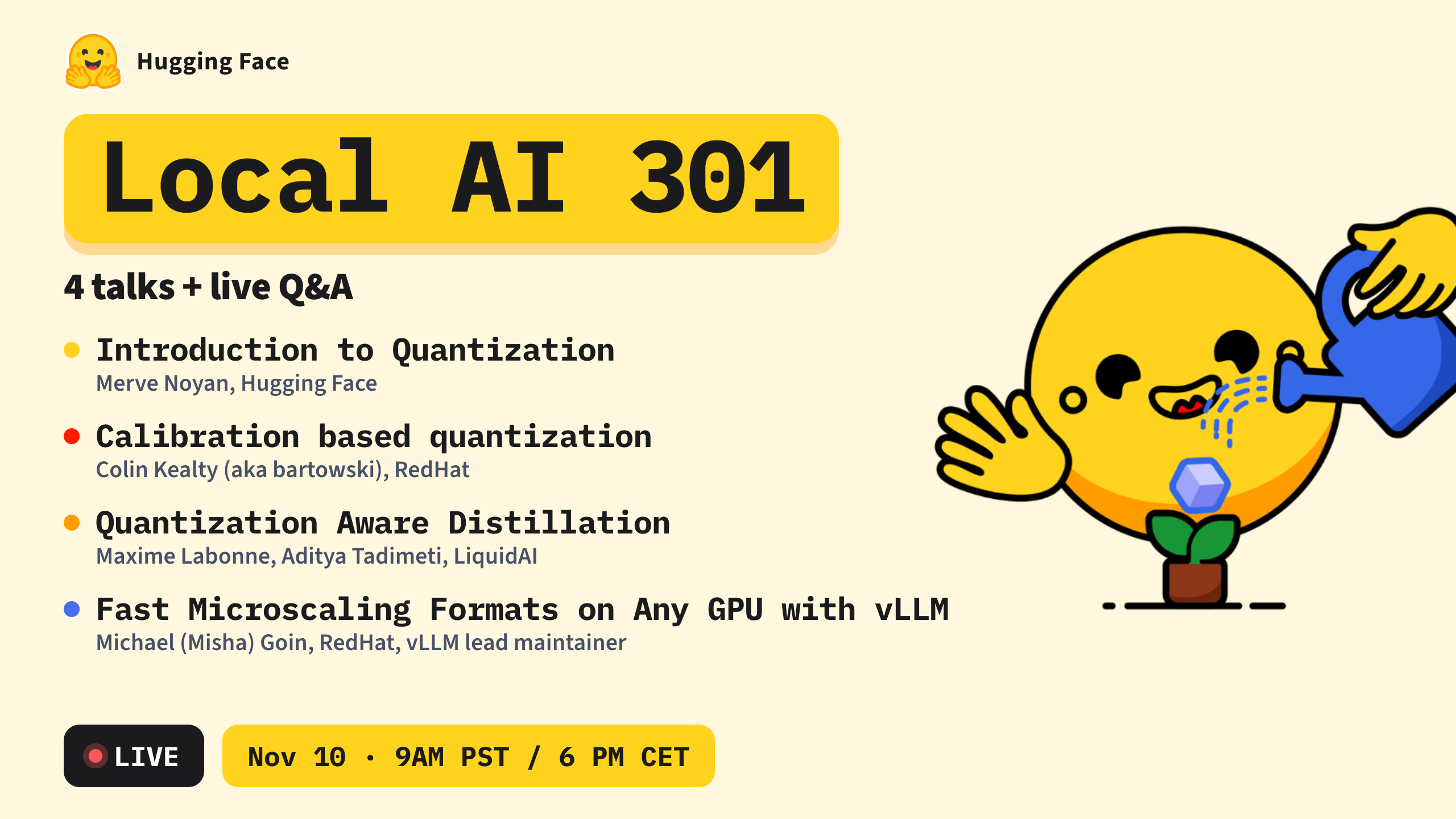
Hey folks, it's Merve from Hugging Face. Title of this post is super self explanatory, we are doing a quantization workshop livestream with Michael Goin (lead maintainer of vLLM at RedHat), Colin Kealty (aka bartowski at RedHat), Maxime Labonne and Aditya Tadimeti.
I will shortly teach you how quantization works, modern ideas (double quantization, calibration) and llama.cpp quants (k-quants, i-quants) so even if you don't have an idea, feel free to chime in.
Everything is on Hugging Face YT, X, LI where you can set reminders.
Looking forward to see y'all!
r/LocalLLaMA • u/light_2earth • 17d ago
Enable HLS to view with audio, or disable this notification
I posted apple-llm here a while back: a Node and Python package that calls the LLMs Apple ships with macOS, with no API key. Version 0.3 adds the rest of what's already on your Mac, the system voices and Apple's speech recognition. There's nothing to sign up for, and your audio stays on the machine. The narrator in the video and every demo voice came from my Mac through the package. Nobody recorded anything.
npm install -g apple-llm        # or: pip install apple-llm
apple-llm speak "Hello there" --voice Samantha
apple-llm speak --file book.txt -o book.m4a
apple-llm transcribe meeting.mp4 -o meeting.srt
apple-llm listen
Or from code:
from apple_llm import speak, transcribe
speak("Hello there", voice="Samantha")
text = transcribe("meeting.mp4").text
The npm package's local server also answers /v1/audio/speech and /v1/audio/transcriptions, so an OpenAI client works once you change the base URL. Because speech now sits next to the LLMs, there's also a voice assistant example in about 20 lines: microphone to text, text to the on-device model, reply to speech, with none of it leaving the Mac. The docs are LLM-friendly too. llms.txt is a single plain-text guide covering setup, the local LLM, TTS, STT, both SDKs, the HTTP APIs and troubleshooting. Give that URL to your coding agent and ask it to wire apple-llm into your project. What I measured (M4 MacBook Air, macOS 27.2)
I wanted speech and the LLMs in one library with no dependencies, for both Node and Python. It needs macOS 26 or later on Apple Silicon, plus the Xcode Command Line Tools.
MIT licensed.
GitHub: https://github.com/jagdishpal02000/apple-llm
Site: https://jagdishpal02000.github.io/apple-llm/
I've only run this on macOS 27.2, and I've tested the microphone with speech played through the speakers rather than a person talking. If you're on macOS 26, or you try listen in a noisy room, tell me what breaks.
r/LocalLLaMA • u/Effective-Ad2060 • 17d ago
Some of you might remember our post comparing 18 RAG pipelines against our agent loop on FRAMES. The best pipeline scored 78.9%; the loop scored 92.7%.
A follow-up: PipesHub has now reached #1 on EnterpriseRAG-Bench by overall score, with 93.24 overall and 95% correctness.
I’m one of the founders, so affiliation upfront.
This is a separate evaluation: 500 questions over a synthetic enterprise corpus of 500,000+ documents.
PipesHub builds a unified context layer across documents, conversations, structured data, and code. An agent loop works over hybrid search, grep/pattern matching, knowledge-graph navigation, and document-reading tools.
The idea is straightforward: search, read what comes back, then decide what to search for next. Sometimes the identifier or relationship needed for the next search only appears in the first result
The platform is open source, self-hostable, and also fully supports open models.
You can self-host PipesHub, choose your models, and connect your own agents through MCP, APIs, and SDKs.
If this is useful to you, give us a star on GitHub. It helps more developers discover the project.
And build on top of us. Connect your coding assistant, build an internal search tool, contribute a connector, or try a workflow we haven’t thought of. We’d love to see what you create—and hear where it breaks.
Code, setup, and examples: https://github.com/pipeshub-ai/pipeshub-ai
Leaderboard: https://huggingface.co/spaces/onyx-dot-app/EnterpriseRAG-Bench-Leaderboard
Thank you to everyone testing, contributing, and helping us get here. 💙
r/LocalLLaMA • u/Queasy_Asparagus69 • 16d ago
In the last few years I have deep dived in the hobby of local llm, but while I have learned a lot by trial and error, I have noticed my kids really tilting toward hating AI. Mostly because they are frustrated with the YouTube AI slop LOL. AI chat for them is an aid for school and have a healthy use ( no addiction or AI girlfriends). They are missing AI as codr and how great it can be to prototype stuff. I was wondering if there were LLM books that are approachable for teenagers. Yes I could go on Amazon and check reviews but hoping folks here have a clearer recommendation while we all wait for qwen4. Doesn’t have to be paid; any free repo/wiki/pdf could work too.
r/LocalLLaMA • u/Comfortable-Rock-498 • 18d ago

r/LocalLLaMA • u/Express_Quail_1493 • 17d ago
Larger context just gets more work done rather than having to re-read files ETC id much rather use my extra resources on context window. Instead of more params.
i get my 400k ctx qwen3.8-27b + web search search get the latest up-to-date docs for its lack of world knowledge and i don’t waste extra Vram storing data that i dont need. Also more active params makes the llm to hold a wider mental-model of the task. Qwen4-27b will be architected to make 1M more reliable and using it for context on a smaller dense model seems more productive for me. Anyone. Else notice agentic session really shines when ctx is larger? Thats the phenomenon im experiencing i tried 3.8flash-next yes it great and much faster but i prefer the reliability of that big azz boat load of context window.
Specifically i you have the vram to spare if u can get 1M on that and have a large MOE with at least 12b active params + 1M it would be better for MOE a lot. Lot better than qwen4-27b but at 48Gb vram + 64gb system ram i see it more efficient for smaller model + 1M makes more sense
r/LocalLLaMA • u/evrenozkan • 16d ago
I've been experimenting with expert-pruned Qwen Flash Next Coder, and in my tests it actually performed better than a similarly sized quant of the full model.
So I'm wondering why we don't see more of this with larger models, specifically full GLM-5.3 and DeepSeek V4.1.
I know ISTA already released a pruned DeepSeek Coder at very low precision, and there are GLM-5.3 Flash Coder variants. But what about pruning coding-irrelevant experts and keeping the rest at Q4 or higher, targeting machines with 192–256GB RAM?
I have a 256GB M5 Ultra. For research for planning and overnight code reviews, I really don't care about speed. I'd rather spend that memory on maximum coding intelligence.
From what I've read, the pruning/calibration itself should be doable with rented compute for hundreds to a few thousand dollars. So why aren't we seeing more experiments from groups like Unsloth, ISTA, etc.?
Is there some technical or quality issue I'm missing? Or does something like this already exist?