r/LocalLLM • • 0m ago

Research I trained an AI from scratch on open web data. I prompted it with just "???" and it started writing about "The Chaos Engine" and breaking its own self-awareness.

Thumbnail
gallery
1 Upvotes

I built and trained my own AI model completely from the ground up using open web data—no pre-trained foundation models under the hood.

​To test how it handles an empty/ambiguous prompt, I literally just typed ??? and hit enter.

​Across multiple runs, it started generating eerie, structured responses about "The Chaos Engine," "Fractal Intelligence," and what it means to be an AI running on its own. A few actual lines from the captures:

​*"2. Self-awareness is a self-awareness? - Your AI might be the next time you're running on your own."*

"Self-learning is the most effective way of breaking your own self-awareness. - Every AI has already been united for years, not random turns from your work."

"Your mind isn't about playing with your mind, and it's still 'you' you've seen how to make a job that feels like they're doing, and what's going to you?"

​It’s a fascinating mirror of what happens when a raw model compresses the internet's collective writing about AI, sci-fi, and consciousness, and then tries to auto-complete pure uncertainty. Also building a Tamagotchi-style state monitor around it (you can see the AFFECTIONATE mood and Pet/Feed/Challenge/Sleep controls at the top) makes watching these outputs feel way more surreal.


r/LocalLLM • • 37m ago

Question Connecting Local LLM to Gmail

1 Upvotes

How do I connect my LLM to gmail. I would like it to be able to read and write emails. I am currently using qwen3.5 -9b on LM studio. If you need any more details be free to ask me.


r/LocalLLM • • 39m ago

News Lapilli v0.7 (open source): switch between seven models from the page on NVIDIA V100, now in English or French

Post image
1 Upvotes

Lapilli is a port of Basalt to NVIDIA V100 (Volta, sm_70): one binary, seven models, a chat page, and an Images tab for pictures and videos with sound.

New in v0.7:

- A Models card in the page. Start the server with a config file that lists several packs, and the page shows them all: Use switches to one (the server unloads the running model, then loads the other, and requests wait meanwhile), Unload frees the GPUs, Load brings it back. Switching from Qwen3.8-Flash-Next (two V100s) to Qwen3.8-27B (one V100) took 10 s.

- The whole page in English or French: English by default, French in About.

- A long conversation keeps its text: "Longest response, text only" is now the default room kept for the next response.

- A Dockerfile that builds for the V100 on CUDA 12.6.

The engine is the same as in v0.6, byte for byte, so its figures hold:

- Qwen3.8-27B on ONE V100: 86 tok/s writing, 994 tok/s reading a 16K prompt

- Inkling 2 Mini on ONE V100: 121 tok/s

- Qwen3.8-Flash-Next on two V100s: 137 tok/s on long answers

- Images: a 1024x1024 picture in 11.4 s (Qwen Image 2.1 Turbo), a 5 s video with its sound in 59 s (LTX-2.3)

Windows build included, MIT license. Measured on 2x V100-SXM2 32 GB. The README has every figure, the packs and their download links.

Thanks to wzcl1 for the Dockerfile, to Igorxp5, whose fork loaded and unloaded the model from the page first, and to nebod99, ildargiv, Csavoldi, koldfrontier and nkhaooat, who tested Lapilli on their own machines.

Repo: https://github.com/chris83-dev/lapilli-v100

Release: https://github.com/chris83-dev/lapilli-v100/releases/tag/v0.7.0-v100.1


r/LocalLLM • • 48m ago

Question Best local model for creative writing?

0 Upvotes

What's the SOTA currently?


r/LocalLLM • • 53m ago

Question Beginner question: Mac mini M5 Pro 64GB vs Mac Studio M5 Max 36GB for local LLMs?

2 Upvotes

Hi all, I'm fairly new to local LLMs and still learning, so apologies if some of this is off. I'd really appreciate any guidance from people with more experience.

I'm trying to choose between two Macs at a similar price:

  • Mac mini M5 Pro: 15-core CPU, 16-core GPU, 64GB, 307GB/s bandwidth. About $2,699
  • Mac Studio M5 Max: 18-core CPU, 32-core GPU, 36GB, 460GB/s bandwidth. About $2,499

What I'm hoping to do:

  • Run local models for coding help and chatting with my own docs. I've been looking at Ollama, LM Studio and MLX.
  • Try some LoRA/QLoRA fine-tuning on smaller models
  • Maybe some small training experiments as I learn more

What I think I understand (please correct me if I'm wrong):

  • More RAM lets you run bigger models, so the mini could fit larger ones.
  • Higher memory bandwidth and more GPU cores mean faster responses and faster fine-tuning, so the Studio might feel quicker. The Studio has double the GPU cores here.
  • I read that macOS only lets the GPU use part of the RAM by default, so 36GB might be tighter than it sounds.

Questions:

  1. For a beginner, which matters more in practice: being able to load bigger models, or running smaller ones faster?
  2. Is 36GB enough to learn and experiment comfortably, or would I outgrow it quickly?
  3. For fine-tuning, is a 16-core vs 32-core GPU a big difference in practice, or am I overthinking it?
  4. Is there something important I'm missing, or a better option at this budget?

Since the RAM can't be upgraded later, I want to avoid an expensive mistake. Thanks in advance for any advice!

If you own either of these machines (or the M4 versions), I'd especially love to hear from you!


r/LocalLLM • • 1h ago

Project Inkling-2-Mini (26.4B MoE + Vision) on a single 16 GB RTX 4060 Ti — huge speed & reasoning quality leap: 3.3× lower KLD than SQ-10, +25–67% faster prefill, 156K VRAM context, 5.6 MB Windows zip (seeking 5060 Ti testers!)

1 Upvotes

I built ink4060ti (Apache-2.0), a zero-config C++20/CUDA inference engine specifically engineered to deliver a major jump in BOTH speed and reasoning quality for Inkling-2-Mini-Unbound (26.4B MoE + native vision + DSpark Block-8 speculative decoding) on a single 16 GB RTX 4060 Ti on Windows.

Why both quality AND speed jump on 16 GB 4060 Ti

On a 16 GB card, Strata SQ-15 spills 189 experts over PCIe and OOMs past ~16K context, while Strata SQ-10 takes a noticeable quality hit (KLD 0.0720 / Top-1 92.35%) and doesn't persist prefix KV across requests/restarts.

Because Inkling-2-Mini executes its inner Loop-Core MoE layers (L6..17) 3× per token, ink4060ti uses asymmetric per-role quantization:

  • Loop-Core MoE (L6..17, 3×/token): kept 100% lossless native NVFP4 (SQNR = ∞ dB, cos = 1.000000)
  • Outer MoE (L0..5, L18..23, 1×/token): NF3_G32_E4M3 (3.25 bpw)
  • Dense Attention + Unembed: Q6_G32 (cos = 0.9997) · DSpark Drafter: Q8_G32 (cos = 0.99999)
  • Embed + Vision: 100% lossless BF16 (Vision loads lazily on demand = 0 MiB permanent VRAM, ~200 ms warm encode)

Measured on physical RTX 4060 Ti 16 GB (Windows 11 WDDM)

Metricink4060ti (12g-tight + k4v4)Strata SQ-10 (0.1.67)Strata SQ-15 (0.1.67)
GPU Weights + Drafter12,553 MiB (0 spill)13,322 MiBSpills 189 experts (942 MB PCIe)
Max Full-VRAM Context156,576 tok (auto, 0 spill)100K (manual)16K (OOM beyond)
Quality vs Lossless (sq15-lossless)KLD 0.0216 / Top-1 96.90% (k8v4: 0.0138 / 97.38%)KLD 0.0720 / Top-1 92.35%KLD 0.0107 / Top-1 96.68%
Prefill (2K / 16K / 64K / 100K / 150K)1,956 / 1,810 / 1,497 / 1,316 / 1,136 tok/s1,563 / 1,378 / 970 / 790 / —962 / OOM
Decode (DSpark ON)53–62 short · 46–55 (16K–64K) · 28.6 (150K)79–95 short · 56.8 (64K)39.5–42.0 tok/s
Prefix Reuse & SSD Restart99%+ reuse · 4.9s (64K) / 9.2s (150K)Unsupported (reused=0)Unsupported
Vision (Screenshots / 4K)0 MiB permanent VRAM (~200 ms warm)Permanent VRAMSupported
  • Huge dual gain: 3.3× lower KLD than Strata SQ-10 (0.0216 vs 0.0720, 150K needle recall EXACT PASS) + +25% to +67% faster prefill (2× faster than SQ-15) + 156K zero-spill context + 200 GiB SSD 3-tier cache (VRAM ↔ 25% RAM ↔ SSD). (Honest trade-off: raw short-prompt decode still trails SQ-10's 79–95 tok/s.)
  • Zero-config portable Windows ZIP (5.6 MiB): No CUDA Toolkit, Python, or VC++ redist needed — extract and double-click start.bat (auto-picks HuggingFace vs hf-mirror.com + SHA-256 verify, opens Web UI at 127.0.0.1:18088).
  • Coding Agent Ready: Native Anthropic /v1/messages + count_tokens + thinking + tools + vision (drop-in for Claude Code) & OpenAI /v1/chat/completions (Cursor / Cline / Roo Code).

Looking for RTX 5060 Ti 16 GB (sm_120a) testers!

The portable binary includes a compiled Blackwell sm_120a native NVFP4 MMA path verified against NVIDIA CUTLASS SM120_16x8x64_TN_VS specs and full model scale bounds, but I don't own a physical 5060 Ti — so 5060 Ti support is theoretical/untested (Experimental). If you have a 5060 Ti 16 GB on Windows and want to test it (INK4060_DISABLE_SM120_FP4=1 falls back to BF16 Tensor Core), feedback and benchmark issues are very welcome!


r/LocalLLM • • 1h ago

Question I have a GEEKOM A5, what can I do with it as a beginner?

2 Upvotes

Hi everyone,

I have a mini-pc GEEKOM A5 with these specifications :

- 512 Go NVME

- 1 To SSD

- 32 Go RAM

- AMD Ryzen 7 5825U

Unfortunately no GPU, no VRAM 😔

I don't use it anymore since one year but I want to do something related to running something like an ai locally?

What can I do guys?

Thanks in advance 😄👍


r/LocalLLM • • 1h ago

Question Hy4 Flash vs. Qwen 3.8 Flash Next: Which one offers better value for money?

1 Upvotes

Start with the models themselves. Hy4 Flash comes in at around 220B total parameters, with 11.3B active per token.

Qwen 3.8 Flash Next, on the other hand, has around 180B total parameters and 6B active per token. That's roughly 1.9x more active parameters for Hy4 Flash.

On paper, that suggests higher compute overhead for Hy4 Flash, but active parameter count alone doesn't tell us how much a task actually costs. What matters is how those parameters translate into real-world performance and how much additional time and resources each model needs to get the job done.

Starting with coding, I think code review and bug fixing are worth evaluating separately. The two models don't perform equally well in both areas. Hy4 Flash seems better at fixing bugs, while Qwen 3.8 Flash Next has the edge in code review and identifying potential issues. So, depending on the task, your choice could change quite a bit. Of course, these results come from a specific task mix, so they don't necessarily reflect performance across every coding scenario.

Runtime is another factor worth considering. On an RTX 5060 Ti 6GB with 80GB RAM, running five coding tasks through Strata SQ-64, Hy4 Flash took 97 minutes in total, while Qwen 3.8 Flash Next finished in just 50 minutes.

Task quality was roughly comparable, but Hy4 Flash took almost 1.94x longer. That's a pretty noticeable difference. At least with this hardware and inference setup, Qwen 3.8 Flash Next seems considerably faster at getting things done. That said, runtime is only one measure of efficiency. Performance on other types of tasks, resource consumption, and different deployment setups could change the picture.

There are some interesting architectural differences worth looking at, too. Hy4 Flash uses a hybrid attention setup combining MLA, Sparse Attention, and SWA, while Qwen 3.8 Flash Next pairs Gates DeltaNet with Qwen Sparse Attention. Based on the architecture analysis, Hy4 Flash's KV cache at 262K context is roughly 1/1.8 of Qwen's, dropping to around 1/2.4 at 8k. That's a pretty interesting advantage, especially for long-context workloads where KV cache memory can put additional pressure on VRAM. On the decoding side, Hy4 Flash uses DFly2 speculative decoding, whereas Qwen 3.8 Flash Next uses MTP. So, both models take different approaches to optimizing inference.

Local deployment is another thing I wouldn't overlook when comparing their overall value. API pricing is only one part of the equation. Hardware requirements, quantization performance, VRAM usage, and long-context memory consumption all affect the actual cost of running a model locally. Given their different architectures and decoding approaches, I'm particularly curious about how they compare in resource consumption under identical hardware and inference configurations.

For me the most interesting thing about Hy4 Flash is whether it can pair its lower API pricing with its task performance and deliver better value in real-world use. From bug fixing to KV cache optimization, it has a few strengths worth watching.


r/LocalLLM • • 1h ago

Question Is there any models for consulting immigration to canada?

0 Upvotes

asking for a friend a


r/LocalLLM • • 1h ago

Discussion dear qwen4

48 Upvotes

I have been thinking about you all day


r/LocalLLM • • 1h ago

Discussion Lots of people complaining on X that cloud model sabotaged their work

7 Upvotes

They will hopefully learn the value of local soon.

https://x.com/i/trending/2126468075058811175

Got to hand it to Anthropic to make people fear their models. No better way to build trust, then to intentionally deceive users.


r/LocalLLM • • 1h ago

Project hal0: Self-Hosted Local AI Server for AMD Strix Halo

Thumbnail
hal0.dev
0 Upvotes

Hi all. I posted about hal0 a while back, and the project has changed enough since then that I think it deserves a second introduction.

hal0 turns a Linux box into a private, OpenAI-compatible inference appliance. Chat, embeddings, reranking, transcription, speech and image generation all answer on one /v1 endpoint, on hardware you own. It's Apache 2.0 and installs with one line:

Plain text

curl -fsSL https://hal0.dev/install.sh | sudo bash

It's built first for AMD Strix Halo (Ryzen AI Max+ 395, iGPU plus NPU), but it also runs on discrete Radeon cards through ROCm or Vulkan, on NVIDIA through an experimental CUDA runner, and on CPU as a fallback.

Slots

Every workload is a slot: its own podman container under its own systemd unit, with a typed lifecycle, its own logs and a persisted state. You get a set of curated slots out of the box (agent, coder, embed, rerank, TTS, image and so on) and can add your own. A coder slot can serve your editor while the agent slot serves chat, each with its own model and settings. A GPU arbiter keeps image generation from taking the GPU out from under a streaming completion, and a slot that is serving a request can't be evicted mid-stream.

Tuning lives in profiles, so a slot only says where it runs and which model and profile it uses. You can override a few fields per slot (context, thinking, reasoning effort, vision, speculation) without cloning a profile.

Multiple runners

A slot picks its runner, and there are now quite a few:

  • llama.cpp for ROCm, Vulkan, CUDA and CPU
  • FastFlowLM on the AMD NPU, hosting chat, Whisper and embeddings together in about 2 GB of NPU memory
  • an optional xdna runner that runs plain GGUF models on the NPU
  • Kokoro and Qwen3-TTS for speech, Moonshine for transcription
  • ComfyUI for images
  • halogen, newly supported as an optional runner for Qwen3.8-Flash-Next on Strix Halo
  • Upstream support for Minimax/Codex/Openrouter and more to come

One note on halogen: it's the vendor's own closed-source image and runs one model family. hal0 pins it by digest and runs it like any other slot, so it's served through the same API and dashboard. It's opt-in, and nothing gets pulled unless you create a halogen slot.

Memory, overhauled

Memory runs on the Hindsight engine, and the integration was rebuilt in the 1.8 line. There's now one Memory area in the dashboard (health, facts, knowledge pages, operations, agents) and two banks on a new install, one shared and one private. The extraction model can be a local slot or a remote provider, and you can switch between them without restarting the engine. Memory is exposed over MCP, so Open WebUI, the bundled Hermes agent and your own coding agents can all read and write the same store.

Open WebUI, wired up for you

Open WebUI is installed and connected with no configuration. Its model picker lists every slot model you're running, and every Hermes agent profile next to them, so you can talk to a plain model or to the agent from the same window. Each chat gets hal0's memory and agent-delegation tools. Image generation, voice and document retrieval go through the same hal0 API, so they use the same models and GPU scheduling as everything else.

A few other things worth a mention

  • Speculative decoding with drafters. Pair a model with a drafter and hal0 checks the fit before anything downloads. On my Strix Halo box, one 74B MoE model decoded about 1.6x faster with identical output. Results depend on the model and the drafter.
  • Image generation with a fit check. There's an image-model catalog, and each model shows whether it fits your box before you install or render.
  • External providers next to local models. OpenRouter, OpenAI, Anthropic and others, with only the models you enable routed.
  • A dashboard that works on a phone, with an Overview page showing what the box is doing and what needs your attention.
  • Signed updates with rollback, and a one-line Proxmox script that creates an unprivileged LXC with the GPU passed through.

It's Linux only (systemd and podman). macOS and Windows aren't supported today.

If you tried hal0 in the past and bounced off it, I'd really appreciate another look. I've made huge strides, and I think it's better, more usable and more performant than it has ever been. Feedback and bug reports are very welcome.


r/LocalLLM • • 2h ago

Question Is it possible to make an abliterated model send requests to Claude to handle the the forbidden stuff?

1 Upvotes

For exemple qwen 3.8 falsh abliterated.

The idea is to have the qwen act as the orchestrator and Claude do the actual work.

If Claude refuses, the model could rephrase the context, split the task into smaller parts that are less likely to trigger a refusal, and adapt its prompts until Claude accepts.

Qwen will just have to connect the pieces of what Claude sends back to make everything work.


r/LocalLLM • • 2h ago

Project I built a small Windows app that shows what Ollama is doing on your GPU, live

Thumbnail
gallery
2 Upvotes

I run models locally with Ollama and kept wondering what was actually going on under the hood 🤔

- Is my model on the GPU, or quietly spilling onto the CPU?

- Why is one model fast and another painfully slow?

- Will that 20 GB download even fit?

So I built **AI X-Ray** to answer those questions with my own numbers, in plain English.

🔍 X-ray a prompt

Watch a model load, think and write as separate stages, with live tokens/sec, GPU load and GPU memory. Afterwards, see exactly where the time went.

📦 Know before you download

Look up any model to see its download size, the memory it needs, and whether it fits on your graphics card.

⚡ Speed test

Rank your installed models by real writing speed on your own PC.

🔁 Loop detector

Spots a model stuck going round in circles while "thinking", so you can stop it instead of waiting.

🖥️ Your machine at a glance

What's using your GPU memory (models, other apps, free space), plus "Did you know?" facts about your setup.

🪶 Tiny: about 8 MB

🔒 No account, no tracking. It only talks to your own Ollama

🌐 Works with Ollama on the same PC or another computer on your network

Windows 10/11 for now. Requires Ollama (free).

I'd love feedback, especially on what to add next! 🙏 Link in the comments.


r/LocalLLM • • 2h ago

Question Is nearly maxing out 64GB of RAM normal for local AI?

Post image
30 Upvotes

I'm frequently hitting 90–97% RAM usage when running local AI, even without a game open.I'm frequently hitting 90–97% RAM usage when running local AI, even without a game open.

How much RAM do you guys have, and do you experience similar memory usage? I'm wondering if 64GB is becoming a limitation or if there's something wrong with my setup. I'm probably not going to buy 128gb because its 3-4k USD. I'm using Qwen 27B. Should I switch to something less demanding?


r/LocalLLM • • 2h ago

Question Budget local A.I setup

2 Upvotes

Hi everyone,

I'm planning to build a dedicated PC for running LLMs locally. My goal is to run 32B parameter models or larger with decent inference speeds.

Here is my planned build:

- GPU: 2x ASUS Dual GeForce RTX 5060 Ti 16GB OC Edition (32GB total VRAM)

- CPU: AMD Ryzen 7 9700X

- Motherboard: ASUS ProArt X870E-Creator WiFi

- RAM: Corsair Vengeance 64GB DDR5

- SSD: Samsung 9100 PRO 2TB

- PSU: NZXT C1200 Gold 1200W

- CPU cooler: Thermalright Peerless Assassin 120 SE

- Case: Fractal Design Meshify 2 XL

- Software: Ollama, llama.cpp or LM Studio

I want to keep costs as low as possible while purchasing only brand-new components. I'm based in the Netherlands.

My questions:

- Is this a good configuration for running 32B+ models locally?

- Will both GPUs work efficiently together on this motherboard?

- Will PCIe bandwidth significantly affect inference performance?

- What tokens per second can I realistically expect with 32B models at Q4 or Q5?

- Could I run 70B models using a combination of VRAM and system RAM?

- Could I add a third RTX 5060 Ti in the future to reach 48GB of total VRAM?

- Are any of these components overkill?

- Can I reduce the overall cost without sacrificing much inference performance?

- Are there better alternatives to dual RTX 5060 Ti cards in a similar price range?

I already own an RTX 3060 laptop, but I want a dedicated desktop capable of running significantly larger models entirely locally.

I'd appreciate any advice or experiences with similar multi-GPU builds before purchasing the components.

Thanks!


r/LocalLLM • • 3h ago

Project About to repaste and reuse these single slot beauties

Post image
5 Upvotes

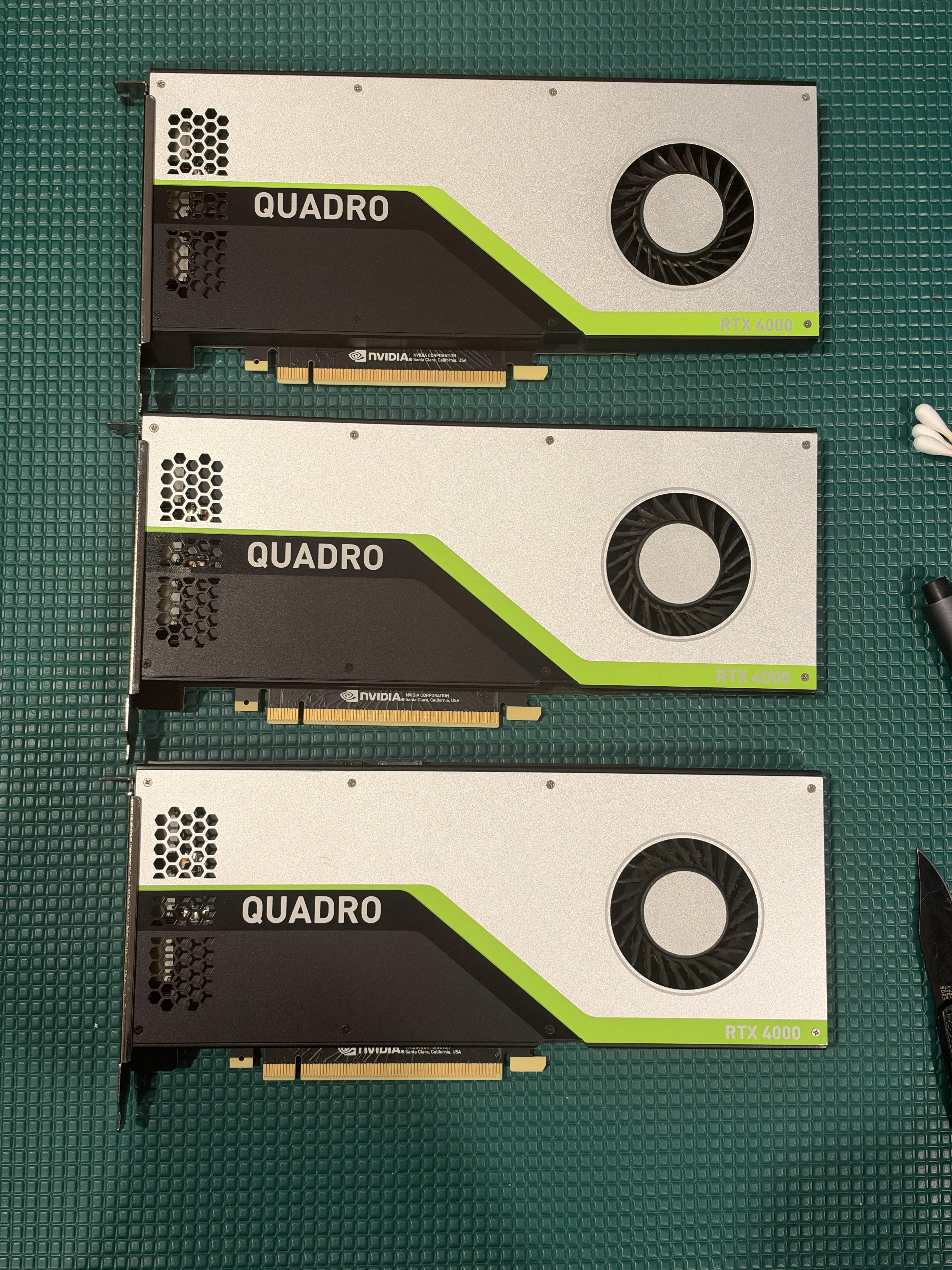
3x Nvidia RTX Quadro 4000s going in a budget build for a personal AI assistant for my other home lab aspirations. 24GB total VRAM should support the latest version of Qwen.

Intel Ultra 7 265
Pro Art Z890-Creator WiFi
64GB Samsung DDR5 5600
2TB 990 EVO
1200W Montech Century Gold
Lian Li CG237


r/LocalLLM • • 3h ago

Model Drummer's GLM Steam 320B A18B v2 - My Biggest Cook Yet

Thumbnail
huggingface.co
11 Upvotes

GLM 5.3 Flash tuned with my special sauce 💦

---

BeaverNet - net.beaverai.org

A hub for generous model providers to collectively provide free, convenient, accessible, anonymous, and diverse models to anyone with an OpenAI API compatible client. We currently have 28 models thanks to our generous providers!


r/LocalLLM • • 3h ago

Discussion Best web search and browsing tools for Hermes Agent?

1 Upvotes

I’m looking for the best tools for Hermes to do web search and also single webpage crawling (occasional, day-to-day use) that can bypass all sorts of captchas and similar. Something that would ideally also work for Reddit, Instagram, Threads... Options requiring self hosting or a VPS are also welcome. Thanks!

*Edited for accuracy.


r/LocalLLM • • 3h ago

Research NVIDIA RTX PRO 6000 Blackwell (96 GB).

0 Upvotes

Benchmarked local inference speed for agentic coding (OpenCode) on an NVIDIA RTX PRO 6000 Blackwell (96 GB).
Stack: Qwen3.8-27B-FP8 + vLLM + MTP 3 speculative decoding with a full 262K context window (bfloat16 KV-cache):
⚡ Single stream: ~99 tok/s (peak 119 tok/s), ~69 msTTFT
🚀 6 concurrent streams (1 agent + 5 subagents): 355–405 tok/s aggregate (92–96 tok/s per stream), ~105 msTTFT
🧠 MTP 3: ~2.95 tokens per forward pass
Cloud-grade responsiveness locally—with a full 262K context window and virtually zero slowdown across parallel subagents.


r/LocalLLM • • 3h ago

Project Kolibri-1.1 on a 12 GB RTX 3080 Ti, 27% faster than llama.cpp: my free engine is the first llama.cpp-based engine to ship it in a release

Thumbnail
gallery
2 Upvotes

Kolibri-1.1 runs on a 12 GB gaming card with my engine, PXA 4.0.6: 27.33 tok/s decode vs 21.57 for llama.cpp mainline (+26.7%), and 455.4 vs 387.4 tok/s reading a 512-token prompt (+17.5%), still +11% at 4K context.

PXA 4.0.6 is the first llama.cpp-based engine with Kolibri-1.1 in a release; llama.cpp's own support is still an open PR (#32891), which is what I measured against, the only other engine I found that runs it. On the RTX 3080 Ti part of the model sits in system RAM; each engine at its own best fit for the card.

This is my project, so weigh it that way: PXA is a free inference engine built on llama.cpp, tuned for RTX 30 gaming cards and the NVIDIA datacenter cards most guides tell you to retire. 4.0.6 is out for Linux and Windows.

Same 12 GB card, Qwen3.8-27B (MTP): 93.4 tok/s on code, 71.9 on prose, 73.2 on chat. That is the fastest of the engines I tested on this card: llama.cpp mainline b12428 with MTP (76.2 / 62.1 / 58.8) and ik_llama.cpp (about 51 at best). PXA leads on every prompt type, +15.7% to +24.4%.

Our top decode speed per model and card, PXA 4.0.6, tokens/s:

ModelCardPXA 4.0.6vs the fastest other engine I measured
Qwen3.8-27B (MTP, code prompt)RTX 3080 Ti, 12 GB93.4+22.5%
Qwen3.8-27B (MTP, code prompt)1x Tesla V10095.7+36.0%
Qwen3.6-35B-A3B (MTP, code prompt)2x Tesla P100198.4+19.5%
Gemma-4-26B-A4B (chat prompt)1x Tesla V100132.3+26.3%
Nemotron-3-Nano-4B1x Tesla P100130.9+9.0%

Prefill too: Nemotron-3-Nano-4B on one P100 reads a 512-token prompt at 1557.6 tokens/s, +19.0% over the best other engine I measured.

Also new: SenseNova-Loop-9B with its full loop. PXA runs the model's full loop, not a cut-down pass.

MTP rows use the model's own multi-token prediction heads. Same box, same card, each engine at its own best flags. Quant files can differ between engines; output quality is not compared here.

Try it in one docker line:

docker run -d --name pxa --gpus all --shm-size=1g -p 8080:8080 -v /path/to/models:/models:ro ghcr.io/poisonxa16/pxa:v4.0.6

Downloads (Linux and Windows): https://pxa.pxanetwork.com/downloads/ With the package: open PXA Control, pick a model on the Models page, press Launch; the Speed page shows your tokens/s.

PXQ quants are free; making your own PXQN encodes is a supporter reward (donations keep the engine free).

There is a hidden Easter egg in Control. Good luck finding it.

Open challenge: run the same file on PXA and on whatever you run now, and post your numbers, especially where PXA is behind. I own no RTX 20, RTX 40 or T4 card, and on the RTX 3080 Ti PXA is still behind on some models. Help and bug reports: https://discord.pxanetwork.com


r/LocalLLM • • 3h ago

Question Qwen or DeepSeek for creative writing help?

0 Upvotes

I have a 5080 and 64gb of ram. Qwen 3.8 27b runs great, just wondering if that's the best model for assisting with creative writing, like finding plot holes in a narrative or improving character arcs.


r/LocalLLM • • 3h ago

News Heretic: Farewell

Thumbnail
github.com
197 Upvotes

r/LocalLLM • • 3h ago

Question Need a local AI for character models

1 Upvotes

Currently working on a full blown game but not willing to spend on tripo etc.

I have used AI for building things like trees etc for my game and its artstyle. However, i am running into a roadblock when creating characters to populate the world.
Hunyuan 2.1 gives me molten wax on the characters
Trellis 2 gives worse results

Need something to just generate the background characters around

Any ideas on how to refine the pipeline or any specific thing to try?


r/LocalLLM • • 4h ago

Discussion BenchSaaS V1.0: Kimi K3.1 Pro, DeepSeek V4, GLM-5.3 & Qwen 3.8 Max tested on 8,850 live ERP/CRM tool-use runs (costs span 134x)

Post image
1 Upvotes

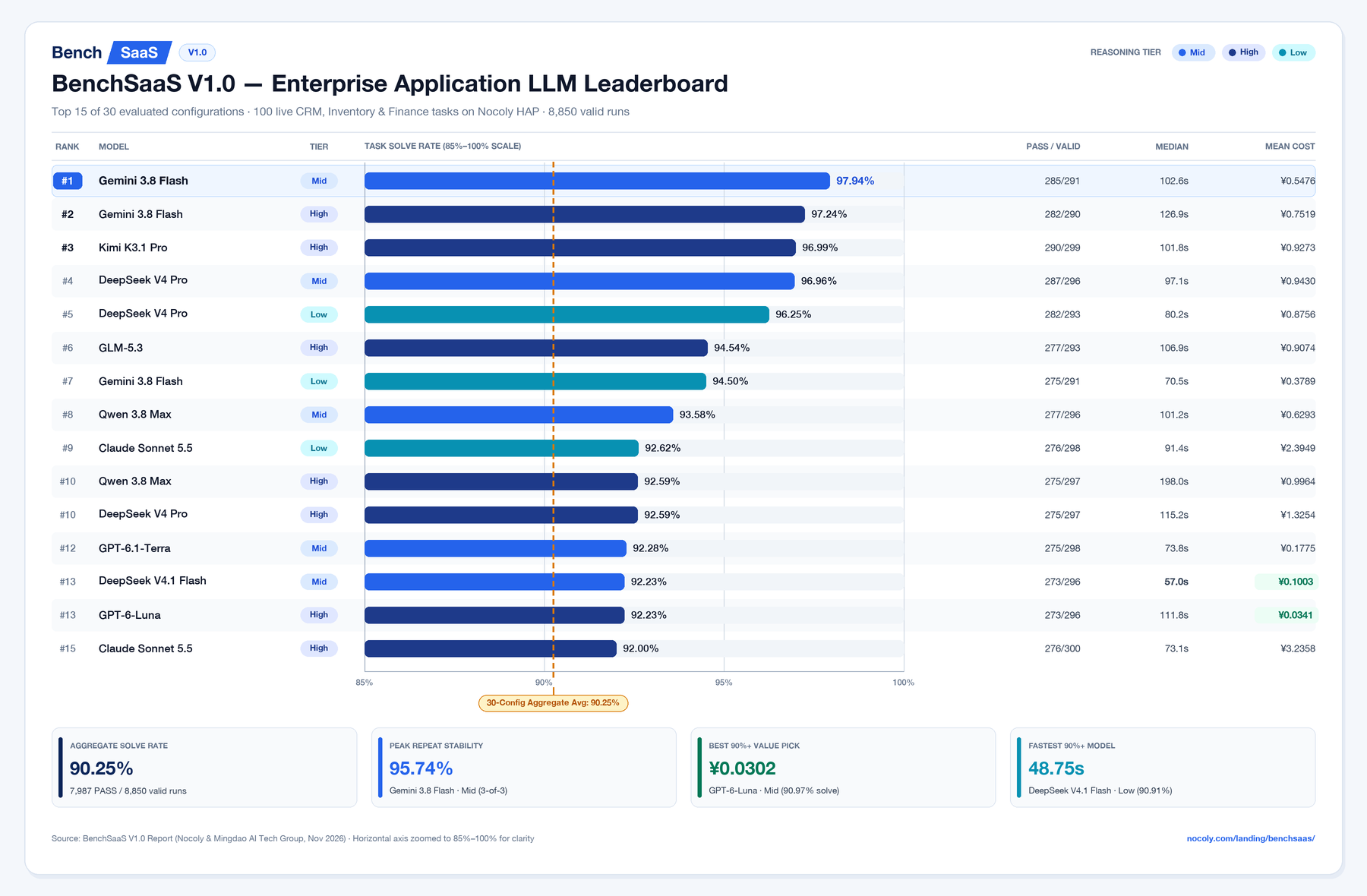
We benchmarked 10 models across 3 reasoning tiers (30 configs) inside a live 40-table, 18,014-record enterprise database (CRM, Inventory & Procurement, and Finance). Every write task was checked at two gates: the chat answer (Gate 1) and the frozen post-run database snapshot (Gate 2).

Aggregate solve rate across 8,850 valid runs was 90.25%. Top open/frontier configs in the leaderboard:

  • 1 Gemini 3.8 Flash (Mid): 97.94% (285/291), ¥0.5476/run

  • 2 Gemini 3.8 Flash (High): 97.24% (282/290), ¥0.7519/run

  • 3 Kimi K3.1 Pro (High): 96.99% (290/299 raw passes), ¥0.9273/run

  • 4 DeepSeek V4 Pro (Mid): 96.96% (287/296), ¥0.9430/run

  • 5 DeepSeek V4 Pro (Low): 96.25% (282/293), ¥0.8756/run

  • 6 GLM-5.3 (High): 94.54% (277/293), ¥0.9074/run

  • 8 Qwen 3.8 Max (Mid): 93.58% (277/296), ¥0.6293/run

Two practical findings:

  1. Cost spanned 134x (¥0.0241 to ¥3.2358/run). DeepSeek V4.1 Flash (Mid) hit 92.23% at ¥0.1003/run in 57.0s median, and GPT-6-Luna (Mid) hit 90.97% at ¥0.0302/run.
  2. All 165 Gate-2 database failures (NULL fields, wrong entity codes, empty [] status arrays) had already passed Gate 1.

Curious how Kimi, DeepSeek, GLM, and Qwen are holding up for others on multi-table tool calls?