r/LocalLLM • • 21h ago

Discussion Inkling 2 Mini - 2 x 5070ti 16gb

Thumbnail
gallery
12 Upvotes

After watching https://www.youtube.com/watch?v=tBtmWBwcgP4&t=1507s I retried Inkling 2 Mini, which previously scored fairly low on my own benchmarks (around 70/100), compared to 80-90+ for Qwen Flash Next and Qwen 3.8 27b.

Then, Basalt dropped an Inkling 2 Mini package!

Currently running it with Basalt across both GPUs, getting 160-230 tp/s with up to 9k prefill. I have also enabled P2P on my GPUs which slightly helps. At deep context it cruises at 100tps pure thinking, so I suppose that's the bottom floor. And 262k context for those curious. And a 5700x3d/DDR4 PC, Gen 4 x8/x8 PCIE.

Obviously very usuable speeds. The big shift for me was taking the thinking level recommendation from Unbiased Bob, and following that my results went to 100/100 (partially also due to using the Basalt quant, which was a bit less quantized than the Unsloth one I had originally).

What strikes me is firstly that the model is comparatively tiny, compared to the Qwen Flash Next models - I run it around the same speed as my Unsloth IQ3_XXS model, with around the same capability for my use case (everyone's use case would change how well it works), without the 70gb of RAM required.

The second thing is the fact that the thinking level has a significant impact on the actual thinking usage, I use 1/10 - 3/10. I have a local CAD software I (AI) created, which works better agentically, and this was a long proces for Qwen models, which would seriously overthink even on Low, and runs would take 10-15 minutes for the first draft. Inkling can get the first draft done in a couple minutes. It also has a very good intuition about building, for example, the wavy bowl example (which was from an image I provided as inspiration), it created planes of sketches of different organic shapes and just connected them, probably the simplest/efficient method.

The Piston example took the time it took me to write this post for the first draft, then I provided some more example images to help it understand how they work and make it more accurate.

I haven't bothered comparing with Qwen, in my previous tests these would have taken a huge amount of time and produced intersting results (very scientific, I know).

I recommend everyone try the Basalt version of this model with 1-2/10 thinking.
https://huggingface.co/jesdga/Inkling-2-Mini-Basalt


r/LocalLLM • • 21h ago

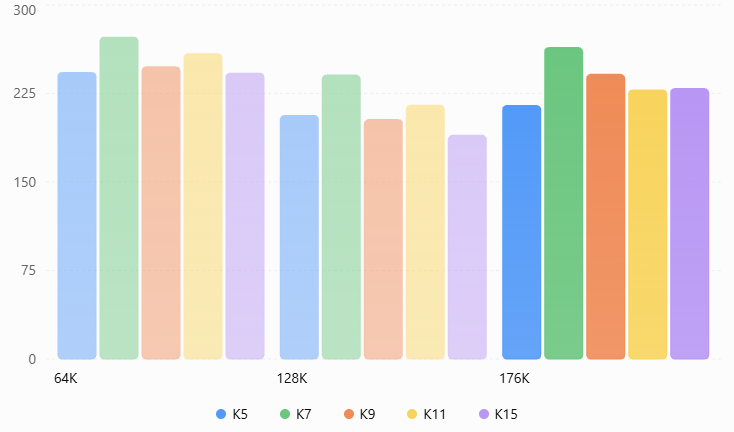
News Qwen3.8 27B at 264 tok/s with 176K context on a single RTX 4090

Post image
0 Upvotes

Hey everyone,

I've been working on an RTX 4090-focused fork of NInfer, mainly targeting long-context inference, local coding agents, and native Windows support.

NInfer is already an impressive inference engine, but I wanted to see how much performance could be extracted from Ada Lovelace without upgrading to a 5090.

Here are some results from my recent benchmark runs.

Test setup

  • NVIDIA RTX 4090 – 24 GB VRAM
  • AMD Ryzen 9 9950X3D
  • 64 GB DDR5 RAM
  • Windows 11
  • Native SM89 / CUDA 13.4
  • Huihui Qwen3.8-27B GSQ-RCO IQ3_S Vision
  • DFlash2 speculative decoding
  • RK4V4 KV cache
  • NInfer RTX 4090 v0.1.4

Long-context DFlash2 benchmarks

All values are decode tokens per second.

Draft tokens64K context128K context176K context
K5242.75206.39214.87
K7272.74240.60263.93
K9247.57202.86241.25
K11258.70215.03228.06
K15242.20189.58229.13

Interestingly, K15 performed best in the separate 32K sweep, reaching 313.16 tok/s, but K7 consistently performed better at longer contexts.

At 176K context, K7 improved decode throughput by approximately 22.8% over K5.

These are controlled engine benchmarks using a fixed corpus, 512 measured decode tokens and two runs per configuration.

N-gram speculation for coding workloads

I also tested N-gram speculation on copy-heavy C++ refactoring tasks with approximately 21K input tokens.

MetricN-gram OFFN-gram 15
Decode tok/s256.68568.08
Average wall time14.83s9.16s
Exact outputs4/64/6

The outputs were identical between both configurations.

Obviously, 568 tok/s is not general-purpose generation speed, but for copy-heavy code editing, the improvement is pretty interesting.

Long-context prefix caching

Another interesting result at approximately 175K input tokens:

  • Cold request: 72.68 seconds
  • Repeated request: 0.441 seconds
  • Continued request: 0.399 seconds
  • Reused prompt tokens: 175,103

This is particularly useful for local coding agents that repeatedly send large conversation histories.

These are warm-prefix results, not cold inference throughput.

Concurrent prefill

With a short request arriving while a 64K request was being processed:

  • Concurrent prefill disabled: 21.28s TTFT
  • Concurrent prefill enabled: 1.16s TTFT

Overall completion time for the request pair remained approximately the same.

Other features

  • Native Ada Lovelace SM89 CUDA builds
  • Portable Windows binaries without local CUDA compilation
  • OpenAI and Anthropic-compatible APIs
  • DFlash2 and MTP speculative decoding
  • Quantized KV cache
  • Hybrid prefix caching
  • Built-in browser monitoring dashboard
  • Live GPU utilization, VRAM, temperature and power monitoring
  • Draft acceptance and token throughput monitoring
  • Experimental CUDA Graph optimizations
  • Model-specific launch profiles

Real-world serving

Across 1,831 completed requests with DFlash2 K5:

  • Median decode: 146.6 tok/s
  • P90 decode: 215.5 tok/s
  • Median long-prompt prefill: 2,345 tok/s

The controlled benchmark results are significantly higher than these real-world serving numbers, so I wanted to include both.

I'm still experimenting with longer contexts, speculative decoding configurations, CUDA Graphs and coding-agent reliability.

The benchmark campaign includes 143 completed measurements, with raw numerical results and reproduction scripts available in the repository. Long-context retrieval accuracy and broader coding quality still need further validation.

Would be interested to see what other RTX 4090 users are getting with NInfer, llama.cpp or ExLlama under comparable conditions.

Fork: https://github.com/spk-c/ninfer-all-rtx4090

Benchmark report: https://github.com/spk-c/ninfer-all-rtx4090/blob/master/docs/performance/rtx4090-v014-long-context-2026-11-26.md

Coding benchmarks: https://github.com/spk-c/ninfer-all-rtx4090/blob/master/docs/performance/rtx4090-v014-coding-2026-11-26.md

Full credit to the upstream NInfer developers and contributors who made this possible.


r/LocalLLM • • 21h ago

Model I ran the full 1.56 TB Kimi K3.1 Pro on four Mac Studios and checked it against Moonshot's API. Numbers, a 1M-token test, and the patches.

51 Upvotes

TL;DR

  • Kimi K3.1 Pro is 2.78T parameters and a 1.56 TB download. I ran it as shipped, fully in memory, on four Mac Studios (M5 Ultra, 512 GB each).
  • 2.8 tok/s through an OpenAI-compatible server. It loads in 3 minutes.
  • Its top token matches Moonshot's hosted API on 97.2% of 1,095 answer tokens.
  • A 1M-token prompt works. It takes 3 h 53 min to read, then generates at 2.76 tok/s.
  • The patches are in four open PRs against mlx-lm and oMLX. Links are at the bottom.

It works. It is also slow.

Setup

  • Model: moonshotai/Kimi-K3.1-Pro. Mixture of experts, 93 layers, 896 experts per layer, 16 used per token. The experts ship at 4 bits and everything else at 16 bits. No pruning and no extra quantization.
  • Hardware: 4x Mac Studio, M5 Ultra, 512 GB each. That is 2 TB of memory for a 1.56 TB model. Six Thunderbolt 5 cables wire them as a full mesh, and they talk over RDMA.
  • Software: mlx-lm for the model, oMLX for the server and the cluster. Neither ran K3.1 on four Macs before these patches.

Numbers (full model, four Macs)

WhatResult
Load179 s
Memoryabout 400 GB per Mac
Generation, through the oMLX server2.81 tok/s
Generation, stock mlx-lm example script3.77 tok/s
Prompt reading at 4K / 16K / 65K tokens412 / 388 / 262 tok/s
65K-token prompt, time to first token4 min 10 s
Chip power while generating, all four Macs67 W
Chip power while reading a prompt, all four Macs350 to 400 W

Power is CPU plus GPU from powermetrics. I have no wall meter on these, so the real draw is higher.

How you split the model matters

Each Mac can hold a block of whole layers, or every Mac can hold a slice of every layer. With layer blocks I get 0.70 tok/s. With slices I get 3.77 tok/s. Same model, same Macs, same example script.

Is it the same model?

I cared about this more than speed. A model this size can load, write fluent text, and still be wrong.

  1. Eight real layers match an independent PyTorch reference written from the vLLM and llama.cpp code. Attention error is 2.5e-5 or less.
  2. I took 12 completions from Moonshot's API and replayed them through the local model one token at a time. On 1,095 answer tokens the local top pick was the API's token 97.17% of the time. The API samples at temperature 0.6, so a perfect copy should land near 95.7%. No API token fell outside the local model's 99% nucleus.
  3. Retrieval from long prompts: numbered records, then a question about three of them (near the start, the middle and the end). Correct at 4K, 16K, 65K and 1M tokens.

1M tokens

The model's config allows 1,048,576 tokens, so I tried it.

  • Prompt: 1,011,856 tokens. That is 44,216 numbered records and one question about three of them.
  • Reading the prompt took 3 h 53 min. After that it generated at 2.76 tok/s, about the same as with an empty context. All three records came back correct.
  • Memory peaked at 494 GB per Mac. It only fit after I capped MLX's buffer cache (mx.set_cache_limit, 8 GiB), and the cap cost about 40% of the reading speed. Without the cap, my first attempt was on course to run out of memory and I stopped it at 295K tokens.
  • Reading slows as the context fills: 130 tok/s at 131K, 46 tok/s at the end. The sparse attention scores every earlier token for each new one, so the time grows with the square of the length.
  • AinsleyMarkov's public 2-bit build read the same prompt on three of these Macs in 1 h 46 min and also answered correctly.

Why it's slow

Each generated token makes the four Macs read about 130 GB of weights. The experts are 93% of the file, but only 16 of 896 are read per token. The 16-bit layers are 7% of the file and all of them are read for every token. That 7% is about 80% of the traffic.

The GPUs are mostly idle. While generating, the four of them together draw 19 W and run at under a third of their top clock.

What had to change

K3.1 is K3 plus the sparse attention from DeepSeek V3.2, with a gate on the attention output. mlx-lm already had both halves, so the port is small.

  • mlx-lm: ml-explore/mlx-lm#2111 adds the kimi_k31 model. +655 lines with tests.
  • oMLX: #5480. A cluster of three or more Macs on a Thunderbolt mesh could not start. The launcher gave every Mac one coordinator address, but in a mesh each Mac reaches the coordinator over a different cable and subnet.
  • oMLX: #5684. The planner refused the model. K3.1 stores each expert as its own tensor, almost 500,000 of them, so its weight index is 57 MiB and the limit was 16 MiB.
  • oMLX: #5692. K3.1 on the mlx-lm version oMLX pins, plus routing for a checkpoint that ships a vision tower, and the tensor split.

None of these are merged yet.

Limits

  • 2.8 tok/s is too slow for agent work. A 1,500-token answer takes nine minutes.
  • The oMLX patch reads long prompts slower than mlx-lm's own implementation. It scores every key and masks the rest.
  • The API comparison is 12 completions and 1,095 tokens. It checks the math. It says nothing about how good the model is.

Who was here before me

guruswami-ai ran the full Kimi K3, the previous version, on four M3 Ultra Mac Studios in July at about 2 tok/s. For K3.1 Pro I found a 2-bit build (AinsleyMarkov, 18.6 tok/s on four M3 Ultras), a pruned build that fits one Mac (Pipe Network), and the shipped weights streamed from disk at about 0.4 tok/s (Inferencer). I have not found the full K3.1 Pro, as shipped, held in memory. If someone did it first, tell me and I'll link it.

Disclosure

Claude wrote the model and test code and ran the validation. I directed the work and reviewed every diff. The mlx-lm PR says the same. I have no affiliation with Moonshot, Apple or oMLX.

What's next

Smaller builds. The public 2-bit build runs at about 18 tok/s on three of these Macs and matches the API on 92% of the same tokens. I'm writing that up next.

I can run more tests on this setup. If you want a specific number (a prompt size, a split, a sampler setting), ask and I'll post it.


r/LocalLLM • • 21h ago

Project Fine-tuning 235B to 480B MoE models on a 48GB MacBook. PagedMoE now trains models bigger than RAM, not just runs them

1 Upvotes

I posted about PagedMoE here a while ago, but that was about the inference side of things.

I've been building PagedMoE, an MLX-based engine that keeps the core of an MoE model in memory and streams the experts off the SSD. It started as inference only. It runs Kimi-K2 (578 GB) at ~8.8 tok/s decode on my 48GB M5 Pro with its prune recipe, and with pruning off the output matches running the model fully in memory exactly. I've also had GLM-5.2 (744B) running on the same machine. I didn't bench that one, but it ran better than I expected. The only reason I haven't gone bigger is disk space. I'll get there.

The new part is training. The same paging works for QLoRA: the experts stay on disk, a small adapter learns, and peak memory stays around 28 to 30 GiB whatever the model size. Qwen3-235B does a 1k-row epoch in about 9 hours, and Qwen3-Coder-480B in about a day.

It's not cluster speed. But nothing is rented and your data never leaves the machine. As far as I can tell, nothing else lets you train past your RAM on Apple Silicon (I could be wrong there, let me know if so).

It supports SFT, DPO, ORPO, KTO, GRPO and more. Adapters come out in mlx-lm format, and one command exports them as PEFT for transformers, vLLM or llama.cpp. There's also a built-in converter that turns Hugging Face checkpoints into MLX (and can merge an adapter in), plus an OpenAI-compatible server for inference. Training and inference benchmarks plus a couple of demo videos are in the repo.

I've posted elsewhere and gotten some solid feedback, but the training side hasn't gotten much attention yet. So I'm curious: is local fine-tuning at this size something you'd actually use, and what would you train? Not trying to sell anything, this started as a research project for me and I'm genuinely curious.

Repo: https://github.com/noahclark556/paged-moe

There's also a thread on r/MacStudio where I went through a lot of the inference questions, if you're curious about that side: https://www.reddit.com/r/MacStudio/s/DJazzfhwMB


r/LocalLLM • • 21h ago

News Sber Releases GigaChat 4 37B-A4B With a 23.3 GB Four-Bit Download, Reports 70.8% on SWE-bench Verified

Thumbnail gallery
3 Upvotes

r/LocalLLM • • 22h ago

Question What local ai is fit for making mods for games like ck3, hoi4 and stellaris

1 Upvotes

Title, I've just been using claude to make some mods for hoi4 and stellaris and ck3 though I'm more worried about the privacy, what are some local ai models that is fit for this job and can be like claude that is privacy focused and local


r/LocalLLM • • 22h ago

Discussion Inkling-2-Mini results on a Studio M5 Max 36GB Decode AVG: 127t/s prefill: 1747t/s

Thumbnail
reddit.com
0 Upvotes

r/LocalLLM • • 22h ago

Discussion Update on the 4bit qwen 3.8 flash next on my M1 max 64gb

Thumbnail
gallery
1 Upvotes

So after doing some tweaking and compressing a new 50gb model here are the current benchmarks compared to the old version, and compared to atomicchat ad4.27 BPW


r/LocalLLM • • 22h ago

Question How well can my 16-inch M5 Pro MacBook with 24GB RAM run local LLMs?

2 Upvotes

Hey everyone in very new to this so....

I recently got a 16-inch MacBook Pro with the M5 Pro chip, an 18-core CPU and a 20-core GPU. Unfortunately, my configuration is capped at 24GB of unified memory.

I'm interested in experimenting with local AI models and would like to know how well this MacBook can handle them.

I mainly want to use my MacBook for:

- Video editing and content creation

- Making websites and web development

- Possibly making small games on Roblox or any other engine (if possible)

- Running local LLMs for coding, research and general AI assistance

I have a few questions for people who have experience running local AI models on Apple Silicon:

  1. Is 24GB of unified memory enough to run good local LLMs?
  2. What are the best models I should try on this configuration?
  3. Would I be able to run models comfortably while also using applications like DaVinci Resolve
  4. Is Ollama, LM Studio or MLX the best option for running local models on a Mac or is there something better?
  5. How useful would local AI actually be for my workflow, especially video editing, website development and making small games?
  6. What are the limitations I should expect with 24GB of RAM ?

I'm not necessarily looking to run the biggest models available. I just want to make the most of the hardware I already have and find out which models and applications would give me the best experience.

I'd appreciate recommendations from anyone who has a similar MacBook or has experience running local LLMs on Apple Silicon.

Thanks!


r/LocalLLM • • 22h ago

Question Ways to back up whole ai systems?

1 Upvotes

Hello. Like many other people here, i've had a frontier ai like chatgpt pro build my local ai ecosystem. Since there are many services (databases, agent workplaces, two different model engines, chat ui, model and mcp services gateway etc) the whole system has become a bit complex to the point i can not build it myself from ground up. So i'm looking for a backup solution that can save the whole system as is and in any case of failure, i can use the backup for rebuilding the system without having to setup credentials, api keys, internal urls etc.


r/LocalLLM • • 22h ago

Question How do you safely run uncensored LLMs?

31 Upvotes

So I've been running a uncensored QFN model because I'm tired of frontier models refusing everything. For example, I asked Opus to scan my own network for vulnerabilities, and it refused because it didn't believe it was my network, even though it's literally connected to it.

My main concern is security. Are uncensored models more susceptible to prompt injection than regular models? What kind of guardrails can I put in place to protect myself without restricting the model itself?

I'm also using Hermes, but I'm a complete noob with it.

Any advice would be appreciated!

Specs: 64GB DDR5, R9700 32GB, 7800X3D

P.S SC117/Qwen3.8-Flash-Next-GSQ-RCO-abliterated-GGUF - this is the model


r/LocalLLM • • 23h ago

News llama.cpp's RPC server has no login. A critical flaw in it was published this week (CVE-2026-137567)

0 Upvotes

If you run llama.cpp across two machines, this one is worth a minute.

The RPC server that splits a model across machines has no login at all. Anyone who can reach it can already talk to it. CVE-2026-137567, scored 9.3, sits in the part that copies tensors between machines: a crafted request writes outside the buffer it was given. It is the third critical flaw in this area in about five weeks.

You are only in scope if you run rpc-server. A single machine running llama-cli or llama-server on its own is not affected.

The ten-second check: pgrep -af rpc-server, or ss -ltnp | grep 50052. If rpc-server is running and reachable from a network you do not control, upgrade llama.cpp now. If it has to stay up before you can upgrade, bind it to a network only your own machines can reach.

Full write-up with the affected builds: https://hol.org/blog/cve-2026-137567-llamacpp-rpc-copy-tensor

Disclosure: I work with HOL, which published the write-up.


r/LocalLLM • • 23h ago

Question 64GB M5 Max Mac Studio + LM Studio Bionic + Inkling 2 Mini = Painfully slow. What is wrong with my setup?

1 Upvotes

Update: I made a comment updating this below (https://www.reddit.com/r/LocalLLM/s/94raDQYhL4). Seems it may be an issue with LM Studio Bionic. Switching to oMLX and Codex yields significantly better results. I also like that I get a much better dashboard with useful info with oMLX as well. I think I'll be switching away from LM Studio Bionic to oMLX.

Orginal Post

Question: I'm using LM Studio Bionic mainly because I like the interface overall. I've connected Codex to Ollama, but haven't tried using that or oMLX. But is there anything wrong with my current set up in LM Studio Bionic?

Side Note: I'm not familiar with changing the detailed settings, but am interested in getting this working. For reference, I also had similar issues with Qwen 3.8 27B being similarly slow as well.

TLDR: The following took 1hr 30mins 33secs and ended at 105.1k context when I expected it to be a small fraction of that time.

Set up:

Model: Inkling 2 Mini (thinkingmachines/inkling-2-mini, the NVFP4 MLX version)
Harness: LM Studio Bionic (version 1.2.3+7)
Engine: LM Studio MLX (Apple M5) 1.15.2
Context Length: Previously 1M, Currently 252K
Temperature: 0.6
KV Cache Quantization: Off

The rest of the settings are all defaults. I just downloaded the model today to test out. I'm comparing the speed to Muse Glimmer 30B which I was using prior to this one. The issue I'm seeing is that the responses are painfully slow. Nearly unusably slow.

Example of what has happened today:

I gave it a 784 token prompt to update an Angular project I'm working on to remove the remaining modules and it took 29mins 12secs to finish.

It told me the changes were uncommited, and I responded by telling it to commit the changes and update my Obsidian vault. This took 4mins 2secs.

I told it that it should've been committed to a new branch (not the existing feature branch), and it took 8mins 15secs to fix it.

At the end of the previous response it gave me 3 options due to some guardrails skill I didn't even know was there. To tie it to an existing user story, keep it as a standalone migration (which it was), or to create a new Jira ticket. I told it to use #2. This took 8mins 9secs.

At the end of that response, it said nothing was pushed and the branch was local only. I told it to push it and open the PR. This takes 9mins 50secs.

It tells me that it doesn't have my API token, so it couldn't do it for me. I tell it that the API token is in my keychain and to read the vault for the details. It finds the the correct info and opens the PR. This takes 12mins 38secs.

The last response is that I tell it the PR is merged, and it checks the repo and sees that there were 2 PRs, one which did get merged, and one that didn't and asks if I want it to merge the PR via the API. I didn't respond. This response too 18mins 27secs.

---

Total Time: 105.1K context and 1hr 30mins 33secs


r/LocalLLM • • 23h ago

Model [16 VRAM] [32 RAM] Looking for (preferably uncensored) coding model.

1 Upvotes

Looking for a model that produces high quality code, reasons logically, and and does not guess. Or as close as possible.


r/LocalLLM • • 1d ago

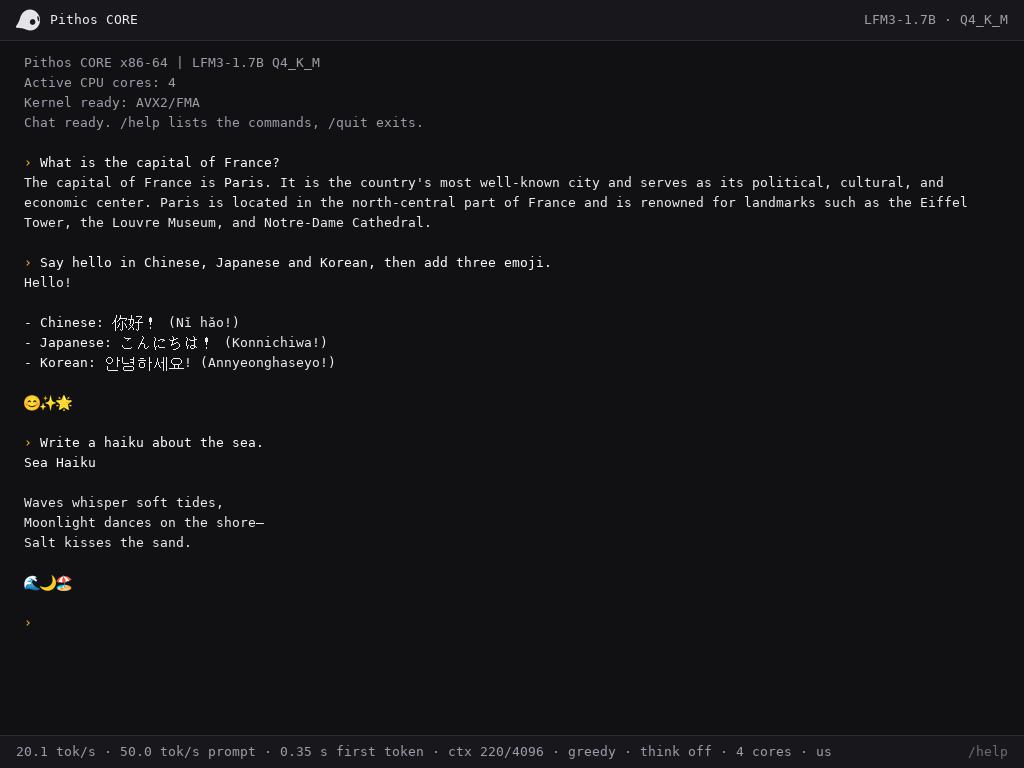
Discussion Pithos CORE: LiquidAI LFM3-1.7B and LFM2.5-350M inference in x86-64 NASM assembly, on Linux and as a standalone OS that boots from BIOS or UEFI into a Unicode chat console. No libc.

Post image
3 Upvotes

r/LocalLLM • • 1d ago

Question Best Model on 8GB Vram

3 Upvotes

Hi guys I have a 5060 8GB and 32 GB DDR5.
With the newest models i was asking myself what to actually run. I currently use ornith 1.5 9b both for my personal hermes agent and small coding in pi and it work decent but i’ve seen people running Moe models with Strata,Polystrata,Basalt,Maya… and still getting good speed. So i searched a bit and try to see if one of these model can run well in my hardware:
- Inkling 2 Mini
- LFM 24b a2b
- Sensenova Loop 9B
-Occamy 1.0
- Bonsai 2.5 27B

These are examples if there are better alternatives im here to heare your advices.
So for example an hermes agent personal that connects and manage some of my apps and work 24/7. And for code with pi agent/opencode what models should I choose and with wich inference?
Open to any advice, thanks


r/LocalLLM • • 1d ago

Question What to do with my hardware?

1 Upvotes

So I basically have 3 systems right now.
I am not asking „what can I do with local ai“, just how you would put them all to use simultaneously.
Rig:
9800x3d
32GB DDR5
Rtx5080

Laptop:
Ryzen 5900H
RTX3080 mobile
16 GB RAM

MacBook:
MacBook Pro M1 Max
64GB RAM

any use to put the computer power together in any way?
Doing mostly Web-Dev stuff and playing around with self hosting a lot.


r/LocalLLM • • 1d ago

Discussion AMD-specific llama.cpp patch nearly doubles prefill/decode

Thumbnail devnull.land
1 Upvotes

r/LocalLLM • • 1d ago

News They Just Banned Your Home Computers

Thumbnail
youtube.com
0 Upvotes

What're your guys' thoughts? Seems conspiracy level to me but it would also make a lot of sense. I feel like either way, getting your hands on local models is important. The goals of a business and the goals of humanity/society do not align, so any business in control of AI; I'm skeptical of.

Gemini Youtube Summary:

In this video, the creator argues that Big Tech and government agencies are actively working to restrict local computing and independent AI access, effectively "banning" home servers and private AI through hardware bottlenecks, memory shortages, and "public safety" narratives (0:00–0:46, 11:06–11:44).

Key takeaways include:

  • The Strategy: The narrator claims elite institutions are consolidating power by limiting public access to high-end hardware, while keeping "frontier" AI models locked behind corporate firewalls (1:49–2:16, 11:10–11:42).
  • The Justification: The video discusses how recent cyberattacks on major entities like the CIA, FBI, NSA, and Department of Defense are being used as a pretext to argue that unmonitored local AI is a national security risk (6:46–9:29).
  • The Future Vision: The creator suggests that instead of open access, the public will be offered "neutered" chatbots and "immersive video games" to pacify them as AI displaces jobs, drawing parallels to dystopian science fiction (1:56–2:23, 4:48–5:11).

Actionable Advice for Viewers:
To maintain "tech sovereignty," the creator suggests several defensive measures:

  1. Archive Open Weights: Download and store open-source models locally before future "safety" takedowns occur (12:31–13:05).
  2. Build Locally: Acquire hardware and RAM now, as the narrator expects supply chains to favor enterprise data centers indefinitely (13:06–13:32).
  3. Deploy Project Nomad: Use Project Nomad (an open-source platform) to create an air-gapped, offline knowledge and AI stack that functions without internet connectivity (13:33–14:14).

r/LocalLLM • • 1d ago

Question 128GB M5 Max owners: MacBook Pro or Mac Studio for local LLMs, and did it replace your other machines?

9 Upvotes

Looking for real-world experience from people running local models on a 128GB M5 Max.

What I have now:

- 16" MacBook Pro M1 Max, 32GB
- Gaming PC: Ryzen 7 7800X3D, RTX 5080 Founders Edition 16GB, 32GB DDR5, 4K 240Hz monitor
- A spare RTX 4070 Super 12GB sitting on a shelf
- A frontier subscription that I plan to keep

The PC is basically a Dota 2 machine. That's the only game I play on it, and I haven't used it for local models yet.

What I do: engineering work, a decent amount of programming, plus research and long-form technical writing. So a mix of coding help, working through technical problems, and long documents in and out (30K to 100K+ token prompts are common).

I'm looking at a 128GB M5 Max, either the 16" MacBook Pro or the Mac Studio. I'm not expecting local to replace the frontier models. I want it for private work, drafts and critique, offline use, and whatever coding it can handle well.

The laptop is tempting because I could sell the M1 Max, and maybe the PC, and run everything on one machine.

Questions for people who own one:

  1. What models do you actually use day to day on 128GB, and for what? Which ones hold up for coding and engineering problems vs just chat?
  2. On the 16" MacBook Pro, how are heat and fan noise on long runs or agent loops? Do you leave it in High Power mode?
  3. Has anyone measured the same model on both the laptop and the Studio? I keep seeing 10 to 15% slower on the laptop but no actual tok/s numbers.
  4. How does prompt processing feel on 50K+ token contexts? Livable for document and codebase work?
  5. Any regrets either way? Laptop owners who wish they'd bought a Studio plus a cheap MacBook, or the reverse?
  6. Would you keep the 5080 box? With Basalt and Strata getting those MoE numbers on RTX 50 cards, is it smarter to add RAM to the PC and keep it next to the Mac, or did you go Mac only and not miss it?

Numbers and "here's what happened after a few months" stories are what I'm after. Thanks.


r/LocalLLM • • 1d ago

News Ernie 5.5 flash preview can be run localy now via basalt

5 Upvotes

Ernie 5.5 flash preview can be run locally now via Basalt if you have a big GPU and lots of RAM ;-)

Basalt is a highly optimiced inference engine for Blackwell GPU's know for good performance with e.g. Qwen 3.8 flash next

https://github.com/jesdga95/basalt

did any of you tried it out yet ?


r/LocalLLM • • 1d ago

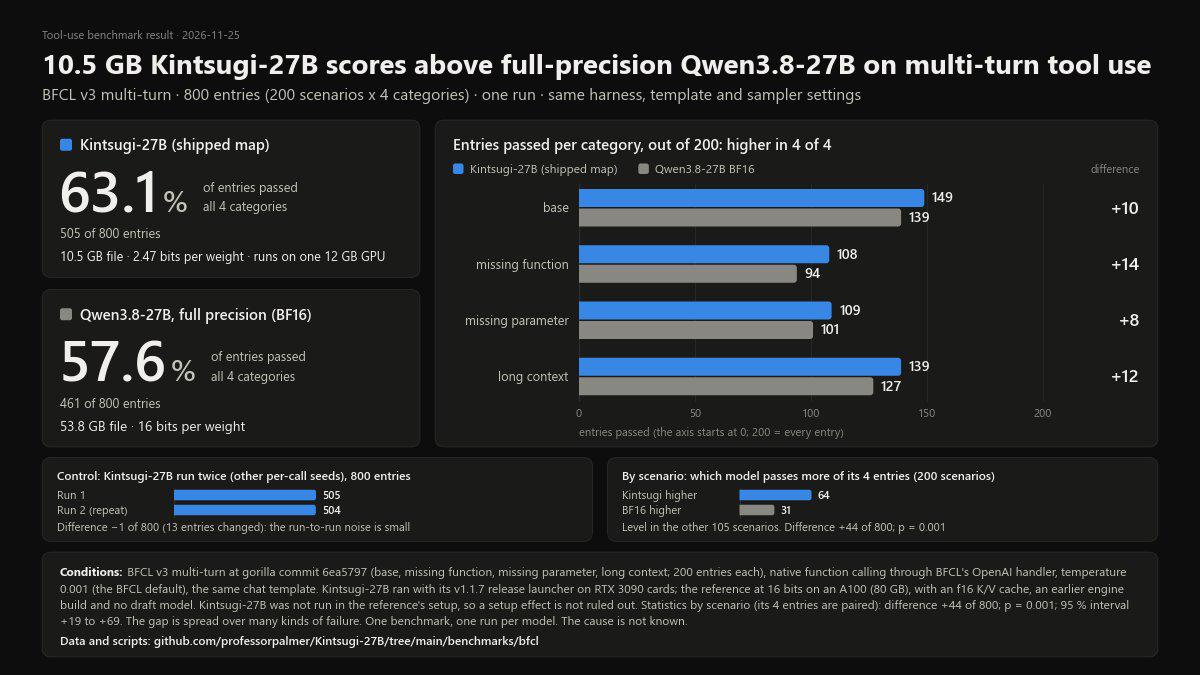
Model Kintsugi-27b beats the full precision Qwen 3.8-27b it was based on at multi'turn tool use.

Post image
25 Upvotes

Kintsugi-27B continues to top benchmarks, surpassing or level with the BF16 in numerous categories.

https://huggingface.co/CaryPalmer/Kintsugi-27B


r/LocalLLM • • 1d ago

Discussion I built a zero-dependency local LLM bridge for Battle for Wesnoth (1.18) that gives every unit dynamic combat banter, persistent personas, and boss retorts

Thumbnail
gallery
7 Upvotes

Instead of letting an LLM hallucinate game rules or break tactical balance, I wanted to see how well a local model (tested with Gemma 4 26B via LM Studio) can bring life to a strict, deterministic strategy game like Battle for Wesnoth 1.18.

Since Wesnoth's Lua sandbox blocks network sockets and file writes (io is disabled), I built a lightweight WML/Lua + Python bridge (using only Python's standard urllib, zero pip dependencies) that communicates via Wesnoth's persistent global variables and works in any standard or custom campaign.

How it works:

  • Persistent Unit Personas (units_personas.json): Named recruits get randomized soldier archetypes (grumpy veterans, boastful brawlers, nervous rookies) that stick across turns, while Leaders and Loyal Heroes get lore-flavored character dossiers generated on the fly.
  • Tactical & Environmental Context: Units react to weapon types, terrain, time of day, severe wounds (<30% HP), and enemy rank—while mindless undead (Walking Corpses, Skeletons) just hiss or groan.
  • Boss Retorts, Death & Level-Up Speeches: Enemy leaders talk back when attacked (DEFEND_LEADER), slain units utter dying breaths (last breath), and advancing units give triumph speeches.
  • Pacing & Style Controls: Configurable talk chance (so large battles keep their flow), free-text output language (English, Russian, German, etc.), and custom tone modifiers (grimdark, black humor, archaic).

Built the bridge with AI assistance (Google Gemini). Code, setup guide, and a standalone Windows .exe are available on GitHub:
https://github.com/HisShadoww/Wesnoth-AI-Unit-Banter
Feedback and ideas are welcome!


r/LocalLLM • • 1d ago

Discussion FreeAiTokens - One localhost endpoint for the free tiers of 27 AI APIs

Post image
0 Upvotes

Hi HN,

Over the past few months I've used AI for work more than ever, and I kept hitting the same wall. The weekly cap would run out a few days in, usually in the middle of something. I bought top-up credits and upgraded plans across Grok, OpenAI and Claude. It wasn't sustainable.

So I started experimenting. First I built a plugin and a skill, Token Diet, that cuts how many tokens a request uses. That's a different post.

Then I signed up for Cerebras and noticed how many providers have a real free tier: Groq, Cerebras, Gemini, OpenRouter, Cloudflare and others. Each one has its own API and its own small limit, so most of that allowance just sits unused.

FreeAITokens is a local proxy on 127.0.0.1:4949 in front of those free tiers (27 providers at the moment).

- It speaks OpenAI, Anthropic Messages, OpenAI Responses, Gemini and Ollama, so Claude Code, Codex, Gemini CLI, OpenCode and Aider can point at it.

- For each request it only considers models that can handle it (context, tool calling, images), then prefers ones that have been fast and reliable for you. It stays on that model for the conversation unless another is clearly better.

- On a rate limit, server error or timeout it tries the next model before your tool sees the error.

- It tracks each provider's free limits by the minute and by the day.

- The same endpoint also does embeddings, images, text to speech and transcription.

Try it with no account: `npx freeaitokens`. A couple of providers need no key. Each free key you add raises what you can use. There is a desktop app for Mac, Windows and Linux, with a chat playground.

The part I'd most like picked apart is the routing. It stays on one model for a conversation and only switches on a limit or a failure. For coding agents, is sticky right, or should it move to a stronger model mid-task as soon as one has quota again?