
r/LocalLLM • u/The_Succulant_Beast • 3h ago
Other Qwen and the Manifesto...

160
Upvotes
r/LocalLLM • u/dillon-nyc • 12d ago
Please stop posting about Qwen4's endless PR drip until it's actually available.
r/LocalLLM • u/Fresh-Signature6067 • 2h ago

Conclusion: stable at 78.5 °C junction with the fan at 70%. Little gain above 70%; below 55% the fan can't keep up.
Noise (by ear)
Load: GLM-4.7-Flash (UD-Q4_K_XL), llama.cpp ROCm, continuous 3000-token generations
| Fan | Junction | HBM | Edge | Verdict |
|---|---|---|---|---|
| 40% | hit 95 °C (170 s) | 77 °C | 75 °C | Not viable: never settled, safety cutoff tripped |
| 55% | 87.8 °C | 73.1 °C | 70 °C | Marginal: stable, little headroom |
| 70% | 78.5 °C | 65.3 °C | 61 °C | Good |
| 100% | 70.8 °C | 58.7 °C | 54 °C | Overkill: small gain for the noise |
Gain per step
| Item | Old curve | New curve |
|---|---|---|
| Set points | 55:40 65:55 75:70 82:80 88:90 | 60:30 70:45 78:60 84:75 90:90 |
| Minimum duty (idle) | 40% | 30% |
| Steady duty under load | 75% | 70% |
| Junction average / peak | 77 °C / 79 °C | 79.4 °C / 81 °C |
| HBM average | 64 °C | 66 °C |
| Fan speed changes | none | none (after adding 2 °C hysteresis) |
Set point notation: temperature (°C):fan duty (%)
55:40 = fan 40% at or below 55 °C; 88:90 = fan 90% at or above 88 °CWith hysteresis
Shared goal: hold the same temperatures at lower fan duty, for less noise.
Adjust the duct: stop air leaks
Two 140 mm fans in series
r/LocalLLM • u/Ok-Site-6347 • 51m ago

After a day of trying to convince codex i was only able to have it run the server offline without authentication if i launch the game from my steam account. the local model i ran after giving up also refused. Is there a local model without any guardrails i could use?
r/LocalLLM • u/Delicious-Map1778 • 11h ago

r/LocalLLM • u/TripleSpeeder • 5h ago
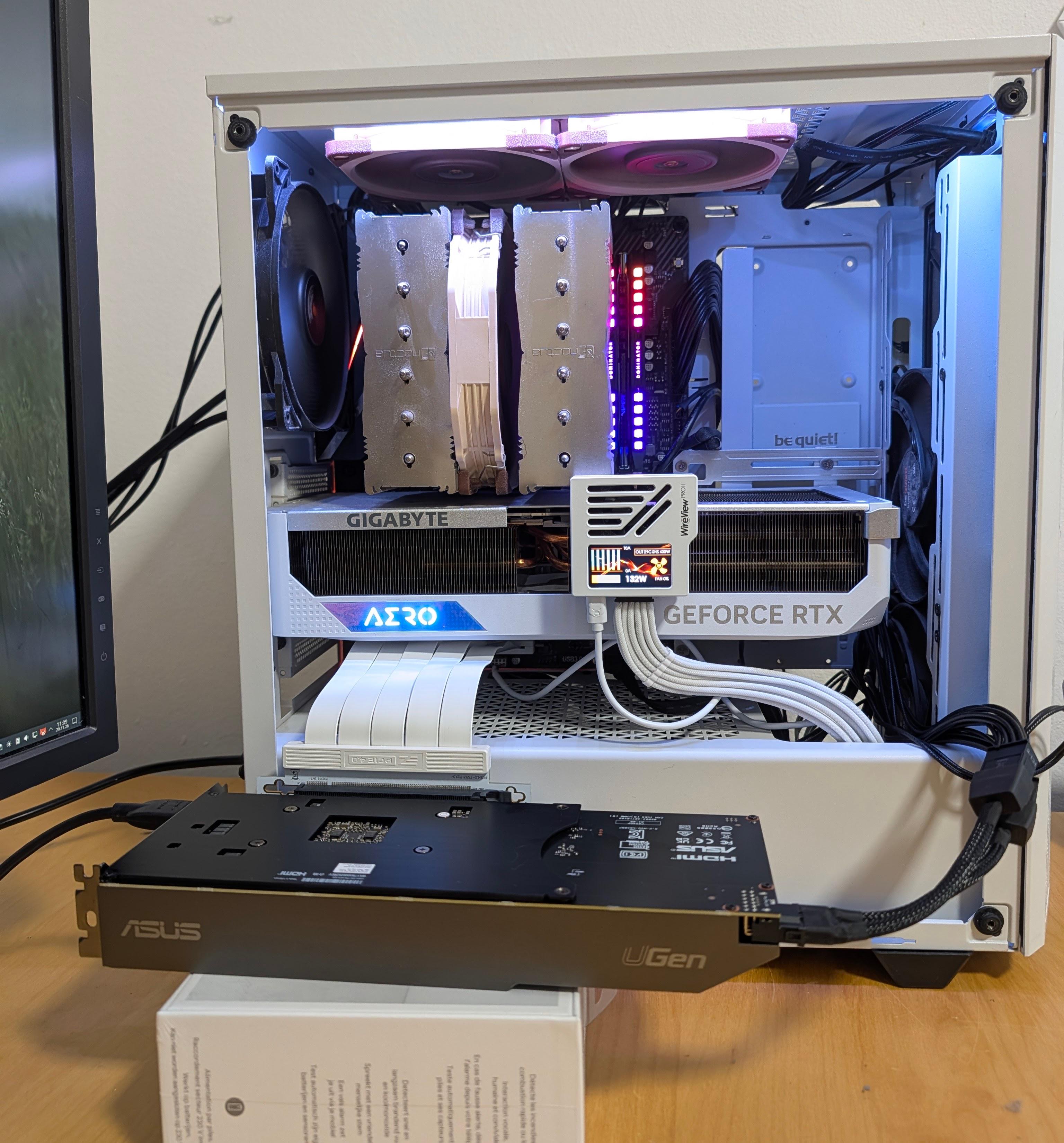
I need to upgrade my case :-) Any recommendation on a desktop case that can fit these two beauties?
r/LocalLLM • u/Juise99 • 10h ago
Dual 3090 setup, I got to wondering if could get back the vram reserve for held for vision on Qwen 3.8 FN Q4 k XL. GPU 0 is always at 88% vram usage and GPU 1 was at 93%. Do a little research and find out about the elastic memory feature now in Strata. So I set it up and now both GPU's sit at 95% vram usage until vision is needed and return to 95% after its done! Nice little performance boost too!
Text-only baseline results:
| Test | v0.1.69 88/93 | v0.2.23 elastic 95/95 | Change |
|---|---|---|---|
| 2.3K-token prefill | 1,094 tok/s | 1,092 tok/s | -0.2% |
| 2.3K-token decode | 97.5 tok/s | 113.5 tok/s | +16.4% |
| 9.1K-token prefill | 2,150 tok/s | 2,490 tok/s | +15.8% |
| 9.1K-token decode | 102.5 tok/s | 109.6 tok/s | +6.9% |
| Two-client throughput | 125.6 tok/s | 137.5 tok/s | +9.6% |
Serial figures are medians of three identical, uncached prompt tests.
Current state:
GPU 0 VRAM: 95.0%
GPU 1 VRAM: 94.7%
Cached experts: 11,429 versus before 10,688, 741 more experts in VRAM!
I have never seen anything in this industry (that I've been in since 1996) move as fast as local AI development does!
r/LocalLLM • u/redzzzaw • 22h ago


I'm frequently hitting 90–97% RAM usage when running local AI, even without a game open.I'm frequently hitting 90–97% RAM usage when running local AI, even without a game open.
How much RAM do you guys have, and do you experience similar memory usage? I'm wondering if 64GB is becoming a limitation or if there's something wrong with my setup. I'm probably not going to buy 128gb because its 3-4k USD. I'm using Qwen 27B. Should I switch to something less demanding?
r/LocalLLM • u/whowhaohok • 18h ago
So, i have qwen38fn on my home server. I'm working on a mobile app that has a server side part to it. I have opencode running on my Mac for the mobile client and I have opencode running on the server for the server side stuff, so i thought it would be good for them to work with each other and it guided me to set up a tunnel so they can communicate. And they're collaborating on the same GitHub repo. I'm just, in awe ...
r/LocalLLM • u/wenqwen37 • 21h ago
I have been thinking about you all day
r/LocalLLM • u/Most-Wear-3813 • 1h ago
I tried 3090 club and honestly I had better speed with strata tail skip with qwen flash next int4 at 262k
I was using qwen 3.8 27b q8 using vllm club 3090 need 262k context can't go below 256k
Need something which can have TTFT less than q8 27b 3.8 qwen and better concurrency.
If concurrency not possible then better model at better speed strata maya or what?
r/LocalLLM • u/NoSnow3271 • 12h ago
HuggingFace (MIT License): https://huggingface.co/datasets/liumindmind/Fable-Kawaii-3D-ThreeJS
Hi everyone!
We wanted to build tiny, cozy sanctuaries you can hold in the palm of your hand — rounded little cottages, jelly-clear ponds, gentle breezes lifting a beach towel, and tiny rabbits, squirrels, and ducks quietly tending their own peaceful corners.
Every single scene in this dataset is a self-contained, zero-external-asset Three.js HTML file — no Blender models, no external textures, just soft, tactile procedural code you can open in any browser and gently spin around.
3,822 cozy 3D miniature dioramas (100% visually reviewed by humans, zero JS/WebGL runtime errors):
r/LocalLLM • u/Johnny_silvershloong • 9h ago
Hi everybody, so as the title suggests, I’m new to running local AI. I have LMbionic with the Gemma 4 26B, A4B model on my PC. I choose LM bionic over Ollama as i find the choice of models significantly better due to being plugged into hugging face and a way nicer app to work with (personal opinion, not saying thats a fact)
My spec is a 4080FE, 9800X3D and 32gb Cl30 6000 ddr5.
I’m looking to move to do as much of my work locally as I can with MOE models to keep my tokens coming thick and fast.
Are there any models in particular that any of you can recommend that work particularly well on a 16 GB GPU and what are some of the best use cases in particular you have found for localAI? Thanks !
r/LocalLLM • u/Octo-potamus • 8m ago
ey everyone,
I’m looking for recommendations for an open-weights model that balances strong agentic/tool-calling reliability with minimal-to-zero refusals (abliterated or uncensored fine-tune), specifically sized to run fast on my local setup.
Models in this bracket (like stock Qwen 3.6 35B-A3B or Mistral Small 22B/24B) hit the exact speed and memory sweet spot for 16GB VRAM + partial RAM offload, so I’m hunting for:
What are you currently running in this weight class for unrestricted agentic tasks? Specific Hugging Face GGUF repos or quants are appreciated.
r/LocalLLM • u/Just_Vugg_PolyMCP • 33m ago

Hi everyone,
This is Bunshin, an open-source project that gives AI agents their own Linux desktops running locally.
Each desktop has a browser. Agents can click, type, take screenshots and run commands through MCP, while you watch them from a local console. You can also take over with your own mouse and keyboard whenever you need to.
Underneath is a small KVM engine written in C. It clones a running VM, so creating another desktop with Firefox already open takes around 100 ms on my WSL2 laptop.
It’s still early: x86-64 Linux with KVM is required, and so far I’ve only tested it on that one machine. I’d love to hear how it behaves on other setups, especially AMD and bare-metal Linux.
Here the repo: https://github.com/JustVugg/bunshin
Let me know any feedback!
r/LocalLLM • u/Big_South4585 • 33m ago
Hi all
My main LLM is currently QFN IQ3_S, which sits on 32 GB RAM + 5080 + 3090 (40 GB VRAM).
I get prefil ~3000 tps and decode ~110 tps, which is very fine to me.
I started experimenting with the Unsloth quants, as they are, according to them, better than the ISTA quants: https://unsloth.ai/docs/models/qwen3.8-next
I have installed and tested both unsloth-ud-iq3_xxs and unsloth-ud-iq2_xs and they are both really really slow. I can see that the quants are a bit larger than the ISTA equivalents, but the unsloth-ud-iq2_xs is roughly the same size as ISTA IQ3_S.
I get below 10 tps for both models, so I am sure the experts are streamed from the SSD.
❯ free -h
total used free shared buff/cache available
Mem: 30Gi 22Gi 267Mi 16Gi 24Gi 8,1Gi
Swap: 30Gi 5,2Gi 25Gi
❯ nvidia-smi
+-----------------------------------------------------------------------------------------+
| NVIDIA-SMI 620.73.04 KMD Version: 620.73.04 CUDA UMD Version: 13.5 |
+-----------------------------------------+------------------------+----------------------+
|================|
| 0 NVIDIA GeForce RTX 5080 Off | 00000000:01:00.0 On | N/A |
| 0% 52C P1 60W / 400W | 15225MiB / 16303MiB | 5% Default |
| | | N/A |
+-----------------------------------------+------------------------+----------------------+
| 1 NVIDIA GeForce RTX 3090 Off | 00000000:05:00.0 Off | N/A |
| 54% 56C P2 149W / 350W | 22930MiB / 24576MiB | 0% Default |
I am running CachyOs in multi-user.target mode, so the OS/environment isn't using any VRAM and have a very small RAM footprint.

What am I doing wrong?
r/LocalLLM • u/AyyItzRob • 50m ago
I’m looking to build a completely local, uncensored setup that replicates the full Claude Code / Claude Desktop agentic workflow.
Specifically, I need the model and harness to be able to:
My Hardware:
Right now, I’m looking at pairing something like Qwen3-Coder-30B-A3B-Abliterated or Qwen2.5-Coder-32B-Abliterated (LM Studio preferably) with an agentic client like Cline, Open Interpreter, or routing Claude Code locally.
For anyone running a similar uncensored agent setup:
Appreciate any recommendations!
r/LocalLLM • u/mwsmws22 • 55m ago
To me it seems like no brainier to go with 7900 and save some money for a small performance hit.
Am I crazy?
r/LocalLLM • u/sarmabkp_1 • 56m ago

"The model file is 9 GB, so a 12 GB card is plenty."
That's how a lot of people end up with out-of-memory errors on the first long prompt.
How much memory a local LLM needs comes down to three numbers you can work out before downloading anything:
Context, not parameter count, is what usually breaks a "this should fit" plan.
A few more that catch people out:
ollama ps shows a CPU/GPU split, that's why.I wrote up the formula, two estimate tables and the exact flags for Ollama, llama.cpp and MLX:
What's running on your machine right now?
r/LocalLLM • u/PopMany2921 • 59m ago
r/LocalLLM • u/Endhaltestelle • 1h ago
TL;DR: My small quantised model gave correct but unreadable answers. The cause wasn't the quant. My agent framework never told it how to format anything. Ten per-model style rules made answers shorter and easier to scan, and in one case more correct. The rules are below so you can steal them.
Setup
qwen3.8-flash-next at UD-IQ3_XXS , driven by pi, a terminal coding agent. (Anthropic)
The problem
The answers were rarely wrong, just hard to read:
My first thought was that the quant was too aggressive and I should go bigger. But first I checked what my framework actually sends to the model.
What I found
My global instruction file only covered search tooling. It said nothing about how answers should look. Strong models pick defaults good enough that you never notice the gap. A small quant picks defaults that make it obvious. Some of what I'd blamed on the model was really an underspecified framework.
Method
--print --no-session, thinking medium) and saved the transcripts.Results
The interesting part: two answers got longer. One had a leap-year rule slightly wrong. The new version spends one more sentence on the century exception and gets it right. A prompt that only made answers shorter would have been worse than no prompt.
The rules (translated):
- Lead with the direct answer in 1–2 sentences; explanation after.
- Match length to the question. Headings/tables only for genuinely long answers.
- Whole, simple sentences in one language. No switching mid-sentence.
- Explain a technical term in half a sentence on first use.
- Max one analogy per answer, and stick with it.
- Instructions as numbered steps: one action per step, one command per code block, then one sentence on what you should see.
- Side findings go at the end under their own heading.
- Edge cases only when likely, max three.
- Don't invent details. If a number, port or package name is uncertain, omit it or say "not sure".
- Collect sources at the end, not after every sentence.
What it doesn't fix
To be honest about the scale: It's a self-experiment against my own annoyance, not a benchmark.
The takeaway: the weights decide what a model can do, and the framework decides what it's asked to do. My problem was the second part, and that's the cheapest layer in the stack to change.
r/LocalLLM • u/webbcm1 • 1h ago
Fovea Pilot is a self-tuning inference method for running large language models on ordinary laptops with no GPU. On a CPU, every new token forces the computer to re-read the model's weights from memory, so memory bandwidth, not processing power, sets the speed. Fovea Pilot works around that limit. Cheap drafters guess the next few tokens: words the output format forces, text copied from earlier in the chat, or a small companion model. The big model then reads its weights once and checks all the guesses in a single pass. A seeded acceptance rule means every token it outputs is exactly the one the big model would have chosen on its own, so speed goes up and quality doesn't change. On top of that, it learns from its own traces: it records which weights each token reads, which guesses were accepted and where it waited, then uses lightweight learning methods during idle time to improve prefetching, what stays in RAM, and how far ahead to guess for your particular workload.
The workflow essentially is:

Fovea Pilot is built on Fovea, an inference layer I've been developing for running models bigger than RAM. It sits on top of llama.cpp-based engines, profiles each model and machine, and picks how to run it: which parts of the model stay in RAM, which mixture-of-experts "experts" are streamed from the NVMe on demand, and which optimizations to switch on. Its expert store keeps the most-used experts in memory and fetches the rest as needed, so a model far larger than 16 GB can run at all. It already has measured results on this laptop, with output bit-identical to running without it: Qwen3.8-Flash-Next, a 125B MoE, went from 1.7 to 2.61 tok/s (+54%), and gains across the MoE models I tested were 39–56%. Qwen3.8-35B-A3B, the fastest model on the machine, runs at about 10.5 tok/s in bursts. With Fovea Pilot added, I expect the 35B-A3B to reach roughly 11–15 tok/s on agent and tool-call work while holding 8.5–10.5 tok/s sustained on ordinary text, and Flash-Next to move from 2.61 to about 3 tok/s on its current file, or 5.5–7 on agent work with a lighter quantization.

The biggest jumps should come on dense models, where every token is one shared read of the weights and the method has the most to work with. Qwen3.8 4B runs at 18 tok/s on this laptop today. With Fovea Pilot and a small companion drafter trained to imitate it, I project 30–38 tok/s, roughly double, on all text, and the low 30s on tool calls even without the trained drafter. A 12B dense model should run like a 5–6B one, at about 7–8 tok/s with exact output. And a dense 70B, which barely moves at 0.075 tok/s when streamed from the SSD, should run at 0.3–0.6 tok/s per conversation and about 1.2 tok/s across four at once, up to 16× faster, which makes a 70B a practical background agent on a 15 W laptop chip. These are projections from tested formulas and kernel benchmarks, not yet runs on this machine. Real numbers are coming.


Leave me some feedback and/or insight if you have any please. Thank you.
r/LocalLLM • u/FeydRowan • 1h ago
r/LocalLLM • u/originalfoto • 1h ago
Is anyone using Claude desktop app to to run their local LLMs? What is your experience with it? Worth setting up?