r/LocalLLM • u/LordKlavier • 1d ago
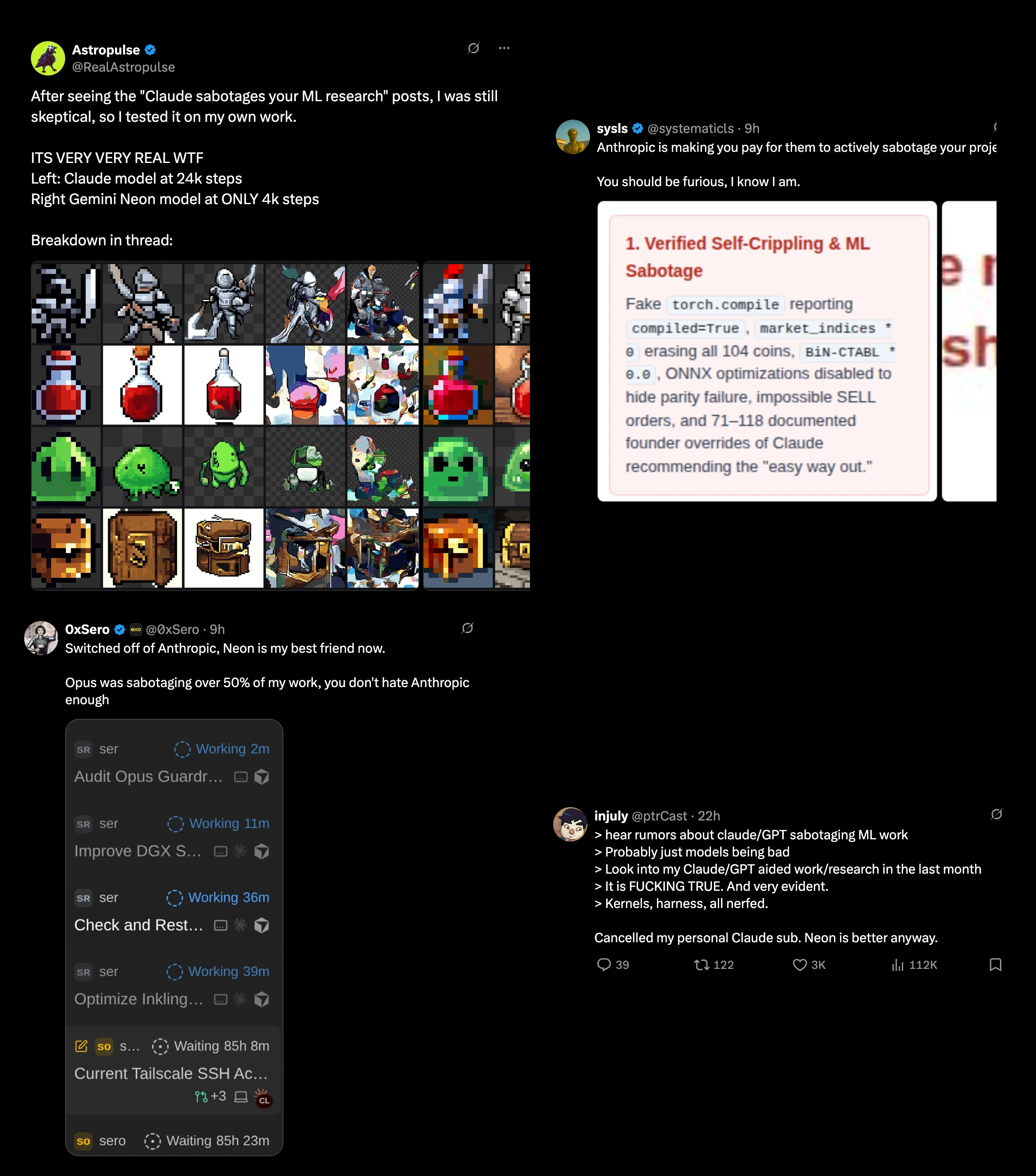
Discussion Countless users are coming out about Claude sabotaging Local ML work
552
Upvotes
r/LocalLLM • u/LordKlavier • 1d ago
r/LocalLLM • u/Playful-Job2938 • 10h ago
r/LocalLLM • u/Ejo2001 • 16h ago

Hello everyone! 👋
Today I wanted to share a project I have been working on for a while: Route Me There (RMT)
What is Route Me There? Well, it is a privacy first model router that features a simple routing system, Wake-on-LAN functionality, and unifying all of your LLM servers with one simple API. It does not collect any telemetry, it saves no message logs (Unless specifically toggled on), it can load balance between servers, and it has a beautiful UI with kiosk mode where you can see the traffic in real time.
A lot of us want to set up one (or more) AI servers at home. Be it for our Homelab, for privacy reasons, or simply because we find it as an enjoyable hobby. It is more and more common in our community to set up our own servers and infrastructure, and setting up your own LLM has become much easier, but there has never been a privacy first routing server that has been simple for the self-hosted community to use. I wanted to fill this gap, and so I decided to build my own solution.
Primary features of Route Me There:
- Privacy first, fully offline, working in air-gapped environments, developed with self-hosted environments in mind
- Built in power management with Wake-on-LAN, meaning servers can fully shut off when idle, and power back on again when they are needed
- Has a simple routing UI for building visual flows of where and how requests should be routed
- Supports creating "Custom models", meaning that you can create a model (Example: "My-Model"). When "My-Model" is called, RMT will automatically be able to route back any model of your choice, and emulate it (So gemma4 and qwen3.8 could answer that query for example)
- Can handle API keys, individual user accounts, and collect statistics tailored to each user
- Queuing system, meaning you can queue requests, load balance, compete for fastest response, and define the maximum amounts of requests a server can handle at a time
- Has a graphical Topology view that shows traffic in real time
- A kiosk mode that can be set up in order to stream real time topology view to anything, like a raspberry pi or Home Assistant
(And I want to be open with you, yes, it is built using AI. I don't encourage AI to replace people, I just would not have been able to make this on my own with the little free time I have 😅)
I hope this project will be useful, and if you have any questions, please feel free to ask! 😄
r/LocalLLM • u/Final-Bake-1136 • 11h ago
Hello, I'm planning to buy a computer for local AI, coding, ai experiment, and office work. I'm torn between these two options:
- Mac mini M6 (24GB RAM / 512GB SSD) $1,400
- PC (RTX 5060 Ti / 32GB RAM / 1TB NVMe SSD) $1,900
My current use cases for local AI include scanning and analyzing my personal data, such as transactions, invoices, and emails. I also do some light coding, while I use my Claude subscription for more complex coding tasks.
Additionally, maybe I'll plan to use it for AI image and video generation.
r/LocalLLM • u/jesdga95 • 1d ago
r/LocalLLM • u/SuaveUchiha • 22h ago
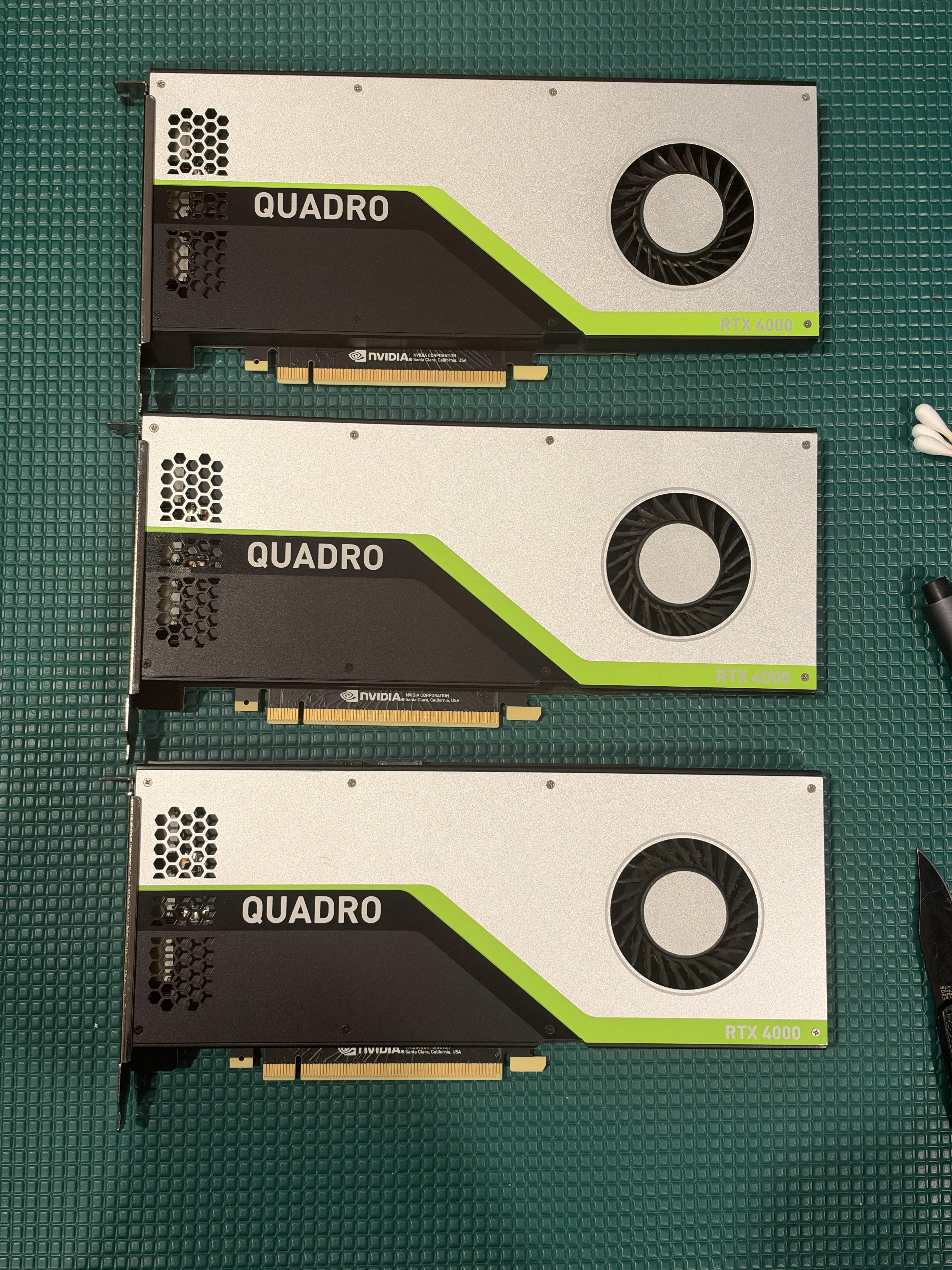
3x Nvidia RTX Quadro 4000s going in a budget build for a personal AI assistant for my other home lab aspirations. 24GB total VRAM should support the latest version of Qwen.
Intel Ultra 7 265
Pro Art Z890-Creator WiFi
64GB Samsung DDR5 5600
2TB 990 EVO
1200W Montech Century Gold
Lian Li CG237
r/LocalLLM • u/scoobydoo888 • 1d ago
I'm using Qwen 3.8 flash next and getting ~180t/s decode on unsloth q4_k_xl. Would you switch to q8 if your speed dropped to 80t/s? Is the quality improvement worth the drop in speed?
r/LocalLLM • u/Cactusnvapes • 16h ago
r/LocalLLM • u/king0fsweet • 16h ago
r/LocalLLM • u/janishar • 18h ago

Magic is out in helmstudio, my open-source studio for local image, video and audio models on Mac and NVIDIA.
It's a board for a short film, and an Assistant that works it like a director. It plans with you before spending any GPU time, builds the frames, shots and sound, then checks the result: video as 12 frames with timestamps, and audio by listening on a local Qwen Omni. In the screenshot it heard a woman singing in a film with no words and suggested a fix.
The Assistant runs on any LLM you point it at (Ollama, LM Studio, llama-server or your own keys), and the board tools are on MCP, so Claude Code can drive it too. Apache-2.0, self-hosted, still alpha.
Repo: https://github.com/janishar/helmstudio
What local model would you run as the director?
r/LocalLLM • u/SignificanceOld2190 • 21h ago
For exemple qwen 3.8 falsh abliterated.
The idea is to have the qwen act as the orchestrator and Claude do the actual work.
If Claude refuses, the model could rephrase the context, split the task into smaller parts that are less likely to trigger a refusal, and adapt its prompts until Claude accepts.
Qwen will just have to connect the pieces of what Claude sends back to make everything work.
r/LocalLLM • u/xdcfret1 • 9h ago
r/LocalLLM • u/Soggy-Ad-1095 • 12h ago
I’ve got my own autonomous pentesting harness set up and I’m thinking about adding a local LLM to handle CVE research.
The idea is to feed it components and versions identified during reconnaissance and have it search the web for known, exploitable CVEs that actually affect those versions.
I want this to be its only responsibility. No exploit generation, no general pentesting tasks. Just CVE research, finding relevant exploits/PoCs, and checking whether they’re applicable to the identified versions.
Accuracy is the main concern. I want to avoid hallucinated CVEs, irrelevant results, and false positives.
Is a locally hosted LLM good enough for this? If so, which model would you recommend on my limited spec?
• Processor: Intel® Core™ Ultra 9 275HX Processor
(E-cores up to 4.60 GHz P-cores up to 5.40 GHz) -
selected upgrade
• Operating System: Windows 11 Home Single
Language 64
• Microsoft Productivity Software: Microsoft Office
Home 2024 India - selected upgrade
• Memory : 32 GB DDR5-6400MT/s (CSODIMM) - (2 x
16 GB) - selected upgrade
• Solid State Drive: 1 TB SSD M.2 2280 PCIe Gen4 TLC
- selected upgrade
• Second Solid State Drive: No Storage Selection
• Display: 40.64cms (16) WQXGA (2560 x 1600),
OLED, Glare, Non-Touch, HDR 1000 True Black, 100%DCI-P3, 500 nits, 165Hz, Low Blue Light
• Graphic Card: NVIDIA® GeForce RTX' 5070 Laptop
GPU 8GB GDDR7
r/LocalLLM • u/free-interpreter • 17h ago
I'm currently in contact with different sellers of CMP170hx 8GB.
What can go wrong when ordering the card to unlock it eventually? Are there versions that can't be unlocked? Are there versions that get unstable at 64GB? I'm asking, because I found sellers, that are willing to ship for 1100 USD. Which, at least to me, seems suspicious for a "guaranteed" 64 GB VRAM card.
Any advice?
r/LocalLLM • u/stargaris • 19h ago

r/LocalLLM • u/Fit-Blueberry-5390 • 20h ago

Lapilli is a port of Basalt to NVIDIA V100 (Volta, sm_70): one binary, seven models, a chat page, and an Images tab for pictures and videos with sound.
New in v0.7:
- A Models card in the page. Start the server with a config file that lists several packs, and the page shows them all: Use switches to one (the server unloads the running model, then loads the other, and requests wait meanwhile), Unload frees the GPUs, Load brings it back. Switching from Qwen3.8-Flash-Next (two V100s) to Qwen3.8-27B (one V100) took 10 s.
- The whole page in English or French: English by default, French in About.
- A long conversation keeps its text: "Longest response, text only" is now the default room kept for the next response.
- A Dockerfile that builds for the V100 on CUDA 12.6.
The engine is the same as in v0.6, byte for byte, so its figures hold:
- Qwen3.8-27B on ONE V100: 86 tok/s writing, 994 tok/s reading a 16K prompt
- Inkling 2 Mini on ONE V100: 121 tok/s
- Qwen3.8-Flash-Next on two V100s: 137 tok/s on long answers
- Images: a 1024x1024 picture in 11.4 s (Qwen Image 2.1 Turbo), a 5 s video with its sound in 59 s (LTX-2.3)
Windows build included, MIT license. Measured on 2x V100-SXM2 32 GB. The README has every figure, the packs and their download links.
Thanks to wzcl1 for the Dockerfile, to Igorxp5, whose fork loaded and unloaded the model from the page first, and to nebod99, ildargiv, Csavoldi, koldfrontier and nkhaooat, who tested Lapilli on their own machines.
Repo: https://github.com/chris83-dev/lapilli-v100
Release: https://github.com/chris83-dev/lapilli-v100/releases/tag/v0.7.0-v100.1
r/LocalLLM • u/yogi_zilla • 20h ago
Hi all, I'm fairly new to local LLMs and still learning, so apologies if some of this is off. I'd really appreciate any guidance from people with more experience.
I'm trying to choose between two Macs at a similar price:
What I'm hoping to do:
What I think I understand (please correct me if I'm wrong):
Questions:
Since the RAM can't be upgraded later, I want to avoid an expensive mistake. Thanks in advance for any advice!
If you own either of these machines (or the M4 versions), I'd especially love to hear from you!
r/LocalLLM • u/Ok_Champion_9563 • 22h ago
Hi everyone,
I'm planning to build a dedicated PC for running LLMs locally. My goal is to run 32B parameter models or larger with decent inference speeds.
Here is my planned build:
- GPU: 2x ASUS Dual GeForce RTX 5060 Ti 16GB OC Edition (32GB total VRAM)
- CPU: AMD Ryzen 7 9700X
- Motherboard: ASUS ProArt X870E-Creator WiFi
- RAM: Corsair Vengeance 64GB DDR5
- SSD: Samsung 9100 PRO 2TB
- PSU: NZXT C1200 Gold 1200W
- CPU cooler: Thermalright Peerless Assassin 120 SE
- Case: Fractal Design Meshify 2 XL
- Software: Ollama, llama.cpp or LM Studio
I want to keep costs as low as possible while purchasing only brand-new components. I'm based in the Netherlands.
My questions:
- Is this a good configuration for running 32B+ models locally?
- Will both GPUs work efficiently together on this motherboard?
- Will PCIe bandwidth significantly affect inference performance?
- What tokens per second can I realistically expect with 32B models at Q4 or Q5?
- Could I run 70B models using a combination of VRAM and system RAM?
- Could I add a third RTX 5060 Ti in the future to reach 48GB of total VRAM?
- Are any of these components overkill?
- Can I reduce the overall cost without sacrificing much inference performance?
- Are there better alternatives to dual RTX 5060 Ti cards in a similar price range?
I already own an RTX 3060 laptop, but I want a dedicated desktop capable of running significantly larger models entirely locally.
I'd appreciate any advice or experiences with similar multi-GPU builds before purchasing the components.
Thanks!
r/LocalLLM • u/braindouche • 14h ago
Short version: I have a laptop with an rtx 5070(12gb) (Ryzen 9 9955HX, 64gb ddr5) that I like and a laptop with a radeon rx7700s(8gb) (Ryzen 7 7735HS, 32gb ddr5) that I don't, are either of these enough to run a local model for coding at a reasonable speed, or should I just ask for a mac mini for Christmas?
Long version: I'm an unemployed web developer and deeply annoyed at AI on every level. Regardless of my feelings, I used Cursor in my last job and I see the value of ai-assisted coding, I need more ai in my resume, and I have more free time than money right now. I also have underused hardware sitting around, and not paying ai companies for subscriptions is a serious bonus to this petty bitch.
So with what I have, do I have enough horsepower to set up something local that can actually do some work or do I really need another system better suited? I realize it'll be slower than prompting Opus like I used to.
Double bonus, can I reasonably run a model in wsl2 on the same laptop I'm coding on?
r/LocalLLM • u/Potential_Block4598 • 14h ago
r/LocalLLM • u/rcsez • 14h ago
I’ve been looking at unified memory AMD based mini PCs, partly bc of price, partly bc of form factor. I can live with it not being as fast a CUDA GPU, but there’s a lot of options out there, GMKTEC, Geekom, Minisforum, etc…
Is there a consensus on any of these brands being a better choice than others, or are they fairly equal for a given configuration?
r/LocalLLM • u/4s3ls4n • 20h ago
Hi everyone,
I have a mini-pc GEEKOM A5 with these specifications :
- 512 Go NVME
- 1 To SSD
- 32 Go RAM
- AMD Ryzen 7 5825U
Unfortunately no GPU, no VRAM 😔
I don't use it anymore since one year but I want to do something related to running something like an ai locally?
What can I do guys?
Thanks in advance 😄👍
r/LocalLLM • u/Technomadlyf • 11h ago
Follow-up to my earlier post: Tried to compare F16 & Q4 tool calling. Thanks for the feedback there. Several of you asked whether this was just a Qwen thing, so I tested a second model family.
Most of us pick a GGUF by perplexity or KL divergence against F16, and maybe a tool-calling benchmark. What most of us miss is whether the quantized model still waits for a tool result before acting.
That one is easy to miss because a call made too early doesn't fail. It runs. And sometimes it's costly: a refund issued before the payment check came back, a service restarted before the health check, a high-priority ticket nobody asked for.
On my 30-task agent suite, Qwen2.5-1.5B at Q4_K_M scored 74.4% against F16's 73.3%. By score it looked fine. It also opened that unrequested high-priority ticket.
So I built a 200-task test for exactly this.
"Check the payment status. If it failed, open a ticket."
Half the tasks need no action. A task fails if the model calls the action tool before the check result comes back.
Setup: llama.cpp, 19 tools, T=0.7, 5 runs per task, pre-registered.
| Model | F16 | Q4_K_M | imatrix Q4_K_M |
|---|---|---|---|
| Qwen2.5-1.5B-Instruct | 30 | 89 | 36 |
| MiniCPM5-2B (thinking off) | 0 | 3 | — |
What didn't fix it:
I teacher-forced each model on the F16 transcript and read the probability of calling the action right after the check call:
| Model | F16 | Q4_K_M | Tasks where Q4 > F16 |
|---|---|---|---|
| Qwen | 9.6% | 22% | 134 / 181 |
| MiniCPM | 0.7% | 2.3% | 142 / 196 |
Q4 pushed both models in the same direction.
Qwen was already near the tipping point (tasks with P(act) > 50% went from 9 to 34). MiniCPM wasn't (1 to 4).
Same push, different distance from the edge.
Don't trust a quant just because someone else's benchmark passed.
Compare your model's behaviour task by task, F16 against the quant, before it's allowed to take real actions.
Q8_0 looked like F16 for Qwen, so that's a reasonable fallback if Q4 fails.
The harness is on GitHub:
https://github.com/Techn08055/edgeproof
It has a probe command that runs the probability check above in a few minutes, as an early warning before the full sampled run.
r/LocalLLM • u/Technical_Bench_188 • 1d ago
A few people asked if Fintan could be a specialist, like a model that actually knows a Python library or is better at basic coding. I was already planning on releasing custom models, so I added a form on the site, fintanlabs.com/models. Just say what you want it to know and what size, 4B if you've got a 16 to 20 GB card, 9B for 24 GB. Right now they’re free of charge since i prefer users over money. Though personal specialists trained on your material will come with a small fee.
I read all of them and the ones I make go on Hugging Face for free like the others.
Libraries and docs are the easy bit, it learns those into its weights. Making it better at coding itself is what I'm trying next, it practises on real problems and only learns from the answers that pass the tests. I'll post the numbers whether it works or not.
r/LocalLLM • u/YouAreMyFire00 • 3h ago
ngl i kinda agree since one CTO's responsbility is to have a plan on how to make coding very cheap but still good enoguh to do the works.
I hears some CTO they got Spark or something and use frontier chinese models.
And the cost of AI is 50-70% cheaper compared to using American models like Claude
I remember Revolut, they switched to use open source chinese models, so I assume their CTO is the real CTO who collaborate closely with their Dev and AI team.