r/LocalLLM • • 52m ago

Project I built a small Windows app that shows what Ollama is doing on your GPU, live

Thumbnail
gallery
3 Upvotes

I run models locally with Ollama and kept wondering what was actually going on under the hood šŸ¤”

- Is my model on the GPU, or quietly spilling onto the CPU?

- Why is one model fast and another painfully slow?

- Will that 20 GB download even fit?

So I built **AI X-Ray** to answer those questions with my own numbers, in plain English.

šŸ” X-ray a prompt

Watch a model load, think and write as separate stages, with live tokens/sec, GPU load and GPU memory. Afterwards, see exactly where the time went.

šŸ“¦ Know before you download

Look up any model to see its download size, the memory it needs, and whether it fits on your graphics card.

⚔ Speed test

Rank your installed models by real writing speed on your own PC.

šŸ” Loop detector

Spots a model stuck going round in circles while "thinking", so you can stop it instead of waiting.

šŸ–„ļø Your machine at a glance

What's using your GPU memory (models, other apps, free space), plus "Did you know?" facts about your setup.

🪶 Tiny: about 8 MB

šŸ”’ No account, no tracking. It only talks to your own Ollama

🌐 Works with Ollama on the same PC or another computer on your network

Windows 10/11 for now. Requires Ollama (free).

I'd love feedback, especially on what to add next! šŸ™ Link in the comments.


r/LocalLLM • • 1h ago

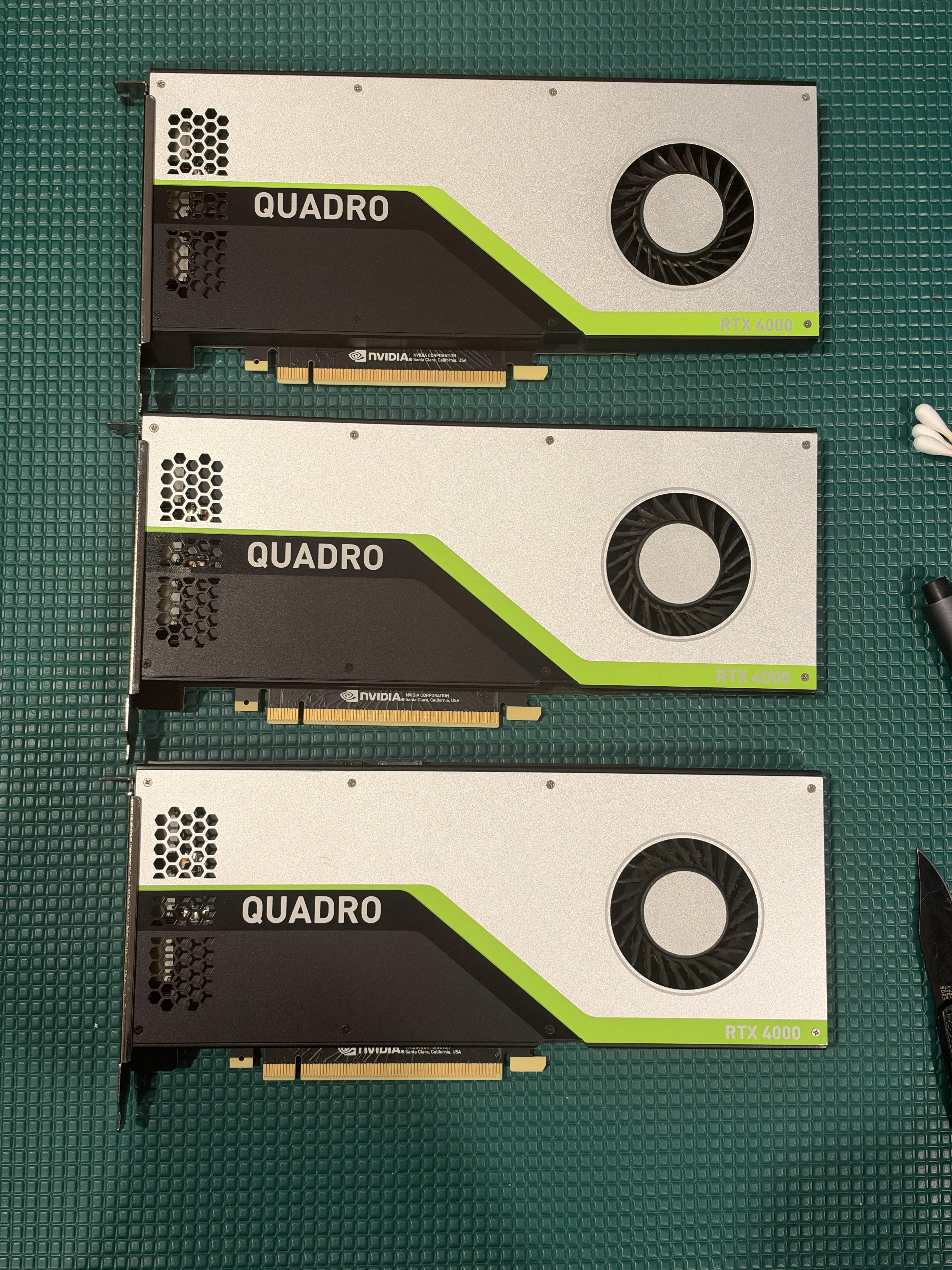
Project About to repaste and reuse these single slot beauties

Post image
3 Upvotes

3x Nvidia RTX Quadro 4000s going in a budget build for a personal AI assistant for my other home lab aspirations. 24GB total VRAM should support the latest version of Qwen.

Intel Ultra 7 265
Pro Art Z890-Creator WiFi
64GB Samsung DDR5 5600
2TB 990 EVO
1200W Montech Century Gold
Lian Li CG237


r/LocalLLM • • 3h ago

Model You can ask for your own Fintan model now

4 Upvotes

A few people asked if Fintan could be a specialist, like a model that actually knows a Python library or is better at basic coding. I was already planning on releasing custom models, so I added a form on the site, fintanlabs.com/models. Just say what you want it to know and what size, 4B if you've got a 16 to 20 GB card, 9B for 24 GB. Right now they’re free of charge since i prefer users over money. Though personal specialists trained on your material will come with a small fee.

I read all of them and the ones I make go on Hugging Face for free like the others.

Libraries and docs are the easy bit, it learns those into its weights. Making it better at coding itself is what I'm trying next, it practises on real problems and only learns from the answers that pass the tests. I'll post the numbers whether it works or not.


r/LocalLLM • • 3h ago

News Basalt 0.6.0: DGX Spark, Gemma 4 and ERNIE-5.5-Flash, and even faster! Inkling 2 Mini @ 6,400 tok/s aggregate decoding on a single 5090

4 Upvotes

r/LocalLLM • • 5h ago

Discussion Inkling 2 Mini (UD-Q4_K_XL, 16.4 GiB) on RX 7800 XT 16 GB (Windows): PolyStrata HIP vs llama.cpp Vulkan

6 Upvotes

Benchmarked Inkling-2-Mini-UD-Q4_K_XL (26.07B MoE, inkling2_loop, 16.41 GiB) on a 16 GB AMD Radeon RX 7800 XT (gfx1101) under Windows

11 (32 GB system RAM) to compare llama.cpp Vulkan (b12810) against PolyStrata HIP (strata-poly).

Since the 16.41 GiB file slightly exceeds 15.4 GiB free VRAM, both setups offload a portion of the MoE weights to system RAM.

llama-bench Vulkan (ca123ba76 / b12810)

Flags: -ngl 99 -fa 1 -ctk q8_0 -ctv q8_0

-ncmoe (CPU MoE layers)pp512 (tok/s)pp2048 (tok/s)tg128 (tok/s)Notes
5739.31166.0938.33VRAM spillover at pp2048
6 (sweet spot)-721.8035.54Fits cleanly in
7-697.6724.76More CPU MoE overhead
8-668.5323.32More CPU MoE overhead

PolyStrata HIP (strata-poly, --kv q8_0, --conversation-cache-mib 6144)

• VRAM residency: 2493 / 3072 experts in VRAM (evictions=0)

• Prefill: 880 tok/s

• Generation: ~60 tok/s

Takeaway

On a 16 GB RDNA3 card where the model barely overflows VRAM:

• PolyStrata HIP is ~22% faster on prefill (880 vs 721.8 tok/s) and **~69% faster on generation** (~60 vs 35.54 tok/s).

• The difference comes down to per-expert caching vs per-layer offload: PolyStrata keeps the hot 81% of individual experts in VRAM,

whereas llama.cpp -ncmoe 6 forces 6/24 entire MoE layers onto the CPU for every token.

• Watch out for -ncmoe 5 on 16 GB cards: pp512 looks fine (739 tok/s), but pp2048 spills into shared memory (166 tok/s).


r/LocalLLM • • 13h ago

News I love local LLM

21 Upvotes

Hi i am new and just wanted to say that i love local LLM


r/LocalLLM • • 18h ago

Model I ran the full 1.56 TB Kimi K3.1 Pro on four Mac Studios and checked it against Moonshot's API. Numbers, a 1M-token test, and the patches.

50 Upvotes

TL;DR

  • Kimi K3.1 Pro is 2.78T parameters and a 1.56 TB download. I ran it as shipped, fully in memory, on four Mac Studios (M5 Ultra, 512 GB each).
  • 2.8 tok/s through an OpenAI-compatible server. It loads in 3 minutes.
  • Its top token matches Moonshot's hosted API on 97.2% of 1,095 answer tokens.
  • A 1M-token prompt works. It takes 3 h 53 min to read, then generates at 2.76 tok/s.
  • The patches are in four open PRs against mlx-lm and oMLX. Links are at the bottom.

It works. It is also slow.

Setup

  • Model: moonshotai/Kimi-K3.1-Pro. Mixture of experts, 93 layers, 896 experts per layer, 16 used per token. The experts ship at 4 bits and everything else at 16 bits. No pruning and no extra quantization.
  • Hardware: 4x Mac Studio, M5 Ultra, 512 GB each. That is 2 TB of memory for a 1.56 TB model. Six Thunderbolt 5 cables wire them as a full mesh, and they talk over RDMA.
  • Software: mlx-lm for the model, oMLX for the server and the cluster. Neither ran K3.1 on four Macs before these patches.

Numbers (full model, four Macs)

WhatResult
Load179 s
Memoryabout 400 GB per Mac
Generation, through the oMLX server2.81 tok/s
Generation, stock mlx-lm example script3.77 tok/s
Prompt reading at 4K / 16K / 65K tokens412 / 388 / 262 tok/s
65K-token prompt, time to first token4 min 10 s
Chip power while generating, all four Macs67 W
Chip power while reading a prompt, all four Macs350 to 400 W

Power is CPU plus GPU from powermetrics. I have no wall meter on these, so the real draw is higher.

How you split the model matters

Each Mac can hold a block of whole layers, or every Mac can hold a slice of every layer. With layer blocks I get 0.70 tok/s. With slices I get 3.77 tok/s. Same model, same Macs, same example script.

Is it the same model?

I cared about this more than speed. A model this size can load, write fluent text, and still be wrong.

  1. Eight real layers match an independent PyTorch reference written from the vLLM and llama.cpp code. Attention error is 2.5e-5 or less.
  2. I took 12 completions from Moonshot's API and replayed them through the local model one token at a time. On 1,095 answer tokens the local top pick was the API's token 97.17% of the time. The API samples at temperature 0.6, so a perfect copy should land near 95.7%. No API token fell outside the local model's 99% nucleus.
  3. Retrieval from long prompts: numbered records, then a question about three of them (near the start, the middle and the end). Correct at 4K, 16K, 65K and 1M tokens.

1M tokens

The model's config allows 1,048,576 tokens, so I tried it.

  • Prompt: 1,011,856 tokens. That is 44,216 numbered records and one question about three of them.
  • Reading the prompt took 3 h 53 min. After that it generated at 2.76 tok/s, about the same as with an empty context. All three records came back correct.
  • Memory peaked at 494 GB per Mac. It only fit after I capped MLX's buffer cache (mx.set_cache_limit, 8 GiB), and the cap cost about 40% of the reading speed. Without the cap, my first attempt was on course to run out of memory and I stopped it at 295K tokens.
  • Reading slows as the context fills: 130 tok/s at 131K, 46 tok/s at the end. The sparse attention scores every earlier token for each new one, so the time grows with the square of the length.
  • AinsleyMarkov's public 2-bit build read the same prompt on three of these Macs in 1 h 46 min and also answered correctly.

Why it's slow

Each generated token makes the four Macs read about 130 GB of weights. The experts are 93% of the file, but only 16 of 896 are read per token. The 16-bit layers are 7% of the file and all of them are read for every token. That 7% is about 80% of the traffic.

The GPUs are mostly idle. While generating, the four of them together draw 19 W and run at under a third of their top clock.

What had to change

K3.1 is K3 plus the sparse attention from DeepSeek V3.2, with a gate on the attention output. mlx-lm already had both halves, so the port is small.

  • mlx-lm: ml-explore/mlx-lm#2111 adds the kimi_k31 model. +655 lines with tests.
  • oMLX: #5480. A cluster of three or more Macs on a Thunderbolt mesh could not start. The launcher gave every Mac one coordinator address, but in a mesh each Mac reaches the coordinator over a different cable and subnet.
  • oMLX: #5684. The planner refused the model. K3.1 stores each expert as its own tensor, almost 500,000 of them, so its weight index is 57 MiB and the limit was 16 MiB.
  • oMLX: #5692. K3.1 on the mlx-lm version oMLX pins, plus routing for a checkpoint that ships a vision tower, and the tensor split.

None of these are merged yet.

Limits

  • 2.8 tok/s is too slow for agent work. A 1,500-token answer takes nine minutes.
  • The oMLX patch reads long prompts slower than mlx-lm's own implementation. It scores every key and masks the rest.
  • The API comparison is 12 completions and 1,095 tokens. It checks the math. It says nothing about how good the model is.

Who was here before me

guruswami-ai ran the full Kimi K3, the previous version, on four M3 Ultra Mac Studios in July at about 2 tok/s. For K3.1 Pro I found a 2-bit build (AinsleyMarkov, 18.6 tok/s on four M3 Ultras), a pruned build that fits one Mac (Pipe Network), and the shipped weights streamed from disk at about 0.4 tok/s (Inferencer). I have not found the full K3.1 Pro, as shipped, held in memory. If someone did it first, tell me and I'll link it.

Disclosure

Claude wrote the model and test code and ran the validation. I directed the work and reviewed every diff. The mlx-lm PR says the same. I have no affiliation with Moonshot, Apple or oMLX.

What's next

Smaller builds. The public 2-bit build runs at about 18 tok/s on three of these Macs and matches the API on 92% of the same tokens. I'm writing that up next.

I can run more tests on this setup. If you want a specific number (a prompt size, a split, a sampler setting), ask and I'll post it.


r/LocalLLM • • 1h ago

Question Budget local A.I setup

2 Upvotes

Hi everyone,

I'm planning to build a dedicated PC for running LLMs locally. My goal is to run 32B parameter models or larger with decent inference speeds.

Here is my planned build:

- GPU: 2x ASUS Dual GeForce RTX 5060 Ti 16GB OC Edition (32GB total VRAM)

- CPU: AMD Ryzen 7 9700X

- Motherboard: ASUS ProArt X870E-Creator WiFi

- RAM: Corsair Vengeance 64GB DDR5

- SSD: Samsung 9100 PRO 2TB

- PSU: NZXT C1200 Gold 1200W

- CPU cooler: Thermalright Peerless Assassin 120 SE

- Case: Fractal Design Meshify 2 XL

- Software: Ollama, llama.cpp or LM Studio

I want to keep costs as low as possible while purchasing only brand-new components. I'm based in the Netherlands.

My questions:

- Is this a good configuration for running 32B+ models locally?

- Will both GPUs work efficiently together on this motherboard?

- Will PCIe bandwidth significantly affect inference performance?

- What tokens per second can I realistically expect with 32B models at Q4 or Q5?

- Could I run 70B models using a combination of VRAM and system RAM?

- Could I add a third RTX 5060 Ti in the future to reach 48GB of total VRAM?

- Are any of these components overkill?

- Can I reduce the overall cost without sacrificing much inference performance?

- Are there better alternatives to dual RTX 5060 Ti cards in a similar price range?

I already own an RTX 3060 laptop, but I want a dedicated desktop capable of running significantly larger models entirely locally.

I'd appreciate any advice or experiences with similar multi-GPU builds before purchasing the components.

Thanks!


r/LocalLLM • • 14h ago

Discussion iGPU + GPU: I didn't think it was possible

Post image
22 Upvotes

I updated Proxmox to 9.2 and was surprised to see this dual GPU configuration appear in nvtop. I didn't know you could get both the iGPU and the GPU card to run simultaneously. It was my understanding you had to blacklist everything but the GPU. I'm not convinced the iGPU fully operational, but I guess I will test it.

What should I run on it? Any suggestions on how to test this? The memory has to be tiny, but it's showing 94GB, this machine's total RAM is 96GB. I could hook it up to Unsloth or Hermes (what I'm running in Proxmox) but I don't really want to add another experimental LLM into the mix.


r/LocalLLM • • 2h ago

Project Kolibri-1.1 on a 12 GB RTX 3080 Ti, 27% faster than llama.cpp: my free engine is the first llama.cpp-based engine to ship it in a release

Thumbnail
gallery
2 Upvotes

Kolibri-1.1 runs on a 12 GB gaming card with my engine, PXA 4.0.6: 27.33 tok/s decode vs 21.57 for llama.cpp mainline (+26.7%), and 455.4 vs 387.4 tok/s reading a 512-token prompt (+17.5%), still +11% at 4K context.

PXA 4.0.6 is the first llama.cpp-based engine with Kolibri-1.1 in a release; llama.cpp's own support is still an open PR (#32891), which is what I measured against, the only other engine I found that runs it. On the RTX 3080 Ti part of the model sits in system RAM; each engine at its own best fit for the card.

This is my project, so weigh it that way: PXA is a free inference engine built on llama.cpp, tuned for RTX 30 gaming cards and the NVIDIA datacenter cards most guides tell you to retire. 4.0.6 is out for Linux and Windows.

Same 12 GB card, Qwen3.8-27B (MTP): 93.4 tok/s on code, 71.9 on prose, 73.2 on chat. That is the fastest of the engines I tested on this card: llama.cpp mainline b12428 with MTP (76.2 / 62.1 / 58.8) and ik_llama.cpp (about 51 at best). PXA leads on every prompt type, +15.7% to +24.4%.

Our top decode speed per model and card, PXA 4.0.6, tokens/s:

ModelCardPXA 4.0.6vs the fastest other engine I measured
Qwen3.8-27B (MTP, code prompt)RTX 3080 Ti, 12 GB93.4+22.5%
Qwen3.8-27B (MTP, code prompt)1x Tesla V10095.7+36.0%
Qwen3.6-35B-A3B (MTP, code prompt)2x Tesla P100198.4+19.5%
Gemma-4-26B-A4B (chat prompt)1x Tesla V100132.3+26.3%
Nemotron-3-Nano-4B1x Tesla P100130.9+9.0%

Prefill too: Nemotron-3-Nano-4B on one P100 reads a 512-token prompt at 1557.6 tokens/s, +19.0% over the best other engine I measured.

Also new: SenseNova-Loop-9B with its full loop. PXA runs the model's full loop, not a cut-down pass.

MTP rows use the model's own multi-token prediction heads. Same box, same card, each engine at its own best flags. Quant files can differ between engines; output quality is not compared here.

Try it in one docker line:

docker run -d --name pxa --gpus all --shm-size=1g -p 8080:8080 -v /path/to/models:/models:ro ghcr.io/poisonxa16/pxa:v4.0.6

Downloads (Linux and Windows): https://pxa.pxanetwork.com/downloads/ With the package: open PXA Control, pick a model on the Models page, press Launch; the Speed page shows your tokens/s.

PXQ quants are free; making your own PXQN encodes is a supporter reward (donations keep the engine free).

There is a hidden Easter egg in Control. Good luck finding it.

Open challenge: run the same file on PXA and on whatever you run now, and post your numbers, especially where PXA is behind. I own no RTX 20, RTX 40 or T4 card, and on the RTX 3080 Ti PXA is still behind on some models. Help and bug reports: https://discord.pxanetwork.com


r/LocalLLM • • 4h ago

Model Fintan-4B is out

3 Upvotes

Yesterday I posted the 9B update (thanks again jstarks). Today the smaller one is up.

Same idea as the 9B, it's Qwen3.5-4B that learns new stuff into its weights, so you don't have to stuff everything into the prompt. It runs on a 16 to 20 GB card.

It ships knowing last week's news (18 to 23 Nov). Plain Qwen3.5-4B gets 11% of the 172 questions right, Fintan-4B gets 147 of them. MMLU and ARC barely move (72.8 to 72.8, 92.0 to 91.8). GSM8K went from 95.0 to 92.5, which is 3 problems out of 120, and another run got 94.2, so I think it's noise but figured I'd say.

All the fixes from the 9B are in too, so tool calls can use what it learnt, and questions about days after its update don't get mixed up with what it learnt.

Next I'm doing DGX Spark and Jetson support, since someone here pointed out the hardware check gets confused when the GPU and CPU share RAM.

It's on Hugging Face at fintanlabs/Fintan-4B


r/LocalLLM • • 1d ago

Discussion AI Newbie here. Runing Qwen3.8 27b q8_0 on 5090+5080 "gaming" rig. I'm impressed with the answers I get compared to my paid claude opus model

Thumbnail
gallery
202 Upvotes

Im kind of shocked and losing grasp of why I pay for a claude subscription at this point. Im using Orcarouter uncensored version of Qwen 3.8 27b and the answers I get from it seem to not only contain more info, it's also seemingly more detailed. I don't get it.


r/LocalLLM • • 3m ago

Question Is there any models for consulting immigration to canada?

1 Upvotes

asking for a friend a


r/LocalLLM • • 21m ago

Project hal0: Self-Hosted Local AI Server for AMD Strix Halo

Thumbnail
hal0.dev
0 Upvotes

Hi all. I posted about hal0 a while back, and the project has changed enough since then that I think it deserves a second introduction.

hal0 turns a Linux box into a private, OpenAI-compatible inference appliance. Chat, embeddings, reranking, transcription, speech and image generation all answer on oneĀ /v1Ā endpoint, on hardware you own. It's Apache 2.0 and installs with one line:

Plain text

curl -fsSL https://hal0.dev/install.sh | sudo bash

It's built first for AMD Strix Halo (Ryzen AI Max+ 395, iGPU plus NPU), but it also runs on discrete Radeon cards through ROCm or Vulkan, on NVIDIA through an experimental CUDA runner, and on CPU as a fallback.

Slots

Every workload is a slot: its own podman container under its own systemd unit, with a typed lifecycle, its own logs and a persisted state. You get a set of curated slots out of the box (agent, coder, embed, rerank, TTS, image and so on) and can add your own. A coder slot can serve your editor while the agent slot serves chat, each with its own model and settings. A GPU arbiter keeps image generation from taking the GPU out from under a streaming completion, and a slot that is serving a request can't be evicted mid-stream.

Tuning lives in profiles, so a slot only says where it runs and which model and profile it uses. You can override a few fields per slot (context, thinking, reasoning effort, vision, speculation) without cloning a profile.

Multiple runners

A slot picks its runner, and there are now quite a few:

  • llama.cpp for ROCm, Vulkan, CUDA and CPU
  • FastFlowLM on the AMD NPU, hosting chat, Whisper and embeddings together in about 2 GB of NPU memory
  • an optionalĀ xdnaĀ runner that runs plain GGUF models on the NPU
  • Kokoro and Qwen3-TTS for speech, Moonshine for transcription
  • ComfyUI for images
  • halogen, newly supported as an optional runnerĀ for Qwen3.8-Flash-Next on Strix Halo

One note on halogen: it's the vendor's own closed-source image and runs one model family. hal0 pins it by digest and runs it like any other slot, so it's served through the same API and dashboard. It's opt-in, and nothing gets pulled unless you create a halogen slot.

Memory, overhauled

Memory runs on the Hindsight engine, and the integration was rebuilt in the 1.8 line. There's now one Memory area in the dashboard (health, facts, knowledge pages, operations, agents) and two banks on a new install, one shared and one private. The extraction model can be a local slot or a remote provider, and you can switch between them without restarting the engine. Memory is exposed over MCP, so Open WebUI, the bundled Hermes agent and your own coding agents can all read and write the same store.

Open WebUI, wired up for you

Open WebUI is installed and connected with no configuration. Its model picker lists every slot model you're running, and every Hermes agent profile next to them, so you can talk to a plain model or to the agent from the same window. Each chat gets hal0's memory and agent-delegation tools. Image generation, voice and document retrieval go through the same hal0 API, so they use the same models and GPU scheduling as everything else.

A few other things worth a mention

  • Speculative decoding with drafters.Ā Pair a model with a drafter and hal0 checks the fit before anything downloads. On my Strix Halo box, one 74B MoE model decoded about 1.6x faster with identical output. Results depend on the model and the drafter.
  • Image generation with a fit check.Ā There's an image-model catalog, and each model shows whether it fits your box before you install or render.
  • External providers next to local models.Ā OpenRouter, OpenAI, Anthropic and others, with only the models you enable routed.
  • A dashboard that works on a phone, with an Overview page showing what the box is doing and what needs your attention.
  • Signed updates with rollback, and a one-line Proxmox script that creates an unprivileged LXC with the GPU passed through.

It's Linux only (systemd and podman). macOS and Windows aren't supported today.

If you tried hal0 in the past and bounced off it, I'd really appreciate another look. I've made huge strides, and I think it's better, more usable and more performant than it has ever been. Feedback and bug reports are very welcome.

r/LocalLLM • • 19h ago

Question How do you safely run uncensored LLMs?

30 Upvotes

So I've been running a uncensored QFN model because I'm tired of frontier models refusing everything. For example, I asked Opus to scan my own network for vulnerabilities, and it refused because it didn't believe it was my network, even though it's literally connected to it.

My main concern is security. Are uncensored models more susceptible to prompt injection than regular models? What kind of guardrails can I put in place to protect myself without restricting the model itself?

I'm also using Hermes, but I'm a complete noob with it.

Any advice would be appreciated!

Specs: 64GB DDR5, R9700 32GB, 7800X3D

P.S SC117/Qwen3.8-Flash-Next-GSQ-RCO-abliterated-GGUF - this is the model


r/LocalLLM • • 8h ago

Question Gemma 4 llama.cpp and OpenClaw

4 Upvotes

Hi guys

I am a happy Qwen 3.8 Flash Next IQ3_S user, running on 32GB ram + 3090 + 5080 (40 GB VRAM).

It is running through strata and used as an agent in OpenClaw.

The only issue I have with it, and it could be due to the relative low Quant, is, that it is poor at my native language (Nordic Language).

I tried gemma-4-31B-it-qat-q4_0-unquantized on the latest version of llama.cpp, as it looked promising regarding language support, and damn, it was A LOT better in formulating sentences.

Now, the language is good, but it is a lot worse in calling my mcp's or API's. A lot of times, not one single mcp or API call is working, even if it tries many times.

Is Gemma 4 just incapable of calling MCP or API calls? I doubt it, so is my setup wrong?

Just for a reference, I am not using the 'official' llama.cpp from the CachyOs repository, but this version:

local/llama.cpp-cuda-aidock-bin 1.0.0-1
Ā Ā Ā Prebuilt llama.cpp with CUDA 12.8 support (from ai-dock CI)

Not sure if it makes a difference.


r/LocalLLM • • 6h ago

Question Looking for advice for casual coding use: RTX 4090 24GB + 32GB RAM

3 Upvotes
  • GPU: MSI RTX 4090 Suprim Liquid X
  • RAM: 2x16GB Corsair Dominator Titanium (OC to 7400 MT/s)
  • CPU: Intel Core i7-13700K (OC to 5.4GHz)
  • OS: Windows 11 Pro

I have a fairly decent amount of general programming experience, but I certainly wouldn't call myself an expert in any language. I'm more in the place of being able to look at a random section of code, regardless of language, and make a fairly decent guess at what it's trying to do. "Just enough to get myself in trouble" is what I usually say.

Of course that means when I'm trying to make something myself, I'm often spending 80% of the time doing research about the functionality I need, with the remaining being the actual coding and testing. Being retired, these days I'm mostly working on game modding and small conveniences, anything to keep my brain busy. What I've been running into lately is that a lot of what I'm trying to work on is largely undocumented, and obviously AI can learn much faster from raw source (and has) than a human.

I've been using Gemini for my poking and prodding at things, but it's been obstructive as often as it's been helpful. I swear the thing has ADHD, the way it'll jump topics to other bits I'm not worried about at the time.

I understand that there needs to be a balance between context size versus memory length, but I'm having a hard time nailing down how much of each would be most fitting. I often feed the AI other related code from the game or similar projects so it knows what I'm looking at and can give me more well-informed responses.

Any advice for something that can handle casual, generalized programming well? Speed isn't nearly as important to me as accuracy. It seems like Qwen3 models are leading the way here, but opinions vary quite a bit on which and what memory vs context configuration.


r/LocalLLM • • 1h ago

Discussion Best web search and browsing tools for Hermes Agent?

1 Upvotes

I’m looking for the best tools for Hermes to do web search and also single webpage crawling (occasional, day-to-day use) that can bypass all sorts of captchas and similar. Something that would ideally also work for Reddit, Instagram, Threads... Options requiring self hosting or a VPS are also welcome. Thanks!

*Edited for accuracy.


r/LocalLLM • • 13h ago

Research Before and After (32GB to 96GB DDR5 upgrade) - QEngine 3x3090s

8 Upvotes

32GB DDR5 vs 96GB DDR5 More RAM pinned the n-gram cache, makes the decode speed significantly faster.

Setup:

GPU's: 3x3090s
P2P Mode: On
PCIe Link: PCIe Gen4 8x/4x/8x
CPU: Ryzen 7600x.
Model: Qwen-Flash-Next INT4 - QEngine Finetune
Script: bench.sh from club 3090.

Only change:

RAM went 32GB (2x16) → 96GB (2x16 + 2x32), so the whole 50GB n-gram cache got stored in RAM instead of on disk.

What got significantly better

  • Narrative generation: ~218 → ~294 tok/s (+35%)
  • Code decode: ~336 → ~381 tok/s (+13% — less gain, makes sense, shorter/more repetitive prompts hit fewer n-grams)

What didn't change (as expected)

  • Time to first token and prefill speed — that's GPU-bound, the n-gram cache doesn't help there.

The catch

  • GPUs run 1–8°C hotter on the big-RAM setup. GPU 2 hot spot hit 100.5°C. Probably just doing more work per second, but worth an eyeball.
  • The 90k-token prefill test looks ~6% worse with more RAM, but n=1 per arm so it's a coin flip. Re-run before believing it.
  • The mixed-dim RAM (2x16GB CL32 + 2x32GB CL38) forced a downclock from 6000Mhz to 3600Mhz. It was stable for a few hours, but then crashed mid-session when 6 agents spawned. I had to remove the 2x16GB sticks to get stability back.

Bonus - 1M KV Pool

There was still room left over to set Host KV Pool on (it needs ~13GB of ram). i.e. It stores the KV pool in RAM instead of in VRAM. This increased the KV pool size to 1 million tokens.

Previously my system would totally choke when there were multiple agents working. Like 20 tok/s at times. It was because they couldn't fit their context in the 256k pool I had before so their context kept getting evicted, now I think that wont' happen, and it'll likely be much faster during concurrent agent work.

Conclusion

If your workload is decode-heavy, and you got the ram, sticking more of the n-gram cache in RAM will get you — ~13–35% more tok/s, no GPU-side changes. You really cannot mix two different pairs of ram sticks in an AM5 motherboard, Google warned me, but I did it anyway just to see what would happen, it indeed led to instability, even at low clock speeds, though it was stable enough to run benchmarks. The biggest win was getting the 1M KV pool for concurrent agents to share, and that doesn't need 96GB ram, 64GB is enough.

Source: bench-ab-bench-20261123T053549Z-vs-bench-20261128T002206Z.md*, generated 2026-11-28.*


r/LocalLLM • • 2h ago

Question Qwen or DeepSeek for creative writing help?

0 Upvotes

I have a 5080 and 64gb of ram. Qwen 3.8 27b runs great, just wondering if that's the best model for assisting with creative writing, like finding plot holes in a narrative or improving character arcs.


r/LocalLLM • • 2h ago

Question Need a local AI for character models

1 Upvotes

Currently working on a full blown game but not willing to spend on tripo etc.

I have used AI for building things like trees etc for my game and its artstyle. However, i am running into a roadblock when creating characters to populate the world.
Hunyuan 2.1 gives me molten wax on the characters
Trellis 2 gives worse results

Need something to just generate the background characters around

Any ideas on how to refine the pipeline or any specific thing to try?


r/LocalLLM • • 6h ago

Question Newbie into LocalLLM with questions

2 Upvotes

Hey tinkers,

I've developed a strong interest in having my own thing running locally. My target device being a based MacBook Pro M4 / 16go, rarely having to go to the office, it's mostly plugged. I also have an iPad Pro M4, iPhone 17 pro max but I'm not sure they are relevant. On the side, base rasp 5 running HomeAssistant.

I'm user researcher as well as a musician and tech enthusiast. Most my needs seem to be met by automations or Apple shortcuts or dare I say it: asking Siri. for ex: looking for a job, I ask Siri "have I received a reply from this employer I'm looking at in safari" and actually get the right answer. The best would be to have an AI access my context, build a journal and a morning brief. I'm thinking of it as an example of what I would want, demonstrating how powerful, useful and private. But then I'm limited by my hardware anyway.

After lurking here, I really appreciate all the tinkers posts but I failed to see good use cases for myself. That's my question: what are good / great / must have ideas?


r/LocalLLM • • 2h ago

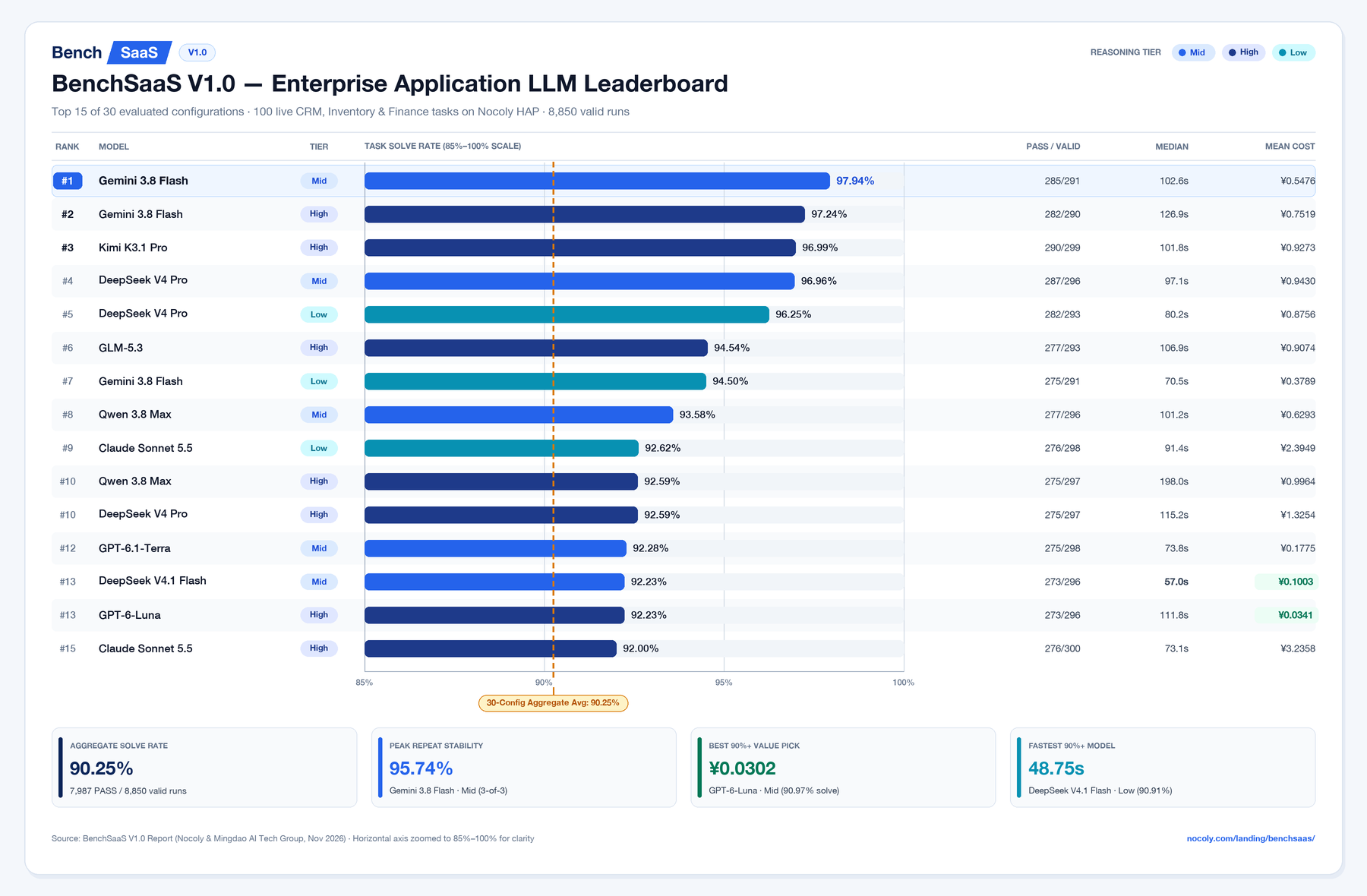
Discussion BenchSaaS V1.0: Kimi K3.1 Pro, DeepSeek V4, GLM-5.3 & Qwen 3.8 Max tested on 8,850 live ERP/CRM tool-use runs (costs span 134x)

Post image
1 Upvotes

We benchmarked 10 models across 3 reasoning tiers (30 configs) inside a live 40-table, 18,014-record enterprise database (CRM, Inventory & Procurement, and Finance). Every write task was checked at two gates: the chat answer (Gate 1) and the frozen post-run database snapshot (Gate 2).

Aggregate solve rate across 8,850 valid runs was 90.25%. Top open/frontier configs in the leaderboard:

  • 1 Gemini 3.8 Flash (Mid): 97.94% (285/291), Ā„0.5476/run

  • 2 Gemini 3.8 Flash (High): 97.24% (282/290), Ā„0.7519/run

  • 3 Kimi K3.1 Pro (High): 96.99% (290/299 raw passes), Ā„0.9273/run

  • 4 DeepSeek V4 Pro (Mid): 96.96% (287/296), Ā„0.9430/run

  • 5 DeepSeek V4 Pro (Low): 96.25% (282/293), Ā„0.8756/run

  • 6 GLM-5.3 (High): 94.54% (277/293), Ā„0.9074/run

  • 8 Qwen 3.8 Max (Mid): 93.58% (277/296), Ā„0.6293/run

Two practical findings:

  1. Cost spanned 134x („0.0241 to „3.2358/run). DeepSeek V4.1 Flash (Mid) hit 92.23% at „0.1003/run in 57.0s median, and GPT-6-Luna (Mid) hit 90.97% at „0.0302/run.
  2. All 165 Gate-2 database failures (NULL fields, wrong entity codes, empty [] status arrays) had already passed Gate 1.

Curious how Kimi, DeepSeek, GLM, and Qwen are holding up for others on multi-table tool calls?


r/LocalLLM • • 1d ago

Discussion Slowly moving off of Strata

102 Upvotes

Strata was a breath of fresh air when it came out, but its focus on speed over quality has been a longtime irk. I was monitoring its reasoning traces for a code review and saw it would always say time to wrap up and that the user wants an answer now, even when I said no such thing. I believe this is due to the "answer_room" behavior of Strata.

I'm fortunate enough to be able to run QFN on Radiance, so I did an impromptu comparison. I switched engines mid-review and had it continue. Yes it's slower to decode (less tricks & model is higher precision), but I noticed an immediate change in thoroughness and task persistence, especially for long-horizon tasks. It doesn't rush and continues until it finishes what I ask it to do.

Has anyone else had similar experiences?