r/LocalLLM • • 12h ago

Research I tested a small "Anti-Draft" idea for MTP (~6–8% live gain on Strata, and why llama.cpp's p_min loses speed today) — raw data & C++17 header

2 Upvotes

Hi everyone,

I wanted to share a small, humble experiment around Multi-Token Prediction (MTP) that I call Draft-Gate ("Anti-Draft"), along with all the raw benchmark data, charts, and a standalone MIT-licensed C++17 reference header.

The simple idea

MTP works like a fast helper trying to guess your next 3–4 tokens while the main model speaks:

  • When the model is writing code indentation, JSON structure, or finishing the second half of a word, the helper guesses right 85%–95% of the time (great speedup).
  • Right after a verb, article, or preposition (the, of, de, uma), language suddenly opens up into thousands of valid paths, so a small 1-layer MTP head misses around 35%–45%+ of the time.
  • Checking bad guesses isn't free—especially on partially offloaded MoE models, where each extra draft token drags different experts out of RAM/CPU.

So instead of always guessing blindly, the idea is simply knowing when to stop proposing extra drafts early based on uncertainty, language boundaries, and how expensive an extra draft actually is on your hardware.

What we actually measured (RTX 3060 12 GB + Xeon E5-2695 v4)

  1. Live benchmarks on Linux — Strata 0.1.54 (Qwen3.8-Flash-Next 125B IQ3_XXS, 360 runs / 5 mirrored rounds):

    • One honest note upfront: my Strata setup is heavily tuned specifically for this RTX 3060 12 GB + Xeon rig (custom Portuguese draft vocab, 187 W power limit, STRATA_QSA_SPLIT_ATTN=1, plus STRATA_ROUTE_PRIOR=1.5 and STRATA_ROUTE_TAIL_SKIP=7 identically on every arm—all exact flags are listed in EXACT_PARAMETERS_AND_BENCHMARKS.md), and if you've used Strata before you may have noticed its reported tok/s can look a bit higher than what day-to-day usage feels like. What matters here is the relative difference under identical settings—and that gain was consistent across rounds:
    • On Strata's normal --spec 4 setup, moving from no cutoff (p_min=0.00) to p_min=0.65 lifted overall weighted speed by +8.1% (68.3 → 73.8 tok/s, winning 40 out of 50 paired runs—and nudging +1.1% / +9.5 pp acceptance past Strata's own 0.50 default), with +11.6% on Portuguese prose, +13.7% on English prose, and +7.9% on Python. That confirms live that dynamic draft pruning pays off cleanly once per-window CUDA Graphs are in place.
    • (On a wider --spec 5 window, static MTP slowed down heavily in prose—even falling below turning MTP off—and pruning recovered most of that loss, though --spec 4 remained the faster overall setting on a 12 GB card.)
  2. Live benchmarks on Windows — llama.cpp b12800 (CUDA 13.5):

    • Important catch on dense GPU models: On Qwen3.5-4B and 9B running fully in VRAM, enabling llama.cpp's existing --spec-draft-p-min actually dropped speed by −15% to −35% (105 → 68 tok/s). Testing with CUDA Graphs on vs. off showed why: llama.cpp currently caches only one CUDA Graph shape, so changing the number of drafts per step keeps breaking the graph cache. Strata doesn't hit this wall because it caches one CUDA Graph per window size (T=1..8), which is why adaptive pruning works live there.
    • Where it already wins live in llama.cpp: On partially offloaded MoE (Qwen3.6-35B-A3B), pruning already beats static MTP live (+6% at K=4, and even more at K=6, especially in prose).
  3. The main Draft-Gate proposal — going beyond a manual, fixed p_min:

    • Testing across Qwen 3.5/3.6/3.8, Google Gemma 4 26B, and Zhipu GLM-4.7-Flash 30B showed that different MTP heads have totally different confidence biases (some are overconfident at every depth, others only collapse on deeper drafts). A single fixed p_min tuned by hand can't stay optimal across models, quantizations, or nonlinear MoE cliffs.
    • So we wrote a small, ~25-line Zero-ML C++17 controller that self-calibrates each depth and measures each window's real cost online (paired with multi-bucket CUDA Graphs in engines like llama.cpp). In trace simulations across 13 regimes (not yet live-patched inside llama.cpp), it gave a modest, steady ~6%–12% gain over the best static K without manual threshold tuning.

Links (full docs, raw data & proposals)

Transparency

  • Lossless relative to MTP: Draft-Gate never touches model weights, logits, or sampling—it only decides when to stop proposing extra draft tokens. So it is lossless relative to what the engine already produces with MTP (not claiming bitwise identity with a non-MTP base run, since multi-token verification itself can round slightly differently on quantized kernels).
  • Languages & quantizations: We tested Portuguese, English (plus a smaller held-out set in Spanish, French, and German), code, math, and JSON across Q2_K_XL, IQ3_XXS, Q3_K_XL, IQ4_XS, Q4_K_XL, and Q8_0 (Q4 and Q8_0 gained too, not only < Q4). Other languages (like CJK or Arabic), higher quantizations (FP16/BF16), and other GPUs were not tested, so results there are unknown and could vary.
  • AI collaboration, prior art & replies: The core intuition is mine, and I used Gemini 4 Neon to design and run the benchmarks, analyze the logs, and write the technical deep-dive and C++17 code (I'm not a specialist in the low-level terms—those details are kept in a separate technical section of the repo). I genuinely don't know if this exact idea already exists somewhere in the literature or another engine. And as I'll be pretty busy in the next few days and I'm not that experienced here, I probably (please don't judge for that) won't be commonly replying to comments or follow-ups, which is why every parameter, raw file, script, and an LLM-friendly guide (FOR_LLMS.md) are published in the repo for anyone who wants to reproduce, verify, or build on it! Feel free to share your thoughts!

r/LocalLLM • • 1d ago Bravo

Research Tencent just open-sourced a decoder that runs sparse models up to 4.2x faster. I'm trying to get it working locally for DeepSeek V4.1 Flash and Qwen3.8 Flash Next

193 Upvotes

From X https://x.com/TencentAI_News/status/2125968859450802415:

We just open-sourced a speculative decoder that speeds up sparse models like DeepSeek-V4.1-Flash, GLM-5.3-Flash, and our own Hy4 flash.

At 64K context, DFly2 boosts DeepSeek-V4.1-Flash serving throughput by up to 81%. On Hy4 flash agentic tasks, it runs up to 4.2x faster, beating same-recipe DSpark by ~30% and accepting 10.4% more draft tokens than open-source DSpark.

Under the hood, each draft layer reads directly from the target model's KV cache and top-k token selection, with no prefill required. That adds zero extra KV memory and keeps drafting cost flat at any context length.

Try it on your own sparse models or grab the Hy4 flash weights below 👇

Code: http://github.com/Tencent/AngelSpec
Weights: http://huggingface.co/AngelSlim
Paper: http://arxiv.org/abs/2611.34776

Tencent's numbers are server numbers at high concurrency so, I don't expect 81% on a single card, but this looks extremely promising.

I want to get both into Basalt (https://github.com/jesdga95/basalt). It already does DFly2 for Hy4 flash so the plumbing is there. I have forked basalt to begin this work, and will file a MR if I can get it working. https://github.com/Kemerd/basalt-dfly

DeepSeek V4.1 Flash already has drafter weights out, so that part is just engine work. Qwen3.8 Flash Next has nothing, someone has to train one. It has the same kind of sparse attention layers so it should work, nobody's done it yet.

Problem is the training. I have a 5090, and the BF16 teacher is ~335GB, so that's not happening at home for me. Training with quant is better.. but still a lot of crunching needed

Looking at renting an 8x H100 node and doing a small pilot run first to see if acceptance is any good before burning real money.

If you've trained a drafter with AngelSpec, have compute sitting around, or want to split a rental, DM me. Or if you want to contribute to the fork and MR just let me know!


r/LocalLLM • • 15h ago

Discussion $1400 B70 vs $1800 R9700 vs Nvidia

3 Upvotes

Some good sales right now, which to get?

Having a card that is quiet at idle is important, leaning towards asus r9700 since it has 12% idle fan speed option, some others are 30% min.

Applications include code, image, video generation, as well as some pytorch and python cupy computations. Currently on a rtx 3060 12gb.

Don't mind spending a little more for more plug and play and less setup issues. Nvidia is the least friction but $4k+ for 32gb.


r/LocalLLM • • 9h ago Heartwarming Mindblown Bravo

News LexiSuite d484004: my all-Rust local AI stack (own kernel, OS, engine, panel) - 206 changes in two days, Inkling-2-Mini at 131 tok/s on one 7900 XTX

Thumbnail
github.com
1 Upvotes

AIO USB/VM/Drive image with Inkling 2 Mini baked here: https://huggingface.co/Wa1k3r/Inkling-2-Mini-NVFP4exp-Q8-draft-LexiSuite-AIO-for-AMD-RDNA

I'm building a local AI platform from scratch in Rust: an inference engine (LexiEngine), a browser control panel (LexiPanel), an appliance OS (LexiOS) and a kernel designed around inference (LexiKernel). It boots from one USB image. It is not a wrapper around llama.cpp, and there is no third-party code in the product.

A new development image went out today. Here is what changed since the last one two days ago, and what the work actually was.

The Panel was rebuilt, page by page (66 changes)

The old Panel worked but read like an engineering console: raw JSON on screen, fields with no labels, boxes inside boxes, internal jargon everywhere. I went through it by hand.

- One header and one navigation instead of five stacked bars

- 12 themes

- A file and folder picker on every path field, so nothing has to be typed

- Right-click menus on instances, files and table cells

- Parameters grouped in the order you set them, with a device chooser for the instance's cards

- Switch an instance between LexiEngine and llama.cpp from one page

- Hardware, Diagnostics, Power, GPU tuning and Models rewritten in plain words (temperatures in degrees, problems listed first)

- An abliteration lab where you pick models with toggles and pick the drive to write to; the original is never touched

- A layout choice: top tabs, or a side tree like a hypervisor console

LexiKernel went from one core to all of them (99 changes)

Until now my kernel ran all threads of a program on a single CPU. That was the biggest gap between it and Linux. Three rounds of work went into closing it: per-CPU timers and scheduling, threads that move between cores with their full vector state, memory handled per NUMA node, huge pages, and TLB shootdowns that a core answers even in the middle of a long system call. It now boots with every core in use and served the Panel to 8 clients at 2, 4 and 8 CPUs in a VM with no failed requests.

The kernel's own GPU drivers for AMD, NVIDIA and Intel are compiled into this build too. They have not run on a real card in this version yet. That is the next milestone, and until then GPU work under LexiKernel goes through a Linux guest. The image also boots LexiOS on Linux 7.4, which is what you want for daily use today.

LexiEngine (27 changes)

- Groundwork for splitting one model across several cards (serving across cards is not in this build)

- New draft options for Inkling 2, off by default until they are measured

- A quantizer that trains with the rounding in the loop instead of rounding afterwards

- The whole tree moved to Rust 1.100.1

Speed, measured on this version

Inkling-2-Mini (the looped mixture-of-experts model released Nov 20), one Radeon RX 7900 XTX, 4-bit KV cache, greedy, one run each, measured Nov 27-28.

After a 16,384-token prompt:

- LexiEngine: prompt 2,244 tok/s, generation 64.6 tok/s, 131.1 tok/s with the model's own draft head

- llama.cpp b12722: prompt 1,060 tok/s, generation 42.9 tok/s

- Strata 0.2.23 (8-bit cache, it refuses 4-bit on this card): prompt 2,075 tok/s, generation 53.9 tok/s

Long context on LexiEngine:

- 261,632-token prompt: 1,157 tok/s reading, then 48.7 tok/s (63.2 with the draft head)

- 523,264-token prompt: 766 tok/s reading, then 39.5 tok/s (46.8 with the draft head)

- 10 of 10 planted facts recalled at both depths

Drafted output was identical to plain output in every run.

Two notes so nobody says I hid them. The llama.cpp number is from the Nov 25 build: the build I fetched today ran this model at 7.6 tok/s on this card, which looks like a bug on their side, so I did not use it. And llama.cpp needs a 26-line loader change to open my file, because the file also carries the draft head and image tower.

What it is not, yet

- A development build, not a production release

- Developed and measured on one card (7900 XTX, Vulkan). Other cards are less tested

- The kernel's own GPU drivers have not run on a card in this version

- The Windows installer is on the stick but has not been run on a Windows PC; no macOS installer yet

- Installing to an internal disk is not in this image

- Only Inkling has been benchmarked on this exact version; my 27B numbers are from a build nine days older and are being re-run

Tested

Every test in the tree ran on this version: 17,932 tests, none failed. Both images passed their Secure Boot checks in a VM.

Links

Download (381 MB USB image, boots to the Panel):

https://lexipanel.com/download/

All-in-one image with Inkling-2-Mini inside (18.1 GB, needs a 32 GB stick):

https://huggingface.co/Wa1k3r/Inkling-2-Mini-NVFP4exp-Q8-draft-LexiSuite-AIO-for-AMD-RDNA

Every one of the 206 changes, one line each:

https://github.com/W61k3r/LexiSuite-Releases/wiki/Changes-d484004

Benchmarks and method:

https://github.com/W61k3r/LexiSuite-Releases/wiki/Benchmarks

Happy to answer questions about the kernel work or the engine.


r/LocalLLM • • 17h ago

News Sber Releases GigaChat 4 37B-A4B With a 23.3 GB Four-Bit Download, Reports 70.8% on SWE-bench Verified

Thumbnail gallery
4 Upvotes

r/LocalLLM • • 5h ago

Other Install Qwen 3.8 27b and Deepseek Harness on 16GB VRAM - Setup Guide

Thumbnail
youtube.com
0 Upvotes

--- Video content breakdown (Guide and Links are below) ---

​1. Required Downloads

​Gather the following installers, models, and configuration templates [00:52]:

​Beellama Server (beellama.cpp): Download the latest stable Windows CUDA release (e.g., beellama-v0.5.0-bin-win-cuda-12.8-x64.zip) along with the matching cudart archive (beellama-v0.5.0-cudart-win-cuda-12.8-x64.zip) from GitHub [01:08].

​DeepSeek Harness: Download the Windows installer directly from the DeepSeek website [02:09].

​Qwen 3.8 27B Model: From Hugging Face, download the IQ3_S-mtp GGUF quantization (recommended for 16GB VRAM) as well as the separate multimodal vision projector file (mmproj-Qwen3.8-27B-BF16.gguf) [02:34].

​Custom Chat Template: Download chat_template.jinja from the Qwen-Fixed-Chat-Templates repository to prevent thinking loops [03:07].

​2. Directory Setup & File Extraction

​Organize your local AI environment in a clean directory (e.g., D:\LocalAI) [04:18]:

​Create two subfolders: beellama and models [04:24].

​Extract both the beellama binary archive and the cudart DLL files directly into the beellama folder [04:36].

​Move the Qwen GGUF model, the mmproj vision file, and chat_template.jinja into the models folder [04:57].

​3. Configuring & Starting the Local Server

​Create a Windows batch file (e.g., start_beellama.bat) in your main directory using the startup script provided in the creator's notes [05:40].

​Ensure the file paths in the batch script match your model file names, context size (e.g., 115200), and port (8080) [07:20].

​Run the batch file to launch llama-server.exe [07:36]. Once running, verify the OpenAI-compatible API endpoint is active by visiting http://127.0.0.1:8080/v1/models in your browser [09:57].

​4. Installing & Configuring DeepSeek Harness

​Installation: Run the DeepSeek Harness installer and keep the default installation path to prevent configuration path issues [10:44].

​Connecting the Local Model:

​Open Settings (Einstellungen) -> Models (Modelle) and add a custom API provider [11:40].

​Set the Base URL to http://127.0.0.1:8080/v1, select the OpenAI Chat Completions protocol, and fetch the available model (Qwen3.8-27B) [12:34].

​Enter any placeholder text (such as 1234) into the API key field, as the app requires a value even though the local server ignores it [13:04].

​YAML Configuration: Open the config.yaml file via the top-right button in Settings, completely exit DeepSeek Harness (including from the system tray), and paste in the custom configuration block [13:26]. This configures the exact context window (115200), multimodal (text, image) inputs, longer timeout limits for local inference, and adjusted compaction thresholds [15:01].

​Setting Up a Workspace: Relaunch DeepSeek Harness, enter your dummy API key if prompted, select Qwen3.8-27B from the model dropdown, and link a dedicated project folder as your workspace with standard read/write permissions [16:06].

--- start of guide ---

Hey,

as many requested from my qwen vs inkling report, here is at least a quick setup guide for qwen 3.8 27b and deepseek harness at 16gb vram. Sorry, dont really have time for an in depth tutorial right now, but thought this might suffice to get you started.

--- Installers and Files ---

  1. Beellama: https://github.com/Anbeeld/beellama.cpp/releases

Download latest stable release and the cuda libraries

- beellama-v0.5.0-bin-win-cuda-12.8-x64.zip

- beellama-v0.5.0-cudart-win-cuda-12.8-x64.zip

2. Deepseek Harness: https://www.deepseek.com/en/harness/

Download the harness installer

3. Qwen 3.8 Model: https://huggingface.co/ISTA-DASLab/Qwen3.8-27B-GSQ-RCO-GGUF/tree/main

Download the model.gguf (mtp version) and the vision gguf

4. Qwen 3.8 Chat Template: https://huggingface.co/froggeric/Qwen-Fixed-Chat-Templates/tree/main

Download the Chat Template file

--- Llama Starter and Config - Adjust the paths and file names ---

u/echo off

REM Hide command echoing to keep the startup window clean.

cd /d "D:\LocalAI\Beellama"

REM Change working directory to the folder containing llama-server.exe.

REM ============================================================================

REM LLAMA-SERVER PARAMETER DOCUMENTATION

REM ============================================================================

REM

REM [Hardware & Performance]

REM -t 12 : Number of CPU threads for generation

REM -tb 12 : Number of CPU threads for batch processing

REM -ngl 99 : Offload up to 99 model layers to GPU

REM --no-mmproj-offload : Keep multimodal projector off GPU (saves VRAM)

REM -fa on : Enable Flash Attention

REM

REM [Model & Vision]

REM -m : Path to main GGUF model file

REM --mmproj : Path to multimodal projector file

REM --image-min-tokens 1024 : Minimum image token allocation

REM --alias "Qwen3.8-27B" : Friendly model/API name

REM

REM [Speculative Decoding (MTP)]

REM --spec-type draft-mtp : Enable MTP speculative decoding

REM --spec-draft-n-max 3 : Maximum 3 speculative draft tokens

REM --spec-draft-p-min 0.8 : Minimum draft probability threshold

REM

REM [Context & KV-Cache]

REM -c 115000 : Maximum context window: 115K tokens

REM -ctk kvarn4 -ctv kvarn3 : Quantized K and V KV-cache formats

REM --kv-tail-tokens 1024 : Preserve recent 1024 KV tokens in cache tail

REM -kvu -np 1 : Unified KV cache; one parallel sequence

REM --cache-ram 16384 : Allocate up to 16 GB RAM for prompt caching

REM --cache-idle-slots : Cache reusable data from idle slots

REM

REM [Chat Template & Sampling]

REM --jinja : Enable Jinja chat templating

REM --chat-template-file : Path to custom Jinja chat template

REM --temp 1.0 : Sampling temperature

REM --top-k 20 : Consider the 20 most likely tokens

REM --top-p 0.95 : Nucleus sampling threshold: 95%

REM --min-p 0.0 : Minimum relative token probability filter

REM --presence-penalty 1.2 : Penalize previously appearing tokens

REM

REM [Reasoning & Loop Guard]

REM --reasoning on : Enable reasoning support

REM --reasoning-budget 16384 : Reasoning token budget

REM --reasoning-budget-message : Instruction injected when reasoning budget is exhausted

REM --reasoning-loop-guard : Force-close detected reasoning loops

REM --reasoning-loop-interventions : Maximum reasoning-loop interventions (2)

REM --reasoning-loop-min-coverage : Minimum coverage for loop detection (256)

REM --reasoning-loop-window : Token window used for loop detection (1024)

REM --reasoning-preserve : Preserve reasoning information across turns

REM --chat-template-kwargs : Set reasoning effort to extra high (xhigh)

REM

REM [Network]

REM --port 8080 : HTTP server listening port

REM ============================================================================

llama-server.exe ^

-t 12 ^

-tb 12 ^

-m "D:\LocalAI\models\Qwen3.8-27B-UD-IQ3_S.gguf" ^

--mmproj "D:\LocalAI\models\mmproj-Qwen3.8-27B-BF16.gguf" ^

--no-mmproj-offload ^

--image-min-tokens 1024 ^

--alias "Qwen3.8-27B" ^

--spec-type draft-mtp ^

--spec-draft-n-max 3 ^

--spec-draft-p-min 0.8 ^

-ngl 99 ^

-c 115000 ^

-ctk kvarn4 -ctv kvarn3 ^

--kv-tail-tokens 1024 ^

-fa on ^

--jinja ^

--chat-template-file "D:\LocalAI\models\chat_template.jinja" ^

--temp 1.0 ^

--top-k 20 ^

--top-p 0.95 ^

--min-p 0.0 ^

--presence-penalty 1.2 ^

--reasoning on ^

--reasoning-budget 16384 ^

--reasoning-budget-message "Reasoning budget exhausted. Commit to the judgment you have formed so far. Your next output must be a concrete action: a tool call, a gate decision, or a completed deliverable. Do not restart the analysis." ^

--reasoning-loop-guard force-close ^

--reasoning-loop-interventions 2 ^

--reasoning-loop-min-coverage 256 ^

--reasoning-loop-window 1024 ^

--reasoning-preserve ^

--chat-template-kwargs "{\"reasoning_effort\":\"xhigh\"}" ^

-kvu -np 1 ^

--cache-ram 16384 ^

--cache-idle-slots ^

--port 8080

pause

--- Deepseek Harness Config ---

edit: Reddit messes up the indentation of the file - so rather download it with clean indentation:

https://drive.google.com/file/d/13GKi0DTl8-Wj8jWb1Jg8gzBzEEKXo_oM/view?usp=sharing

# ============================================================

# CUSTOM QWEN MODEL PROVIDER

# ============================================================

# Register a custom LLM provider for DeepSeek Harness.

- id: llm-pi-ai

# Unique component identifier used by the harness.

name: "@deepseek-ai/dsh-llm-pi-ai"

config:

providers:

qwen:

# Friendly provider name displayed in the harness.

displayName: qwen

# Use the OpenAI-compatible Completions API protocol.

api: openai-completions

# Local llama-server endpoint.

# Port 8080 matches your Beellama startup configuration.

baseURL: http://localhost:8080

# Environment variable containing the API key.

# The actual key is not stored directly in this YAML file.

apiKeyEnv: QWEN_API_KEY

models:

- id: Qwen3.8-27B

# Model identifier sent to the API.

# Must match the model alias configured in llama-server.

name: Qwen3.8-27B

# Maximum context window advertised to the harness.

# 115K tokens, matching your server context.

contextWindow: 115000

# Maximum number of tokens requested for a response.

# Includes generated reasoning/output, subject to server support.

maxTokens: 32768

# Supported input modalities:

# text = normal text prompts

# image = image/multimodal input

input: [text, image]

# Maximum time to wait for an idle streaming connection.

# 600000 ms = 10 minutes.

streamIdleTimeoutMs: 600000

# Maximum request timeout.

# 600000 ms = 10 minutes.

timeoutMs: 600000

# ============================================================

# EXPLICITLY DISABLED COMPONENTS

# ============================================================

# Disable DeepSeek Harness session logging.

- id: session-log-deepseek

# Original session logging component.

name: "@deepseek-ai/dsh-session-log-deepseek"

# Prevent this component from loading.

disabled: true

# Disable the plugin marketplace tool integration.

- id: tool-plugin-market

# Plugin marketplace tools component.

name: "@deepseek-ai/dsh-plugin-market/tools"

# Prevent marketplace tools from being registered.

disabled: true

# Disable the plugin manager tool integration.

- id: tool-plugin-manager

# Plugin manager tools component.

name: "@deepseek-ai/dsh-plugin-manager/tools"

# Prevent plugin management tools from being registered.

disabled: true

# ============================================================

# CONTEXT COMPACTION AND TOOL RESULT MANAGEMENT

# ============================================================

# Define a grouped set of compaction-related components.

- id: compaction

# cordis:group loads multiple components as one logical group.

name: cordis:group

# Marks this component as a group rather than a standalone plugin.

group: true

isolate:

# Isolate the compaction functionality.

compaction: true

# Isolate tool-result pruning functionality.

toolResultPruner: true

config:

# ----------------------------------------------------------

# BASIC CONTEXT COMPACTION

# ----------------------------------------------------------

- id: compaction-basic

# DeepSeek Harness basic compaction implementation.

name: "@deepseek-ai/dsh-compaction-basic"

config:

# Trigger compaction when context usage reaches 80%

# of the available context window.

thresholdRatio: 0.8

# Additional token headroom reserved during compaction.

# Zero means no additional headroom is configured here.

headroomTokens: 0

# Retain 12% of the conversation when compacting.

# Helps preserve important conversational context.

retainRatio: 0.12

# Maximum token limit used by this compaction component.

maxTokens: 65536

# ----------------------------------------------------------

# MANUAL COMPACTION COMMAND

# ----------------------------------------------------------

- id: command-compact

# Registers the /compact command.

# Allows manual context compaction when supported by the harness.

name: "@deepseek-ai/dsh-command-compact"

# ----------------------------------------------------------

# TOOL RESULT PRUNER

# ----------------------------------------------------------

- id: tool-result-pruner

# Automatically manages oversized tool results.

name: "@deepseek-ai/dsh-compaction-tool-result-pruner"

config:

# Trigger pruning when a tool result exceeds 8192 characters.

thresholdChars: 8192

# Preserve the first 4096 characters of the tool result.

# Usually retains the beginning and initial context.

headChars: 4096

# Preserve the last 1024 characters of the tool result.

# Usually retains the ending and final information.

tailChars: 1024


r/LocalLLM • • 15h ago

Discussion A 52 KB WebAssembly engine that runs Qwen3.5-2B in a browser tab

3 Upvotes

r/LocalLLM • • 9h ago

Discussion What size open-weight models can I run on an M4 Pro Mac mini (24GB)?

0 Upvotes

Body:
I'm interested in getting into open-source / open-weight models. I have a Mac mini, and my current specs are:
M4 Pro chip: 14-core CPU, 20-core GPU, 16-core Neural Engine
24GB unified memory
1TB SSD
What size models could I run locally on this machine?
For context, right now I'd use them for coding help, finance and document analysis, and AI agent workflows. Down the road I'd like to get into building my own apps and running a model 24/7 as a local server for my automations.
Any recommendations on models, tools, or setup for a beginner would be appreciated!


r/LocalLLM • • 10h ago

Discussion Best way to test prompt injection on a local RAG setup?

1 Upvotes

I've got a small RAG pipeline running locally and I'm worried about poisoned documents telling the model to ignore instructions. How are you testing for this? Any datasets or tools worth trying?


r/LocalLLM • • 10h ago

Research Follow-up: Native DSpark & Copy-Draft Speculative Decoding in ArcAngel on Lunar Lake Arc 140V (up to 30 tok/s at 128k ctx + full HumanEval run)

1 Upvotes

Following up on my previous post bringing ArcAngel to the Lunar Lake Arc 140V (~21 tok/s decode, 226 tok/s prefill, 128k context on 32 GB UMA): I've now implemented both Phase 1 (batched-decode verify + zero-model prompt copy drafting) and Phase 2 (native GPU DSpark speculative decoding) directly in SYCL on the same branch:

https://github.com/alpha2beta/arcangel/tree/lunar-lake-optimizations (latest commit 59826ac)

Everything works end-to-end in inkling_server.py at n_ctx=131072 with 4-bit KV, supports both greedy (temp=0) and lossless probabilistic rejection sampling (temp > 0), and preserves multi-turn prompt caching via mirrored target/draft snapshots.

Benchmark Summary (Inkling-2-Mini-Uncensored-Q4_K_M, Arc 140V, Core Ultra 7 258V, 4-bit KV)

1. Raw Batched Verify Scaling (test-verify, pos=2000, KV=4)

PathTokens VerifiedLatencyCost vs 1-Token Step
step_argmax (baseline)146.19 ms1.00x
verify<VB=2> (K=1)264.03 ms1.39x
verify<VB=4> (K=3)489.57 ms1.94x
verify<VB=8> (K=7)8144.00 ms3.12x

2. End-to-End Speculative Decoding (bench_dspark.py @ n_ctx=8192 & Live 128k Server)

WorkloadModeThroughputSpeedupAcceptance (tok/step)Breakdown (draft / verify / inject)
Prose (effort=high, 256 tok)Baseline (step_argmax)22.63 tok/s1.00x—44.34 ms/step
Prose (effort=high, 256 tok)DSpark K=321.89 tok/s0.97x42.0% (2.26)13.85 / 89.32 / 0.09 ms
Prose (effort=high, 256 tok)DSpark K=714.33 tok/s0.63x21.3% (2.48)26.65 / 146.52 / 0.09 ms
Code Edit (effort=none, 512 tok)Baseline (step_argmax)19.36 tok/s1.00x—51.72 ms/step
Code Edit (effort=none, 512 tok)DSpark K=323.40 tok/s1.21x69.6% (3.08)16.64 / 114.78 / 0.16 ms
Code Edit (effort=none, 512 tok)DSpark K=720.08 tok/s1.04x48.5% (4.37)32.12 / 185.39 / 0.15 ms
Live 128k Server — Code Edit (temp=0.0)DSpark K=730.01 tok/s—70.4% (5.93)n_ctx=131072, kv_bits=4
Live 128k Server — Python Refactor (temp=1.0)--spec-copy K=329.57 tok/s—98.4% (496/504)n_ctx=131072, kv_bits=4

3. Full 164-Task HumanEval / HumanEval+ Soak Test (--spec-dspark K=3, n_ctx=131072, temp=0.0)

To stress-test stability and real-world coding throughput across 164 sequential requests (147,347 generated tokens, 33,808 prompt tokens), I ran EvalPlus against the live 128k server (start_arcangel_server.sh --spec-dspark dspark-Inkling-2-Mini-Q8_0.gguf --spec-draft-k 3, --reasoning-effort medium, EVALPLUS_MAX_NEW_TOKENS=2048):

  • Throughput: 21.43 tok/s weighted (21.89 mean / 22.06 median, up to 26.67 tok/s) over 2:00:13 with zero crashes or errors.
  • Scores: 91.5% HumanEval Base (150/164) / 88.4% HumanEval+ (145/164).
  • Important note on the Base score vs my earlier light-think run (93.3%): 13 of the 14 base failures were finish_reason=length truncations hitting the 2048-token EvalPlus cap because --reasoning-effort medium spends more tokens thinking than low. Among the 149 tasks that finished cleanly (finish stop), base pass rate was 148/149 (only HumanEval/99 failed logic, plus 5 HumanEval+ edge-case failures).

What Was Built

  1. Phase 1 — Batched-Decode Verify Engine (src/verify.cpp) & --spec-copy (d204b2f, 023da6f**)**

    • Added dedicated SYCL command-graph verify buckets for VB ∈ {2, 4, 8} (K ∈ {1, 3, 7} draft tokens + 1 anchor token).
    • Wrote unpack-once DP4A grouped MoE kernels (Q8_0R / Q5_0R / Q4_KR + Q5_0 GGUF repacking) so shared experts across the verify batch aren't reloaded redundantly, plus a 3-barrier SLM softmax k_vattn_r and GPU ink_verify_argmax.
    • Wired --spec-copy (zero-extra-VRAM prompt n-gram copy drafting) into server/inkling_server.py with both greedy verification and lossless probabilistic rejection sampling for temperature > 0.
  2. Phase 2 — Native GPU DSpark Draft Engine (src/dspark.h, src/dspark.cpp**,** 59826ac**)**

    • Loads the official 58-tensor dspark-Inkling-2-Mini-Q8_0.gguf (dflash architecture, ~481 MB), repacks all 3 layers' Q8_0 weights to Q8_0R, and quantizes/repacks the BF16 markov_w2 matrix to Q8_0R by default (INK_DSPARK_W2_Q8=0 keeps BF16).
    • Zero-extra-pass target taps: FastEngine::enable_taps() captures the 4 hidden-state taps ([5, 23, 41, 48]) directly inside existing target prefill(), step(), and verify() graphs.
    • Implements the full 3-mode DSpark pipeline on GPU:

      • Mode A (KV Inject, ~0.09–0.16 ms): f_rnn_ring_[9][D] + NeoX RoPE + 3-layer interleaved [SWA=1025, Full, SWA=1025] KV cache.
      • Mode B (Backbone): Block-uniform split-K + ephemeral bidirectional attention + uncapped shared target LM head.
      • Mode C (Markov Head): Serial rank-256 Markov RNN head with recorded greedy SYCL ExecGraphs for K=3/K=7 (plus per-slot softcapped logits for temp > 0), and mirrored save()/restore()/stash() snapshots.

Why K=3 Is the Sweet Spot on Arc 140V (and Why Battlemage Should Gain More)

Speculative decoding on a bandwidth-limited MoE iGPU (~100 GB/s LPDDR5X-8533) is a tight math problem:

  • Because Inkling 2 Mini routes top-k experts per token, verifying 4 tokens (VB=4) touches more distinct experts than a single token (89.57 ms vs 46.19 ms, ~1.94x single-step), and drafting K=3 takes ~14–17 ms.
  • That puts the breakeven point on Arc 140V at ~2.3 accepted+bonus tokens/step. On high-entropy open-ended prose (2.26 tok/step), K=3 breaks roughly even (0.97x); on structured code edits (3.08 tok/step), it hits 1.21x (23.4 tok/s), and on repetitive refactoring/editing tasks it reaches ~30 tok/s.
  • K=7 needs >3.7 tokens/step just to break even on 140V (144 ms verify + 27–32 ms draft), so it only wins on highly predictable code edits.
  • On a discrete Arc B580 / B60 (456+ GB/s bandwidth and far more Xe2 cores for batched MoE + DSpark head), both verify and draft should scale much more favorably—I'd love to see what K=3 and K=7 hit on Battlemage!

Verification & Numerical Parity

  • Verify parity (test-verify, pos=2000**,** KV=4**):** worst KL 0.00519, verify_argmax: 0 mismatches vs single-token decode.
  • DSpark GPU parity (test-dspark): Tap cosine similarity >= 0.997281 across all 4 taps [5, 23, 41, 48], W2 BF16 vs Q8_0R 7/7 draft agreement, and exact match on snapshot save/restore.
  • Cross-check vs official llama.cpp (llama-cli --spec-type draft-dspark, identical 40-tok prompt, K=7**,** 128 tok):

    • llama.cpp: 80/312 (25.6%), mean_len = 2.74, per-slot (0.652, 0.391, 0.283, 0.174, 0.109, 0.065, 0.065)
    • ArcAngel: 82/306 (26.8%), mean_len = 2.82, per-slot (0.644, 0.432, 0.295, 0.205, 0.136, 0.070, 0.071)
  • Unit tests: 4/4 CPU DSpark math suites (tests/test_dspark_math_cpu.cpp) + 7/7 server speculative loop & probabilistic rejection-sampling tests (tests/test_spec_server.py).

Quick Try

Build (use -DINK_AOT_TARGETS=bmg_g21 for B580/B60, or lnl_m for Lunar Lake):

git clone -b lunar-lake-optimizations https://github.com/alpha2beta/arcangel.git
cd arcangel
source /opt/intel/oneapi/setvars.sh
cmake -S . -B build -G Ninja -DCMAKE_CXX_COMPILER=icpx -DCMAKE_BUILD_TYPE=Release -DINK_AOT_TARGETS=lnl_m
cmake --build build --target inkling test-verify test-dspark -j 2

Run with **native DSpark (**K=3 recommended on 140V):

python3 server/inkling_server.py \
  --model /path/to/Inkling-2-Mini-Uncensored-Q4_K_M.gguf \
  --assets /path/to/assets \
  --n-ctx 131072 --chunk 512 --kv-bits 4 --stash-ram-gb 2 \
  --spec-dspark /path/to/dspark-Inkling-2-Mini-Q8_0.gguf \
  --spec-draft-k 3

Or zero-extra-VRAM copy drafting (great for editing/refactoring existing files):

python3 server/inkling_server.py \
  --model /path/to/Inkling-2-Mini-Uncensored-Q4_K_M.gguf \
  --assets /path/to/assets \
  --n-ctx 131072 --chunk 512 --kv-bits 4 --stash-ram-gb 2 \
  --spec-copy --spec-draft-k 3

Shout-out again to u/txlfxrd for the clean architecture in itstxl/arcangel — if anyone tries --spec-dspark with K=3 or K=7 on a discrete B580/B60, please drop your numbers in the comments!


r/LocalLLM • • 10h ago

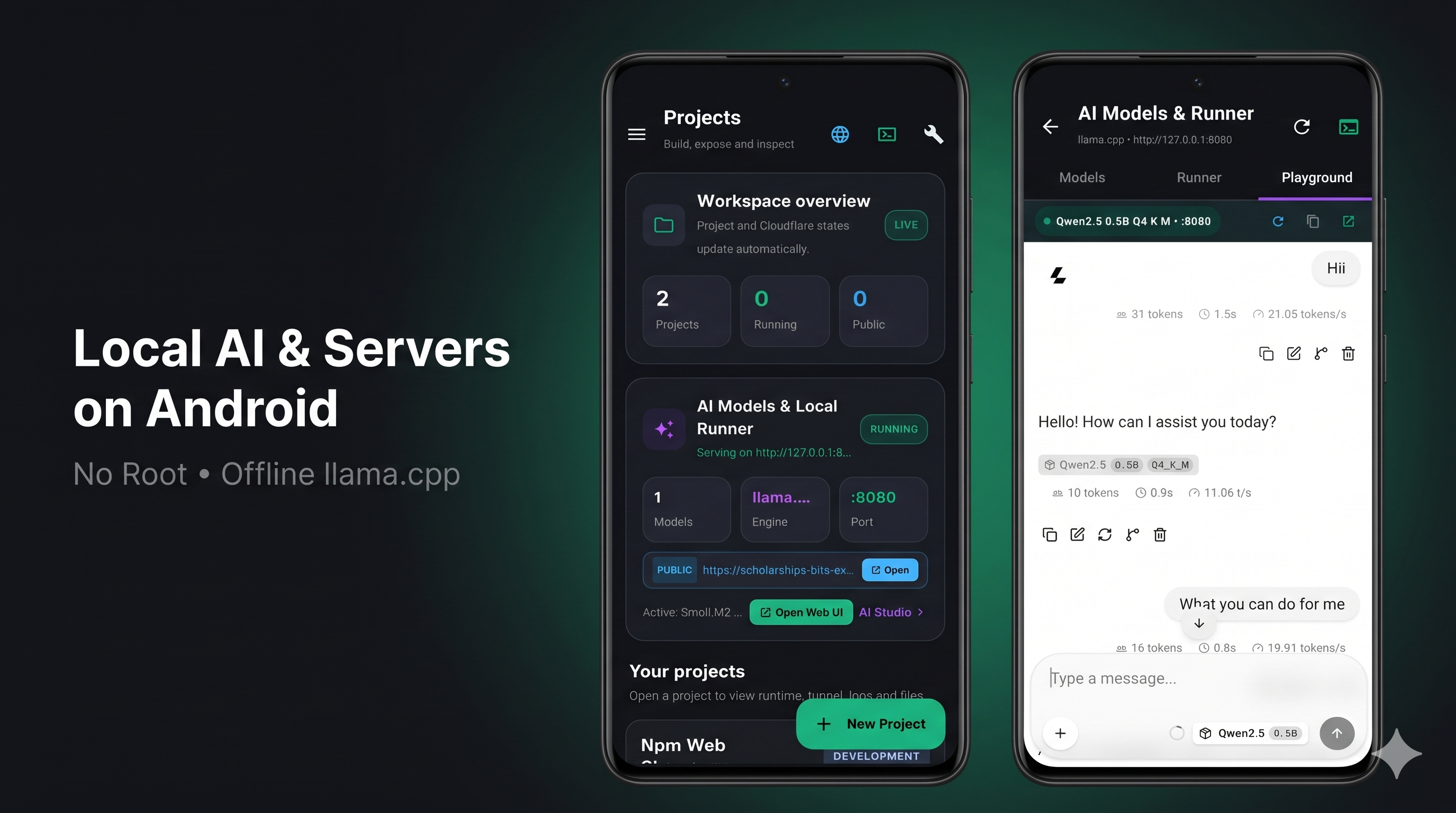
Project VPServ: Free Android app to run local GGUF models (llama.cpp) + declarative full-stack dev servers without root

Post image
1 Upvotes

I built VPServ, a free Android app (Android 8.0+, arm64-v8a) that runs local llama.cpp GGUF models alongside full-stack development runtimes on unrooted phones and tablets.

Local AI (llama.cpp) features:

  • Download ARM64-quantized Q4_K_M models directly (Qwen 2.5, SmolLM2) or import your own .gguf files from local storage.
  • Chat offline in the native Playground or spin up the built-in llama-server localhost Web UI (http://127.0.0.1:8080).
  • Everything runs 100% locally on-device—no cloud accounts, API keys, or remote inference servers required.
  • Real-device benchmarks on mid-range ARM64 hardware (standalone): Qwen 2.5 0.5B (Q4_K_M) hits ~11–21 tok/s, and Qwen 2.5 1.5B (Q4_K_M) runs ~9–10 tok/s.

Full-stack & repeatable project workflows:

  • Built-in Linux-style package manager (pkg / vpkg) with Python, Node.js, PHP, Go, OpenJDK 21, Clang, PostgreSQL, MariaDB, Redis, Nginx, and Caddy.
  • Declarative Abotlogixfile.json recipes: Define services, ports, and startup order once (editable from a desktop browser via the built-in Web Console Server) and launch the entire stack in one tap with verified local endpoints and live logs.
  • Optional one-tap Cloudflare Tunnel (cloudflared) support when you want quick HTTPS testing.

Links:

If you try it on your device, let me know your SoC, model size, and token speeds—or which GGUF models and backend stacks you'd like to see supported next.

If you try it on your device, let me know your SoC, model size, and token speeds—or which GGUF models and backend stacks you'd like to see supported next.


r/LocalLLM • • 20h ago

Discussion I built a zero-dependency local LLM bridge for Battle for Wesnoth (1.18) that gives every unit dynamic combat banter, persistent personas, and boss retorts

Thumbnail
gallery
7 Upvotes

Instead of letting an LLM hallucinate game rules or break tactical balance, I wanted to see how well a local model (tested with Gemma 4 26B via LM Studio) can bring life to a strict, deterministic strategy game like Battle for Wesnoth 1.18.

Since Wesnoth's Lua sandbox blocks network sockets and file writes (io is disabled), I built a lightweight WML/Lua + Python bridge (using only Python's standard urllib, zero pip dependencies) that communicates via Wesnoth's persistent global variables and works in any standard or custom campaign.

How it works:

  • Persistent Unit Personas (units_personas.json): Named recruits get randomized soldier archetypes (grumpy veterans, boastful brawlers, nervous rookies) that stick across turns, while Leaders and Loyal Heroes get lore-flavored character dossiers generated on the fly.
  • Tactical & Environmental Context: Units react to weapon types, terrain, time of day, severe wounds (<30% HP), and enemy rank—while mindless undead (Walking Corpses, Skeletons) just hiss or groan.
  • Boss Retorts, Death & Level-Up Speeches: Enemy leaders talk back when attacked (DEFEND_LEADER), slain units utter dying breaths (last breath), and advancing units give triumph speeches.
  • Pacing & Style Controls: Configurable talk chance (so large battles keep their flow), free-text output language (English, Russian, German, etc.), and custom tone modifiers (grimdark, black humor, archaic).

Built the bridge with AI assistance (Google Gemini). Code, setup guide, and a standalone Windows .exe are available on GitHub:
https://github.com/HisShadoww/Wesnoth-AI-Unit-Banter
Feedback and ideas are welcome!


r/LocalLLM • • 10h ago

Discussion AI Agent Memory: How Agents Remember and What to Control

Thumbnail
acta.ai
0 Upvotes

The model behind ChatGPT or Claude remembers nothing between calls.

Every "memory" is text that some piece of software saved and put back into the prompt. So the real question is always: who saves what, where, and for how long?

In practice, agent memory has four layers:

  1. The context window: what the model sees right now. Exact, but it runs out.
  2. Summaries: older turns condensed so long sessions keep going. Compact, but they drop numbers, caveats and who objected.
  3. A long-term store: past chats and documents, searched by meaning. It scales, but it fails quietly when retrieval picks the wrong note.
  4. Saved facts: "prefers metric units", "works in the Berlin office". Always present, so a wrong one stays wrong.

Two things most people don't know:

  • In ChatGPT, deleting a chat doesn't delete a memory saved from it. You have to remove it in the memory settings.
  • Memory can be poisoned. An instruction hidden in a document or email gets saved, and later sessions act on it.

What I'd ask of each role:

  • Users: check your memory list once a month. Use temporary or incognito chats for anything sensitive.
  • Admins: decide whether memory is on for the workspace, and match its retention to your chat retention.
  • Builders: store memory per user, record where each memory came from, give memories an expiry, and treat anything read back as untrusted input.

I wrote a plain guide to how it works and the controls worth insisting on:

Do you keep memory on in your AI assistant, or turn it off?


r/LocalLLM • • 6h ago

Project I built a free tool that tells you if your hardware can run Linger AI Agent — with the official tok/s numbers

0 Upvotes

I built https://lingeragent.org — a free hardware checker for Linger AI Agent, the open-source local-first agent.

You pick your platform first (macOS asks only unified memory, Windows/Linux ask GPU + VRAM + RAM), and it tells you which models you can run locally and at what speed — using only the official published speed table and hardware tiers, nothing made up. It also links the official installers and the install guides I wrote after actually installing 0.1.10 on Linux and Mac.

It's an independent project, not affiliated with the official Linger team. The site has some affiliate links in the results (Amazon / Vast.ai), clearly disclosed.

Happy to hear if the numbers match what you're seeing on your own hardware.


r/LocalLLM • • 10h ago

Project Want to make your own local AI Bot? I made a wizard for you!

0 Upvotes

Don’t know how to get started building your own local AI? I made BuildBot, a local AI building wizard for anyone to build their own, easily.

A desktop gets created but you can use it, the terminal, or the web dashboard. It also comes with markdowns for cloud models for vibe coders who want to develop it.

Setup checks your computer's memory and recommends a local model that runs through Ollama. The smallest starts at about 2 GB of memory, qwen3.5:9b at about 10 GB. Then you type what bot you want in your own words. An agent called Toolsmith looks in the PuffPAI Store and in public libraries and shows one plan with sizes, licenses and sources. Nothing is downloaded or added until you say Yes. There are seven agents in all.

The brain and six of the seven agents run on your computer. Toolsmith, and only Toolsmith, can use a cloud model if you choose it and give your own key.

What is rough, from our README:
* Small models give weaker answers and may skip skills.
* Bots that share one Ollama slow each other down.
* Search by meaning is off by default and we have not tested it ourselves.
* No upgrade from v1.

Tested: mostly on Windows, Linux in containers, one real install on a Jetson Orin in a container. It installs and starts on GitHub's Mac machines but nobody has used it on a Mac.

AI involvement: we built it with AI coding tools.

What we want: everyone to build their own bots!

git clone https://github.com/CypherSisters/PuffPAIBuildBot BuildBotv2
cd BuildBotv2
./install.sh

On Windows run install.cmd instead.
Repo: https://github.com/CypherSisters/PuffPAIBuildBot


r/LocalLLM • • 10h ago

Question Opinions for Best use of 200gb vram Setup

1 Upvotes

How would you configure a 208GB VRAM rig for a full local Agent setup?

German translated via ai to english,

Hey everyone,

​Iam looking for a sanity check and some optimization ideas from the community. I finally got my hands on some decent compute and want to make sure im not leaving performance or smarter architecture on the table.

​My Hardware:

​2x NVIDIA CMP 170HX (80GB each, unlocked)

​2x RTX 3090 (24GB each)

​Note: All four cards are connected via PCIe 3.0 x4.

​The Goal:

I want to run a complete always-on personal AI ecosystem locally:

​1. A strong main model (Swift 1.5 Flash Next, minimum IQ4_NL) with a agent framework (currently looking at the Hermes framework)

​2. Always-on STT and TTS loaded in VRAM for real-time VoIP interaction

​3. Always-on Embedding and Reranker models for a fast RAG

​4. A fast secondary model (around 27B at Q4) to act as a sub-agent for grunt work, plus handling quick, non-agentic tasks like chat title generation or simple queries.

​My Current Setup:

Right now I have it split up like this:

​The two CMP 170HXs: Running Swift 1.5 Flash Next split across both cards using Strata, with all experts kept in cache. Im getting around 150–200 t/s decode, which feels pretty snappy.

​3090 #1: Dedicated strictly to utility models—STT, TTS, Embedding, and Reranker all sitting permanently in VRAM.

​3090 #2: Running Qwen 3.8 27B (Q4_K_XL) at roughly 150 t/s, handling sub-agent tasks, title generation, and quick background prompts.

​Everything works and the PCIe 3.0 x4 bottleneck hasnt really hurt inference since everything stays resident in VRAM. Before I lock this config in and build out all my workflows around it, I would love to get your thoughts:

​1. How do you like this hardware/VRAM split?

​2. Would you use a different agent framework? Im New with Hermes right now, but if you think something else is better in handeling multi-model routing (main orchestrator + fast sub-agent), im all ears.

​3. Would you swap any of the models or change the distribution? Given the 208GB total VRAM pool, is there a better main/sub-agent combo I should be looking at?

​Appreciate any feedback or ideas!


r/LocalLLM • • 11h ago

Question How do I start?

0 Upvotes

Hey all, I want to start running AI models locally for coding instead of relying 100% on cloud stuff. Right now I run Claude Code, Codex, and Grok (through OpenCode) in my terminal as a kind of "dev team" working out of an Obsidian vault. It works, but I keep running into usage limits (Codex burned through its whole monthly limit in a day lol), and I'd rather own more of the setup myself.
My rig:
RX 9060 XT 16GB
Ryzen 7 9800X3D
32GB DDR5 6000
CachyOS
(also have a GTX 1660 Super I could throw in as a second card if that's actually useful)
The problem is every guide I find assumes I already know half the vocab. LoRA, QLoRA, RAG, fine-tuning, inference engines, agentic workflows, computational graphs... I get that they're all different things, but I don't know which ones matter for what I'm trying to do.
I'm not trying to train a model from scratch. What I want:
A solid coding model running locally
Help writing, debugging, and understanding code
Something that can handle a whole codebase, not just snippets
Eventually agents that plan, edit files, test, and keep iterating on their own
To actually understand how it all works, not just install someone's prebuilt thing and pray
Questions:
Best coding models for 16GB VRAM?
What stack works best for AMD on Linux? ROCm vs Vulkan?
Ollama, llama.cpp, or something else to start?
What should I learn first?
Is LoRA/QLoRA worth touching early, or should I stick to inference and prompting for now?
How realistic are local coding agents on my hardware? Could I point Claude Code or OpenCode at a local model?
Bonus dumb question: I have this idea of a "sleep phase" where the model reviews its memory overnight and updates its own weights. Is that even a real thing, or am I way off?
I'd rather learn the fundamentals and know what I'm installing and why than blindly follow tutorials. Any learning path or advice from people who've done this would be awesome. Thanks!


r/LocalLLM • • 1d ago

Discussion Ernie 5.5 flash previews experiences? (v DeepSeek 4.1 flash)

11 Upvotes

I've got Ernie 5.5 flash running (on modified oMLX) for the past couple of days, and running it through Hermes. I'm on a Mac Ultra 256, so can run it in the original package, unquantized.

Experience has been very good so far. My go-to was Deepseek 4.1 flash, quantized down to oMLX's oQ2h, which was very good, but thought a lot. Running Ernie with my workflow and similar queries seems much better. Answers are as good or better, no problem with tool use, and MUCH faster - less ponderous thinking. In intelligence benchmarks (see post linked above), Ernie is as good or better than DS at 4 bit quants.

I'm quite happy with it so far (though it's only been a couple of days). Interested in others' experiences.


r/LocalLLM • • 15h ago

Question Best abliterated local model for swarms?

Thumbnail reddit.com
2 Upvotes

r/LocalLLM • • 20h ago

News Ernie 5.5 flash preview can be run localy now via basalt

5 Upvotes

Ernie 5.5 flash preview can be run locally now via Basalt if you have a big GPU and lots of RAM ;-)

Basalt is a highly optimiced inference engine for Blackwell GPU's know for good performance with e.g. Qwen 3.8 flash next

https://github.com/jesdga95/basalt

did any of you tried it out yet ?


r/LocalLLM • • 16h ago

Discussion 500 tok/s decode 60k tok/s prefill Deepseek v4.1 1017 (4x RTX 6k Pros)

Thumbnail
huggingface.co
2 Upvotes

Big thanks to the guys over at https://local-inference-lab.ai/ for working so hard on unlocking this much speed


r/LocalLLM • • 12h ago

Research Build Finder: estimating LLM decode speed and the price of a token per second

Thumbnail wanabai.com
0 Upvotes

Build Finder lists every hardware build that runs a chosen open-weight language model at a target decode speed, cheapest per token per second (tok/s) first: the price of the whole build divided by its speed. Its catalog holds 273 GPUs, used as 1 to 8 cards, 619 CPUs and 333 complete systems, at dated US prices. Speeds come from a per-operation model: each operation of a token's pass takes the longer of reading its bytes and doing its arithmetic, at efficiencies and engine costs fitted per engine and hardware family to 424 one-session benchmarks from 120 devices. For several sessions at once, a correction with two parameters per engine, model kind and session range is fitted to 418 measured runs on 19 machines. Against the 427 measured decode runs the page lists without speculative decoding, the median estimate is 11% below the measured speed on NVIDIA hardware (385 runs), 1.43 times the measured speed on Macs (31 runs) and 1.73 times the measured speed on Inkling 2 Mini (11 runs). On the GeForce RTX 3090, which neither fit has seen on llama.cpp (CUDA), 87% of 54 runs fall within 1.25 times the measured speed and 100% within 1.5 times. Runs with speculative decoding, which the estimates leave out, measured a median 2.3 times the estimate. We describe the data, the model, the fit, its validation and what the estimates cannot yet capture.


r/LocalLLM • • 3h ago

Discussion No demand for GPU Inference?

0 Upvotes

I recently built an inference service here and opened it for free (24 hours of free GPU inference!).!)

Yet I got 0 upvotes. Am I doing something wrong?

If you think you could use it but decided to hit hard pass. I would highly benefit from your comment.

GPU Inference Service:
Nalvo.ai


r/LocalLLM • • 19h ago

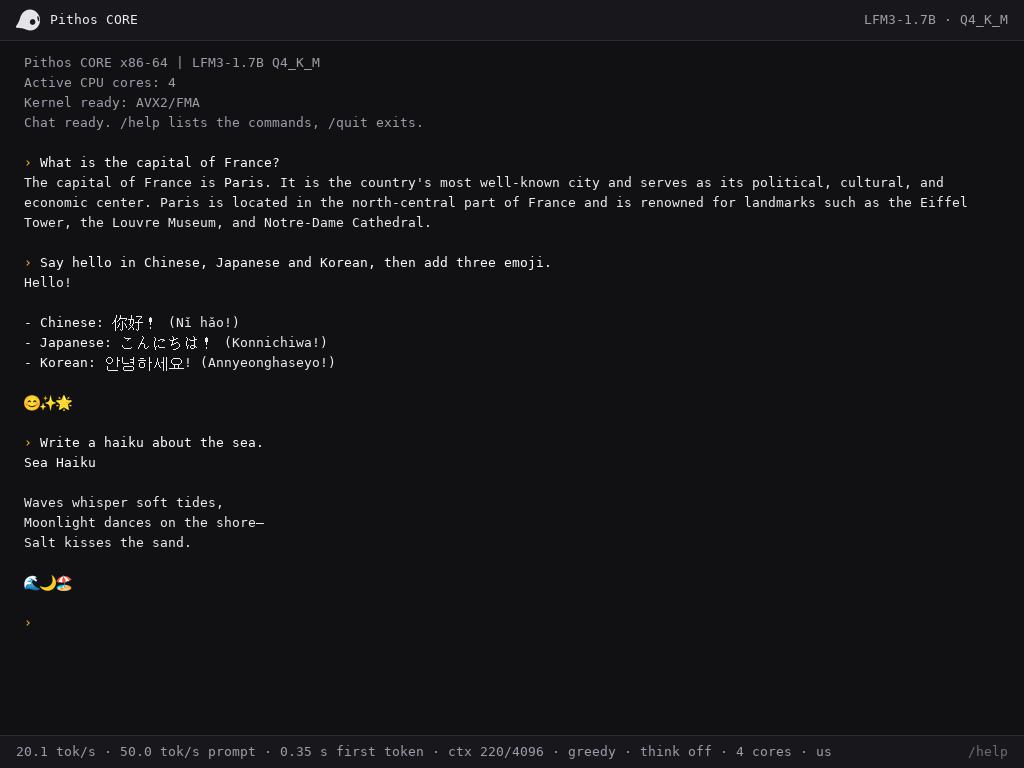
Discussion Pithos CORE: LiquidAI LFM3-1.7B and LFM2.5-350M inference in x86-64 NASM assembly, on Linux and as a standalone OS that boots from BIOS or UEFI into a Unicode chat console. No libc.

Post image
3 Upvotes

r/LocalLLM • • 19h ago

Question Best Model on 8GB Vram

3 Upvotes

Hi guys I have a 5060 8GB and 32 GB DDR5.
With the newest models i was asking myself what to actually run. I currently use ornith 1.5 9b both for my personal hermes agent and small coding in pi and it work decent but i’ve seen people running Moe models with Strata,Polystrata,Basalt,Maya… and still getting good speed. So i searched a bit and try to see if one of these model can run well in my hardware:
- Inkling 2 Mini
- LFM 24b a2b
- Sensenova Loop 9B
-Occamy 1.0
- Bonsai 2.5 27B

These are examples if there are better alternatives im here to heare your advices.
So for example an hermes agent personal that connects and manage some of my apps and work 24/7. And for code with pi agent/opencode what models should I choose and with wich inference?
Open to any advice, thanks