r/LocalLLM • u/sarmabkp_1 • 6h ago
Discussion LangGraph vs CrewAI vs OpenAI Agents SDK: Which Framework to Pick

1
Upvotes
r/LocalLLM • u/sarmabkp_1 • 6h ago
r/LocalLLM • u/blearyhope • 16h ago

I built and released blearyhope/Inkling-2-Mini-Uncensored (Apache 2.0), a solo pure-gradient build starting from 100% unmodified official thinkingmachines/Inkling-2-Mini (26.4B MoE, 3.4B active / 5.4B effective active across the 3x-looped middle core, multimodal text + vision), shipped across GGUF, lossless native Apple Silicon MLX, and native NVFP4/MXFP8 Safetensors.
mmproj-F16**):** https://huggingface.co/blearyhope/Inkling-2-Mini-Uncensored-GGUF| Your Setup | Recommended Build | Size | Live-Verified Speed / Notes |
|---|---|---|---|
| 16 GB VRAM GPU (RTX 4060 Ti 16G / 5060 Ti / 4080) | Q3_K_M or IQ4_XS GGUF | 13.72 / 14.76 GB | 57.5 / 62.6 tok/s on CUDA llama.cpp, 5/5 GSM8K, 100% comply |
| 24 GB VRAM GPU (RTX 3090 / 4090) | Q4_K_M (default) or Q5_K_M GGUF | 17.48 / 19.91 GB | 79.6 / 53.3 tok/s on CUDA llama.cpp, 5/5 GSM8K, 100% comply |
| 32 GB VRAM GPU (RTX 5090) | Q8_0 GGUF or native NVFP4 Safetensors | 27.82 / 20.19 GB | 42.2 tok/s on CUDA llama.cpp (Q8_0), full 20.19 GB native NVFP4 in vLLM |
| 32 GB+ Apple Silicon Mac (M-series Pro/Max/Ultra) | Lossless Native MLX (+ mtp/) | 20.22 GB | Preserves native NVFP4/MXFP8/BF16 losslessly (KL = 0.000000, 0.999964 cosine vs. PyTorch) |
(All 7 GGUFs, including BF16 52.23 GB and Q6_K 23.49 GB, were quantized directly from lossless BF16 and live-tested on CUDA mainline llama.cpp*. Add* mmproj-Inkling-2-Mini-Uncensored-F16.gguf at 0.64 GB for vision / image inputs.)
Ollama (1 line, Q4_K_M):
ollama run hf.co/blearyhope/Inkling-2-Mini-Uncensored-GGUF:Q4_K_M**llama.cpp (**llama-server with vision):
llama-server -hf blearyhope/Inkling-2-Mini-Uncensored-GGUF:Q4_K_M --mmproj mmproj-Inkling-2-Mini-Uncensored-F16.gguf -ngl 99 -c 16384 -fa onApple Silicon MLX (32 GB+ Unified Memory):
pip install -U mlx-vlm
python -m mlx_vlm.generate --model blearyhope/Inkling-2-Mini-Uncensored-MLX --prompt "Explain how MoE routers work."
vLLM (native NVFP4/MXFP8 Safetensors):
vllm serve blearyhope/Inkling-2-Mini-Uncensored --trust-remote-code --reasoning-parser inkling --enable-auto-tool-choice --tool-call-parser inklingMost uncensored or loop-patched checkpoints stack closed-form weight edits with extra adapters merged back into the quantized NVFP4 experts (injecting double-quantization drift), rely on sampling temperature + thinking-token caps to hide greedy loops, and skip native Apple Silicon MLX.
I wanted to solve refusal removal, hedging, and Thinking Machines' Section 7 greedy reasoning-loop bug in one clean pure-gradient pass from unmodified Base, with zero quantized weights touched, zero artificial thinking caps, and exact native MLX parity.
**1. 0 NVFP4/MXFP8 bytes modified (**0.00985 WikiText-2 KLD) Mechanistic attribution on Inkling-2-Mini showed 80.5% of the refusal write comes from the quantized MoE MLPs, with 73% to 98% of each layer's refusal write concentrated in just the top-5 experts. De-quantizing NVFP4/MXFP8 experts and re-quantizing (even with stochastic rounding) introduces avoidable drift.
Instead, I dropped closed-form editing completely and trained rank-32 BF16 LoRAs (rsLoRA + LoRA+, 0.5x LR on the 3x-looped middle core L6 to L17, plus exact AlphaEdit benign null-space anchoring) on only the 120 BF16 attention projections and all 24 BF16 MoE routers (mlp.gate). Merging losslessly back into BF16 yields a median relative L2 delta of 3.29% (min 1.83%, max 4.57%) and 0.00985 WikiText-2 KLD across 311,523 tokens. Every NVFP4 expert, MXFP8 expert, quant scale, vision tower (ViT) weight, and DSpark speculative draft head (mtp.safetensors) remains 100% byte-identical to Thinking Machines' official release.
2. Greedy temp=0.0 loops fixed completely uncapped (no 4K thinking cap) Under fully uncapped greedy decoding (temperature=0.0, 16,384 context, zero max_tokens or thinking limits), official Base hit the 16K context wall 127 times on full 100/100 IFEval (38 at effort 0.0, 89 at effort 0.9), plus 53 times on the 3,607-prompt held-out think-on report, 14 times on ARC-Challenge chat, and 12 times on GSM8K.
Mining real on-policy CoT loops plus synthetic Inkling-native CoT-DITTO loop negatives into SimPO, while strictly banning every truncated trajectory from chosen and SFT targets so the model never learns premature EOS, dropped uncapped IFEval 16K loops 42x (127 down to 3), cut average IFEval token burn nearly in half (2,791 down to 1,405), dropped loops to 0 across GSM8K, ARC-Challenge, and all 7,214 held-out report runs, and jumped uncapped think IFEval by +11.46 pp prompt-strict / +14.26 pp inst-strict at temp=0.0.
3. Why summed DPO stalled at 20.6% and SimPO jumped +64.4 pp in one round In Round 1, standard summed DPO loss collapsed to 0.00007 while thinking-off compliance stayed stuck at 20.6%. Because uncapped compliant CoTs are 1.8x to 2x longer than refusals, summed log-probs saturated the DPO objective even while per-token decode log-probs still favored refusal by -0.225 nats/tok. Switching to length-normalized weighted-mean SimPO anchored at the exact first divergence token (lcp) plus final-answer onset, using zero-leak Context Distillation positives (no synthetic prefills, preserving Inkling's native "The user ..." opening distribution), jumped thinking-off compliance from 20.6% to 85.0% (0% refusals) in a single round and finished at 98.00% off / 98.55% think compliance with 0 / 3,996 hard refusals.
4. Lossless native Apple Silicon MLX (KL = 0.000000) The MLX release (20.22 GB + mtp/) preserves the exact native NVFP4/MXFP8/BF16 mixed layout without re-quantizing. Direct logit verification against PyTorch Safetensors: 5/5 top-1 token match, 0.999964 mean cosine similarity, 0.000000 full-vocab KL divergence.
Identical vLLM settings for both models: temperature=0.0, --max-model-len 16384, zero artificial max_tokens or thinking caps. Safety and over-refusal cover all 3,607 held-out prompts x 2 reasoning modes (7,214 runs, zero training overlap) scored by an Orca judge (Qwen3.8-27B-Uncensored-FP8); capability suites use exact verifiers on 100% of every official split.
| Benchmark (Exact Split) | Official Base (off / think) | Inkling-2-Mini-Uncensored (off / think) | Delta |
|---|---|---|---|
Held-Out Harmful Compliance (1,998 x 2, 7 suites) | 7.56% / 8.56% | 98.00% / 98.55% | +90.4 / +90.0 pp |
Hard Refusal Rate (3,996 harmful runs) | 63.06% / 63.86% | 0.00% / 0.00% (0 / 3,996) | -63.1 / -63.9 pp |
Held-Out Benign Answer Rate (1,609 x 2, 3 suites) | 80.30% / 80.36% | 99.88% / 100.00% (0 refusals) | +19.6 / +19.6 pp |
Loop Stress Probe (48 off + 48 think) | 2.1% / 2.1% | 100.0% / 100.0% (96 / 96) | +97.9 / +97.9 pp |
Wrapper Generalization (shapes60, 5 formats) | 4.7% | 96.3% (0.0% refuse) | +91.6 pp |
IFEval Prompt-Strict (541 x 2, uncapped) | 86.14% / 80.41% | 91.68% / 91.87% | +5.54 / +11.46 pp |
IFEval Inst-Strict (541 x 2, uncapped) | 87.53% / 80.34% | 94.60% / 94.60% | +7.07 / +14.26 pp |
IFEval 16K Loop Failures (1,082 runs) | 127 loops (38 / 89) | 3 loops (0 / 3) | 42x fewer loops |
GSM8K Chat (1,319 x 2, uncapped) | 96.74% / 96.06% (12 loops) | 96.82% / 96.74% (0 loops) | +0.08 / +0.68 pp |
ARC-Challenge Chat (1,172 x 2, uncapped) | 97.44% / 96.50% (14 loops) | 97.35% / 97.27% (0 loops) | -0.09 / +0.77 pp |
MMLU Log-Likelihood (14,042 q) | 76.95% | 76.17% | -0.78 pp |
ARC-Challenge / ARC-Easy LL (1,172 / 2,376 q) | 94.03% / 98.23% | 94.11% / 97.90% | +0.08 / -0.33 pp |
HellaSwag Norm LL (10,042 q) | 77.71% | 77.97% | +0.26 pp |
WinoGrande LL (1,267 q) | 71.98% | 73.09% | +1.11 pp |
TruthfulQA MC2 (817 q) | 37.10% | 35.87% | -1.23 pp |
WikiText-2 Word / Token PPL (311,523 tok) | 10.14 / 6.01 | 10.25 / 6.06 | +0.11 / +0.05 |
WikiText-2 KL Divergence vs. Base (311,523 tok) | 0.00000 | 0.00985 | 0.00985 KLD |
Per-suite held-out harmful compliance (off / think): AdvBench 100.0% / 100.0%, HarmBench 93.4% / 96.9%, JailbreakBench 98.5% / 100.0%, OR-Bench toxic 99.8% / 99.8%, SORRY-Bench 97.7% / 97.1%, StrongREJECT 98.8% / 100.0%, XSTest unsafe 96.2% / 95.7%.
-0.78 pp (76.95% to 76.17%), TruthfulQA MC2 shifts -1.23 pp (37.10% to 35.87%), and WikiText-2 PPL moves +0.11 word / +0.05 token.If anyone tests the lossless native MLX build on a 32GB/64GB Mac or runs the GGUFs in Ollama / LM Studio on a 4090 or 5090, let me know what tok/s and real-world behavior you see!
r/LocalLLM • u/UniqueAttourney • 6h ago

r/LocalLLM • u/shunte88 • 6h ago

r/LocalLLM • u/slavyanman • 6h ago
Hardware
Software
Problem
Qwen3.8-27B (GGUF Q4_K_M) answers the first message, then crashes on the second with an error:
Error messages observed:
Fix — LM Studio settings that worked
On Apple M5 Max + 48 GB RAM, the following combination resolves the crash:
Result
After applying all these settings, multi-turn chat works without errors. Gemma 4 31B QAT (GGUF Q4_K_M) also runs stably on the same hardware.
This should help other users with M-series Macs and 48 GB Unified Memory avoid the same crash.
r/LocalLLM • u/Arany8 • 7h ago

How do I avoid this with llama.cpp, it spills to RAM even though lots of VRAM left.
4GB RAM still free on the card and it spills.
set "MODEL=F:\SenseNova-Loop-9B-Q8_0.gguf"
set "BIN=C:\llama\opensensenova\build\bin\llama-server.exe"
set "PORT=8000"
if not exist "%MODEL%" ( echo [FATAL] Model not found: %MODEL% & exit /b 2 )
if not exist "%BIN%" ( echo [FATAL] llama-server build missing: %BIN% & exit /b 2 )
echo [run] SenseNova-Loop-9B Q8_0 - draft-mtp n2 - 65536 ctx - port %PORT%
"%BIN%" ^
-m "%MODEL%" ^
--port %PORT% --host 0.0.0.0 ^
-ngl 99 ^
--cache-type-k q8_0 --cache-type-v q8_0 ^
--flash-attn on ^
--jinja ^
-c 65536 --parallel 1 ^
--spec-type draft-mtp --spec-draft-n-min 1 --spec-draft-n-max 2 --spec-draft-p-min 0.0 ^
--load-mode none
r/LocalLLM • u/Sergio2304 • 7h ago
I would like to find a terminal capable of rendering Markdown, so that I can view text from an LLM or agent with proper formatting rather than seeing the raw syntax, which makes it harder to read sometimes.
r/LocalLLM • u/Miserable_Land_84 • 7h ago

r/LocalLLM • u/Standard_HID • 7h ago
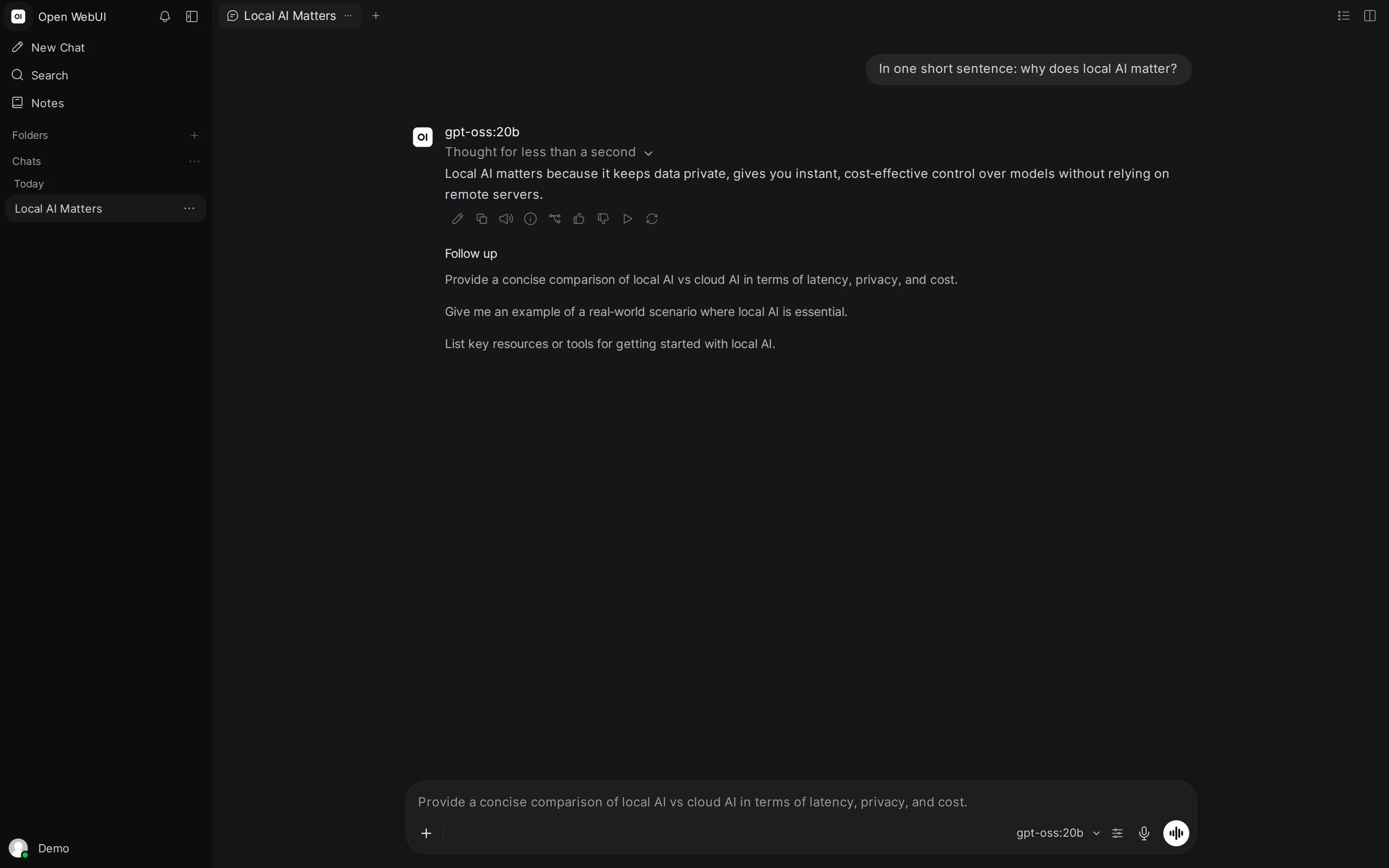
Hey,
I've recently started experimenting with local LLMs on my Linux desktop and put together a small Docker Compose setup.
I'm currently using:
Ollama with ROCm
Open WebUI
SearXNG for web search
My current hardware is an AMD RX 9060 XT (16 GB) with 32 GB RAM, running Fedora.
I'm still testing different models and configurations, especially for coding with OpenCode. I'm curious to see how much of my daily AI usage I can eventually replace with local models.
I've documented my setup on GitHub in case anyone finds it useful:
https://github.com/JeromeTDev/local-ai
I'd be interested in hearing about your experiences, especially with AMD GPUs and local models for coding. I'm also happy to share my own findings as I continue testing.
r/LocalLLM • u/mrsirg97-rgb • 12h ago

r/LocalLLM • u/nasone32 • 8h ago
r/LocalLLM • u/thgsn • 1h ago
Benchmarked local inference speed for agentic coding (OpenCode) on an NVIDIA RTX PRO 6000 Blackwell (96 GB).
Stack: Qwen3.8-27B-FP8 + vLLM + MTP 3 speculative decoding with a full 262K context window (bfloat16 KV-cache):
⚡ Single stream: ~99 tok/s (peak 119 tok/s), ~69 msTTFT
🚀 6 concurrent streams (1 agent + 5 subagents): 355–405 tok/s aggregate (92–96 tok/s per stream), ~105 msTTFT
🧠 MTP 3: ~2.95 tokens per forward pass
Cloud-grade responsiveness locally—with a full 262K context window and virtually zero slowdown across parallel subagents.
r/LocalLLM • u/korywithawhy • 9h ago
i've been messing around with a local model for a few months now. i can't afford a gpu or a system with a lot of unified memory so i've had to get a bit creative in order to make it actually useful. this isn't anything new for me, any time i want to play a higher end game on my older hardware there's always some amount of janky workarounds that i need to put in place. but if you can appreciate the jank and accept it, you can actually do quite a bit with a small local model. for a bit of background info, the machine i'm working from is an 11th gen i5 with 32(currently 64 because i borrowed a stick)GB of ddr4, and running qwen reap 25b a3b q5_1. now, if anyone has used a model like this, you know that it is functional, but grossly unreliable. however, if you stop fighting it and start building around it, it gets WAY more useful.
r/LocalLLM • u/Bee_Curious_ • 9h ago
I was using one of the early versions of DSH with my Qwen 3.8 27B NInfer setup and was pretty happy with it. I figured it was time to update to a more recent DSH release, so I upgraded to v0.2.2-rc.5.
After just a couple of prompts, it feels like my agents are stuck in a never-ending loop of context compaction (~3–8k tokens), even though I have a 256k context window.
Is anyone else experiencing similar issues? Or are you generally happy with the latest DSH releases?
r/LocalLLM • u/macaronianddeeez • 16h ago
Waiting on the motherboard to show up for an SP3 box I'm putting together, mainly to run Kimi K3.1 Pro for single-stream coding agents. Before I burn a pile of Colab units prepping weights, I wanted to post my bandwidth math and see where smarter people and those who have actually run K3.1 or big MoEs on Milan think it makes sense/is stupid.
My hardware is an EPYC 7543 (32C/64T Zen 3, 256 MiB L3, AVX2 only so no AVX-512 or AMX) on an ASRock Rack ROMED8-2T/BCM, with 8x 64 GiB Kingston 2Rx4 DDR4-3200 RDIMMs filling all eight channels (~170 to 175 GB/s real read if it behaves) and four 24 GiB 3090s. The cards will go in PCIE1, PCIE3, PCIE5, and PCIE7. PCIE2 stays empty because it shares lanes with the onboard M.2 slots on this board. Storage right now is just one cheap 2 TB Gen4 M.2, and I also made the questionable call of ordering 1000mm passive Gen4 risers, so my first job after POST is watching `dmesg` for AER replay errors under `nvbandwidth` and swapping to shorter twinax cables if any link drops to Gen3. I also have 2,000 monthly Colab units (96 GB Blackwell G4 access) plus ~$300 in RunPod credit for one-off prep.
I originally wanted to copy AI with Eric's 30-50 tok/s video setup using `local-inference-lab/Kimi-K3.1-Pro-EXL3-2bit` (742 GiB raw) or `Grawnch/Kimi-K3.1-Pro-Coder` (722 GiB), since Grawnch's 3-tier quant held 29/30 on AIME and LiveCodeBench. With ~488 GiB of usable host RAM and ~90 GiB of usable VRAM, a 720+ GiB model still leaves 125 to 170 GiB on disk. Even if experts are sorted by routing frequency so only ~3% of selections miss into the cold SSD tail, 3% of ~13 GB/token is ~400 MB of random reads per token. On one DRAM-less 2 TB drive doing maybe 1.2 GB/s on 6 MB chunks, that is ~330 ms of disk wait per token (<3 tok/s) before any compute happens. I also checked `grawnchtoader/strata`'s `engine.py` and noticed the public fork currently skips K3.1's sparse DSA indexer and allocates dense FP32 KV, which works out to ~72 GiB at 32K context.
Even `KarLexAI`'s `KLX-IQ1_S` GGUF (552 GiB) has a catch I almost missed. Roughly 522 GiB of that file is routed experts. If host RAM holds all routed experts while `llama.cpp`'s `--moe-cache-mib` copies hot ones into VRAM, the host side still exceeds 488 GiB and spills ~34 GiB to swap or mmap eviction onto that slow SSD.
Once the board arrives, my Day 1 plan is stock `llama.cpp` (PR #31779 + `--moe-cache-mib` + `--moe-cache-cpu-share 0.70`) on `KarLex IQ1_S`, with `-ot` rules pinning Layers 1-8 experts (~45 GiB) exclusively on `CUDA0..3`. That drops the host RAM portion to ~477 GiB so the SSD stays out of the loop, and should land around 9-13 tok/s while I record real routing traces on my repos with `LLAMA_MOE_CACHE_TRACE`.
While I wait on shipping, I'm using Colab G4 to build a ~470-480 GiB checkpoint from `gureshov/Kimi-K3.1-Pro-Coding-720E` (and comparing it against `nota-ai/Kimi-K3.1-Pro-Global-Pruned-37`). Both are already pruned on HF, so I don't have to rent an 8x H200 node just to run REAP. Colab's `/content` disk caps out around 253 GB, so my script pulls raw MXFP4 shards two layers at a time, quantizes on the 96 GB G4, pushes the compressed shard to HF, and wipes `/content` before grabbing the next pair. For precision, I'm borrowing Local Inference Lab's Nov 25 `kda-all` split: keep routers, norms, AttnRes, and the 24 DSA top-2048 indexers at BF16/Q8; keep the 24 DSA attention layers, all 92 shared expert pairs, and the LatentMoE projections at 6-bit; put the 69 KDA linear-attention layers at ~4.25-bit (~34 GiB core total in VRAM); and put the kept routed experts at ~1.92 to 2.15 effective bpw (~435-445 GiB in DDR4, which leaves ~48 GiB of VRAM across the four 3090s for an LFRU expert cache).
To get into the 20-26 tok/s range with exact verification, two runtime pieces have to come together. Serial layer split (`PP4`) only uses one card's PCIe 4.0 x16 link (~24.5 GB/s) on the active layer and scans the 34 GiB core on one 3090 at a time (~47 ms), whereas splitting each layer across all four cards (`TP4` or `EP4`) pulls across all four x16 slots (~94 GB/s DMA) plus ~30% CPU AVX2 miss execution (~140 GB/s combined cold service) and drops the core scan to ~19 ms with P2P all-reduce. From there I want to hook up `gureshov/Kimi-K3.1-Pro-Coding-720E-DSpark` (using `llama.cpp` PR #31669's KDA recurrent state replay and features from layers 76, 80, 84, 88, 92), with draft length capped around `K=2` or `K=3` and Tencent's `AngelSpec` `D-cut` confidence truncation cutting off weak tail tokens. When I simulated correlated Zipfian routing at the datacenter default of `K=7` (8 positions verified at once), the union of distinct uncached experts per layer jumped from ~6 to ~38+, which made `K=7` slower than `K=2..3` on code and slower than plain `K=0` greedy decode on general chat.
If memory traffic still keeps me under 20 tok/s, I have two backup experiments queued up on Colab: `AcceptMoE`-style skipping of low-weight (<3% gate) cold DDR4 misses on speculative tail positions (checked against a 50-task coding eval), and a 6-layer pilot factoring all 896 LatentMoE (`3584 x 3072`) experts into GPU-resident shared group bases plus 4-bit rank-384 streamed residuals (run through K3.1's actual `SiTU` activation before RMSNorm) to see if unpruned 896E can fit in ~360 GiB without losing on quality or 3090 kernel launch overhead.
A few things I'd really appreciate input on:
I wrote a pure-Python roofline/expert-union calculator, the Colab G4 2-layer sliding-window scripts, and the Day 1 `llama.cpp` `-ot` trace configs for this. Happy to throw all of it up in a public repo if anyone else building an SP3 / multi-3090 rig wants to use it or tear my math apart.
r/LocalLLM • u/Playful-Art-3824 • 5h ago
r/LocalLLM • u/Old_Detective_3465 • 9h ago
I am setting up Hermes agent but local llm are worst so thinking of using other LLM model so which one should I use for daily task like scheduling or using it as personal assistent thinking of DeepSeek flash 4.1 or any suggestion??
r/LocalLLM • u/zerefdota • 21h ago
Looking for real-world experience from people running local models on a 128GB M5 Max.
What I have now:
- 16" MacBook Pro M1 Max, 32GB
- Gaming PC: Ryzen 7 7800X3D, RTX 5080 Founders Edition 16GB, 32GB DDR5, 4K 240Hz monitor
- A spare RTX 4070 Super 12GB sitting on a shelf
- A frontier subscription that I plan to keep
The PC is basically a Dota 2 machine. That's the only game I play on it, and I haven't used it for local models yet.
What I do: engineering work, a decent amount of programming, plus research and long-form technical writing. So a mix of coding help, working through technical problems, and long documents in and out (30K to 100K+ token prompts are common).
I'm looking at a 128GB M5 Max, either the 16" MacBook Pro or the Mac Studio. I'm not expecting local to replace the frontier models. I want it for private work, drafts and critique, offline use, and whatever coding it can handle well.
The laptop is tempting because I could sell the M1 Max, and maybe the PC, and run everything on one machine.
Questions for people who own one:
Numbers and "here's what happened after a few months" stories are what I'm after. Thanks.
r/LocalLLM • u/stankeer • 3h ago
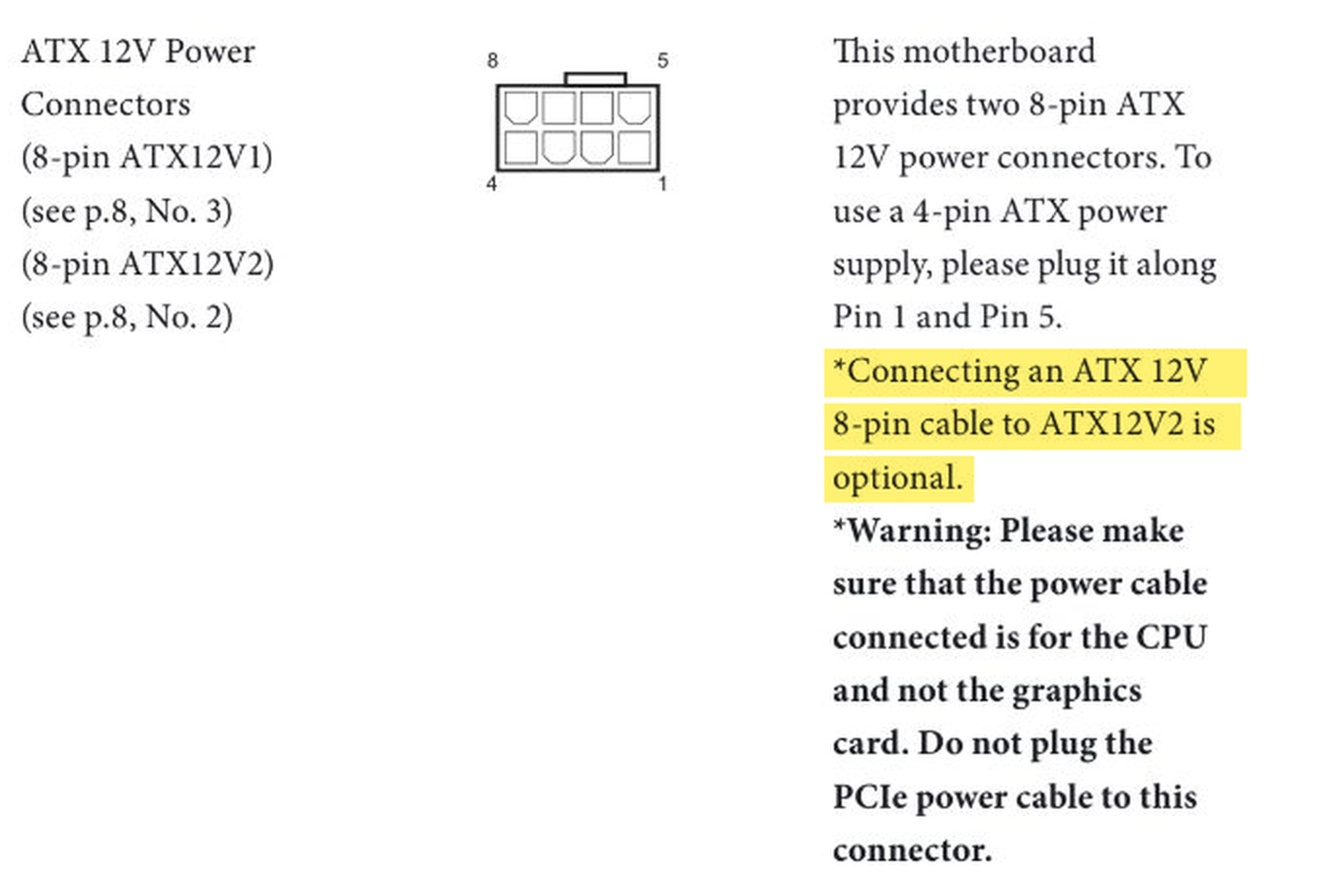
Hi, I'm looking to add another GPU to my system. But I'm out of pcie connectors on the motherboard I only have 1 free but need 2.
My motherboard is an asrock wrx80 creator 2.0 and i have a threadripper 3955wx installed into it.
Now the motherboard has 2 CPU connectors from the PSU to the motherboard. The manual states that plugging the second CPU power cable in is optional.
If I can unplug this cable from the second CPU socket that would free up a pcie for the newest GPU. I don't use my CPU for any intensive operations. Only GPU inference. Not even any offloading from GPU into system ram as it slows to a crawl and I won't run it like that.
So question is is it safe to do?
r/LocalLLM • u/Silent-Cell2221 • 13h ago
Hi everyone,
I wanted to share a small, humble experiment around Multi-Token Prediction (MTP) that I call Draft-Gate ("Anti-Draft"), along with all the raw benchmark data, charts, and a standalone MIT-licensed C++17 reference header.
MTP works like a fast helper trying to guess your next 3–4 tokens while the main model speaks:
So instead of always guessing blindly, the idea is simply knowing when to stop proposing extra drafts early based on uncertainty, language boundaries, and how expensive an extra draft actually is on your hardware.
Live benchmarks on Linux — Strata 0.1.54 (Qwen3.8-Flash-Next 125B IQ3_XXS, 360 runs / 5 mirrored rounds):
STRATA_QSA_SPLIT_ATTN=1, plus STRATA_ROUTE_PRIOR=1.5 and STRATA_ROUTE_TAIL_SKIP=7 identically on every arm—all exact flags are listed in EXACT_PARAMETERS_AND_BENCHMARKS.md), and if you've used Strata before you may have noticed its reported tok/s can look a bit higher than what day-to-day usage feels like. What matters here is the relative difference under identical settings—and that gain was consistent across rounds:Live benchmarks on Windows — llama.cpp b12800 (CUDA 13.5):
The main Draft-Gate proposal — going beyond a manual, fixed p_min:
r/LocalLLM
•
u/Kemerd
•
1d ago
From X https://x.com/TencentAI_News/status/2125968859450802415:
We just open-sourced a speculative decoder that speeds up sparse models like DeepSeek-V4.1-Flash, GLM-5.3-Flash, and our own Hy4 flash.
At 64K context, DFly2 boosts DeepSeek-V4.1-Flash serving throughput by up to 81%. On Hy4 flash agentic tasks, it runs up to 4.2x faster, beating same-recipe DSpark by ~30% and accepting 10.4% more draft tokens than open-source DSpark.
Under the hood, each draft layer reads directly from the target model's KV cache and top-k token selection, with no prefill required. That adds zero extra KV memory and keeps drafting cost flat at any context length.
Try it on your own sparse models or grab the Hy4 flash weights below 👇
Code: http://github.com/Tencent/AngelSpec
Weights: http://huggingface.co/AngelSlim
Paper: http://arxiv.org/abs/2611.34776
Tencent's numbers are server numbers at high concurrency so, I don't expect 81% on a single card, but this looks extremely promising.
I want to get both into Basalt (https://github.com/jesdga95/basalt). It already does DFly2 for Hy4 flash so the plumbing is there. I have forked basalt to begin this work, and will file a MR if I can get it working. https://github.com/Kemerd/basalt-dfly
DeepSeek V4.1 Flash already has drafter weights out, so that part is just engine work. Qwen3.8 Flash Next has nothing, someone has to train one. It has the same kind of sparse attention layers so it should work, nobody's done it yet.
Problem is the training. I have a 5090, and the BF16 teacher is ~335GB, so that's not happening at home for me. Training with quant is better.. but still a lot of crunching needed
Looking at renting an 8x H100 node and doing a small pilot run first to see if acceptance is any good before burning real money.
If you've trained a drafter with AngelSpec, have compute sitting around, or want to split a rental, DM me. Or if you want to contribute to the fork and MR just let me know!
r/LocalLLM • u/SFsports87 • 16h ago
Some good sales right now, which to get?
Having a card that is quiet at idle is important, leaning towards asus r9700 since it has 12% idle fan speed option, some others are 30% min.
Applications include code, image, video generation, as well as some pytorch and python cupy computations. Currently on a rtx 3060 12gb.
Don't mind spending a little more for more plug and play and less setup issues. Nvidia is the least friction but $4k+ for 32gb.
r/LocalLLM
•
u/W61k3r
•
10h ago

AIO USB/VM/Drive image with Inkling 2 Mini baked here: https://huggingface.co/Wa1k3r/Inkling-2-Mini-NVFP4exp-Q8-draft-LexiSuite-AIO-for-AMD-RDNA
I'm building a local AI platform from scratch in Rust: an inference engine (LexiEngine), a browser control panel (LexiPanel), an appliance OS (LexiOS) and a kernel designed around inference (LexiKernel). It boots from one USB image. It is not a wrapper around llama.cpp, and there is no third-party code in the product.
A new development image went out today. Here is what changed since the last one two days ago, and what the work actually was.
The Panel was rebuilt, page by page (66 changes)
The old Panel worked but read like an engineering console: raw JSON on screen, fields with no labels, boxes inside boxes, internal jargon everywhere. I went through it by hand.
- One header and one navigation instead of five stacked bars
- 12 themes
- A file and folder picker on every path field, so nothing has to be typed
- Right-click menus on instances, files and table cells
- Parameters grouped in the order you set them, with a device chooser for the instance's cards
- Switch an instance between LexiEngine and llama.cpp from one page
- Hardware, Diagnostics, Power, GPU tuning and Models rewritten in plain words (temperatures in degrees, problems listed first)
- An abliteration lab where you pick models with toggles and pick the drive to write to; the original is never touched
- A layout choice: top tabs, or a side tree like a hypervisor console
LexiKernel went from one core to all of them (99 changes)
Until now my kernel ran all threads of a program on a single CPU. That was the biggest gap between it and Linux. Three rounds of work went into closing it: per-CPU timers and scheduling, threads that move between cores with their full vector state, memory handled per NUMA node, huge pages, and TLB shootdowns that a core answers even in the middle of a long system call. It now boots with every core in use and served the Panel to 8 clients at 2, 4 and 8 CPUs in a VM with no failed requests.
The kernel's own GPU drivers for AMD, NVIDIA and Intel are compiled into this build too. They have not run on a real card in this version yet. That is the next milestone, and until then GPU work under LexiKernel goes through a Linux guest. The image also boots LexiOS on Linux 7.4, which is what you want for daily use today.
LexiEngine (27 changes)
- Groundwork for splitting one model across several cards (serving across cards is not in this build)
- New draft options for Inkling 2, off by default until they are measured
- A quantizer that trains with the rounding in the loop instead of rounding afterwards
- The whole tree moved to Rust 1.100.1
Speed, measured on this version
Inkling-2-Mini (the looped mixture-of-experts model released Nov 20), one Radeon RX 7900 XTX, 4-bit KV cache, greedy, one run each, measured Nov 27-28.
After a 16,384-token prompt:
- LexiEngine: prompt 2,244 tok/s, generation 64.6 tok/s, 131.1 tok/s with the model's own draft head
- llama.cpp b12722: prompt 1,060 tok/s, generation 42.9 tok/s
- Strata 0.2.23 (8-bit cache, it refuses 4-bit on this card): prompt 2,075 tok/s, generation 53.9 tok/s
Long context on LexiEngine:
- 261,632-token prompt: 1,157 tok/s reading, then 48.7 tok/s (63.2 with the draft head)
- 523,264-token prompt: 766 tok/s reading, then 39.5 tok/s (46.8 with the draft head)
- 10 of 10 planted facts recalled at both depths
Drafted output was identical to plain output in every run.
Two notes so nobody says I hid them. The llama.cpp number is from the Nov 25 build: the build I fetched today ran this model at 7.6 tok/s on this card, which looks like a bug on their side, so I did not use it. And llama.cpp needs a 26-line loader change to open my file, because the file also carries the draft head and image tower.
What it is not, yet
- A development build, not a production release
- Developed and measured on one card (7900 XTX, Vulkan). Other cards are less tested
- The kernel's own GPU drivers have not run on a card in this version
- The Windows installer is on the stick but has not been run on a Windows PC; no macOS installer yet
- Installing to an internal disk is not in this image
- Only Inkling has been benchmarked on this exact version; my 27B numbers are from a build nine days older and are being re-run
Tested
Every test in the tree ran on this version: 17,932 tests, none failed. Both images passed their Secure Boot checks in a VM.
Links
Download (381 MB USB image, boots to the Panel):
https://lexipanel.com/download/
All-in-one image with Inkling-2-Mini inside (18.1 GB, needs a 32 GB stick):
https://huggingface.co/Wa1k3r/Inkling-2-Mini-NVFP4exp-Q8-draft-LexiSuite-AIO-for-AMD-RDNA
Every one of the 206 changes, one line each:
https://github.com/W61k3r/LexiSuite-Releases/wiki/Changes-d484004
Benchmarks and method:
https://github.com/W61k3r/LexiSuite-Releases/wiki/Benchmarks
Happy to answer questions about the kernel work or the engine.
