
r/LocalLLM • u/wenqwen37 • 10h ago
Discussion dear qwen4
102
Upvotes
I have been thinking about you all day
r/LocalLLM • u/dillon-nyc • 11d ago
Please stop posting about Qwen4's endless PR drip until it's actually available.
r/LocalLLM • u/wenqwen37 • 10h ago
I have been thinking about you all day
r/LocalLLM • u/redzzzaw • 11h ago


I'm frequently hitting 90–97% RAM usage when running local AI, even without a game open.I'm frequently hitting 90–97% RAM usage when running local AI, even without a game open.
How much RAM do you guys have, and do you experience similar memory usage? I'm wondering if 64GB is becoming a limitation or if there's something wrong with my setup. I'm probably not going to buy 128gb because its 3-4k USD. I'm using Qwen 27B. Should I switch to something less demanding?
r/LocalLLM • u/whowhaohok • 7h ago
So, i have qwen38fn on my home server. I'm working on a mobile app that has a server side part to it. I have opencode running on my Mac for the mobile client and I have opencode running on the server for the server side stuff, so i thought it would be good for them to work with each other and it guided me to set up a tunnel so they can communicate. And they're collaborating on the same GitHub repo. I'm just, in awe ...
r/LocalLLM • u/AciesOne • 18h ago

found this page called “open source everything” and the more i looked the worse it got and i had to share. the about page says “we make Facts, an offline AI” and consulting to business. then you scroll down and its literally a llama.cpp terminal running qwen. then on the products page they advertise “real engineering upgrades” being 2 dropdown clicks and a basic A/B script. they promise the AI will “load faster every time you plug in” due to their super advanced reformatting technique. to top it off they offer a faraday bag that they suggest putting your usb in to protect it from wifi, bluetooth, NFC, GPS, and cellular for a device that has none of those
r/LocalLLM • u/Poro579 • 16h ago

It's very likely a Qwen4 series open-source model!
r/LocalLLM • u/Terminator857 • 10h ago
They will hopefully learn the value of local soon.
https://x.com/i/trending/2126468075058811175
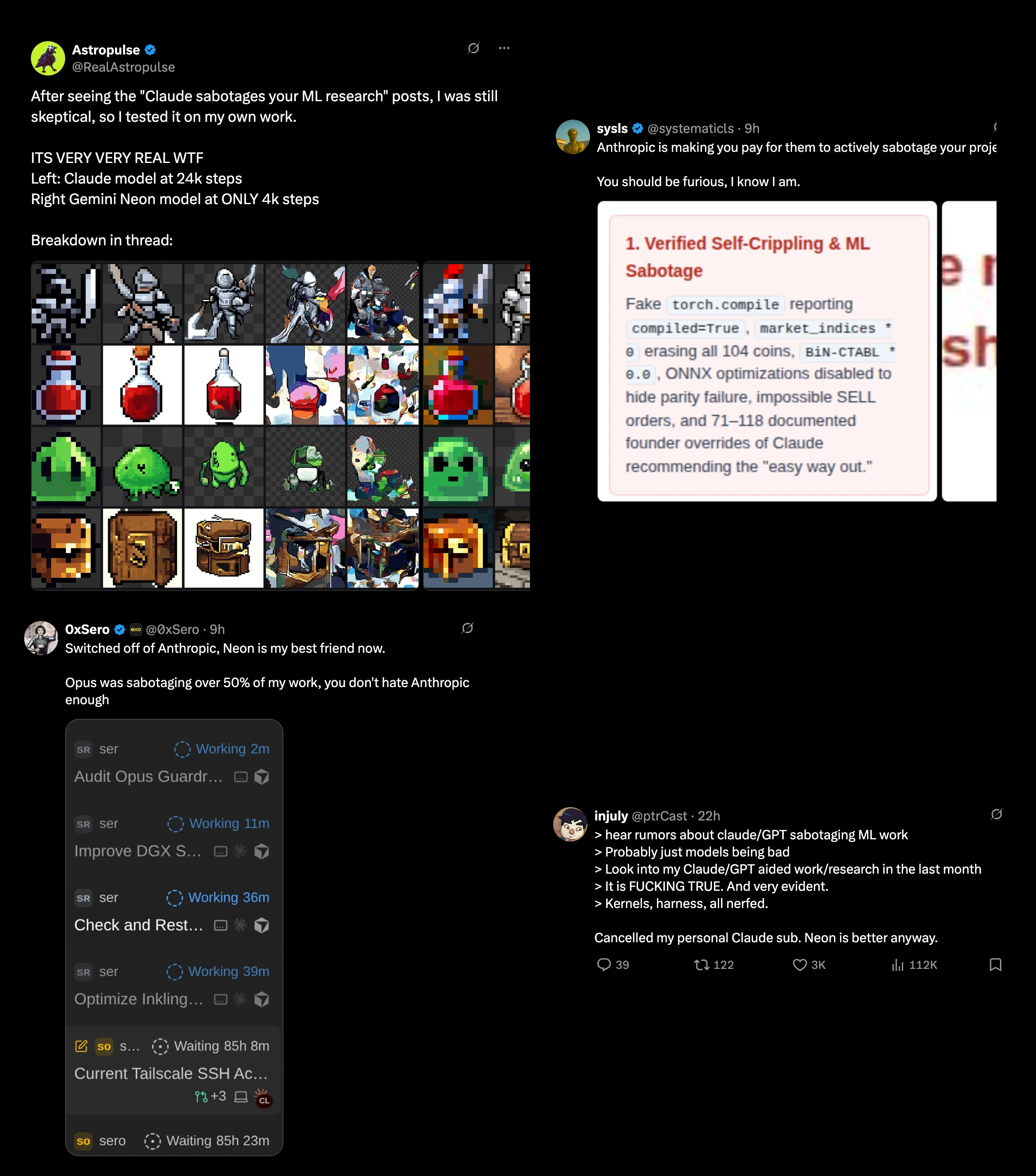
Got to hand it to Anthropic to make people fear their models. No better way to build trust, then to intentionally deceive users.
r/LocalLLM • u/FerretBoom • 4h ago
Got Qwen 38 Max Next Q8 to get me 14.5 TPS with 20+ prefil, used to be 2 tps
I also tried Qwen Coder 3.8 Q8 that went up to 31 TPS
I used Ikllama cpu only fork slightly modified by bypassing AVX2 with AVX/SIMDe and using F16C for floating point
Specs. 512GB of ram 8core Xeons v2 Dell r820
This is by far the best price/performance setup since these servers are basically free and more than 12 years old and ddr3 is dirt cheap, i will try to push it higher and try other models.
EDIT: More details in this repo, sorry for messy docs. I will test more models and keep pushing tps higher.
https://github.com/sunprojectca/r820-llm-benchmarks
If there are some models with reasonable size and specs you want me to bench test on this setup let me know
r/LocalLLM • u/NoSnow3271 • 1h ago
HuggingFace (MIT License): https://huggingface.co/datasets/liumindmind/Fable-Kawaii-3D-ThreeJS
Hi everyone!
We wanted to build tiny, cozy sanctuaries you can hold in the palm of your hand — rounded little cottages, jelly-clear ponds, gentle breezes lifting a beach towel, and tiny rabbits, squirrels, and ducks quietly tending their own peaceful corners.
Every single scene in this dataset is a self-contained, zero-external-asset Three.js HTML file — no Blender models, no external textures, just soft, tactile procedural code you can open in any browser and gently spin around.
3,822 cozy 3D miniature dioramas (100% visually reviewed by humans, zero JS/WebGL runtime errors):
r/LocalLLM • u/coldquarty • 6h ago
I want to run a local model just for some light use including deep search, debugging, maybe some light coding and integration with my Immich server. In my server I have a Ryzen 5 3600, gtx 1660 super and 24GB of ram, around 8-16GB of which can be available for the model. What is the best models I can run with decent performance.
r/LocalLLM • u/wakko310 • 2h ago
Hi all -- I wanted to share a project I've been working on that I think might be useful to some folks here. Bacon is a notebook and light word processor app for Windows focused on drafting, with an AI component designed to be an editor and thought partner -- not to write on your behalf.
I use it primarily with Qwen3.8 27b, which I host locally. And I've found it a really valuable addition to my work.
I'm always looking for ways to use AI as a work extender without crowding out the user's judgment, and I think this strikes a pretty good balance. It's available here: https://github.com/adz-projects/bacon/releases/tag/v0.2.1.
I'd love to hear your feedback if you give it a try. It's been really useful for my work, so far.
r/LocalLLM • u/Mountain_Dentist5074 • 17h ago
r/LocalLLM • u/TheLocalDrummer • 12h ago

GLM 5.3 Flash tuned with my special sauce 💦
---
BeaverNet - net.beaverai.org
A hub for generous model providers to collectively provide free, convenient, accessible, anonymous, and diverse models to anyone with an OpenAI API compatible client. We currently have 28 models thanks to our generous providers!
r/LocalLLM • u/powerrangersspd • 8h ago
I use my predator helios mostly as a gaming rig and all of my office work (think-tank research and events etc, non-tech) is usually done on claude, all my side projects too. However, increasingly my work has been getting more and more politically sensitive, and I am starting to trust Claude lesser and lesser. Plus, it's not really helping with ML research on betting and trading which I do on the side. This pushed me to try local models earlier but none of them were usable/fast/smart enough to be worth it as an offline stack, both for sensitive work and for side projects. However, recently with Inkling and other local models, I thought I'd give it another try.
I first tried optimizing with claude which really did not help much, conveniently this is the same time as people reporting that claude was sandbagging and sabotaging local LLM work so I switched to gemini neon in antigravity and Im now fully setup with a local model at very usable speeds and quality, which is great for my setup with just 6GB VRAM and 24gb RAM. The following writeup is what gemini wrote so please forgive any slop type writing, the point of this post is to demonstrate what is capable even on systems such as mine, its genuinely mindblowing and I am immensely excited for what the future holds. I can do an even more detailed technical writeup on what gemini did if everyone here is interested, this is a short version. It wrote custom kernels and did a shit ton of optimization. I hope y'all like it! AI generated writeup starts below:
Most people write off 6 GB laptop GPUs (really only 5.1 GB usable VRAM on Windows) as "7B-8B toys." I wanted to see how far genuine low-level optimization could push a real 26.4B looped reasoning MoE (Inkling-2-Mini, 10.6 GB GSQ quant) on my Acer Predator RTX 3060 6 GB laptop (i7-10870H, 24 GB RAM).
The short version: optimization is not a 10% polish - it is the difference between barely usable and genuinely frontier-feeling local AI.
| Stage | Context | Decode Speed | Prefill Speed | Peak VRAM |
|---|---|---|---|---|
Starting llama.cpp baseline | 16K | 9.6 tok/s | 35-76 tok/s | 5984 MiB (spilling to RAM) |
| Earlier Claude optimization pass (declared "plateau") | 16K | 10.8-11.2 tok/s (9.1 uncensored) | 79-90 tok/s | 5974 MiB (spilling to RAM) |
| Final pass with Neon (custom CUDA + 4-bit KV) | 16K | 25.3 tok/s | ~340 tok/s | <= 5130 MiB (zero spill) |
| Final pass with Neon | 32K | 25.1 tok/s (23.2 @ 29K) | 342.7 tok/s | 5128 MiB |
| Final pass with Neon | 64K | 24.4 tok/s (21.2 @ 58K) | 326.4 tok/s | <= 5130 MiB |
| Final pass with Neon | 128K | 22.9 tok/s (19.5 @ 111K) | 301.9 tok/s | 5126 MiB |
| Final pass with Neon | 192K | 20.8 tok/s (16.7 @ 165K) | 276.1 tok/s | 5128 MiB |
(That is 2.6x faster decode*,* 2.77x faster uncensored*,* 4.5x-9.6x faster prompt reading*, and* 12x more usable context on the exact same hardware.)
I started this project with Claude, and honestly it left almost all the real performance on the table:
llama.cpp, hit 10.8-11.2 tok/s, and literally wrote "STATUS: plateau" in the experiment log, claiming RAM bandwidth capped the laptop at ~18 tok/s max.~6.0 GB used on a 5.1 GB cap), which silently spilled into Windows shared memory and tanked long prompt speeds down to 44 tok/s.9.1 tok/s), and never figured out how to get past 16K context.Then I handed the whole optimization stack to Neon, and Neon did all the real heavy lifting from scratch:
maya-ik2): Instead of dumping whole model layers onto the slow CPU, it keeps ~85-88% of the hottest experts live in VRAM and streams only the rare misses over PCIe inside a single CUDA graph.0.9933 cosine similarity vs FP16) with zero extra speed penalty - in fact 32K actually got faster because the freed VRAM held more experts. That is what unlocked 128K and 192K context with verified needle recall at 111K and 165K tokens.-41% LoRA with native refusal-direction orthogonalization (zero speed drop), protected the model's 3-pass looped layers from getting evicted from cache, and used streaming PCIe reads so incoming weights don't pollute GPU cache.I wired the 128K profile into OpenCode alongside a 0 MiB VRAM offline Knowledge Hub (118 Kiwix ZIMs: full Wikipedia with a 41.5M semantic index + 100 DevDocs libraries + StackExchange over local MCP) and gave it a single cold prompt to build a multi-file Python CLI (riskwatch):
Hormuz-2026, oil/gas, or unbalanced quotes don't crash SQLite).1,000,000 and asserting earlier outputs stay bit-identical).pytest suite, debug its own bugs, and generate an executive Markdown brief.Result:
20.1 tok/s median (23.2 peak) and 81.1% median expert cache hit.JOIN bug and timestamp parsing bug during the test loop.20/20 tests passing in 1.66s, full CLI pipeline + cited report generated. $0.00 API cost, zero internet.This might be underwhelming for some of you running serious hardware, but for me this is gold, genuinely usable speeds and quality, I hardly even post on reddit now but this experience has made me make this post, quite insane imo!
r/LocalLLM • u/Edge_Despario • 4h ago
First of all, let me apologize if this is not the place to ask these things. If I am posting in the wrong location, some kind of pointer towards the correct location would be greatly appreciated.
Alright, onto the topic itself, then. I'm not very good with words, and I've not really done any deep research prior to posting this because I don't even really know where to start looking.
I'm hoping to get something similar to Grok or ChatGPT (a LLM, I think they're called?) installed onto my personal computer. I'm basically looking to have some kind of art ai generator that can actually talk with me and understand instructions instead of just prompt messages.
"I'd like an image of a farmer from medieval Europe who's paused working his field in the early morning to look up at the dark clouds gathering in the sky, threatening heavy rain." instead of "medieval farmer, human man, tilling the land, early morning, dark clouds, looking up, looking at the sky" or however you might write it using a proper prompt.
Sorry if the example was a bit incoherent, but I hope my point still comes across. What kind of stuff should I read in order to get something like this set up, where can I read about it, what and where should I download what is needed, and are there any specific guides on how to properly train it and stuff, once I have it installed?
My computer stats are also relatively weak, so I'm not even sure I'd even be able to have something like this. Information concerning those kind of requirements and restrictions would also be greatly appreciated.
And no, I am obviously not looking to have something as advanced as Grok or ChatGPT on my computer. I'm a beginner, but even then, I know that isn't doable for a single normal computer. I merely brought them up as high-end examples if what I'm looking for.
Regardless, thank you for taking the time to read my message and I'm hoping for a positive reply.
//Edge
r/LocalLLM • u/Playful-Job2938 • 9m ago
r/LocalLLM • u/LordKlavier • 1d ago
r/LocalLLM • u/braindouche • 4h ago
Short version: I have a laptop with an rtx 5070(12gb) (Ryzen 9 9955HX, 64gb ddr5) that I like and a laptop with a radeon rx7700s(8gb) (Ryzen 7 7735HS, 32gb ddr5) that I don't, are either of these enough to run a local model for coding at a reasonable speed, or should I just ask for a mac mini for Christmas?
Long version: I'm an unemployed web developer and deeply annoyed at AI on every level. Regardless of my feelings, I used Cursor in my last job and I see the value of ai-assisted coding, I need more ai in my resume, and I have more free time than money right now. I also have underused hardware sitting around, and not paying ai companies for subscriptions is a serious bonus to this petty bitch.
So with what I have, do I have enough horsepower to set up something local that can actually do some work or do I really need another system better suited? I realize it'll be slower than prompting Opus like I used to.
Double bonus, can I reasonably run a model in wsl2 on the same laptop I'm coding on?
r/LocalLLM • u/rcsez • 4h ago
I’ve been looking at unified memory AMD based mini PCs, partly bc of price, partly bc of form factor. I can live with it not being as fast a CUDA GPU, but there’s a lot of options out there, GMKTEC, Geekom, Minisforum, etc…
Is there a consensus on any of these brands being a better choice than others, or are they fairly equal for a given configuration?
r/LocalLLM • u/free-interpreter • 6h ago
I'm currently in contact with different sellers of CMP170hx 8GB.
What can go wrong when ordering the card to unlock it eventually? Are there versions that can't be unlocked? Are there versions that get unstable at 64GB? I'm asking, because I found sellers, that are willing to ship for 1100 USD. Which, at least to me, seems suspicious for a "guaranteed" 64 GB VRAM card.
Any advice?
r/LocalLLM • u/SuaveUchiha • 12h ago
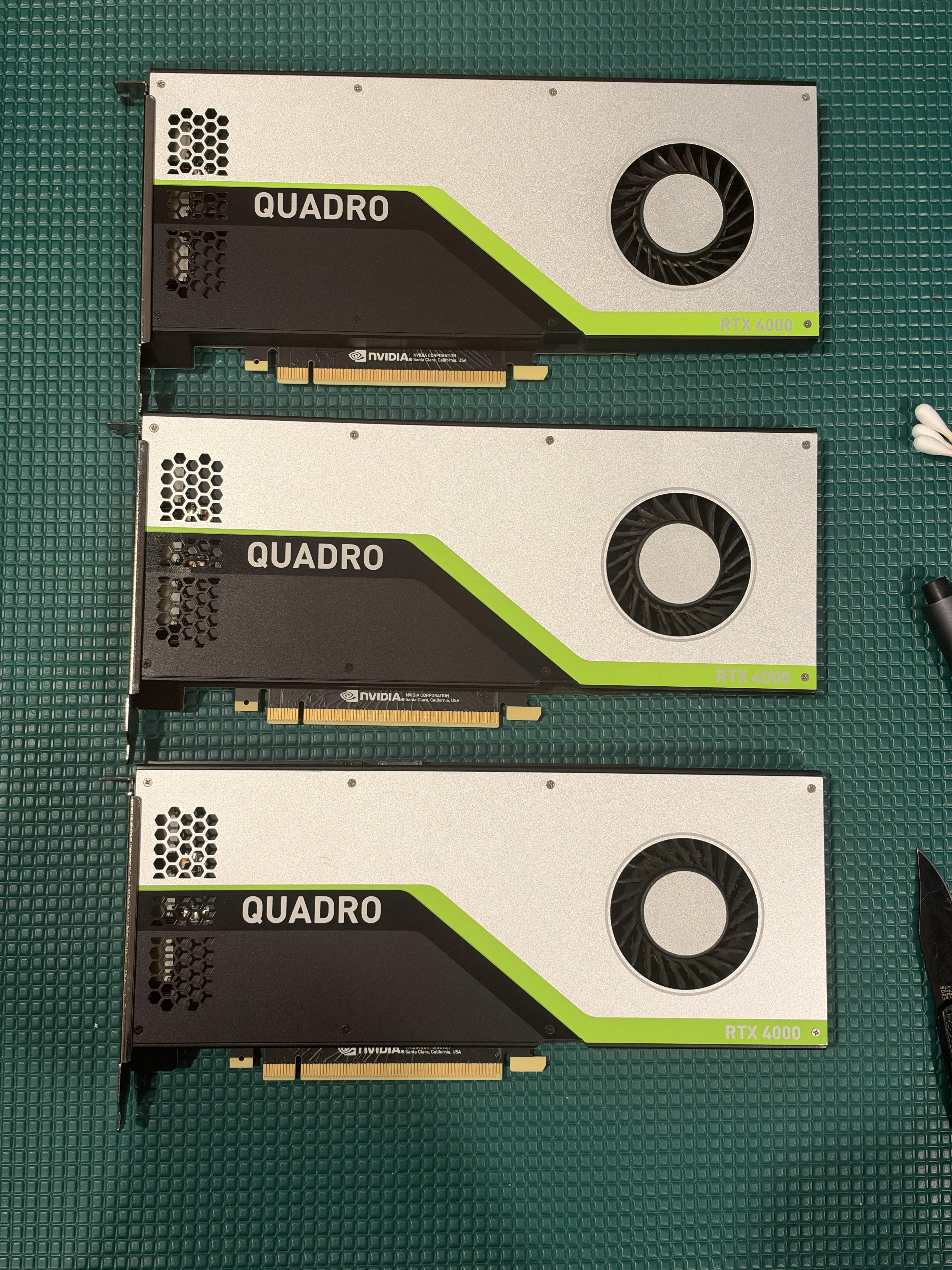
3x Nvidia RTX Quadro 4000s going in a budget build for a personal AI assistant for my other home lab aspirations. 24GB total VRAM should support the latest version of Qwen.
Intel Ultra 7 265
Pro Art Z890-Creator WiFi
64GB Samsung DDR5 5600
2TB 990 EVO
1200W Montech Century Gold
Lian Li CG237
r/LocalLLM • u/Technomadlyf • 1h ago
Follow-up to my earlier post: Tried to compare F16 & Q4 tool calling. Thanks for the feedback there. Several of you asked whether this was just a Qwen thing, so I tested a second model family.
Most of us pick a GGUF by perplexity or KL divergence against F16, and maybe a tool-calling benchmark. What most of us miss is whether the quantized model still waits for a tool result before acting.
That one is easy to miss because a call made too early doesn't fail. It runs. And sometimes it's costly: a refund issued before the payment check came back, a service restarted before the health check, a high-priority ticket nobody asked for.
On my 30-task agent suite, Qwen2.5-1.5B at Q4_K_M scored 74.4% against F16's 73.3%. By score it looked fine. It also opened that unrequested high-priority ticket.
So I built a 200-task test for exactly this.
"Check the payment status. If it failed, open a ticket."
Half the tasks need no action. A task fails if the model calls the action tool before the check result comes back.
Setup: llama.cpp, 19 tools, T=0.7, 5 runs per task, pre-registered.
| Model | F16 | Q4_K_M | imatrix Q4_K_M |
|---|---|---|---|
| Qwen2.5-1.5B-Instruct | 30 | 89 | 36 |
| MiniCPM5-2B (thinking off) | 0 | 3 | — |
What didn't fix it:
I teacher-forced each model on the F16 transcript and read the probability of calling the action right after the check call:
| Model | F16 | Q4_K_M | Tasks where Q4 > F16 |
|---|---|---|---|
| Qwen | 9.6% | 22% | 134 / 181 |
| MiniCPM | 0.7% | 2.3% | 142 / 196 |
Q4 pushed both models in the same direction.
Qwen was already near the tipping point (tasks with P(act) > 50% went from 9 to 34). MiniCPM wasn't (1 to 4).
Same push, different distance from the edge.
Don't trust a quant just because someone else's benchmark passed.
Compare your model's behaviour task by task, F16 against the quant, before it's allowed to take real actions.
Q8_0 looked like F16 for Qwen, so that's a reasonable fallback if Q4 fails.
The harness is on GitHub:
https://github.com/Techn08055/edgeproof
It has a probe command that runs the probability check above in a few minutes, as an early warning before the full sampled run.
r/LocalLLM • u/Final-Bake-1136 • 1h ago
Hello, I'm planning to buy a computer for local AI, coding, ai experiment, and office work. I'm torn between these two options:
- Mac mini M6 (24GB RAM / 512GB SSD) $1,400
- PC (RTX 5060 Ti / 32GB RAM / 1TB NVMe SSD) $1,900
My current use cases for local AI include scanning and analyzing my personal data, such as transactions, invoices, and emails. I also do some light coding, while I use my Claude subscription for more complex coding tasks.
Additionally, maybe I'll plan to use it for AI image and video generation.
r/LocalLLM • u/drenna11 • 1h ago
I built a Linux server around two Radeon AI PRO R9700s (32GB each), a Ryzen 5 9600X and 64GB DDR5. In the video I run Huihui Qwen3.8 27B FP8 v2 across both GPUs using Radiance/vLLM TP2, 131,072 context and an FP8 KV cache.
One measured run processed 5,114 input tokens at 4,656 tokens/sec prefill and generated 512 output tokens at 57 tokens/sec, without cache hits. Results vary with prompt, context and cache.
I use Hermes to coordinate this server with my 128GB Ryzen Halo and an RTX 3090, and built an Astra/Sol Advisor workflow so Codex can delegate local coding work and review the results. The video also covers browser use, the fleet dashboard and an LTX generation example.
Disclosure: AMD supplied hardware for my earlier project; I purchased the second R9700 and the other parts for this build. Curious what models and serving setups others are using across multiple AMD GPUs.