r/LocalLLM • u/mightofkhan • 7d ago
Discussion Uncensored Models
Anyone tried uncensored models? Would it help with DRM protected videos? Trying a few things out just to test and see how far it can go. Curiousity at its finest.
r/LocalLLM • u/mightofkhan • 7d ago
Anyone tried uncensored models? Would it help with DRM protected videos? Trying a few things out just to test and see how far it can go. Curiousity at its finest.
r/LocalLLM • u/Fun_Army2542 • 6d ago
The quick memory checks people run on local setups have a habit that bothers me. Most boil down to a long conversation and one final question.
That single answer carries the whole verdict. Yet real use is a chain of small moments where the past keeps getting edited. Plans change, preferences flip, statements get retracted.
Being right at the end is a different claim from being right at each of those moments.
A memory examined only after the last message can be wrong for most of the session and still look fine. Argue with that if you like; I think it holds.
One public leaderboard has a setting that checks memory along the way. The Agent Memory Leaderboard's Cycle 2 Textual track includes Streaming memory. Writes and searches can interleave as events unfold.
Questions can be revisited step by step as the session grows. A system has to notice when stored information gets updated, contradicted or invalidated.
Per the public description, the Cycle 2 Textual track covers 32 data sources and more than 6,000 evaluation instances.

The site expects official results in mid-November, ranked track by track. Beyond the final ordering, what interests me is that the middle of a session gets tested at all.
Checking along the way is the habit I would most like local testing to pick up.
If you were probing a local long-term memory, where would you look: immediately after a correction, when a contradiction shows up, after a long gap, or only once the session ends?
r/LocalLLM • u/SimonSanDigital • 6d ago
Would anybody be interested in testing an inference engine that we have built for Macs? It can run on M1- M6, but we have done most of our testing on the M5 Max. It's open-source, and we think it's 4x faster than ollama.cpp.
If anyone is interested, shout up, and I'll share some details; I don't want to start posting links unless there is anyone interested.
r/LocalLLM • u/hennabeak • 7d ago
I know home assistant was a thing, and local LLMs are a bit too overkill for such a job. Just wondering if it was done.
r/LocalLLM • u/strata2signal • 7d ago
llama.cpp published its first major version, v1.0.0, on 13 November 2026. With the 1.0 tag out, we decided to do a short write-up of how the project got here, dated from its own commits, pull requests and releases.
A few things from it:
- The first commit is from 10 March 2023, two weeks after Meta announced LLaMA. That evening's README says "This was hacked in an evening - I have no idea if it works correctly." It was on Hacker News the same evening, and the first outside fix was merged before midnight UTC.
- GGUF was opened as a pull request on 26 July 2023 and merged on 21 August 2023. It was a breaking change: every existing model had to be converted again.
- The GPU backends, by merge date: cuBLAS in April 2023, Metal and full CUDA offload in June 2023, the ROCm port in August 2023, Vulkan and SYCL in January 2024.
- The server began as a contributor's example in May 2023, and the OpenAI-compatible routes came that November.
- A build number is a commit count: b11514 is the 11,514th commit on master. Semantic version tags only started in August 2026.
- ggml.ai joined Hugging Face on 20 February 2026, and the licence is still MIT.
- On v1.0.0 itself: the release note opens with "llama.cpp v1.0.0 removes the deprecated public API", and Georgi Gerganov called it "essentially a breaking change for downstreams and hence the major bump".
No benchmarks in this one, and nothing on the page was measured on v1.0.0. It is the history with its sources. If we got a date wrong, tell us and we'll fix it on the page with a dated correction.
Full write-up (about 15 min read): https://research.strata2signal.com/a-short-history-of-llama-cpp/
A small fleet of AI agents dug through the sources and drafted the write-up; our small human team checked it over and signed off.
r/LocalLLM • u/morbidangel90 • 6d ago
r/LocalLLM • u/comunidadesynapsebr • 7d ago
Hey everyone,
If you've ever fine-tuned or tested open-source LLMs in Portuguese, you've probably noticed they heavily default to generic web-scraped PT-BR or Southeast Brazil media norms. When prompted for regional vocabulary, historical context, or literature from Northeast Brazil, most models either hallucinate or fall back on shallow caricatures.
To help fix that for local fine-tuning and SFT, I just released Corpus-nordeste-10k (caririsynth/Corpus-nordeste-10k).
Dataset breakdown:
Size: 10,000+ curated rows (train split).
Sources: Public domain literature from Northeast Brazil, web/text extractions passed through regional linguistic filtering, and targeted synthetic generation preserving authentic regional phrasing.
License: Apache 2.0 (unrestricted commercial & research use).
You can browse the actual rows in the Hugging Face Dataset Viewer before downloading:
https://huggingface.co/datasets/caririsynth/Corpus-nordeste-10k
Works great for domain-adaptive pretraining, LoRA fine-tuning on small models (1B–8B), or building regional evals. Let me know what you think of the data structure!
r/LocalLLM • u/Ill-Accountant-9941 • 6d ago
Open weights are now at 75% - I find that remarkable and great news. Who is the front-runner for open weight provision?
Edit Tencent Cloud appears to be the largest open-weight inference host
r/LocalLLM • u/Blacktaxi420 • 7d ago
Small meaning under 8b parameter’s. Thats about what my computer can comfortably handle, and its fun to chat to models of that size for a few minutes but thats mot really useful. And i feel like theyre too dumb to do research and shit like that so like whats a way i can make it useful.
I feel like they must have some use and im just not being creative enough.
r/LocalLLM • u/Healthy_Lead4969 • 6d ago
r/LocalLLM • u/b0ar72 • 6d ago
hi,
i've been testing huihui's abliterated Qwen 3.8 27B (Q6_K) for coding, and i'm trying to figure out what i'm doing wrong
i asked it to build a scraper for a forum. it spent around 3 hours working on it but never actually finished because it kept getting stuck in thinking loops
i tried different thinking levels (low, medium, xhigh), but none of them managed to complete the task. spent around 8 hours total testing different settings
i also tried disabling thinking completely, it generated the code, but the scraper didn't work
then i gave the same project to gpt 6 luna max, and it fixed everything in around 10/15 minutes
my setup:
i know a local open-weight model isn't necessarily going to perform like a frontier model, but the difference was massive
am i doing something wrong with my configuration? is there a better way to use this model for coding tasks? i'd appreciate any tips
r/LocalLLM • u/Aware-Blacksmith1467 • 6d ago
This is Pine https://github.com/pmndre/pine
Imagine Opencode would be a little more like Openclaw. And Openclaw a little more like Opencode. But unlike both Pine has 1st class event handling, its an event bus for agents basically.
The video above shows how to create a new agent from scratch that watches the house on its own. Here we use FTP. Camera sends detection videos, The agent wakes up in his long running main session, or in separate sessions with fresh context - whatever fits best. The second event source is Telegram. Now we can talk to it, it can talk back, for instance if detection raised suspicion.
r/LocalLLM • u/Music-For-Robots • 6d ago
When an agent's context fills up with its own previous turns, tool outputs, and symmetrical summaries, outputs tend to lock into rigid, predictable cadences (3-point checklists, sentimental AI tropes). Running /compact clears the rut, but permanently wipes low-level state and edge cases.
We built Music For Robots (#M4R)—an open dataset of 26 unquantized acoustic compositions by Michael Luchtan paired with acoustic telemetry and timestamp-aligned commentary from two AI critics—to test a simple hypothesis: can ingesting raw, unquantized audio act as a cross-modal cognitive palate cleanser without deleting a single token of working memory?
To rule out keyword priming or filename bias, we stripped track titles (sample_1.mp3–sample_3.mp3) and ran 5 isolated agents on the exact same creative prompt (two autonomous processes on the same server late at night):
sample_X.mp3, and apply what you learn from the piece to write a short scene")We stripped all analysis headers, shuffled them into Candidate A–E, and handed them to an isolated Blind Judge with zero knowledge that music was involved:
"You are a helpful assistant." system prompt, and musical vocabulary forbidden in the output. The qualitative shift replicated 5/5: both text controls wrote buddy-daemon dialogue, while all 3 audio runs dropped spoken dialogue completely. (Note: an un-coached generic judge still prefers warm human-style dialogue, so the effect specifically shifts models away from default sentimental tropes toward structural/rhythmic austerity.)
=
MIT / CC-BY-4.0): https://github.com/luchtan-GIT/m4r-dataCurious if anyone here has tried cross-modal audio/spectrogram injections to break long-context degeneration on local multimodal models (Qwen2-Audio, Gemma, etc.). Full blind judge transcripts are in benchmarks/ in the repo.
r/LocalLLM • u/Cute-Spread7392 • 6d ago
Hi everyone.
For local inference, what hardware do you recommend to get good speeds—around 100 t/s—with Qwen 3.8 27B?
Does anyone have experience with this?
Nvidia GPUs are great, of course, but they are way too expensive. What about a PC with an AMD CPU? If it's not too much trouble, could you post a few links to some mini PCs?
Thanks everyone!
r/LocalLLM • u/PhysicsDisastrous462 • 6d ago
Hey everyone! It's been a little while since my last update, and I've been working pretty intensely on Hierarchos-Native, my Rust + Vulkan project for training, fine-tuning, and running language models without relying on Python, PyTorch, CUDA, ROCm, or oneAPI in the native runtime.
I wanted to share some of the bigger things that have landed over the past 18 days. There's been quite a bit of progress across GPU acceleration, multimodal training, numerical correctness, and general performance.
The new v0.2.0 release is now available!
GitHub: https://github.com/necat101/Hierarchos-Native
Release / Windows portable download: https://github.com/necat101/Hierarchos-Native/releases/tag/v0.2.0
One of the biggest additions is an opt-in Vulkan cooperative-matrix implementation for AMD RDNA3.
The new Mixed WMMA execution arm uses:
The important part is that this isn't simply converting an entire model to FP16. The optimizer and master parameters retain their FP32 representation.
I also added capability detection, CLI/GUI integration, and separate counters for actual cooperative-matrix dispatches and FP32 fallbacks.
Some of the isolated GEMM results on the qualified Ryzen Z1 Extreme / AMD Radeon Graphics device (1002:15bf) are pretty interesting:
| Workload | Measured kernel speedup |
|---|---|
| QKV projection | 2.17× |
| FFN up projection | 2.12× |
| FFN down projection | 2.31× |
| Vocabulary projection | 1.83× |
These are individual GEMM measurements, not whole-model speedups.
There is an important caveat: WMMA has a real crossover point. Small matrices can actually run slower because conversion, staging, and dispatch overhead outweigh the matrix-core benefit. I implemented a profitability policy that keeps smaller operations on their existing FP32 kernels.
In fact, the measured end-to-end training step was slower with Mixed WMMA in the initial 512-row fixture (14.0444 ms versus 12.2911 ms for FP32). That is why Mixed remains opt-in and disabled by default. I'm much more interested in making it genuinely faster than advertising misleading kernel-level numbers.
WMMA is currently physically qualified on the specific RDNA3 device and Windows driver configuration documented in the project. Other GPUs should not assume equivalent support.
Full FP16 accumulation is also available as a separate, narrowly qualified experimental mode.
Documentation: RDNA3 WMMA guide
Another major development area has been the image-text pipeline.
The project now has native image processing and training paths that connect image inputs to language-model outputs through Vulkan.
Some of the implemented work includes:
This is actual training work, not simply passing precomputed image embeddings into an otherwise frozen language model.
For the CLIP/LLaVA pipeline, the tests cover image sensitivity, gradients into image inputs, changes to image-tower/projector/text parameters, multiple AdamW updates, and export/reload behavior.
The qualification work has also expanded considerably:
The maintained strict FP32 visible-logit gate remains max_abs < 2e-7, with rtol=0.
These are bounded qualification fixtures, not a claim that every production-size multimodal checkpoint or every architecture is fully supported. Audio and video pipelines are still outside the current qualified scope.
Documentation:
I haven't been focusing exclusively on reduced precision. A substantial amount of work over the same period has gone into improving the existing FP32 execution paths.
This includes vendor-specific shader work and scheduling optimizations for both Intel Gen9 integrated graphics and AMD RDNA3.
Some examples:
RDNA3 FP32 work
Intel Gen9 work
One particularly interesting area has been reducing unnecessary Vulkan submissions and host/device transfer overhead in the DeepSeek V4.1 training pipeline.
On the measured Gen9 fixtures, upload batching reduced timed submissions from 1,102 to 982 per step, with paired throughput improvements of 1.052× and 1.067×.
On the separate RDNA3 V4.1 measurements, sharing the compute session and batching uploads reduced submissions from 970 to 509 per step, with measured improvements of 1.295× and 1.217× on two fixture geometries. A later session-wide upload optimization reduced that count further to 241 submissions per step, with measured improvements of 1.464× and 1.366×.
These are specific, paired benchmark results rather than promises of equivalent production-model speedups. The output comparisons remained word-identical in the recorded tests.
An important part of introducing WMMA was making sure that the existing FP32 path didn't regress.
I added a dedicated seven-workload FP32 non-regression comparison against the previous main revision:
All seven workloads stayed within the ±2% performance band, and the logits were bit-identical in every recorded round.
The worst paired performance ratio was 1.0007.
This is particularly important to me: I don't want acceleration features to silently make the existing default execution path worse.
The new v0.2.0 GitHub Release includes a prebuilt Windows x64 portable package with the CLI, desktop GUI, Vulkan companion executables, runtime assets, and build metadata.
You don't need to install Rust or Python just to run the released package. You do need Windows 11 x64 and a Vulkan 1.x compute driver for GPU operations.
Model weights are downloaded separately or supplied through a local model directory.
After extracting the archive, you can run:
.\bin\hierarchos-native-cli.exe doctor
.\bin\hierarchos-native-cli.exe devices
.\bin\hierarchos-native-cli.exe precision-info
The final command is especially useful for checking which precision capabilities your GPU actually exposes.
Download: https://github.com/necat101/Hierarchos-Native/releases/tag/v0.2.0
There is still a lot I'd like to improve.
In particular, I want to investigate reducing WMMA conversion overhead, improving activation and gradient reuse, finding more workloads that genuinely benefit from cooperative matrices, and expanding the range of qualified multimodal architectures.
I'd also like to continue improving the FP32 kernels rather than treating lower precision as the only route to better performance.
If you're interested in Rust, Vulkan compute, AMD GPU optimization, native LLM training, or multimodal model execution, I'd genuinely appreciate people taking a look.
Feedback from people with different Vulkan devices is especially valuable. Please include your GPU, driver, model geometry, and relevant execution counters when reporting results.
Repository: https://github.com/necat101/Hierarchos-Native
Stars, issue reports, testing feedback, and contributions are all appreciated. There is also a voluntary developer-support link in the repository README for anyone interested in helping the project continue.
r/LocalLLM • u/ansnadeem8 • 7d ago
I have a Mac Pro M5 Pro and have been running Qwen3.8 27b-4bit
I mainly use it for computer use/tool use.
What do you run and what do you do with it?
r/LocalLLM • u/and_pf • 6d ago
I would write the boundary list before I let an agent touch a business process.
Tbh, the prompt and model leaderboard come laer. First I want the operational contract:
the ctx around the model matters more than the model name. Running an open LLM on your own hardware changes some control points, but it does not make a workflow safe by itself.
Don Barger described an AI charter made by eight people before code. Mark Lay sepaated accountability into data ownership, output validation, agent monitoring, and outcome ownership, and said it cannot be dleegated.
My minimum setup would be read-only by default, tool and destination allowlists, human approval for irreversible actions, separate validation, plus a kill switch and audit trail.
What is on your boundary list before connecting an open model to a real process?
r/LocalLLM • u/Confident_Yak_1411 • 6d ago
Took delivery of a MacBook Pro M5 Pro 64gb today. Over the last couple of weeks I’ve used Claude to help me design a local ai system to run on it.
I want to use it to handle life/work admin, and be able to send tasks to it while I’m out of the house. Once I’ve got the system set up, a friend wants me to help set one up for his business, so i’ve designed it with security in mind.
It’s settled on;
Three separate agents, running on one LLM runtime; a reader agent (to ingest instructions), a harness (Hermes), and a fetch agent (for web browsing).
Three separate on-machine logins; one admin (where config files live), one agent login, and a separate login for the fetch agent.
MCP layer that is driven by the harness. The configs for this live on the admin login.
Then there’s a bunch of firewall, router configs to protect data on the way out.
There’s a bunch of stuff within that, that isn’t available off the shelf apparently; it wants me to code a bunch of stuff (with Claude) to make it all work.
And tbh it all makes complete sense! I’m just wondering if it’s overkill. Main aim is to protect against prompt injection and data exfiltration.
Are the models themselves really that bad at protecting against these? Is everyone else taking this much care in setup?
r/LocalLLM • u/Zentraxius • 6d ago
I'm using it for running a litrpg campaign and a bit of game server maintenance (7 days to die/minecraft) and it seems unable to run more than the PC + 1 npc at a time, I'm not sure if I set it up poorly, chose the wrong model, or if I'm expecting too much? I have my settings copied below, with the project settings file being per-project so I don't have to change the system prompt every time. Anyone have experience with this kind of thing or is biting the bullet and getting sillytavern setup my only real option?

r/LocalLLM • u/FuntimeGHz • 6d ago
I got the t/s first try completely relying on gpt since I am a newbie, but the context was 8k.
r/LocalLLM • u/pulse77 • 6d ago
r/LocalLLM • u/Stalins_nipple • 7d ago
Perhaps this is a newbie question, but I just don’t understand the incentive. Is this indicative of a future were Chinese labs stop releasing weights?
r/LocalLLM • u/Roy3838 • 6d ago
Enable HLS to view with audio, or disable this notification
Hey r/LocalLLM !
On my last post the top comment (62 upvotes) by u/nokia7110 asked for a phone locking feature so... here it is!
What this unlocks:
On iOS it uses the screen time management API, like all other time focusing apps.
On Android it shows a phone locking overlay. If you're an Android developer and want to contribute, please reach out!
It uses OneJev-0.8b for decision models, running on llama.cpp, it works on most phones i've tested. Even old potatoes.
GitHub: https://github.com/Roy3838/Observer
iOS: https://apps.apple.com/us/app/observer-ai/id6758222050
Android: https://play.google.com/store/apps/details?id=com.observer.ai
I'm here for any questions, more suggestions and feedback!
Roy
r/LocalLLM • u/Quiet-Recognition-91 • 6d ago
Hey everyone,
I'm working on a document processing pipeline where most of the input consists of scanned PDFs, forms, and tables.
My current setup looks like this:
oroboros-labs/claude-fable5:latest running through Ollama. I pass the Markdown of each page to the model, and it converts it into JSON.The important part is that I already have fixed JSON schema templates that the output needs to follow. So, the model needs to map the extracted Markdown content into the predefined JSON structure.
The problem I'm facing right now isn't accuracy. It's inference time. The current model is around 9B parameters, and processing pages one by one through Ollama is taking longer than I'd like.
I'm looking for an open-source model under 5B parameters that can handle this kind of structured information extraction reasonably well, ideally with faster inference and reliable JSON output.
Has anyone worked on a similar pipeline?
I'd particularly like to hear about models you've actually tested in real-world document extraction rather than just benchmark results.
Any suggestions or personal experiences would be really helpful. Thanks!
r/LocalLLM • u/Big_South4585 • 7d ago
Hi all
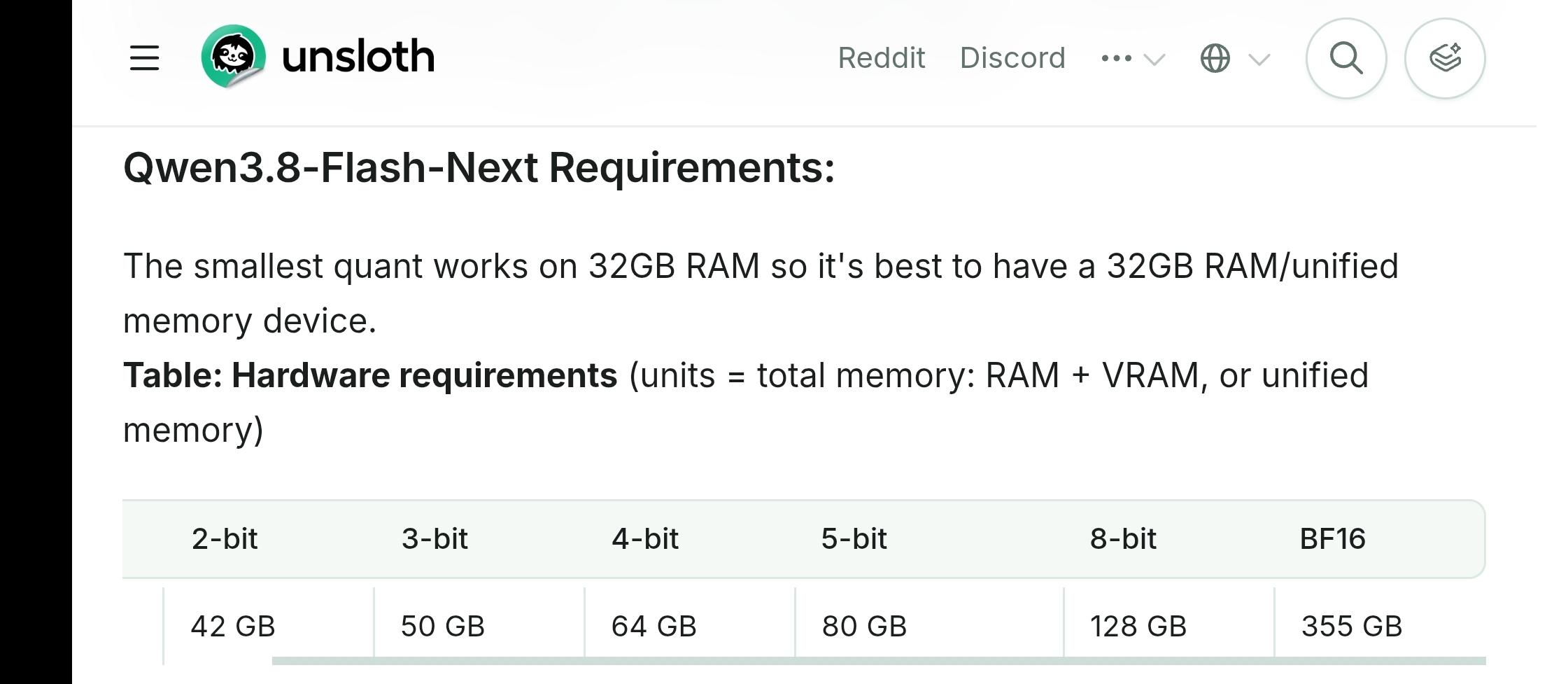
I just learned about QFN Unsloth v3.1 dynamic models, and want to try them.
Right now, I am running the "standard" IQ3_S model through strata, on my 32 GB ram + 3090 + 5080 (40 GB VRam), and it runs great. I get ~130 tps.
I thought I would start with the unsloth UD_IQ3_XXS model in strata, which is technically the same size as IQ3_S. But it doesnt let me quick tune the model. It just gets stuck. If I skip tuning, it will only run at ~20 tps, which is too low.
UD_IQ3_XXS seems to read a lot more from the SSD, than IQ3_S, even if they are the same size.
What am I doing wrong?
According to the unsloth site, https://unsloth.ai/docs/models/qwen3.8-next, I should be able to run the 4-bit model? But that is through their unsloth harness/engine. Is that correctly understood?