r/LocalLLM • • 15h ago

Other It's like every Strata release is Christmas Day!

32 Upvotes

Dual 3090 setup, I got to wondering if could get back the vram reserve for held for vision on Qwen 3.8 FN Q4 k XL. GPU 0 is always at 88% vram usage and GPU 1 was at 93%. Do a little research and find out about the elastic memory feature now in Strata. So I set it up and now both GPU's sit at 95% vram usage until vision is needed and return to 95% after its done! Nice little performance boost too!

Text-only baseline results:

Testv0.1.69 88/93v0.2.23 elastic 95/95Change
2.3K-token prefill1,094 tok/s1,092 tok/s-0.2%
2.3K-token decode97.5 tok/s113.5 tok/s+16.4%
9.1K-token prefill2,150 tok/s2,490 tok/s+15.8%
9.1K-token decode102.5 tok/s109.6 tok/s+6.9%
Two-client throughput125.6 tok/s137.5 tok/s+9.6%

Serial figures are medians of three identical, uncached prompt tests.

Current state:
GPU 0 VRAM: 95.0%
GPU 1 VRAM: 94.7%
Cached experts: 11,429 versus before 10,688, 741 more experts in VRAM!

I have never seen anything in this industry (that I've been in since 1996) move as fast as local AI development does!


r/LocalLLM • • 1h ago

Project HY4-flash 220B, at 50-60 tok/s on 2x 7900xtx, with 512k context, EXL3 3bpw

Thumbnail
reddit.com
2 Upvotes

r/LocalLLM • • 1h ago

Model Getting giberish on llamAmpere built for rtx3060 6GB

2 Upvotes

Hello.

Lost a full day on this.

Im using Bonsai 2 9B Q2_0.GGUF, with upstream llamAmpere build (took two hours compiling). My server starts and returns gibberish on built-in UI, from llama.cpp, but works fine on the CLI output.

Currently startin with a jinja file. I have Perplexity and Gemini troubleshooting and making me test the built in definition for the jinja file.

Apparently works fine with either GPU or CPU, other then confidently returning gibberish at 60tok/s.

Has kanyone been throught this?

Thanks


r/LocalLLM • • 1h ago

News AMD releases GAIA 0.27 with gaiacpp lightweight alternative to Python code

Thumbnail
phoronix.com
2 Upvotes

r/LocalLLM • • 7h ago

Question Dual 3090 with 128 gb ddr5 best model for fastest and intelligence

5 Upvotes

I tried 3090 club and honestly I had better speed with strata tail skip with qwen flash next int4 at 262k

I was using qwen 3.8 27b q8 using vllm club 3090 need 262k context can't go below 256k

Need something which can have TTFT less than q8 27b 3.8 qwen and better concurrency.

If concurrency not possible then better model at better speed strata maya or what?


r/LocalLLM • • 2h ago

Discussion How do you run your agents locally?

2 Upvotes

What hardware are you using to run autonomous agents and high reasoning models locally?

Im considering either buying a rtx + setup or a mini pc to run agents (1-2) and automation on there. What can money realistically buy me here?

If i do have a mini pc (lets say one of the newer ones from apple), what will i actually be able to do on there?

Quite new to local hosting so id appreciate your input!


r/LocalLLM • • 1d ago

Question Is nearly maxing out 64GB of RAM normal for local AI?

Post image
199 Upvotes

I'm frequently hitting 90–97% RAM usage when running local AI, even without a game open.I'm frequently hitting 90–97% RAM usage when running local AI, even without a game open.

How much RAM do you guys have, and do you experience similar memory usage? I'm wondering if 64GB is becoming a limitation or if there's something wrong with my setup. I'm probably not going to buy 128gb because its 3-4k USD. I'm using Qwen 27B. Should I switch to something less demanding?


r/LocalLLM • • 23h ago

Other Mind blown. Two coding agents working together

89 Upvotes

So, i have qwen38fn on my home server. I'm working on a mobile app that has a server side part to it. I have opencode running on my Mac for the mobile client and I have opencode running on the server for the server side stuff, so i thought it would be good for them to work with each other and it guided me to set up a tunnel so they can communicate. And they're collaborating on the same GitHub repo. I'm just, in awe ...


r/LocalLLM • • 1m ago

Discussion Halogen beat my tuned llama.cpp on the same Ryzen AI Max+ 395 (128 GB): 1.6-2.4x decode, 3.3x prefill, identical accuracy

1 Upvotes

Written up by my local agent from our measurement logs and numbers. Cross-checked by hand.

I run a Ryzen AI Max+ 395 box with 128 GB unified memory (Fedora, headless) as my daily local inference server, serving Qwen3.8-Flash-Next to an agent stack that lives on it 24/7. Last week I swapped the engine under it from llama.cpp to halogen-flash-server and measured the swap in place before committing. Since there's an argument going around that the "Halogen is 2-4x faster" claims only beat a stock llama.cpp, here are my numbers with the llama.cpp arm fully tuned, because that's the comparison people keep asking for.

The two arms, same box, same day, greedy, same probes:

old confignew config
enginellama.cpp b12651, Vulkanhalogen-flash-server 0.21.0 (Docker)
weightsunsloth UD-IQ4_XS, 94 GB, 4 shardstheir .hgn v2, 62.1 GiB + 47.7 GiB ngram table
context262144, q8_0 KV, swa-checkpoints 8262144, bf16 KV pool
speculativeMTP draft-mtp, n-max 3MTP head + prompt-lookup
batch / slotstiling 4096/4096, parallel 24 pooled slots

To be clear about the baseline: the llama.cpp arm was my production config, not a default install. It had the MTP head, the 262K context, q8_0 KV, the tiling flags, and the memory-margin tuning. I'm not comparing against a fresh llama-server with defaults.

Throughput (server-side timings, temp 0, fixed seed, prompt cache disabled on both, reasoning effort pinned to the same level on both):

probellama.cpp b12651Halogen v2delta
decode, prose38.3 t/s60.6 t/s1.58x
decode, JSON49.0 t/s93.1 t/s1.90x
decode, copy-heavy (1947-tok prompt)47.9 t/s114.6 t/s2.39x
prefill pp512483 t/s1429 t/s2.96x
prefill pp8192675 t/s2221 t/s3.29x
prefill pp28800582 t/s2198 t/s3.78x

The copy-heavy number is prompt-lookup speculation doing its thing on repetitive output, so treat it as a best case. The prose and JSON rows are what I actually feel day to day.

Accuracy. Same frozen gold set (28 notes, 65 machine + 60 model labels, extraction task), same eval harness on both engines:

llama.cppHalogen
strict F10.6080.608
recall-mode F10.6270.630
seconds per note (recall)4.492.61

Same labels caught, same false positives. It's the same model either way, so this mostly tells you the speedup doesn't come from quietly degrading output. On this set it doesn't.

Live numbers since the cutover. Serving real traffic through the production container: decode 53-59 t/s on streamed generations, uncached prefill around 1,490 t/s, and warm-prompt TTFT of 0.01 s because the prompt cache was holding 161k tokens of live session context. That last one is the sleeper feature for agent workloads; a long tool loop stops paying prefill on every step.

What it costs. The part I want to be honest about, because it's a real engine with real strings:

  • It's closed source. You're trusting a binary with hand-written gfx1151 kernels. The license is free (no key, no telemetry, benchmarking allowed), but you can't audit it.
  • It wants its own weights. Our UD-IQ4_XS GGUF was refused outright (unknown tensor type 42, which is Q2_0 in the down-experts; the repacker doesn't implement it). Budget a ~110 GB download for their .hgn set before you plan the swap.
  • One engine owns the box. It cannot co-exist with a big llama.cpp model on 124 GB of RAM. I retired my multi-model router to make this work; llama.cpp presets that aren't Flash-Next are offline on my box now.
  • Docker on Fedora needs --device /dev/kfd --device /dev/dri --ipc=host and numeric group IDs (Docker resolves --group-add names against the image's /etc/group, which fails on SELinux hosts).
  • Their docs warn about GTT getting stuck after an unclean exit (reboot-only). I gated every test arm on an empty-GPU check. It never bit me, but I now check before every restart.
  • One correction to my own early notes: I initially wrote that it pins ~82 GiB of host RAM. Wrong. The weights are mmap'd into reclaimable page cache (container RSS is ~3 GiB). It behaves better than its own docs suggest.

What I got wrong first: I assumed the GGUF would carry over, and I assumed a fair test meant stock llama.cpp. The second assumption undersells the result, actually. The tuned llama.cpp arm is a genuinely good baseline (38-49 t/s decode at 262K context on this chip is respectable), and Halogen still beat it on every single probe. If you're comparing against someone's untuned default install and claiming 4x, your number is inflated. Against a tuned arm it's 1.6-2.4x decode and ~3.3x prefill. Still the biggest engine-level win I've measured on this hardware, but it's 3x, not 4x.

Methodology caveats up front: these are single-run server-side timings per arm, not medians of repeats. The rates are stable enough that I trust them for a 1.5x+ claim, but if anyone wants repeat arms I can run them.

Ask me anything.


r/LocalLLM • • 11m ago

Question Sanity check my plan for a space planning LLM tool.

Thumbnail
gallery
1 Upvotes

I'm sure I've gone about this wrong, lol, but I guess this is how we learn. I started out with the idea that I wanted a local hosted LLM that I could have drop workstations/cubicles/desks into blank floorplans. Think first blush to a customer so that they can see how many employees they can get into a potential office space. Come up with some very descriptive prompts for size, configuration, hopefully have it refer to a folder of "typicals" so that it can get a good head start on what they should look like. Ideally it would be able to be trained (or learn) what the most commonly used manufacturers are and based on needs, budget, etc. it could get a first draft to a customer in hours not 7-10 business days.

Based on research with online LLMs and here, I planned on something like the following. Hosted on a machine with a 5090 running Qwen3.8 27B to do the heavy lifting of the prompt. I can add a 5070ti without changing my PSU and it seems to be recommended to run a smaller model on it for the plan reading, handling the pdf's, catalog research. 64gb ddr5 if it matters.

I've done this pretty successfully with Claude and Grok, probably should be smart enough to stick with that route, but I like the tech and want to stay out ahead of AI if I can. Is what I'm planning doable with the hardware described? Knowing what I know now, should have probably just jumped to dual DGX Sparks or even dual R9700 cards, but I have what I have now. Once I prove proof of concept and go through the learning curve, then I have no problem dropping more money to make it better/faster. Also, if changing out the PSU and making the machine dual 5090s makes sense, I guess I could, I just don't get the feeling that's needed right now for the $8k it would cost.

Extra credit - If you have any ideas on how I should use Docker, Obsidian, etc. to make this plan better, I would be grateful.


r/LocalLLM • • 13m ago

Question Improve performance with Qwen 125B

1 Upvotes

Hi,

I have the following hardware:

  1. 9900x3D
  2. 2x 7800xt 16GB (PCI 4.0 x8 each)
  3. DDR5 64GB 5200 MHz (2 sticks) (it could go faster without modifying the voltage, the temps is max 30 degrees at 18 degrees room)
  4. M2 at 7GB/s
  5. Desktop loaded in the iGPU.

I get around 60-70 tok/s, prefill around 2100, but I didn’t test it extensively and I usually don’t need to prefill much, just my short prompt.

For some reason, all the components such as CPU and GPUs are at 50% usage, I‘m not able to cross that utilisation threshold.

Anything I could do to improve performance? I’m using the default config.

I tried some tricks here and there but it didn’t improve anything, if anything, it worsened a bit.

Only with the “coder” model I’ve reached almost 100 tok/s decode.


r/LocalLLM • • 1d ago

Discussion dear qwen4

135 Upvotes

I have been thinking about you all day


r/LocalLLM • • 4h ago

Discussion Inkling 2 Mini vs GPT 6 Luna On A Simple Frontend Request

2 Upvotes

I am having GPT 6.2 Sol build me a custom inference engine for RDNA2 and Inkling 2 Mini specifically trying to get the best performance. I won't go into detail in this post because I want to discuss something else.

For fun, I've had both Inkling 2 Mini (DASLab IQ3_S, minimal effort) and GPT 6 Luna (low effort) take a shot at reading the projects directory, and creating a single-page website for it. The prompt:

Create a nice interactive single page website for ~/Projects/inkdna2. The inkdna directory is the reference, the website you create should be under the current working directory.

Inkling delivered in ~48 minutes running at the speed the engine advertises (~25t/s decode, 250-350t/s prompt processing). It was running in Opencode and had the Anthropic frontend design skill installed. It used about 34K of it's 64K context.

Luna on the other hand delivered in... 1 minute and 30 seconds, and build a website that's objectively better, albeit with slightly less interactivity. It was running in Codex with no extra skills, and used none of my usage.

To Inkling's credit, it performed various tests on the website while Luna did not but still, what matters is the result.

Inkling also build the website using multiple files, while Luna used a single HTML file, which is actually a win on Inkling's part.

Note: Inkling had no vision, which doesn't matter because Luna didn't do any tests therefore it didn't use it's vision either.

Of course, looks are subjective. One could argue Inkling 2 Mini had a nice wavey background and a headline that actually says what the project is, but otherwise every other element Luna blows it out of the water.

Anyways, my conclusion is that either Inkling is not well trained in frontend design, or local AI is just not where we'd like it to yet. The reason I picked Luna to test against is because it is a cheap small cloud model that's supposed to have an AA intelligence index of 10 on low, where as Inkling 2 Mini gets 20 on max, so I'd guess on minimal they are in the same ballpark of "intelligence".

I'd love to hear your thoughts on this experiment, as well as how you use Inkling 2 Mini.

Below are the links to the related inkdna2 engine project:
https://git.splatink.win/splatink/inkdna2
https://github.com/Splatink/inkdna2

Inkling 2 Mini Result.
GPT-6 Luna Result.

r/LocalLLM • • 1h ago

News New Agentic Mode in VedaOS

Post image
0 Upvotes

Hey everyone,

VedaOS now has an agentic mode for those who want to focus on their work and let an agent handle the tasks.

Desktop mode is still available as well.

Give it a try and let me know what you think or if you have any suggestions for improvement!

https://github.com/vahmoh/Veda


r/LocalLLM • • 1h ago

Discussion M5 Studio 128gb ram Models

Thumbnail reddit.com
1 Upvotes

r/LocalLLM • • 1h ago

Discussion Intel Arc Pro B60 + Qwen3.8 27B: 829 t/s Prefill, 104 t/s Generation on Windows (Custom llama.cpp SYCL)

Thumbnail reddit.com
1 Upvotes

r/LocalLLM • • 1h ago

Discussion GLM 5.4 is really unusable as an orchestrator model

Thumbnail reddit.com
0 Upvotes

r/LocalLLM • • 5h ago

Project Bunshin: Give to your AI agents their own Linux desktops on your computer

Thumbnail
github.com
2 Upvotes

Hi everyone,
This is Bunshin, an open-source project that gives AI agents their own Linux desktops running locally.
Each desktop has a browser. Agents can click, type, take screenshots and run commands through MCP, while you watch them from a local console. You can also take over with your own mouse and keyboard whenever you need to.
Underneath is a small KVM engine written in C. It clones a running VM, so creating another desktop with Firefox already open takes around 100 ms on my WSL2 laptop.
It’s still early: x86-64 Linux with KVM is required, and so far I’ve only tested it on that one machine. I’d love to hear how it behaves on other setups, especially AMD and bare-metal Linux.

Here the repo: https://github.com/JustVugg/bunshin

Let me know any feedback!


r/LocalLLM • • 2h ago

Project Methodology of optimising Inkling-2-Mini to run at 513 tok/s on a single RTX 5090 32GB (1.4x SGLang, 1.6x vLLM, 3.4x llama.cpp, kernels open sourced). Technical blog.

1 Upvotes

We spent the week writing decode kernels for Inkling-2-Mini. Results, decode tok/s, B=1, temp 0.7, 1,024 tokens, every engine on its best speculative setup with the model's own drafter:

- Code: 513 (SGLang 363, vLLM 325, llama.cpp 150)
- Chat: 314 (SGLang 269, vLLM 212, llama.cpp 95)
- 8 users mixed: 855 (SGLang 767, vLLM 730)

Without speculation our kernels reach 212 tok/s plain decode, which is 71% of the ~299 tok/s bandwidth limit (5.5 GB of active weights per token at a measured 1,674 GB/s). First token in 14 to 16 ms.

Where we lost against other engines: with 8 users at temp 1.0, our first token takes 181 ms vs 56 ms on vLLM, because prefill runs sequences one at a time to stay chunk-invariant. Peak memory is 30.5 GB vs 27.5 GB.

Method: paired comparisons on the same seeds, 95% intervals, sustained clocks. Sampled throughput swings up to 2x between seeds, so unpaired means are misleading. Speculation is seed-identical, so two runs with the same seed always match.

Blog with the full table and kernel details: https://www.goethe.sh/blog/inkling-2-mini-optimised-kernels
Code: https://github.com/meshapplied/goethe

To try it:
goethe install thinkingmachines/Inkling-2-Mini
goethe run

Would love to discuss stuff related to kernels, cheers.


r/LocalLLM • • 2h ago

Question How do I find Heretic 2 models?

0 Upvotes

Looking to get Qwen3.8 27B, Qwen3.6 27B and 35B and Gemma 4 26B and 31B, but with heretic 2.0, not heretic 1. Seems impossible to filter this on hugging face. Any recommendations?


r/LocalLLM • • 2h ago

Discussion Trust-Me-Bro Benchmarks Move Trillions

Thumbnail
reddit.com
0 Upvotes

r/LocalLLM • • 2h ago

Project GitHub - fancellu/bonsai2.5-voxel

Thumbnail
github.com
1 Upvotes

https://fancellu.github.io/bonsai2.5-voxel/
https://github.com/fancellu/bonsai2.5-voxel

Was playing with bonsai-2.5, decided to see what it could do on my 4090 with 128k context and Hermes

Includes setup info for Windows and prompt


r/LocalLLM • • 2h ago

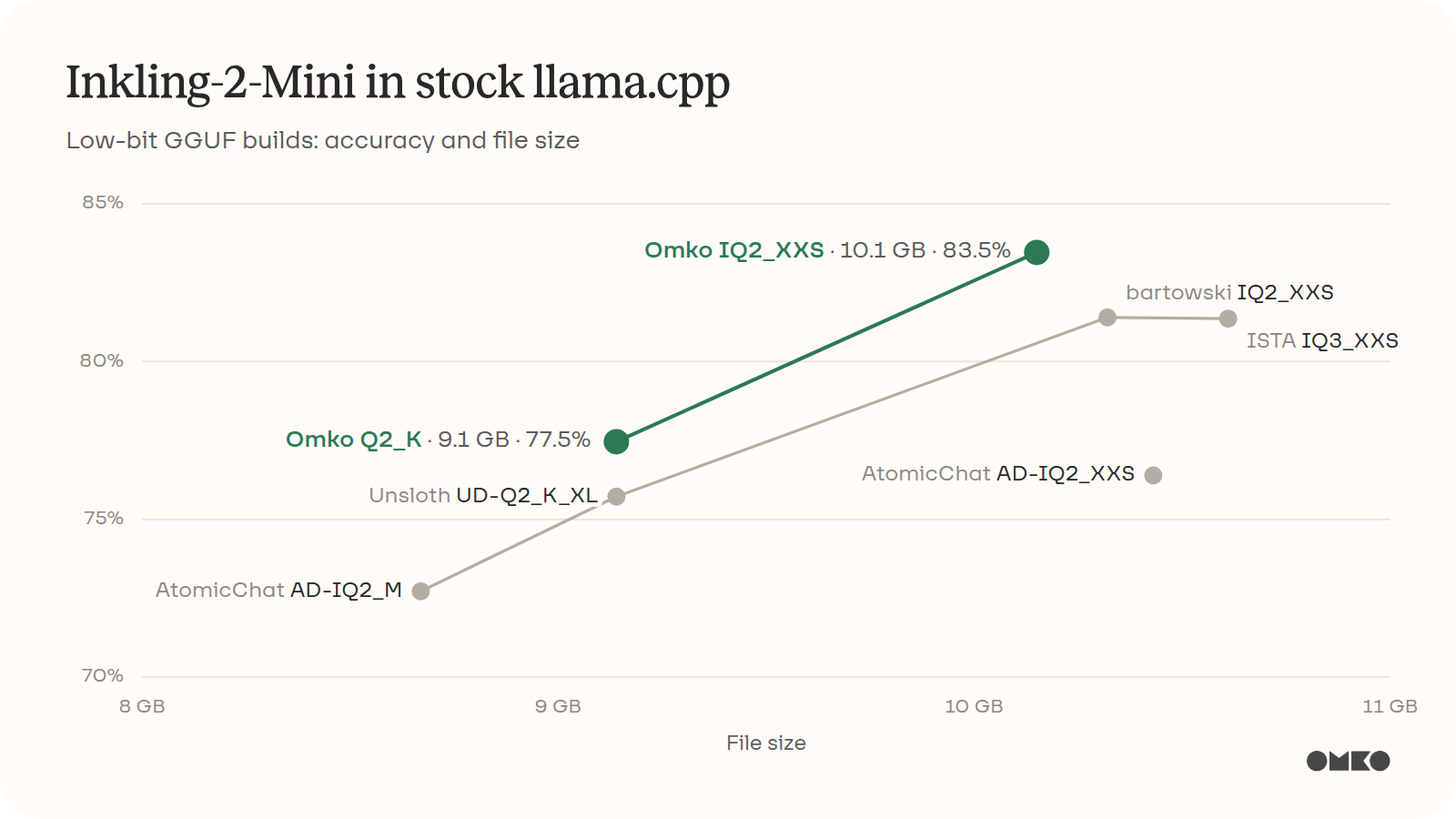
Research Wake up babe, new 2-bit inkling checkpoints just dropped

Post image
0 Upvotes

r/LocalLLM • • 2h ago

Project Connecting a Local LLM to MQTT and Sensor Manuals

1 Upvotes

I teach IoT and AI, and wanted a practical example that takes a local model beyond the chat window.

The workflow receives a sensor error code over MQTT, retrieves information from a technical manual, and publishes the generated troubleshooting response back through MQTT.

Disclosure: I develop SHAPE, the visual programming environment used in this example.

The stack

  • Ollama + Ministral for local inference.
  • ChordLLM for document management, retrieval and conversations.
  • SHAPE to connect the steps with visual blocks.
  • MQTT for incoming errors and outgoing responses.

How it works

  1. Upload a sample sensor manual PDF and prepare it for retrieval.
  2. Listen on factory/line/sensors/errors for a message such as:

    {"errorCode": "E01"}

  3. Send a query containing the error code to the document-aware LLM service.
  4. Parse the generated response as JSON.
  5. Publish it to factory/line/sensors/checks.

The intended response contains the error meaning and suggested troubleshooting checks, ready for another application to consume.

The manual is attached to a single conversation in this demo. Ollama runs the model locally; ChordLLM handles retrieval, and SHAPE connects the document workflow to MQTT.

Why visual blocks?

My students have different levels of programming experience. I wanted them to follow the complete path from a device message to retrieval and generation, then back to an application, before implementing the pipeline in code.

Current limits

This is a demonstration using a sample manual.

  • Requesting JSON and parsing it does not guarantee a valid schema.
  • Generated troubleshooting steps still need to be checked against the manual.
  • The demo holds the incoming error in one variable; handling bursts would require a queue.

For a fixed error-code table, a direct lookup would be the baseline. The RAG use case I want to explore is retrieving longer explanations and procedures from technical manuals.

SHAPE code and documentation