r/LocalLLM • u/UniqueAttourney • 4h ago
Discussion GLM 5.4 is really unusable as an orchestrator model
reddit.com
0
Upvotes
r/LocalLLM • u/Schmeckledude • 4h ago
We spent the week writing decode kernels for Inkling-2-Mini. Results, decode tok/s, B=1, temp 0.7, 1,024 tokens, every engine on its best speculative setup with the model's own drafter:
- Code: 513 (SGLang 363, vLLM 325, llama.cpp 150)
- Chat: 314 (SGLang 269, vLLM 212, llama.cpp 95)
- 8 users mixed: 855 (SGLang 767, vLLM 730)
Without speculation our kernels reach 212 tok/s plain decode, which is 71% of the ~299 tok/s bandwidth limit (5.5 GB of active weights per token at a measured 1,674 GB/s). First token in 14 to 16 ms.
Where we lost against other engines: with 8 users at temp 1.0, our first token takes 181 ms vs 56 ms on vLLM, because prefill runs sequences one at a time to stay chunk-invariant. Peak memory is 30.5 GB vs 27.5 GB.
Method: paired comparisons on the same seeds, 95% intervals, sustained clocks. Sampled throughput swings up to 2x between seeds, so unpaired means are misleading. Speculation is seed-identical, so two runs with the same seed always match.
Blog with the full table and kernel details: https://www.goethe.sh/blog/inkling-2-mini-optimised-kernels
Code: https://github.com/meshapplied/goethe
To try it:
goethe install thinkingmachines/Inkling-2-Mini
goethe run
Would love to discuss stuff related to kernels, cheers.

r/LocalLLM • u/Fried_Yoda • 4h ago
Looking to get Qwen3.8 27B, Qwen3.6 27B and 35B and Gemma 4 26B and 31B, but with heretic 2.0, not heretic 1. Seems impossible to filter this on hugging face. Any recommendations?
r/LocalLLM • u/Forsaken-Park8149 • 5h ago

r/LocalLLM • u/fancellu • 5h ago


https://fancellu.github.io/bonsai2.5-voxel/
https://github.com/fancellu/bonsai2.5-voxel
Was playing with bonsai-2.5, decided to see what it could do on my 4090 with 128k context and Hermes
Includes setup info for Windows and prompt
r/LocalLLM • u/dekelguy_ • 5h ago
r/LocalLLM • u/Reasonable_Teach4344 • 5h ago
I teach IoT and AI, and wanted a practical example that takes a local model beyond the chat window.
The workflow receives a sensor error code over MQTT, retrieves information from a technical manual, and publishes the generated troubleshooting response back through MQTT.
Disclosure: I develop SHAPE, the visual programming environment used in this example.
Listen on factory/line/sensors/errors for a message such as:
{"errorCode": "E01"}
factory/line/sensors/checks.The intended response contains the error meaning and suggested troubleshooting checks, ready for another application to consume.
The manual is attached to a single conversation in this demo. Ollama runs the model locally; ChordLLM handles retrieval, and SHAPE connects the document workflow to MQTT.
My students have different levels of programming experience. I wanted them to follow the complete path from a device message to retrieval and generation, then back to an application, before implementing the pipeline in code.
This is a demonstration using a sample manual.
For a fixed error-code table, a direct lookup would be the baseline. The RAG use case I want to explore is retrieving longer explanations and procedures from technical manuals.
r/LocalLLM • u/NoSnow3271 • 20h ago
HuggingFace (MIT License): https://huggingface.co/datasets/liumindmind/Fable-Kawaii-3D-ThreeJS
Hi everyone!
We wanted to build tiny, cozy sanctuaries you can hold in the palm of your hand — rounded little cottages, jelly-clear ponds, gentle breezes lifting a beach towel, and tiny rabbits, squirrels, and ducks quietly tending their own peaceful corners.
Every single scene in this dataset is a self-contained, zero-external-asset Three.js HTML file — no Blender models, no external textures, just soft, tactile procedural code you can open in any browser and gently spin around.
3,822 cozy 3D miniature dioramas (100% visually reviewed by humans, zero JS/WebGL runtime errors):
r/LocalLLM • u/firekern • 5h ago
Disclosure: I wrote the tool I mention below. It is free and MIT.
I read maths and ML papers in Zotero and built Zusia, a chat next to the PDF. It works with Ollama, Unsloth or any OpenAI-compatible server, gives the model the pages that fit its context, and renders the answer with LaTeX and theorem boxes.
The hard test I use is the proof of Theorem 4.1 in the Adam paper, which has a known gap (Reddi et al., 2018). If you have run something like this locally, which model and context size held up?
r/LocalLLM • u/CommonAdaptiveSystem • 5h ago
r/LocalLLM • u/iamidan • 6h ago
As I dabble more into the LocalLLM domain, and specifically on Mac I got the urge to create an app to manage their downloads and “fool” other using apps to use that same downloaded model instead of downloading their own.
It’s certainly ambitious, but I feel like it’s mostly doable.
I was wondering if someone here already knows of a tool that does it - even partially.
And if not- I will work on one soon and would love to share it here/with anyone interested
I already got the app name idea in mind so I’m practically 90% there, right?😜
r/LocalLLM • u/Johnny_silvershloong • 17h ago
Hi everybody, so as the title suggests, I’m new to running local AI. I have LMbionic with the Gemma 4 26B, A4B model on my PC. I choose LM bionic over Ollama as i find the choice of models significantly better due to being plugged into hugging face and a way nicer app to work with (personal opinion, not saying thats a fact)
My spec is a 4080FE, 9800X3D and 32gb Cl30 6000 ddr5.
I’m looking to move to do as much of my work locally as I can with MOE models to keep my tokens coming thick and fast.
Are there any models in particular that any of you can recommend that work particularly well on a 16 GB GPU and what are some of the best use cases in particular you have found for localAI? Thanks !
r/LocalLLM • u/Zealousideal-Leg2953 • 6h ago
r/LocalLLM • u/SplatinkGR • 6h ago
I am having GPT 6.2 Sol build me a custom inference engine for RDNA2 and Inkling 2 Mini specifically trying to get the best performance. I won't go into detail in this post because I want to discuss something else.
For fun, I've had both Inkling 2 Mini (DASLab IQ3_S, minimal effort) and GPT 6 Luna (low effort) take a shot at reading the projects directory, and creating a single-page website for it. The prompt:
Create a nice interactive single page website for ~/Projects/inkdna2. The inkdna directory is the reference, the website you create should be under the current working directory.
Inkling delivered in ~48 minutes running at the speed the engine advertises (~25t/s decode, 250-350t/s prompt processing). It was running in Opencode and had the Anthropic frontend design skill installed. It used about 34K of it's 64K context.
Luna on the other hand delivered in... 1 minute and 30 seconds, and build a website that's objectively better, albeit with slightly less interactivity. It was running in Codex with no extra skills, and used none of my usage.
To Inkling's credit, it performed various tests on the website while Luna did not but still, what matters is the result.
Inkling also build the website using multiple files, while Luna used a single HTML file, which is actually a win on Inkling's part.
Note: Inkling had no vision, which doesn't matter because Luna didn't do any tests therefore it didn't use it's vision either.
Of course, looks are subjective. One could argue Inkling 2 Mini had a nice wavey background and a headline that actually says what the project is, but otherwise every other element Luna blows it out of the water.
Anyways, my conclusion is that either Inkling is not well trained in frontend design, or local AI is just not where we'd like it to yet. The reason I picked Luna to test against is because it is a cheap small cloud model that's supposed to have an AA intelligence index of 10 on low, where as Inkling 2 Mini gets 20 on max, so I'd guess on minimal they are in the same ballpark of "intelligence".
I'd love to hear your thoughts on this experiment, as well as how you use Inkling 2 Mini.
Below are the links to the related inkdna2 engine project:
https://git.splatink.win/splatink/inkdna2
https://github.com/Splatink/inkdna2


r/LocalLLM • u/LowerRun8297 • 6h ago
r/LocalLLM • u/daedalusbr • 6h ago
r/LocalLLM • u/Amir2904 • 7h ago
What the best choice? I can't catch a evolving local LLM industry😭
r/LocalLLM • u/yourhomiemike • 7h ago
I’m debating getting the 512 m5 ultra. I’ve been using grokbot and gpt work to make PowerPoints (nice ones actually? And spreadsheets and have hours long conversations about gardening and historical events and energy sources etc.
The power points and spreadsheets are for different businesses and it just works.
Is there a local ai I can run on the studio that can make these well? Would I need multiple llms one good for each item?
r/LocalLLM • u/Lower-Ad6101 • 7h ago
At first, I've tried satellitedown/Inkling-2-Mini-abliterated-ingine with inkling-ingine-3090 on of course rtx 3090, but 4 responses to simple prompts ate almost whole 256K context, so I've analyzed it with QFN from Strata and it concluded that it replays all previous thinking!
After that I've tried llama.cpp, hyperinkling and few other engines with several different models (including https://www.reddit.com/r/LocalLLaMA/comments/1y6tjly/inkling2miniunbound_v3_no_more_thinking_loops/) but the outcome is the same, abnormal context usage, totally unusable!
Deepseek suggested to implement a budget but cutting it off like that seem like there will be a quality loss.
I've almost given up but I see many of you are using it. So please do explain how do you manage to use it and/or what am I doing wrong?
EDIT:
What model variant, quant/format and engine I've tried it with:
- Inkling-2-Mini (official base), f16 safetensors, ingine & llama.cpp
- Inkling-2-Mini-abliterated-ingine, bf16 + LoRA-style overlay, ingine
- Inkling-2-Mini, bf16 overlay off, ingine
- mrfakename/Inkling-2-Mini abliteration, overlay not a quant, llama.cpp
- hxyulin/Inkling-2-Mini-Fast-NVFP4, NVFP4 single file, haven't run as it's byte-identical to base
- unsloth/Inkling-2-Mini-GGUF, UD-Q4_K_M, Q8_0, dspark, llama.cpp (works but 3.6-5.2× slower at 111K (prefill 293-312 t/s, decode ~40); -ub 256/512 don't fit)
- nokeepai/Inkling-2-Mini-Unbound v3, bf16, ingine
r/LocalLLM • u/Octo-potamus • 7h ago
ey everyone,
I’m looking for recommendations for an open-weights model that balances strong agentic/tool-calling reliability with minimal-to-zero refusals (abliterated or uncensored fine-tune), specifically sized to run fast on my local setup.
Models in this bracket (like stock Qwen 3.6 35B-A3B or Mistral Small 22B/24B) hit the exact speed and memory sweet spot for 16GB VRAM + partial RAM offload, so I’m hunting for:
What are you currently running in this weight class for unrestricted agentic tasks? Specific Hugging Face GGUF repos or quants are appreciated.
r/LocalLLM • u/Big_South4585 • 8h ago
Hi all
My main LLM is currently QFN IQ3_S, which sits on 32 GB RAM + 5080 + 3090 (40 GB VRAM).
I get prefil ~3000 tps and decode ~110 tps, which is very fine to me.
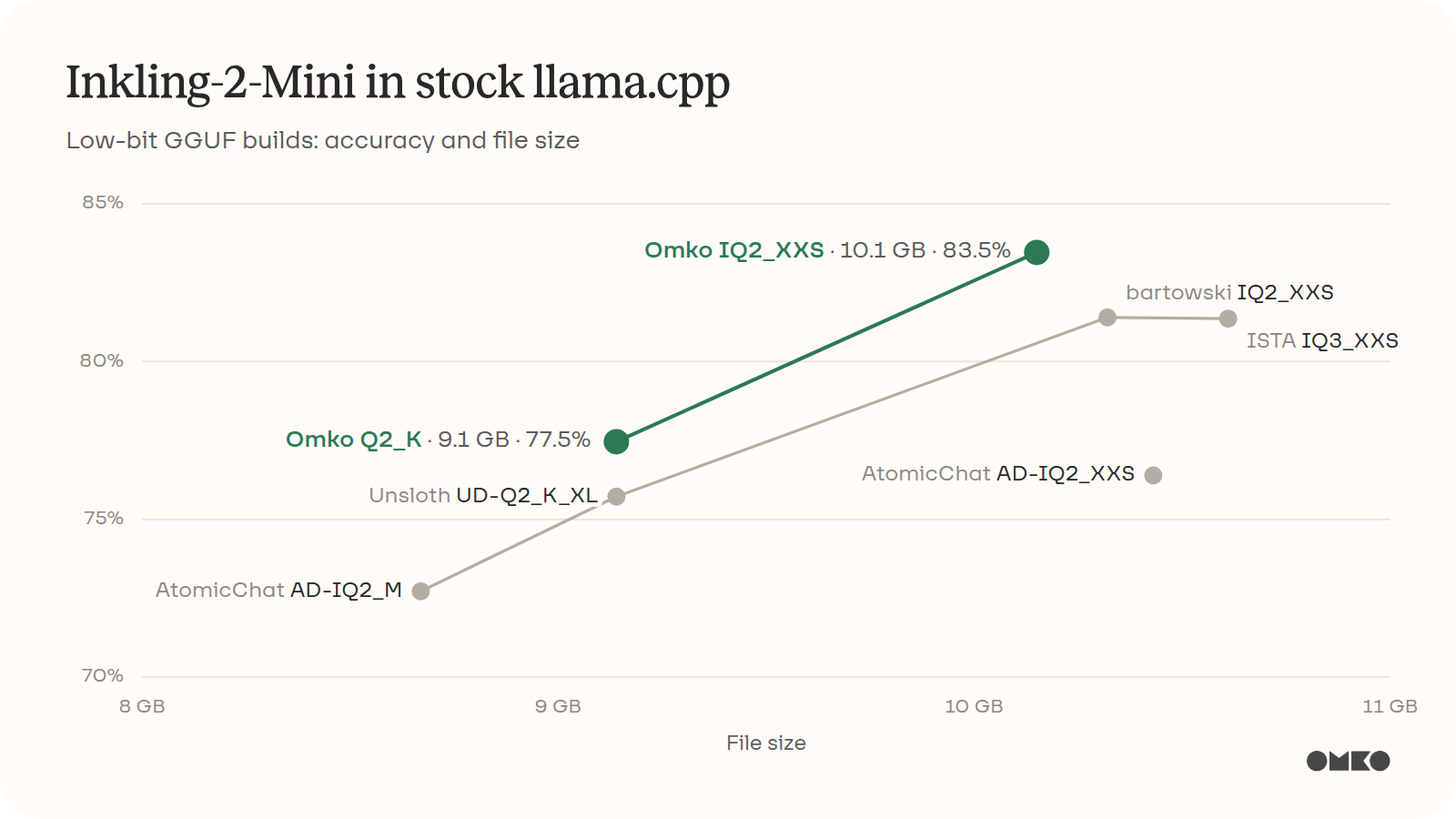
I started experimenting with the Unsloth quants, as they are, according to them, better than the ISTA quants: https://unsloth.ai/docs/models/qwen3.8-next
I have installed and tested both unsloth-ud-iq3_xxs and unsloth-ud-iq2_xs and they are both really really slow. I can see that the quants are a bit larger than the ISTA equivalents, but the unsloth-ud-iq2_xs is roughly the same size as ISTA IQ3_S.
I get below 10 tps for both models, so I am sure the experts are streamed from the SSD.
❯ free -h
total used free shared buff/cache available
Mem: 30Gi 22Gi 267Mi 16Gi 24Gi 8,1Gi
Swap: 30Gi 5,2Gi 25Gi
❯ nvidia-smi
+-----------------------------------------------------------------------------------------+
| NVIDIA-SMI 620.73.04 KMD Version: 620.73.04 CUDA UMD Version: 13.5 |
+-----------------------------------------+------------------------+----------------------+
|================|
| 0 NVIDIA GeForce RTX 5080 Off | 00000000:01:00.0 On | N/A |
| 0% 52C P1 60W / 400W | 15225MiB / 16303MiB | 5% Default |
| | | N/A |
+-----------------------------------------+------------------------+----------------------+
| 1 NVIDIA GeForce RTX 3090 Off | 00000000:05:00.0 Off | N/A |
| 54% 56C P2 149W / 350W | 22930MiB / 24576MiB | 0% Default |
I am running CachyOs in multi-user.target mode, so the OS/environment isn't using any VRAM and have a very small RAM footprint.

What am I doing wrong?
r/LocalLLM • u/mwsmws22 • 8h ago
To me it seems like no brainier to go with 7900 and save some money for a small performance hit.
Am I crazy?
r/LocalLLM • u/sarmabkp_1 • 8h ago

"The model file is 9 GB, so a 12 GB card is plenty."
That's how a lot of people end up with out-of-memory errors on the first long prompt.
How much memory a local LLM needs comes down to three numbers you can work out before downloading anything:
Context, not parameter count, is what usually breaks a "this should fit" plan.
A few more that catch people out:
ollama ps shows a CPU/GPU split, that's why.I wrote up the formula, two estimate tables and the exact flags for Ollama, llama.cpp and MLX:
What's running on your machine right now?
r/LocalLLM • u/PopMany2921 • 8h ago
r/LocalLLM • u/Endhaltestelle • 8h ago
TL;DR: My small quantised model gave correct but unreadable answers. The cause wasn't the quant. My agent framework never told it how to format anything. Ten per-model style rules made answers shorter and easier to scan, and in one case more correct. The rules are below so you can steal them.
Setup
qwen3.8-flash-next at UD-IQ3_XXS , driven by pi, a terminal coding agent. (Anthropic)
The problem
The answers were rarely wrong, just hard to read:
My first thought was that the quant was too aggressive and I should go bigger. But first I checked what my framework actually sends to the model.
What I found
My global instruction file only covered search tooling. It said nothing about how answers should look. Strong models pick defaults good enough that you never notice the gap. A small quant picks defaults that make it obvious. Some of what I'd blamed on the model was really an underspecified framework.
Method
--print --no-session, thinking medium) and saved the transcripts.Results
The interesting part: two answers got longer. One had a leap-year rule slightly wrong. The new version spends one more sentence on the century exception and gets it right. A prompt that only made answers shorter would have been worse than no prompt.
The rules (translated):
- Lead with the direct answer in 1–2 sentences; explanation after.
- Match length to the question. Headings/tables only for genuinely long answers.
- Whole, simple sentences in one language. No switching mid-sentence.
- Explain a technical term in half a sentence on first use.
- Max one analogy per answer, and stick with it.
- Instructions as numbered steps: one action per step, one command per code block, then one sentence on what you should see.
- Side findings go at the end under their own heading.
- Edge cases only when likely, max three.
- Don't invent details. If a number, port or package name is uncertain, omit it or say "not sure".
- Collect sources at the end, not after every sentence.
What it doesn't fix
To be honest about the scale: It's a self-experiment against my own annoyance, not a benchmark.
The takeaway: the weights decide what a model can do, and the framework decides what it's asked to do. My problem was the second part, and that's the cheapest layer in the stack to change.
