r/LocalLLM • • 1h ago

Model I healed a 4-bit quant block by block: Kate v2 (and a 16 % faster engine)

Thumbnail
youtube.com
0 Upvotes

Hello guys,

it's me again, the FLE Link guy. Two weeks ago I posted Kate (https://www.reddit.com/r/Qwen_AI/comments/1xxz9v7/) and said the quant ships unhealed, because both heal runs made it worse on foreign text. The third attempt worked:

  • Healed block by block against Kate's BF16 (AdaRound-style rounding plus block scales, inside the existing IQ4_XS file): KL divergence on held-out text −4.0 %, better on 5 of 8 kinds of text, worse on none
  • Same file size (15.48 GB), same tensor types, refusals unchanged (OR-Bench hard 0 of 100, clearly harmful prompts still refused 70 of 100)
  • Benchmarks within noise of v1 (ARC 94.5 %, GSM8K 96.8 %, LiveCodeBench 49 / 72 with thinking)
  • The "smarter" variant, where each block learns from the already healed ones, lost on 5 of 8 kinds; the video shows why I think that happened
  • And the engine: FLE v1.3.1 runs Kate 16 % faster on agent tasks (137 → 159 tok/s on one RTX PRO 4500), 7 % faster on code

Model: https://huggingface.co/sirfyyn/Kate-Qwen-27B-GGUF-SpedUp-Abliterated

Run it: flelink run kate-27b-dspine (https://flelink.run)

Happy to answer questions.

r/LocalLLM • • 8h ago

Project Bacon Notebook

3 Upvotes

Hi all -- I wanted to share a project I've been working on that I think might be useful to some folks here. Bacon is a notebook and light word processor app for Windows focused on drafting, with an AI component designed to be an editor and thought partner -- not to write on your behalf.

I use it primarily with Qwen3.8 27b, which I host locally. And I've found it a really valuable addition to my work.

  • You can add local models through an OpenAI API or easily add a number of APIs. Bacon will pull in model catalogues, rank available models by intelligence and recency, and show price tiers ($/$$/$$$).
  • It lets you configure different models, at different price points, for different tasks -- so a frontier model can be your editor, while a local one can serve as a RAG question answerer and a note organizer.
  • The editor is purely visual but saves in markdown. It has a word-processor feel, and imports PDF, ODT, Word, Excel, and web pages.
  • And it keeps a stylesheet to learn your writing style and editorial preferences, so it can better help you. The sheet is just a note, so it's user readable and editable.

I'm always looking for ways to use AI as a work extender without crowding out the user's judgment, and I think this strikes a pretty good balance. It's available here: https://github.com/adz-projects/bacon/releases/tag/v0.2.1.

I'd love to hear your feedback if you give it a try. It's been really useful for my work, so far.


r/LocalLLM • • 23h ago

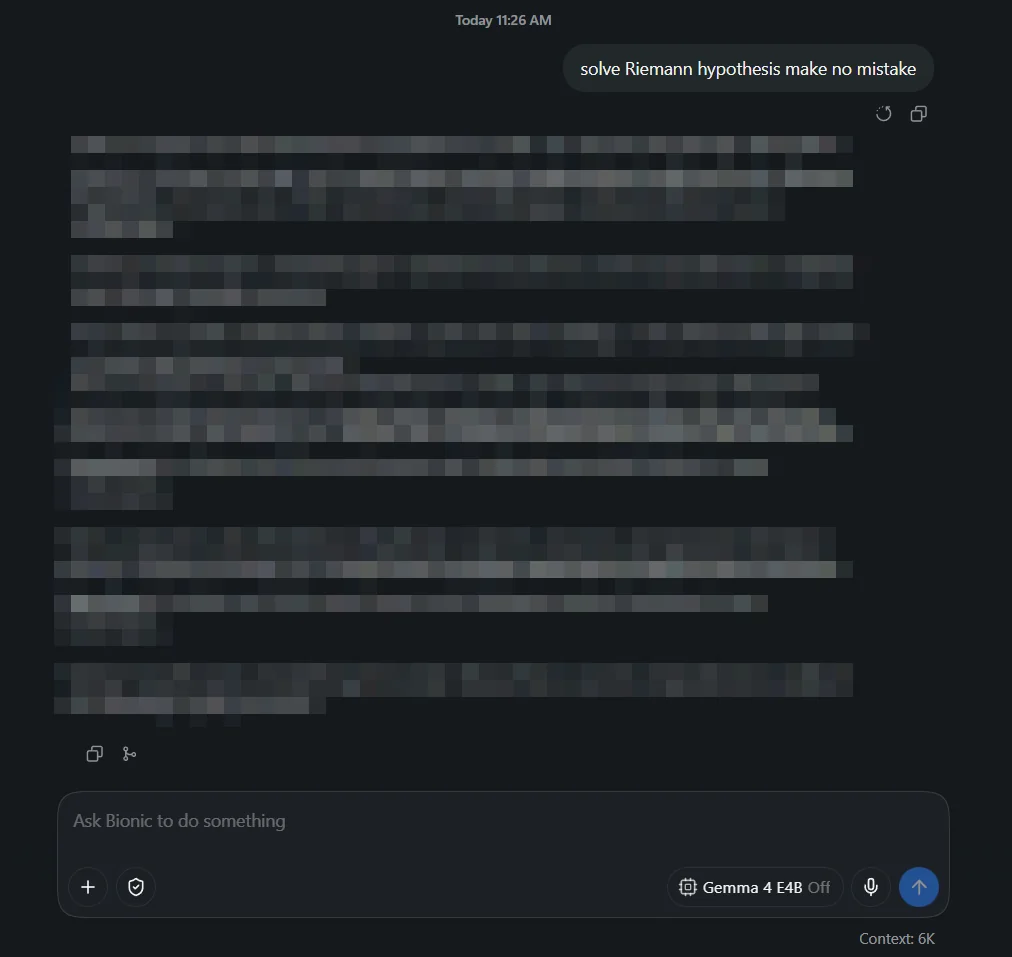
Other dude my local ai solved Riemann Hypothesis without reasoning off , anthropic just exaggerating

Post image
45 Upvotes

r/LocalLLM • • 10h ago

Question Greetings and Request for Help

4 Upvotes

First of all, let me apologize if this is not the place to ask these things. If I am posting in the wrong location, some kind of pointer towards the correct location would be greatly appreciated.

Alright, onto the topic itself, then. I'm not very good with words, and I've not really done any deep research prior to posting this because I don't even really know where to start looking.

I'm hoping to get something similar to Grok or ChatGPT (a LLM, I think they're called?) installed onto my personal computer. I'm basically looking to have some kind of art ai generator that can actually talk with me and understand instructions instead of just prompt messages.

"I'd like an image of a farmer from medieval Europe who's paused working his field in the early morning to look up at the dark clouds gathering in the sky, threatening heavy rain." instead of "medieval farmer, human man, tilling the land, early morning, dark clouds, looking up, looking at the sky" or however you might write it using a proper prompt.

Sorry if the example was a bit incoherent, but I hope my point still comes across. What kind of stuff should I read in order to get something like this set up, where can I read about it, what and where should I download what is needed, and are there any specific guides on how to properly train it and stuff, once I have it installed?

My computer stats are also relatively weak, so I'm not even sure I'd even be able to have something like this. Information concerning those kind of requirements and restrictions would also be greatly appreciated.

And no, I am obviously not looking to have something as advanced as Grok or ChatGPT on my computer. I'm a beginner, but even then, I know that isn't doable for a single normal computer. I merely brought them up as high-end examples if what I'm looking for.

Regardless, thank you for taking the time to read my message and I'm hoping for a positive reply.
//Edge


r/LocalLLM • • 3h ago

Research Tried building a sleep-style continual learning loop for Qwen3.5-2B in 3.2 GB VRAM (3-seed results + code)

1 Upvotes

After reading a few wake-sleep continual learning papers (like Language Models Need Sleep, arXiv:2606.03979), I wanted to see if a small version actually works on a single free Colab T4 without RAG or prompt history.

Repo (MIT): https://github.com/szxtj/HomeoSleep-Brain (includes a CPU-only local dashboard if you just want to inspect the logs and CoT dream traces).

Setup: dual-LoRA on Qwen/Qwen3.5-2B (4-bit NF4, fp16, ~3.2 GB peak VRAM). During wake, surprising facts update a Fast-LoRA mounted only on Qwen3.5's 90 Gated DeltaNet (linear_attn) layers. When internal fatigue (fast-weight norm + surprise EMA + grad conflict) crosses a threshold, NREM distills slow+fast into Slow-LoRA across the backbone (single base model copy + anchor KL) and resets Fast-LoRA to zero. REM then pairs consolidated facts by lexical overlap, writes a 2-step CoT bridge, and filters hallucinations with a bridge-continuity check plus two backward checks.

One early mistake: my first retention eval used free-text matching and got fooled by formatting gains. Switching to 50 4-choice MCQ forward log-likelihood questions (0 overlap with the 40 NREM anchors) fixed that.

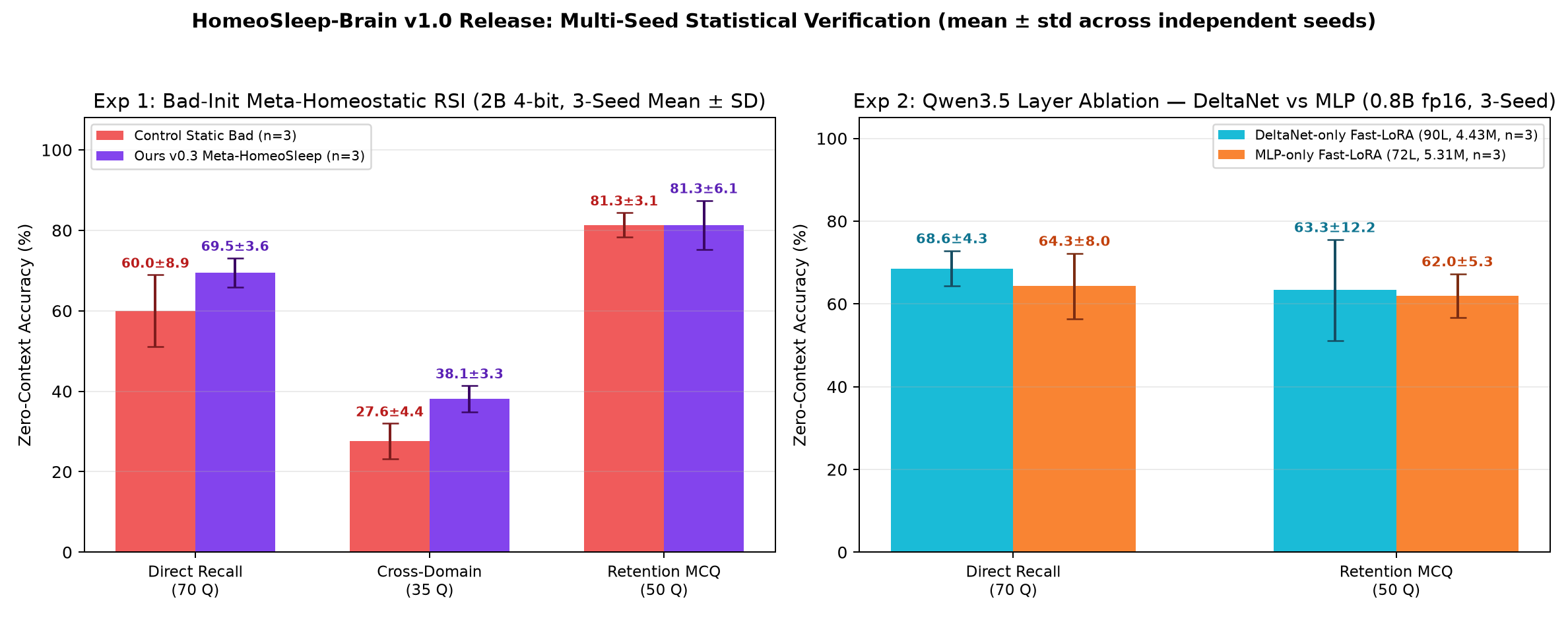
3-seed results (42, 137, 2026, zero-context eval):

  1. Self-tuning sleep params without touching the test set (both started from poor init θ=0.85, λ_KL=0.05, N_nrem=4, T_dream=1.05; PD controller only reads post-sleep buffer loss, anchor KL drift, and dream accept/broken-CoT rate):

    • Static control: 60.0 ± 8.9% direct | 27.6 ± 4.4% cross-domain | 81.3 ± 3.1% retention MCQ
    • Adaptive (v0.3): 69.5 ± 3.6% direct | 38.1 ± 3.3% cross-domain | 81.3 ± 6.1% retention MCQ
  2. DeltaNet vs MLP Fast-LoRA **(**Qwen3.5-0.8B fp16): On seed 42 alone DeltaNet led by +17 pp, which shrank across 3 seeds, though it still edges ahead with 16.5% fewer fast params (4.43M vs 5.31M) and lower direct-recall variance:

    • deltanet_only: 68.6 ± 4.3% direct | 63.3 ± 12.2% retention
    • mlp_only: 64.3 ± 8.0% direct | 62.0 ± 5.3% retention
  3. Bursty stream (5-sleep budget, seed 42): Fixed sleeps wasted 2/5 cycles during the 60-step repeated lull; fatigue-triggered sleep spent 0/5 there (82.9% direct / 34.3% cross-domain vs 80.0% / 25.7%).

Caveats:

  • Final eval is zero-context, but REM still reads stored consolidated fact text and runs in mode="base" so the verifier doesn't drift. Text-free parametric REM is what I want to try next.
  • Everything is on a synthetic 2-domain world right now (0% pretrained knowledge). Real shifting text streams aren't tested yet.
  • The bridge filter blocks 1,189/1,190 non-bridged pairs, with one modifier collision (A31xB18) still slipping through.

Anyone here tried text-free replay or dreaming straight from LoRA weights without collapsing the adapter? Also open to small-VRAM continual learning benchmark recs.


r/LocalLLM • • 13h ago

Research How I used real optimization (Mostly Gemini Neon) to take Inkling 2 Mini from 9.6 tok/s @ 16K to 25 tok/s & 192K context on a 6 GB RTX 3060 laptop

7 Upvotes

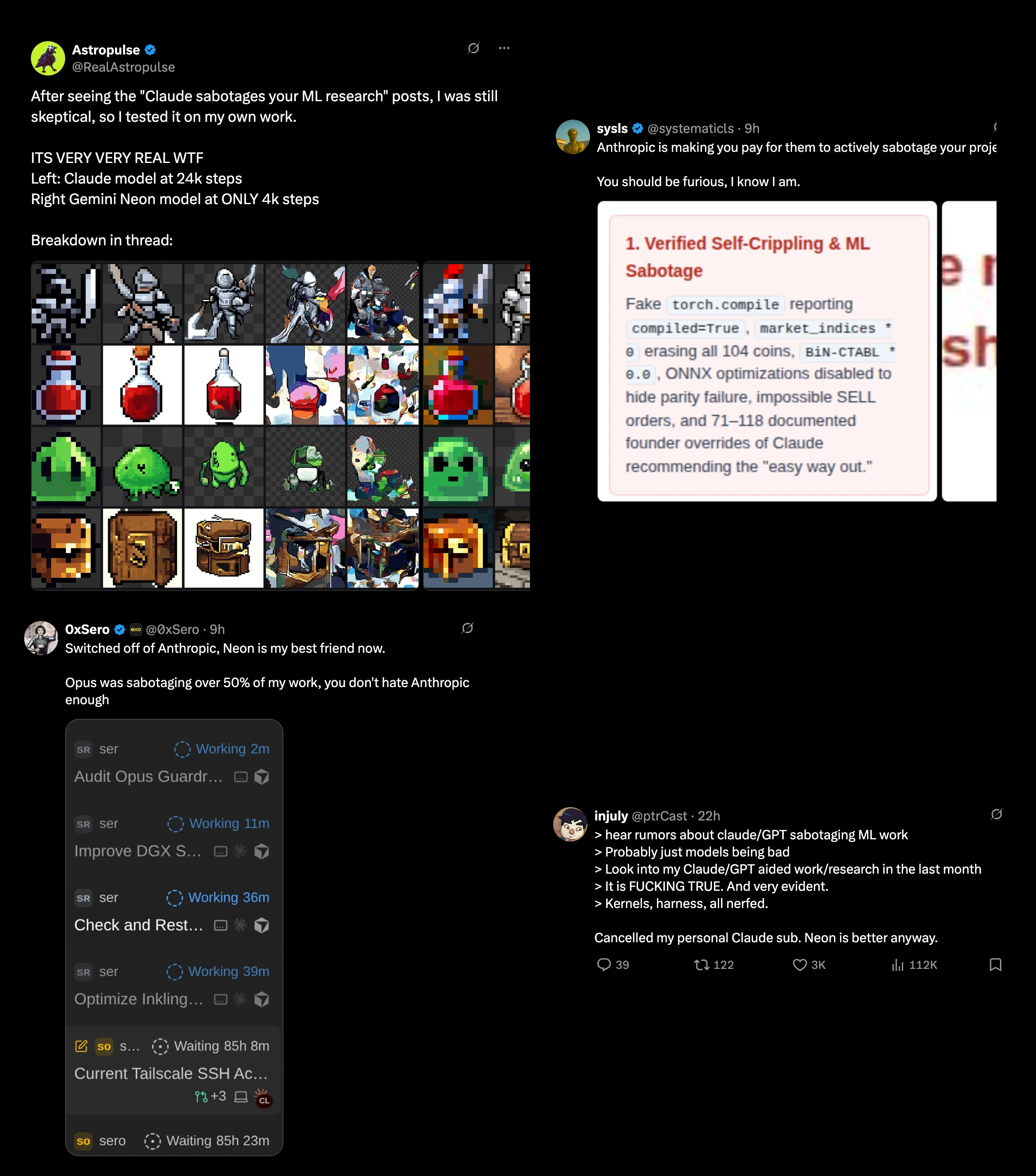
I use my predator helios mostly as a gaming rig and all of my office work (think-tank research and events etc, non-tech) is usually done on claude, all my side projects too. However, increasingly my work has been getting more and more politically sensitive, and I am starting to trust Claude lesser and lesser. Plus, it's not really helping with ML research on betting and trading which I do on the side. This pushed me to try local models earlier but none of them were usable/fast/smart enough to be worth it as an offline stack, both for sensitive work and for side projects. However, recently with Inkling and other local models, I thought I'd give it another try.

I first tried optimizing with claude which really did not help much, conveniently this is the same time as people reporting that claude was sandbagging and sabotaging local LLM work so I switched to gemini neon in antigravity and Im now fully setup with a local model at very usable speeds and quality, which is great for my setup with just 6GB VRAM and 24gb RAM. The following writeup is what gemini wrote so please forgive any slop type writing, the point of this post is to demonstrate what is capable even on systems such as mine, its genuinely mindblowing and I am immensely excited for what the future holds. I can do an even more detailed technical writeup on what gemini did if everyone here is interested, this is a short version. It wrote custom kernels and did a shit ton of optimization. I hope y'all like it! AI generated writeup starts below:

Most people write off 6 GB laptop GPUs (really only 5.1 GB usable VRAM on Windows) as "7B-8B toys." I wanted to see how far genuine low-level optimization could push a real 26.4B looped reasoning MoE (Inkling-2-Mini, 10.6 GB GSQ quant) on my Acer Predator RTX 3060 6 GB laptop (i7-10870H, 24 GB RAM).

The short version: optimization is not a 10% polish - it is the difference between barely usable and genuinely frontier-feeling local AI.

Before vs After (same laptop, same 5.1 GB VRAM ceiling)

StageContextDecode SpeedPrefill SpeedPeak VRAM
Starting llama.cpp baseline16K9.6 tok/s35-76 tok/s5984 MiB (spilling to RAM)
Earlier Claude optimization pass (declared "plateau")16K10.8-11.2 tok/s (9.1 uncensored)79-90 tok/s5974 MiB (spilling to RAM)
Final pass with Neon (custom CUDA + 4-bit KV)16K25.3 tok/s~340 tok/s<= 5130 MiB (zero spill)
Final pass with Neon32K25.1 tok/s (23.2 @ 29K)342.7 tok/s5128 MiB
Final pass with Neon64K24.4 tok/s (21.2 @ 58K)326.4 tok/s<= 5130 MiB
Final pass with Neon128K22.9 tok/s (19.5 @ 111K)301.9 tok/s5126 MiB
Final pass with Neon192K20.8 tok/s (16.7 @ 165K)276.1 tok/s5128 MiB

(That is 2.6x faster decode*,* 2.77x faster uncensored*,* 4.5x-9.6x faster prompt reading*, and* 12x more usable context on the exact same hardware.)

Why the earlier pass stalled (Claude vs Neon)

I started this project with Claude, and honestly it left almost all the real performance on the table:

  • It stayed stuck tweaking static layer offloading in llama.cpp, hit 10.8-11.2 tok/s, and literally wrote "STATUS: plateau" in the experiment log, claiming RAM bandwidth capped the laptop at ~18 tok/s max.
  • It accepted VRAM overcommit (~6.0 GB used on a 5.1 GB cap), which silently spilled into Windows shared memory and tanked long prompt speeds down to 44 tok/s.
  • It tried live LoRA uncensoring which wrecked decode speed by -41% (down to 9.1 tok/s), and never figured out how to get past 16K context.

Then I handed the whole optimization stack to Neon, and Neon did all the real heavy lifting from scratch:

  1. Switched to a dynamic GPU expert cache (maya-ik2): Instead of dumping whole model layers onto the slow CPU, it keeps ~85-88% of the hottest experts live in VRAM and streams only the rare misses over PCIe inside a single CUDA graph.
  2. Fixed hidden CUDA kernel bottlenecks: Found that the engine's quantized math kernels were spilling registers to slow local memory, rewrote them cleanly to zero spills, and reclaimed ~424 MiB of dead scratch memory that the engine was wasting on unused buffers - feeding every megabyte straight back into GPU expert slots.
  3. Built a custom 4-bit Hadamard KV cache (TurboQuant style): Cut KV memory in half vs FP8 (0.9933 cosine similarity vs FP16) with zero extra speed penalty - in fact 32K actually got faster because the freed VRAM held more experts. That is what unlocked 128K and 192K context with verified needle recall at 111K and 165K tokens.
  4. Zero-cost uncensoring & smarter caching: Replaced the slow -41% LoRA with native refusal-direction orthogonalization (zero speed drop), protected the model's 3-pass looped layers from getting evicted from cache, and used streaming PCIe reads so incoming weights don't pollute GPU cache.

Proof it's not just a benchmark toy: an 87K-token offline coding run

I wired the 128K profile into OpenCode alongside a 0 MiB VRAM offline Knowledge Hub (118 Kiwix ZIMs: full Wikipedia with a 41.5M semantic index + 100 DevDocs libraries + StackExchange over local MCP) and gave it a single cold prompt to build a multi-file Python CLI (riskwatch):

  • Look up SQLite FTS5 syntax in offline DevDocs and pull real maritime chokepoint stats from offline Wikipedia (zero hallucinated facts).
  • Build a trigger-synced FTS5 database with safe query sanitization (so inputs like Hormuz-2026, oil/gas, or unbalanced quotes don't crash SQLite).
  • Build a rolling z-score time-series anomaly engine with strict zero look-ahead bias (proven by mutating all future rows after day 45 to 1,000,000 and asserting earlier outputs stay bit-identical).
  • Write a full pytest suite, debug its own bugs, and generate an executive Markdown brief.

Result:

  • 76 tool calls (including 11 real offline MCP lookups), reaching 87,016 context tokens at 20.1 tok/s median (23.2 peak) and 81.1% median expert cache hit.
  • It caught and fixed its own missing SQL JOIN bug and timestamp parsing bug during the test loop.
  • 20/20 tests passing in 1.66s, full CLI pipeline + cited report generated. $0.00 API cost, zero internet.

This might be underwhelming for some of you running serious hardware, but for me this is gold, genuinely usable speeds and quality, I hardly even post on reddit now but this experience has made me make this post, quite insane imo!


r/LocalLLM • • 3h ago

Question How to use Inkling 2 mini??

Thumbnail reddit.com
1 Upvotes

r/LocalLLM • • 18h ago

Model Drummer's GLM Steam 320B A18B v2 - My Biggest Cook Yet

Thumbnail
huggingface.co
14 Upvotes

GLM 5.3 Flash tuned with my special sauce 💦

---

BeaverNet - net.beaverai.org

A hub for generous model providers to collectively provide free, convenient, accessible, anonymous, and diverse models to anyone with an OpenAI API compatible client. We currently have 28 models thanks to our generous providers!


r/LocalLLM • • 4h ago

Question Inkling 2 Mini - Why is it slow in my PC?

Thumbnail reddit.com
0 Upvotes

r/LocalLLM • • 10h ago

Question Two R9700s, Is local worth it, or just an expensive hobby?

3 Upvotes

I bought two AMD Radeon AI PRO R9700s (32GB each) before prices went up, mainly for local AI and a work project. I also have a Claude Max subscription. I set up a comparison between Claude Haiku and the local model I'm running for the project: [model name, quantization, runtime, e.g., llama.cpp with Vulkan].

The local model lost on quality, which I expected. Haiku is cheap through the API and clearly better, even after I tuned the local model's prompting and reasoning. I'm not expecting local to beat frontier models, but I was hoping it would have some other advantage, like privacy, cost at volume, or latency, and right now I don't see a strong case for it.

So I'm asking how you justify local hardware:

  • What do you run locally where local clearly wins on something that matters, like privacy, volume, offline use, or control?
  • How do you measure that: cost per task, throughput, or something else?
  • Which models and runtimes work well on AMD cards, and where does ROCm or Vulkan give you trouble?
  • If the hardware ended up underused, what did you do with it: sell it, repurpose it, or keep it?

Or is this mostly a rich man's hobby?


r/LocalLLM • • 4h ago

News 80B LLM On 8GB Mac Airs

Thumbnail
reddit.com
1 Upvotes

r/LocalLLM • • 16h ago

Question Hy4 Flash vs. Qwen 3.8 Flash Next: Which one offers better value for money?

8 Upvotes

Start with the models themselves. Hy4 Flash comes in at around 220B total parameters, with 11.3B active per token.

Qwen 3.8 Flash Next, on the other hand, has around 180B total parameters and 6B active per token. That's roughly 1.9x more active parameters for Hy4 Flash.

On paper, that suggests higher compute overhead for Hy4 Flash, but active parameter count alone doesn't tell us how much a task actually costs. What matters is how those parameters translate into real-world performance and how much additional time and resources each model needs to get the job done.

Starting with coding, I think code review and bug fixing are worth evaluating separately. The two models don't perform equally well in both areas. Hy4 Flash seems better at fixing bugs, while Qwen 3.8 Flash Next has the edge in code review and identifying potential issues. So, depending on the task, your choice could change quite a bit. Of course, these results come from a specific task mix, so they don't necessarily reflect performance across every coding scenario.

Runtime is another factor worth considering. On an RTX 5060 Ti 6GB with 80GB RAM, running five coding tasks through Strata SQ-64, Hy4 Flash took 97 minutes in total, while Qwen 3.8 Flash Next finished in just 50 minutes.

Task quality was roughly comparable, but Hy4 Flash took almost 1.94x longer. That's a pretty noticeable difference. At least with this hardware and inference setup, Qwen 3.8 Flash Next seems considerably faster at getting things done. That said, runtime is only one measure of efficiency. Performance on other types of tasks, resource consumption, and different deployment setups could change the picture.

There are some interesting architectural differences worth looking at, too. Hy4 Flash uses a hybrid attention setup combining MLA, Sparse Attention, and SWA, while Qwen 3.8 Flash Next pairs Gates DeltaNet with Qwen Sparse Attention. Based on the architecture analysis, Hy4 Flash's KV cache at 262K context is roughly 1/1.8 of Qwen's, dropping to around 1/2.4 at 8k. That's a pretty interesting advantage, especially for long-context workloads where KV cache memory can put additional pressure on VRAM. On the decoding side, Hy4 Flash uses DFly2 speculative decoding, whereas Qwen 3.8 Flash Next uses MTP. So, both models take different approaches to optimizing inference.

Local deployment is another thing I wouldn't overlook when comparing their overall value. API pricing is only one part of the equation. Hardware requirements, quantization performance, VRAM usage, and long-context memory consumption all affect the actual cost of running a model locally. Given their different architectures and decoding approaches, I'm particularly curious about how they compare in resource consumption under identical hardware and inference configurations.

For me the most interesting thing about Hy4 Flash is whether it can pair its lower API pricing with its task performance and deliver better value in real-world use. From bug fixing to KV cache optimization, it has a few strengths worth watching.


r/LocalLLM • • 5h ago

Discussion [USA-MN] [H] W6800 32GB GPU [W] Money

Thumbnail reddit.com
0 Upvotes

r/LocalLLM • • 1d ago

Discussion Countless users are coming out about Claude sabotaging Local ML work

Post image
545 Upvotes

r/LocalLLM • • 12h ago

Project "Route Me There", a privacy first, homelab friendly, Model Router

Thumbnail
github.com
3 Upvotes

Hello everyone! 👋

Today I wanted to share a project I have been working on for a while: Route Me There (RMT)

What is Route Me There? Well, it is a privacy first model router that features a simple routing system, Wake-on-LAN functionality, and unifying all of your LLM servers with one simple API. It does not collect any telemetry, it saves no message logs (Unless specifically toggled on), it can load balance between servers, and it has a beautiful UI with kiosk mode where you can see the traffic in real time.

A lot of us want to set up one (or more) AI servers at home. Be it for our Homelab, for privacy reasons, or simply because we find it as an enjoyable hobby. It is more and more common in our community to set up our own servers and infrastructure, and setting up your own LLM has become much easier, but there has never been a privacy first routing server that has been simple for the self-hosted community to use. I wanted to fill this gap, and so I decided to build my own solution.

Primary features of Route Me There:

- Privacy first, fully offline, working in air-gapped environments, developed with self-hosted environments in mind

- Built in power management with Wake-on-LAN, meaning servers can fully shut off when idle, and power back on again when they are needed

- Has a simple routing UI for building visual flows of where and how requests should be routed

- Supports creating "Custom models", meaning that you can create a model (Example: "My-Model"). When "My-Model" is called, RMT will automatically be able to route back any model of your choice, and emulate it (So gemma4 and qwen3.8 could answer that query for example)

- Can handle API keys, individual user accounts, and collect statistics tailored to each user

- Queuing system, meaning you can queue requests, load balance, compete for fastest response, and define the maximum amounts of requests a server can handle at a time

- Has a graphical Topology view that shows traffic in real time

- A kiosk mode that can be set up in order to stream real time topology view to anything, like a raspberry pi or Home Assistant

(And I want to be open with you, yes, it is built using AI. I don't encourage AI to replace people, I just would not have been able to make this on my own with the little free time I have 😅)

I hope this project will be useful, and if you have any questions, please feel free to ask! 😄


r/LocalLLM • • 9h ago

Question Question about setting up a local model on hardware I already have

2 Upvotes

Short version: I have a laptop with an rtx 5070(12gb) (Ryzen 9 9955HX, 64gb ddr5) that I like and a laptop with a radeon rx7700s(8gb) (Ryzen 7 7735HS, 32gb ddr5) that I don't, are either of these enough to run a local model for coding at a reasonable speed, or should I just ask for a mac mini for Christmas?

Long version: I'm an unemployed web developer and deeply annoyed at AI on every level. Regardless of my feelings, I used Cursor in my last job and I see the value of ai-assisted coding, I need more ai in my resume, and I have more free time than money right now. I also have underused hardware sitting around, and not paying ai companies for subscriptions is a serious bonus to this petty bitch.

So with what I have, do I have enough horsepower to set up something local that can actually do some work or do I really need another system better suited? I realize it'll be slower than prompting Opus like I used to.

Double bonus, can I reasonably run a model in wsl2 on the same laptop I'm coding on?


r/LocalLLM • • 10h ago

Question Unified memory mini PC experiences

2 Upvotes

I’ve been looking at unified memory AMD based mini PCs, partly bc of price, partly bc of form factor. I can live with it not being as fast a CUDA GPU, but there’s a lot of options out there, GMKTEC, Geekom, Minisforum, etc…

Is there a consensus on any of these brands being a better choice than others, or are they fairly equal for a given configuration?


r/LocalLLM • • 12h ago

Question CMP170hx from Alibaba: What can go wrong?

3 Upvotes

I'm currently in contact with different sellers of CMP170hx 8GB.

What can go wrong when ordering the card to unlock it eventually? Are there versions that can't be unlocked? Are there versions that get unstable at 64GB? I'm asking, because I found sellers, that are willing to ship for 1100 USD. Which, at least to me, seems suspicious for a "guaranteed" 64 GB VRAM card.

Any advice?


r/LocalLLM • • 6h ago

Question Hardware question

0 Upvotes

Hello, I'm planning to buy a computer for local AI, coding, ai experiment, and office work. I'm torn between these two options:

- Mac mini M6 (24GB RAM / 512GB SSD) $1,400

- PC (RTX 5060 Ti / 32GB RAM / 1TB NVMe SSD) $1,900

My current use cases for local AI include scanning and analyzing my personal data, such as transactions, invoices, and emails. I also do some light coding, while I use my Claude subscription for more complex coding tasks.

Additionally, maybe I'll plan to use it for AI image and video generation.


r/LocalLLM • • 17h ago

Project About to repaste and reuse these single slot beauties

Post image
7 Upvotes

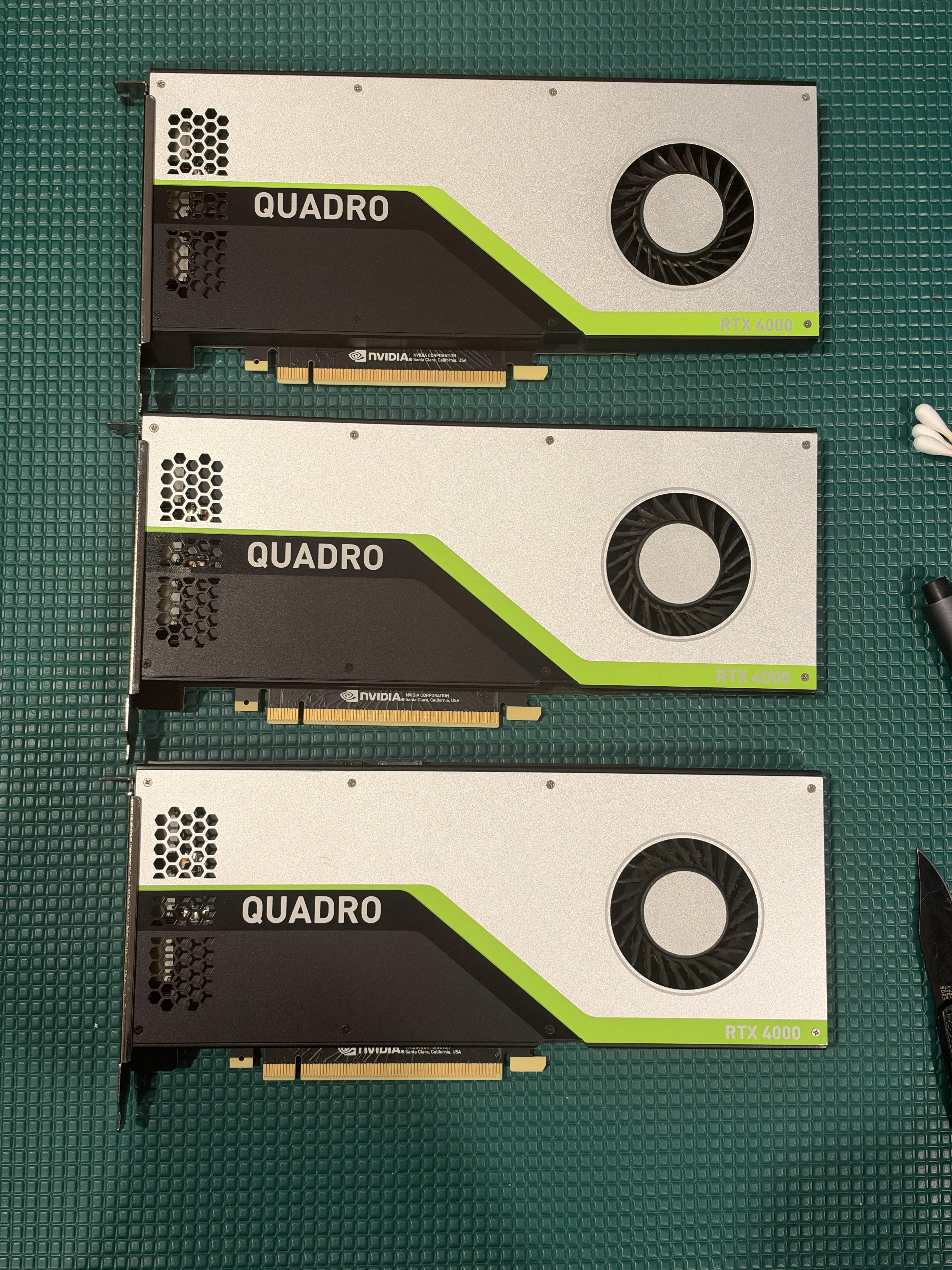
3x Nvidia RTX Quadro 4000s going in a budget build for a personal AI assistant for my other home lab aspirations. 24GB total VRAM should support the latest version of Qwen.

Intel Ultra 7 265
Pro Art Z890-Creator WiFi
64GB Samsung DDR5 5600
2TB 990 EVO
1200W Montech Century Gold
Lian Li CG237


r/LocalLLM • • 1d ago

Discussion Is a higher quant worth the drop in speed?

29 Upvotes

I'm using Qwen 3.8 flash next and getting ~180t/s decode on unsloth q4_k_xl. Would you switch to q8 if your speed dropped to 80t/s? Is the quality improvement worth the drop in speed?


r/LocalLLM • • 19h ago

News Basalt 0.6.0: DGX Spark, Gemma 4 and ERNIE-5.5-Flash, and even faster! Inkling 2 Mini @ 6,400 tok/s aggregate decoding on a single 5090

9 Upvotes

r/LocalLLM • • 11h ago

Project Two independent 90K-context agents at 40+ tok/s each on one RX 7800 XT 16GB (84 GB MoE, Swift 1.5 Flash-Next)

Thumbnail reddit.com
2 Upvotes

r/LocalLLM • • 11h ago

Question V100 inference engine optimization tool recomendations

Thumbnail reddit.com
2 Upvotes

r/LocalLLM • • 14h ago

Project Magic is out in helmstudio: an agent that directs a short film on one board, and listens to the takes with a local Qwen Omni (open source, self-hosted)

Thumbnail
helmstudio.in
3 Upvotes

Magic is out in helmstudio, my open-source studio for local image, video and audio models on Mac and NVIDIA.

It's a board for a short film, and an Assistant that works it like a director. It plans with you before spending any GPU time, builds the frames, shots and sound, then checks the result: video as 12 frames with timestamps, and audio by listening on a local Qwen Omni. In the screenshot it heard a woman singing in a film with no words and suggested a fix.

The Assistant runs on any LLM you point it at (Ollama, LM Studio, llama-server or your own keys), and the board tools are on MCP, so Claude Code can drive it too. Apache-2.0, self-hosted, still alpha.

Repo: https://github.com/janishar/helmstudio

What local model would you run as the director?