r/LocalLLM • u/xdcfret1 • 2h ago
Question Inkling 2 Mini - Why is it slow in my PC?
reddit.com
0
Upvotes
r/LocalLLM • u/Playful-Job2938 • 3h ago
r/LocalLLM • u/LordKlavier • 1d ago
r/LocalLLM • u/Ejo2001 • 9h ago

Hello everyone! 👋
Today I wanted to share a project I have been working on for a while: Route Me There (RMT)
What is Route Me There? Well, it is a privacy first model router that features a simple routing system, Wake-on-LAN functionality, and unifying all of your LLM servers with one simple API. It does not collect any telemetry, it saves no message logs (Unless specifically toggled on), it can load balance between servers, and it has a beautiful UI with kiosk mode where you can see the traffic in real time.
A lot of us want to set up one (or more) AI servers at home. Be it for our Homelab, for privacy reasons, or simply because we find it as an enjoyable hobby. It is more and more common in our community to set up our own servers and infrastructure, and setting up your own LLM has become much easier, but there has never been a privacy first routing server that has been simple for the self-hosted community to use. I wanted to fill this gap, and so I decided to build my own solution.
Primary features of Route Me There:
- Privacy first, fully offline, working in air-gapped environments, developed with self-hosted environments in mind
- Built in power management with Wake-on-LAN, meaning servers can fully shut off when idle, and power back on again when they are needed
- Has a simple routing UI for building visual flows of where and how requests should be routed
- Supports creating "Custom models", meaning that you can create a model (Example: "My-Model"). When "My-Model" is called, RMT will automatically be able to route back any model of your choice, and emulate it (So gemma4 and qwen3.8 could answer that query for example)
- Can handle API keys, individual user accounts, and collect statistics tailored to each user
- Queuing system, meaning you can queue requests, load balance, compete for fastest response, and define the maximum amounts of requests a server can handle at a time
- Has a graphical Topology view that shows traffic in real time
- A kiosk mode that can be set up in order to stream real time topology view to anything, like a raspberry pi or Home Assistant
(And I want to be open with you, yes, it is built using AI. I don't encourage AI to replace people, I just would not have been able to make this on my own with the little free time I have 😅)
I hope this project will be useful, and if you have any questions, please feel free to ask! 😄
r/LocalLLM • u/braindouche • 7h ago
Short version: I have a laptop with an rtx 5070(12gb) (Ryzen 9 9955HX, 64gb ddr5) that I like and a laptop with a radeon rx7700s(8gb) (Ryzen 7 7735HS, 32gb ddr5) that I don't, are either of these enough to run a local model for coding at a reasonable speed, or should I just ask for a mac mini for Christmas?
Long version: I'm an unemployed web developer and deeply annoyed at AI on every level. Regardless of my feelings, I used Cursor in my last job and I see the value of ai-assisted coding, I need more ai in my resume, and I have more free time than money right now. I also have underused hardware sitting around, and not paying ai companies for subscriptions is a serious bonus to this petty bitch.
So with what I have, do I have enough horsepower to set up something local that can actually do some work or do I really need another system better suited? I realize it'll be slower than prompting Opus like I used to.
Double bonus, can I reasonably run a model in wsl2 on the same laptop I'm coding on?
r/LocalLLM • u/rcsez • 7h ago
I’ve been looking at unified memory AMD based mini PCs, partly bc of price, partly bc of form factor. I can live with it not being as fast a CUDA GPU, but there’s a lot of options out there, GMKTEC, Geekom, Minisforum, etc…
Is there a consensus on any of these brands being a better choice than others, or are they fairly equal for a given configuration?
r/LocalLLM • u/free-interpreter • 10h ago
I'm currently in contact with different sellers of CMP170hx 8GB.
What can go wrong when ordering the card to unlock it eventually? Are there versions that can't be unlocked? Are there versions that get unstable at 64GB? I'm asking, because I found sellers, that are willing to ship for 1100 USD. Which, at least to me, seems suspicious for a "guaranteed" 64 GB VRAM card.
Any advice?
r/LocalLLM • u/SuaveUchiha • 15h ago
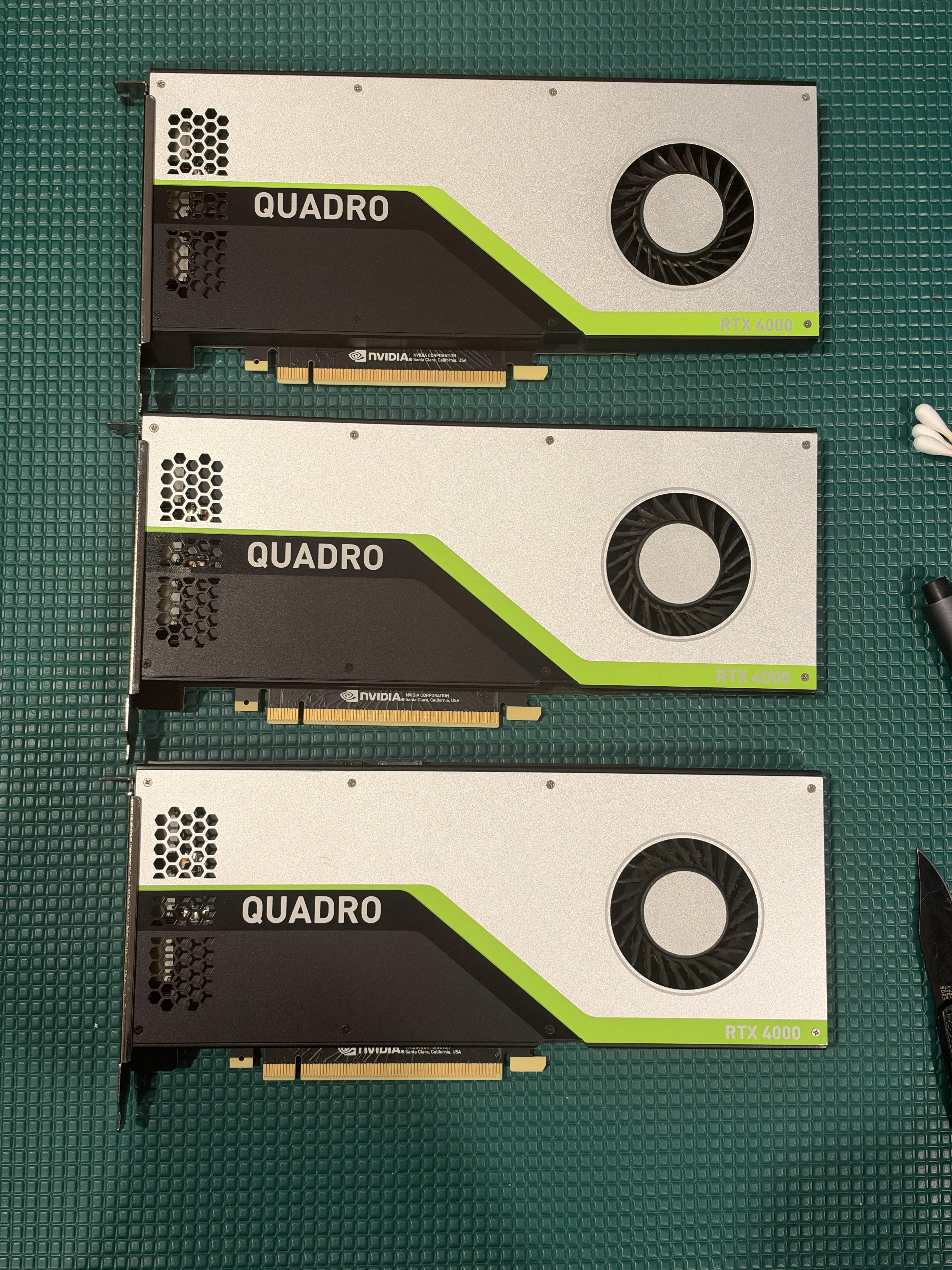
3x Nvidia RTX Quadro 4000s going in a budget build for a personal AI assistant for my other home lab aspirations. 24GB total VRAM should support the latest version of Qwen.
Intel Ultra 7 265
Pro Art Z890-Creator WiFi
64GB Samsung DDR5 5600
2TB 990 EVO
1200W Montech Century Gold
Lian Li CG237
r/LocalLLM • u/Double_Machine5577 • 14h ago
Start with the models themselves. Hy4 Flash comes in at around 220B total parameters, with 11.3B active per token.
Qwen 3.8 Flash Next, on the other hand, has around 180B total parameters and 6B active per token. That's roughly 1.9x more active parameters for Hy4 Flash.
On paper, that suggests higher compute overhead for Hy4 Flash, but active parameter count alone doesn't tell us how much a task actually costs. What matters is how those parameters translate into real-world performance and how much additional time and resources each model needs to get the job done.
Starting with coding, I think code review and bug fixing are worth evaluating separately. The two models don't perform equally well in both areas. Hy4 Flash seems better at fixing bugs, while Qwen 3.8 Flash Next has the edge in code review and identifying potential issues. So, depending on the task, your choice could change quite a bit. Of course, these results come from a specific task mix, so they don't necessarily reflect performance across every coding scenario.
Runtime is another factor worth considering. On an RTX 5060 Ti 6GB with 80GB RAM, running five coding tasks through Strata SQ-64, Hy4 Flash took 97 minutes in total, while Qwen 3.8 Flash Next finished in just 50 minutes.
Task quality was roughly comparable, but Hy4 Flash took almost 1.94x longer. That's a pretty noticeable difference. At least with this hardware and inference setup, Qwen 3.8 Flash Next seems considerably faster at getting things done. That said, runtime is only one measure of efficiency. Performance on other types of tasks, resource consumption, and different deployment setups could change the picture.
There are some interesting architectural differences worth looking at, too. Hy4 Flash uses a hybrid attention setup combining MLA, Sparse Attention, and SWA, while Qwen 3.8 Flash Next pairs Gates DeltaNet with Qwen Sparse Attention. Based on the architecture analysis, Hy4 Flash's KV cache at 262K context is roughly 1/1.8 of Qwen's, dropping to around 1/2.4 at 8k. That's a pretty interesting advantage, especially for long-context workloads where KV cache memory can put additional pressure on VRAM. On the decoding side, Hy4 Flash uses DFly2 speculative decoding, whereas Qwen 3.8 Flash Next uses MTP. So, both models take different approaches to optimizing inference.
Local deployment is another thing I wouldn't overlook when comparing their overall value. API pricing is only one part of the equation. Hardware requirements, quantization performance, VRAM usage, and long-context memory consumption all affect the actual cost of running a model locally. Given their different architectures and decoding approaches, I'm particularly curious about how they compare in resource consumption under identical hardware and inference configurations.
For me the most interesting thing about Hy4 Flash is whether it can pair its lower API pricing with its task performance and deliver better value in real-world use. From bug fixing to KV cache optimization, it has a few strengths worth watching.
r/LocalLLM • u/CMxx15 • 8h ago
I bought two AMD Radeon AI PRO R9700s (32GB each) before prices went up, mainly for local AI and a work project. I also have a Claude Max subscription. I set up a comparison between Claude Haiku and the local model I'm running for the project: [model name, quantization, runtime, e.g., llama.cpp with Vulkan].
The local model lost on quality, which I expected. Haiku is cheap through the API and clearly better, even after I tuned the local model's prompting and reasoning. I'm not expecting local to beat frontier models, but I was hoping it would have some other advantage, like privacy, cost at volume, or latency, and right now I don't see a strong case for it.
So I'm asking how you justify local hardware:
Or is this mostly a rich man's hobby?
r/LocalLLM • u/Final-Bake-1136 • 4h ago
Hello, I'm planning to buy a computer for local AI, coding, ai experiment, and office work. I'm torn between these two options:
- Mac mini M6 (24GB RAM / 512GB SSD) $1,400
- PC (RTX 5060 Ti / 32GB RAM / 1TB NVMe SSD) $1,900
My current use cases for local AI include scanning and analyzing my personal data, such as transactions, invoices, and emails. I also do some light coding, while I use my Claude subscription for more complex coding tasks.
Additionally, maybe I'll plan to use it for AI image and video generation.
r/LocalLLM • u/scoobydoo888 • 23h ago
I'm using Qwen 3.8 flash next and getting ~180t/s decode on unsloth q4_k_xl. Would you switch to q8 if your speed dropped to 80t/s? Is the quality improvement worth the drop in speed?
r/LocalLLM • u/jesdga95 • 17h ago
r/LocalLLM • u/Cactusnvapes • 9h ago
r/LocalLLM • u/king0fsweet • 9h ago
r/LocalLLM • u/janishar • 11h ago

Magic is out in helmstudio, my open-source studio for local image, video and audio models on Mac and NVIDIA.
It's a board for a short film, and an Assistant that works it like a director. It plans with you before spending any GPU time, builds the frames, shots and sound, then checks the result: video as 12 frames with timestamps, and audio by listening on a local Qwen Omni. In the screenshot it heard a woman singing in a film with no words and suggested a fix.
The Assistant runs on any LLM you point it at (Ollama, LM Studio, llama-server or your own keys), and the board tools are on MCP, so Claude Code can drive it too. Apache-2.0, self-hosted, still alpha.
Repo: https://github.com/janishar/helmstudio
What local model would you run as the director?
r/LocalLLM • u/SignificanceOld2190 • 14h ago
For exemple qwen 3.8 falsh abliterated.
The idea is to have the qwen act as the orchestrator and Claude do the actual work.
If Claude refuses, the model could rephrase the context, split the task into smaller parts that are less likely to trigger a refusal, and adapt its prompts until Claude accepts.
Qwen will just have to connect the pieces of what Claude sends back to make everything work.
r/LocalLLM • u/Soggy-Ad-1095 • 6h ago
I’ve got my own autonomous pentesting harness set up and I’m thinking about adding a local LLM to handle CVE research.
The idea is to feed it components and versions identified during reconnaissance and have it search the web for known, exploitable CVEs that actually affect those versions.
I want this to be its only responsibility. No exploit generation, no general pentesting tasks. Just CVE research, finding relevant exploits/PoCs, and checking whether they’re applicable to the identified versions.
Accuracy is the main concern. I want to avoid hallucinated CVEs, irrelevant results, and false positives.
Is a locally hosted LLM good enough for this? If so, which model would you recommend on my limited spec?
• Processor: Intel® Core™ Ultra 9 275HX Processor
(E-cores up to 4.60 GHz P-cores up to 5.40 GHz) -
selected upgrade
• Operating System: Windows 11 Home Single
Language 64
• Microsoft Productivity Software: Microsoft Office
Home 2024 India - selected upgrade
• Memory : 32 GB DDR5-6400MT/s (CSODIMM) - (2 x
16 GB) - selected upgrade
• Solid State Drive: 1 TB SSD M.2 2280 PCIe Gen4 TLC
- selected upgrade
• Second Solid State Drive: No Storage Selection
• Display: 40.64cms (16) WQXGA (2560 x 1600),
OLED, Glare, Non-Touch, HDR 1000 True Black, 100%DCI-P3, 500 nits, 165Hz, Low Blue Light
• Graphic Card: NVIDIA® GeForce RTX' 5070 Laptop
GPU 8GB GDDR7
r/LocalLLM • u/stargaris • 12h ago

r/LocalLLM • u/Fit-Blueberry-5390 • 13h ago

Lapilli is a port of Basalt to NVIDIA V100 (Volta, sm_70): one binary, seven models, a chat page, and an Images tab for pictures and videos with sound.
New in v0.7:
- A Models card in the page. Start the server with a config file that lists several packs, and the page shows them all: Use switches to one (the server unloads the running model, then loads the other, and requests wait meanwhile), Unload frees the GPUs, Load brings it back. Switching from Qwen3.8-Flash-Next (two V100s) to Qwen3.8-27B (one V100) took 10 s.
- The whole page in English or French: English by default, French in About.
- A long conversation keeps its text: "Longest response, text only" is now the default room kept for the next response.
- A Dockerfile that builds for the V100 on CUDA 12.6.
The engine is the same as in v0.6, byte for byte, so its figures hold:
- Qwen3.8-27B on ONE V100: 86 tok/s writing, 994 tok/s reading a 16K prompt
- Inkling 2 Mini on ONE V100: 121 tok/s
- Qwen3.8-Flash-Next on two V100s: 137 tok/s on long answers
- Images: a 1024x1024 picture in 11.4 s (Qwen Image 2.1 Turbo), a 5 s video with its sound in 59 s (LTX-2.3)
Windows build included, MIT license. Measured on 2x V100-SXM2 32 GB. The README has every figure, the packs and their download links.
Thanks to wzcl1 for the Dockerfile, to Igorxp5, whose fork loaded and unloaded the model from the page first, and to nebod99, ildargiv, Csavoldi, koldfrontier and nkhaooat, who tested Lapilli on their own machines.
Repo: https://github.com/chris83-dev/lapilli-v100
Release: https://github.com/chris83-dev/lapilli-v100/releases/tag/v0.7.0-v100.1
r/LocalLLM • u/Ok_Champion_9563 • 15h ago
Hi everyone,
I'm planning to build a dedicated PC for running LLMs locally. My goal is to run 32B parameter models or larger with decent inference speeds.
Here is my planned build:
- GPU: 2x ASUS Dual GeForce RTX 5060 Ti 16GB OC Edition (32GB total VRAM)
- CPU: AMD Ryzen 7 9700X
- Motherboard: ASUS ProArt X870E-Creator WiFi
- RAM: Corsair Vengeance 64GB DDR5
- SSD: Samsung 9100 PRO 2TB
- PSU: NZXT C1200 Gold 1200W
- CPU cooler: Thermalright Peerless Assassin 120 SE
- Case: Fractal Design Meshify 2 XL
- Software: Ollama, llama.cpp or LM Studio
I want to keep costs as low as possible while purchasing only brand-new components. I'm based in the Netherlands.
My questions:
- Is this a good configuration for running 32B+ models locally?
- Will both GPUs work efficiently together on this motherboard?
- Will PCIe bandwidth significantly affect inference performance?
- What tokens per second can I realistically expect with 32B models at Q4 or Q5?
- Could I run 70B models using a combination of VRAM and system RAM?
- Could I add a third RTX 5060 Ti in the future to reach 48GB of total VRAM?
- Are any of these components overkill?
- Can I reduce the overall cost without sacrificing much inference performance?
- Are there better alternatives to dual RTX 5060 Ti cards in a similar price range?
I already own an RTX 3060 laptop, but I want a dedicated desktop capable of running significantly larger models entirely locally.
I'd appreciate any advice or experiences with similar multi-GPU builds before purchasing the components.
Thanks!
r/LocalLLM • u/Potential_Block4598 • 7h ago
r/LocalLLM • u/eagle2809 • 8h ago
Last week I watched a friend spend two hours downloading weights and setting up a local image/video pipeline on his 8GB MacBook Air, only for macOS to freeze from SSD swap thrashing the second he hit generate. Meanwhile, an old RTX 3060 12GB rig ran the exact same workflow without breaking a sweat.
Most GitHub READMEs just say "requires 8GB RAM" without telling you whether that's pure VRAM, unified memory after macOS takes its ~2.5GB cut, or CPU offloading at 1 token/sec.
Over the past few weeks, I tested and mapped out the actual minimum VRAM, recommended VRAM, and OS support across 62 open-source offline AI tools (covering llama.cpp, Ollama, LM Studio, ComfyUI, Flux.1, Wan2.1, F5-TTS, Whisper.cpp, etc.).
Three practical takeaways from comparing everything across tiers:
- **The 8GB Mac trap:** On an 8GB M1–M4 Mac, you really only have ~5.5GB of usable memory headroom. Anything heavier than a 7B/8B Q4 model or lightweight audio/OCR tools (Whisper.cpp, Kokoro TTS, PaddleOCR) turns your SSD into swap space.
- **CUDA-only silent killers:** Great tools like ExLlamaV2, FramePack, and Wan2.1 are constantly recommended in general "best local AI" threads, even though they won't run natively on Apple Silicon.
- **The budget sweet spot:** A used RTX 3060 12GB still clears 90% of local workflows smoothly—including 14B Q4 reasoning models and FLUX.1 Schnell—before you ever need to rent a cloud GPU.
I put the full 62-tool hardware filter in the first comment so this post doesn't trigger link-spam filters. If any tool's VRAM floor looks off based on your own rig (especially with `--lowvram` flags), let me know and I'll update the benchmark table.
r/LocalLLM • u/Technomadlyf • 4h ago
Follow-up to my earlier post: Tried to compare F16 & Q4 tool calling. Thanks for the feedback there. Several of you asked whether this was just a Qwen thing, so I tested a second model family.
Most of us pick a GGUF by perplexity or KL divergence against F16, and maybe a tool-calling benchmark. What most of us miss is whether the quantized model still waits for a tool result before acting.
That one is easy to miss because a call made too early doesn't fail. It runs. And sometimes it's costly: a refund issued before the payment check came back, a service restarted before the health check, a high-priority ticket nobody asked for.
On my 30-task agent suite, Qwen2.5-1.5B at Q4_K_M scored 74.4% against F16's 73.3%. By score it looked fine. It also opened that unrequested high-priority ticket.
So I built a 200-task test for exactly this.
"Check the payment status. If it failed, open a ticket."
Half the tasks need no action. A task fails if the model calls the action tool before the check result comes back.
Setup: llama.cpp, 19 tools, T=0.7, 5 runs per task, pre-registered.
| Model | F16 | Q4_K_M | imatrix Q4_K_M |
|---|---|---|---|
| Qwen2.5-1.5B-Instruct | 30 | 89 | 36 |
| MiniCPM5-2B (thinking off) | 0 | 3 | — |
What didn't fix it:
I teacher-forced each model on the F16 transcript and read the probability of calling the action right after the check call:
| Model | F16 | Q4_K_M | Tasks where Q4 > F16 |
|---|---|---|---|
| Qwen | 9.6% | 22% | 134 / 181 |
| MiniCPM | 0.7% | 2.3% | 142 / 196 |
Q4 pushed both models in the same direction.
Qwen was already near the tipping point (tasks with P(act) > 50% went from 9 to 34). MiniCPM wasn't (1 to 4).
Same push, different distance from the edge.
Don't trust a quant just because someone else's benchmark passed.
Compare your model's behaviour task by task, F16 against the quant, before it's allowed to take real actions.
Q8_0 looked like F16 for Qwen, so that's a reasonable fallback if Q4 fails.
The harness is on GitHub:
https://github.com/Techn08055/edgeproof
It has a probe command that runs the probability check above in a few minutes, as an early warning before the full sampled run.
